

Book review of ‘We Are Balogun: A Black Lives Matter Memoir’

by Eric Hunter
We Are Balogun: A Black Lives Matter Memoir, by Yafeuh Balogun, is an autobiography about coming up in the Oak Cliff neighborhood in Dallas, Texas, and his journey of becoming a freedom fighter. It is a powerful first-person account of a man who really molded a movement out of the mud during one of the most turbulent periods in modern history. Yafeuh tells his story about growing up in a household with a Nation of Islam family structure. He was taught about Black history and developed knowledge of self at an early age at Adelle Turner Elementary School. He highlights the experiences that cultivated his character, from playing sports and running the streets with the Polk Terrace Playas to being mentored by elder Black Panthers and Pan-African pillars of the Dallas community.
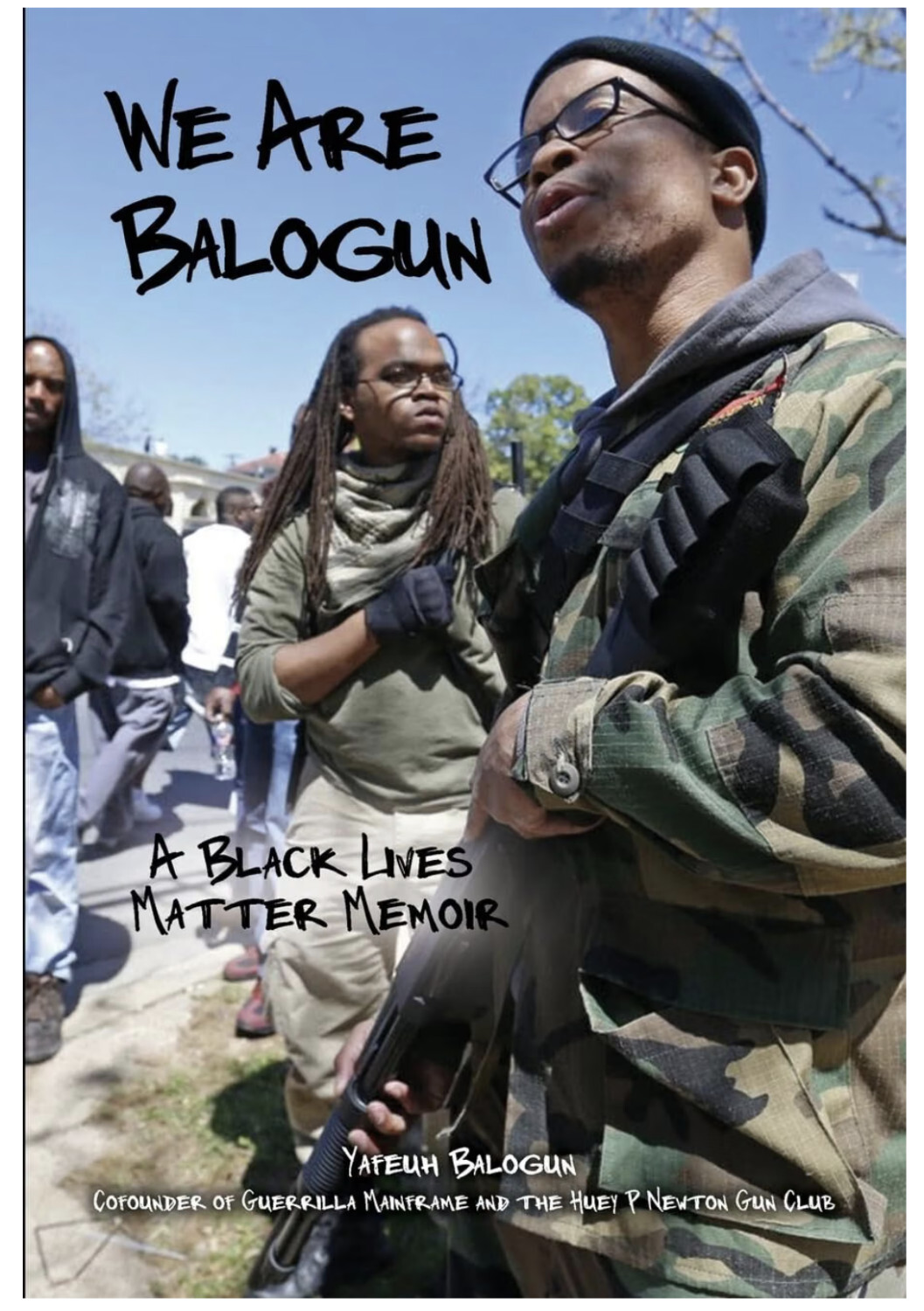
Through his own experiences, Yafeuh Balogun shares his story about community organizing in Dallas, including the founding of the Huey P. Newton Gun Club during the national wave of Black Lives Matter protests that followed the police killings of Michael Brown, Eric Garner, Tamir Rice, Sandra Bland, Freddie Gray, Philando Castile, Alton Sterling, George Floyd, Breonna Taylor and many others.
The author describes an upbringing grounded in discipline, self-respect, Black history and the principle of community responsibility. These early influences helped shape his understanding of the world and how it works. They inspired his participation in revolutionary political activism and formed his views on self-determination, economic independence and African communal culture. He tells the story from the perspective of a person who was directly involved in local campaigns against police brutality and racist terrorism.
His memoir argues that the movement was a unified effort from many different organizations, strategies, philosophies and battle fronts. Yafeuh’s portrait of Oak Cliff is hella descriptive. He really paints a picture that gives the reader a visual of what it’s like in the hood where he grew up. He gives you an understanding of a community shaped by resilience, struggle and traditions of resistance. He humanizes himself so you can know the mind of a man behind this militant movement. No matter what your cultural or socioeconomic background is, you can relate to something in this story.
Another strength of this book is its emphasis on putting in work organizing boots on the ground and not “conscious celebrity” clout chasing. Yafeuh describes in detail the coalition building, political education, serving the people and proactive paramilitary patrolling of the streets, instead of only popping up to protest as a reaction to isolated, crisis-oriented outrage. This memoir shows how he learned and studied revolutionary politics, put those teachings into practice and developed his own understanding of what methods move the people forward to freedom. Every encounter he had while engaging with the folks he was surrounded by prepared him for the role he played during this defining period in modern history.
One of the dopest parts of this book is its examination of the Huey P. Newton Gun Club, which Yafeuh Balogun co-founded in 2014. The memoir portrays the organization as the armed self-defense component that emerged alongside mass demonstrations and civil disobedience. According to Yafeuh, the gun club drew inspiration from Huey P. Newton, the co-founder and minister of defense of the Black Panther Party. Hence the name Huey P. Newton Gun Club. Its focus was on practicing the teachings of Huey P. Newton’s example, explained in Huey’s works, “In Defense of Self-Defense” and “The Correct Handling of a Revolution.” The operation of community patrols is linked to a historical tradition of armed Black self-defense found in groups such as the Deacons for Defense and Justice. Yafeuh argues that visible, lawful armed patrols were intended to deter violence against Black communities while asserting constitutional rights.
The book also highlights the historic event when the Huey P. Newton Gun Club did an armed march on the Texas State Capitol in Austin, Texas, during the SXSW Music Festival to advocate armed self-defense against police terrorism. This action took place while Texas state legislators were on the Capitol floor debating open-carry rights. They were discussing a bill called HB 910, which removes the requirement that concealed handgun licensees keep their handguns concealed and gives them the option of openly carrying them. This armed maneuver agitated political officials to pass the bill.
This operation was inspired by the Black Panther Party’s armed march on the California State Capitol in Sacramento in 1967 to deliver the statement of BPP Executive Mandate Number 1, which denounced the Mulford Act on a global platform. This demonstration caused the restriction of openly carrying firearms in the state of California. When the Huey P. Newton Gun Club did an armed march on the Texas State Capitol in Austin in 2015, it created the atmosphere for HB 910 to be passed and made it legal to openly carry pistols in the state of Texas.
Whether readers agree with this philosophy or not, the book puts the people up on game about the approach of armed self-defense to counter police terrorism, which has been overshadowed by the nonviolent, civil-disobedience, direct-action protests of the Black Lives Matter era. Yafeuh describes the Huey P. Newton Gun Club as one strategic element of the Black Liberation Struggle, which also includes mutual aid, legal advocacy, community patrols and survival training.
Yafeuh breaks down the story of his experience becoming involved with People’s Lunch Counter before the national spotlight reached Dallas. He talks about how his organizing was rooted in political education and direct service to the community. Rather than viewing programs that addressed immediate needs as charity, he describes them as opportunities to build relationships, raise political consciousness and demonstrate the principle that the people have the potential to empower themselves and push the line against all forms of oppression.
His organizing efforts eventually contributed to the co-founding of Guerrilla Mainframe, a grassroots organization dedicated to political education, holistic wellness, physical fitness and combat training. He portrays Guerrilla Mainframe as more than just a group of activists; it’s a close-knit, family-oriented communal cadre training for survival in the fight for freedom. The organization emphasized disciplined study. They are also really heavy on promoting healthy lifestyles and martial arts.
The REALationship Yafeuh built with the Pan African Connection Bookstore and Resource Center in Dallas was also a key element in the process of his awakening. He describes this place as an intellectual and cultural atmosphere where activists, scholars, artists and community members gathered to exchange ideas, study African and African American history and build a Black Power base. He describes the environment of the Pan African Connection as similar to a living classroom that preserves our history and creates generations of warriors and teachers.
The author reflects on the relationships he built with elder Black Panther veterans and other seasoned movement activists by learning directly from them. Rather than romanticizing the Black Panther Party, he portrays these elders as mentors who shared hard-earned lessons about organization, political discipline, security and the difficulties of sustaining movements over time. Their guidance encouraged younger organizers to learn from both the achievements and shortcomings of previous generations.
These relationships reinforce one of the memoir’s central themes: Every generation inherits both responsibilities and unfinished work from those who came before. Yafeuh describes mentorship as a solid bridge between historical movements for Black liberation and today’s struggles against police brutality, poverty and Black-on-Black violence. Through these intergenerational exchanges, he shows how political traditions are preserved, adapted and carried on rather than simply remembered.
As the corporate mainstream media put the spotlight on the Black Lives Matter protests after the police killing of Michael Brown in Ferguson, Missouri, Yafeuh expresses the fact that he and his comrades did not view themselves as creating something entirely new. They saw it as keeping the legacy of Black resistance alive. They knew it was necessary to build on the foundation that our ancestors established from the way back in the Reconstruction period, through the Civil Rights Movement, the Black Power era and into the current times.
This modern autobiography is unique because the author is not only telling his story; he puts his city on his shoulders and stands on the principles of his elders. He makes the connection between the Black Power wave of the 1960s and the current wave of Black Liberation Struggle. He shows how it’s bigger than the headline-making events. He sheds light on the behind-the-scenes process of teaching people in the streets by setting an example of selfless service. In this book, he reflects on how social movements are sustained not only by protest but by study, mentorship and constantly confronting racism.
In one chapter, Yafeuh gives a brief rundown on the history of armed self-defense in Dallas. He takes it beyond his personal experience and offers the reader a solid lesson on the roots of Dallas’ often-overlooked tradition of Black community organizing and self-defense. He argues that the Huey P. Newton Gun Club emerged from a culture of resistance stretching back decades. According to the book, that lineage includes the Dallas chapter of the Original Black Panther Party, the African American Men Against Narcotics (AMAN) patrols of the late 1980s and later organizations such as Community Movement Builders.
Yafeuh introduces readers to the history of the Dallas chapter of the Original Black Panther Party, paying homage to Fahim J. Minkah and other local organizers who sought to adapt the Panthers’ philosophy to the conditions facing Black communities in Dallas. The author reminds readers that the original Black Panther Party understood armed patrols as one element of a broader political program that also emphasized education, food programs, health care and community empowerment.
This chapter also introduces many readers to the history of African American Men Against Narcotics (AMAN), a Dallas-based community initiative that organized neighborhood patrols during the height of the crack cocaine epidemic. Yafeuh presents AMAN as an example of community members standing up against predatory capitalist gangsterism. He expresses how these patrols are examples of the neighborhood governing itself instead of relying on the police and politicians.
AMAN patrols even shut down Jamaican Shower Posse trap spots. The Shower Posse was backed by the Jamaican Labor Party (JLP), which was aligned with the U.S. government. They were used to undermine the People’s Nationalist Party (PNP) of Jamaica, which was aligned with socialist Cuba. It’s kind of like how the CIA funded the capitalist Contras in Nicaragua to overthrow socialist Sandinistas. It exposes the reality that many of the dope kingpins who are often glorified in urban Black culture are historically capitalist collaborators with the U.S. government.
I found this chapter to be very informative. It covers history that most people haven’t heard about. Much of the national conversation about Black liberation has mostly centered around places like Oakland, LA, Chicago, New York and other Black Power hotspots. Yafeuh reminds us that Dallas also played a key role in the history of the Black Liberation Struggle. By documenting those local experiences, We Are Balogun expands our understanding of how Black political traditions are still carrying on.
The author stresses that each generation of revolutionaries inherited lessons from those who came before them. The political education of the Black Panther era influenced the actions of AMAN. Those experiences, in turn, influenced the development of Guerrilla Mainframe and eventually the Huey P. Newton Gun Club. This chapter encourages readers to view movements not as isolated moments but as evolving traditions shaped by theory and practice.
I rate this book a 4.5/5. I recommend this book as required reading to teach the youth about history that they are closely connected to so they don’t view Black Liberation Struggle as a distant thing of the past that they can’t identify with. In order to make movement relevant for the next generation, they have to see themselves as a part of the history that they must carry on.
With the 60th anniversary of the Black Panther Party on the horizon, it’s important to showcase today’s victories of fighting back against racist terrorism the same way they did in the 1960s. These stories must be told! We need to hear about the events that took place in this book, like what happened when the white supremacist militia known as the Bureau of American Islamic Relations (BAIR) threatened to pull up to the Black community of Dallas and was met with the Black Power paramilitary presence of the Huey P. Newton Gun Club. Examples of community control, such as getting streets and parks named after real heroes of the hood like Fahim J. Minkah and Marvin Crenshaw, should not seem distant and less relevant.
We Are Balogun offers readers both an intimate personal narrative and an important historical document. It captures the essence of the environment that molded Black militancy during one of the most transformative periods of the last decade. In order to lead and succeed, we must get the youth to read. The lack of literacy in Black communities is a part of the sickness and menticide that we have to cure in order to free ourselves.
Rating: ★★★★☆ (4.5/5)
“To describe We Are Balogun as merely a Black Lives Matter memoir is to underestimate its historical significance. It is, more importantly, a contribution to the literature of the Black Liberation Movement, a work that documents the political development of a revolutionary organizer, preserves the organizing traditions of Dallas’ Black Freedom Struggle, and situates the Black Lives Matter era within the longer lineage of Black resistance, self-determination, and community self-defense.”
Eric “E Da Ref” Hunter is a guest journalist for the San Francisco Bay View
The post Book review of ‘We Are Balogun: A Black Lives Matter Memoir’ appeared first on San Francisco Bay View.
Source: https://sfbayview.com/2026/09/book-review-of-we-are-balogun-a-black-lives-matter-memoir/
Anyone can join.
Anyone can contribute.
Anyone can become informed about their world.
"United We Stand" Click Here To Create Your Personal Citizen Journalist Account Today, Be Sure To Invite Your Friends.
Before It’s News® is a community of individuals who report on what’s going on around them, from all around the world. Anyone can join. Anyone can contribute. Anyone can become informed about their world. "United We Stand" Click Here To Create Your Personal Citizen Journalist Account Today, Be Sure To Invite Your Friends.
LION'S MANE PRODUCT
Try Our Lion’s Mane WHOLE MIND Nootropic Blend 60 Capsules
Mushrooms are having a moment. One fabulous fungus in particular, lion’s mane, may help improve memory, depression and anxiety symptoms. They are also an excellent source of nutrients that show promise as a therapy for dementia, and other neurodegenerative diseases. If you’re living with anxiety or depression, you may be curious about all the therapy options out there — including the natural ones.Our Lion’s Mane WHOLE MIND Nootropic Blend has been formulated to utilize the potency of Lion’s mane but also include the benefits of four other Highly Beneficial Mushrooms. Synergistically, they work together to Build your health through improving cognitive function and immunity regardless of your age. Our Nootropic not only improves your Cognitive Function and Activates your Immune System, but it benefits growth of Essential Gut Flora, further enhancing your Vitality.

Our Formula includes: Lion’s Mane Mushrooms which Increase Brain Power through nerve growth, lessen anxiety, reduce depression, and improve concentration. Its an excellent adaptogen, promotes sleep and improves immunity. Shiitake Mushrooms which Fight cancer cells and infectious disease, boost the immune system, promotes brain function, and serves as a source of B vitamins. Maitake Mushrooms which regulate blood sugar levels of diabetics, reduce hypertension and boosts the immune system. Reishi Mushrooms which Fight inflammation, liver disease, fatigue, tumor growth and cancer. They Improve skin disorders and soothes digestive problems, stomach ulcers and leaky gut syndrome. Chaga Mushrooms which have anti-aging effects, boost immune function, improve stamina and athletic performance, even act as a natural aphrodisiac, fighting diabetes and improving liver function. Try Our Lion’s Mane WHOLE MIND Nootropic Blend 60 Capsules Today. Be 100% Satisfied or Receive a Full Money Back Guarantee. Order Yours Today by Following This Link.


| Visits: | 1,835,410,000 |
| Stories: | 8,723,585 |
Whistler Blowers, Insiders

