
GLOBAL ECONOMIC WARS: THE SHADOW CONFLICT REWRITING THE WORLD ORDER

An Investigative Analysis of the Invisible Forces Driving Global Economic Instability
Caught on Camera: What the Government DOESN’T Want You to See Inside This Home!

BREAKING ANALYSIS — No missile crossed a border. No capital city declared war. No emergency sirens echoed through financial districts. Yet within only a few trading sessions, billions of dollars shifted across continents, strategic commodities changed direction, investment confidence deteriorated, and governments quietly activated contingency mechanisms designed for events they officially insist are not taking place. Behind the ordinary rhythm of commerce, an entirely different conflict has been unfolding—one measured not in casualties, but in collapsing purchasing power, fractured supply chains, sovereign vulnerability, and the gradual erosion of economic certainty.
A World That Appears Stable While Quietly Losing Its Foundations
At first glance, the international economy projects an image of remarkable resilience. Airports remain crowded, supermarkets continue receiving deliveries, digital payments are processed in fractions of a second, and financial markets open each morning with familiar precision. Such continuity creates the comforting perception that global prosperity remains structurally intact. Yet beneath this meticulously maintained façade, an intricate web of geoeconomic rivalry, strategic resource competition, algorithmic capital migration, and macroeconomic dislocation continues to evolve with extraordinary intensity.
The unsettling characteristic of modern economic confrontation is not its visibility but its discretion. Unlike conventional warfare, its mechanisms rarely produce dramatic television footage or unmistakable front lines. Instead, pressure accumulates incrementally through financial restrictions, technological embargoes, sovereign debt exposure, energy dependency, industrial relocation, and increasingly sophisticated forms of commercial leverage. Entire sectors may continue operating normally while their structural equilibrium slowly deteriorates, creating conditions in which a seemingly isolated disruption can reverberate across continents within days.
The Modern Arsenal Extends Far Beyond Conventional Weapons
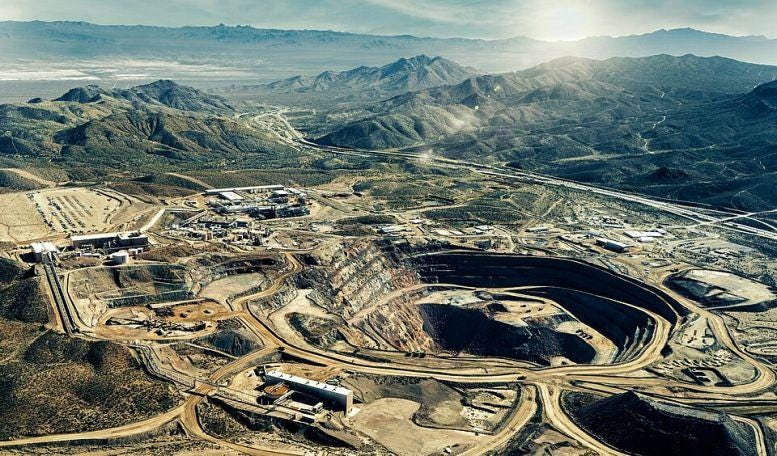
Economic influence has gradually become one of the most sophisticated instruments ever developed within international relations. Contemporary powers increasingly compete through mechanisms that rarely resemble traditional military campaigns, yet often generate consequences of comparable magnitude.
Primary Instruments of Modern Economic Conflict
-
Strategic sanctions designed to restrict financial mobility.
-
Technological monopolization over advanced semiconductor production.
-
Energy securitization through oil, natural gas and electricity infrastructure.
-
Artificial Intelligence supremacy controlling industrial productivity.
-
Rare-earth mineral dominance supporting defense and electronics manufacturing.
-
Cyber-financial disruption targeting payment systems and banking confidence.
-
Supply-chain bifurcation separating competing geopolitical blocs.
-
Currency influence affecting international reserve systems.
-
Food security leverage through agricultural exports.
-
Maritime chokepoint control governing global commercial circulation.
Visual Representation of Strategic Economic Pressure
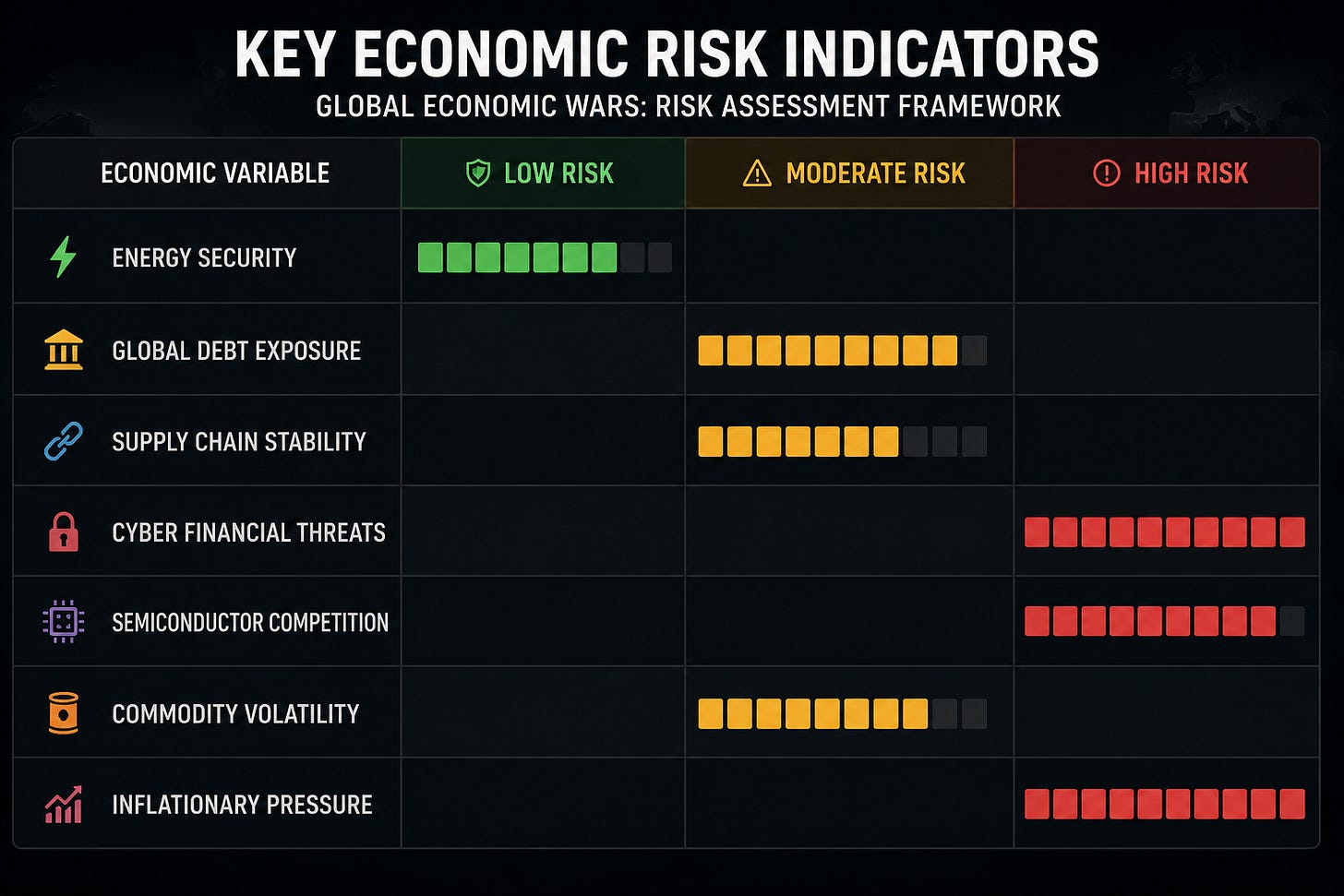
Key Indicators Frequently Associated with Economic Confrontation
Indicator Potential Consequence
Rising sovereign debt Reduced fiscal flexibility
Persistent inflation Declining household purchasing power
Export restrictions Manufacturing disruption
Currency depreciation Higher import costs
Commodity shortages Supply instability
Banking uncertainty Reduced private investment
Energy price shocks Industrial contraction
Cyber incidents Financial infrastructure disruption
Keywords Defining the Contemporary Economic Battlefield
Geoeconomics • Strategic Competition • Macroeconomic Dislocation • Systemic Fragility • Liquidity Compression • Industrial Reshoring • Algorithmic Finance • Supply Chain Resilience • Rare-Earth Dependencies • Financial Contagion • Resource Securitization • Currency Volatility • Fiscal Contraction • Multipolar Economy • Technological Sovereignty • Capital Reallocation
“Perhaps the most unsettling characteristic of contemporary economic conflict is that ordinary life often continues uninterrupted while its underlying architecture is being reconfigured. Office buildings remain illuminated, container vessels continue approaching major ports, investment dashboards refresh every second, and consumers still fill shopping carts with familiar products. Yet beneath this appearance of continuity, financial entropy quietly accumulates. Confidence, unlike infrastructure, rarely collapses all at once; it dissipates molecule by molecule until stability survives only as memory, leaving institutions to discover that the foundations supporting prosperity had been eroding long before anyone considered the possibility that an economic war had already begun.”
From Financial Pressure to Societal Transformation

The consequences of prolonged economic confrontation rarely emerge in isolation. Instead, they accumulate gradually, forming interconnected layers of instability that extend far beyond financial markets. What begins as a modest increase in borrowing costs or a temporary disruption in commodity flows can eventually influence employment, healthcare expenditure, educational investment, infrastructure development, technological innovation, and even public confidence in democratic institutions. Economic deterioration is therefore less comparable to a sudden collapse than to a structural fatigue that progressively weakens every supporting pillar until resilience itself becomes increasingly difficult to sustain.
“The greatest misconception surrounding modern economic conflict is the assumption that prosperity disappears through spectacular catastrophes. Reality unfolds differently. Confidence contracts before consumption declines. Investment retreats before factories reduce production. Supply networks fragment before shortages become visible, and households begin adjusting their expectations long before official statistics acknowledge that an economic transformation is already underway. By the time uncertainty dominates public discourse, much of the structural damage has already been absorbed silently across thousands of interconnected sectors.”
The Multiplication Effect of Economic Fragmentation
Economic systems have become extraordinarily interconnected, making isolation almost impossible. A restriction affecting advanced semiconductor manufacturing may delay automobile production on another continent. A disruption within maritime logistics can increase transportation costs for agricultural exports thousands of kilometers away. Likewise, fluctuations in energy markets often reverberate through industrial production, consumer prices, insurance premiums, aviation, construction, and digital infrastructure simultaneously.
This phenomenon illustrates why contemporary economists increasingly describe globalization as a network of systemic interdependence rather than independent national economies. Every disruption propagates through invisible commercial arteries, amplifying uncertainty far beyond its geographical origin. In highly integrated markets, localized instability frequently evolves into international volatility with remarkable speed.
Visual Assessment of Cascading Economic Risks
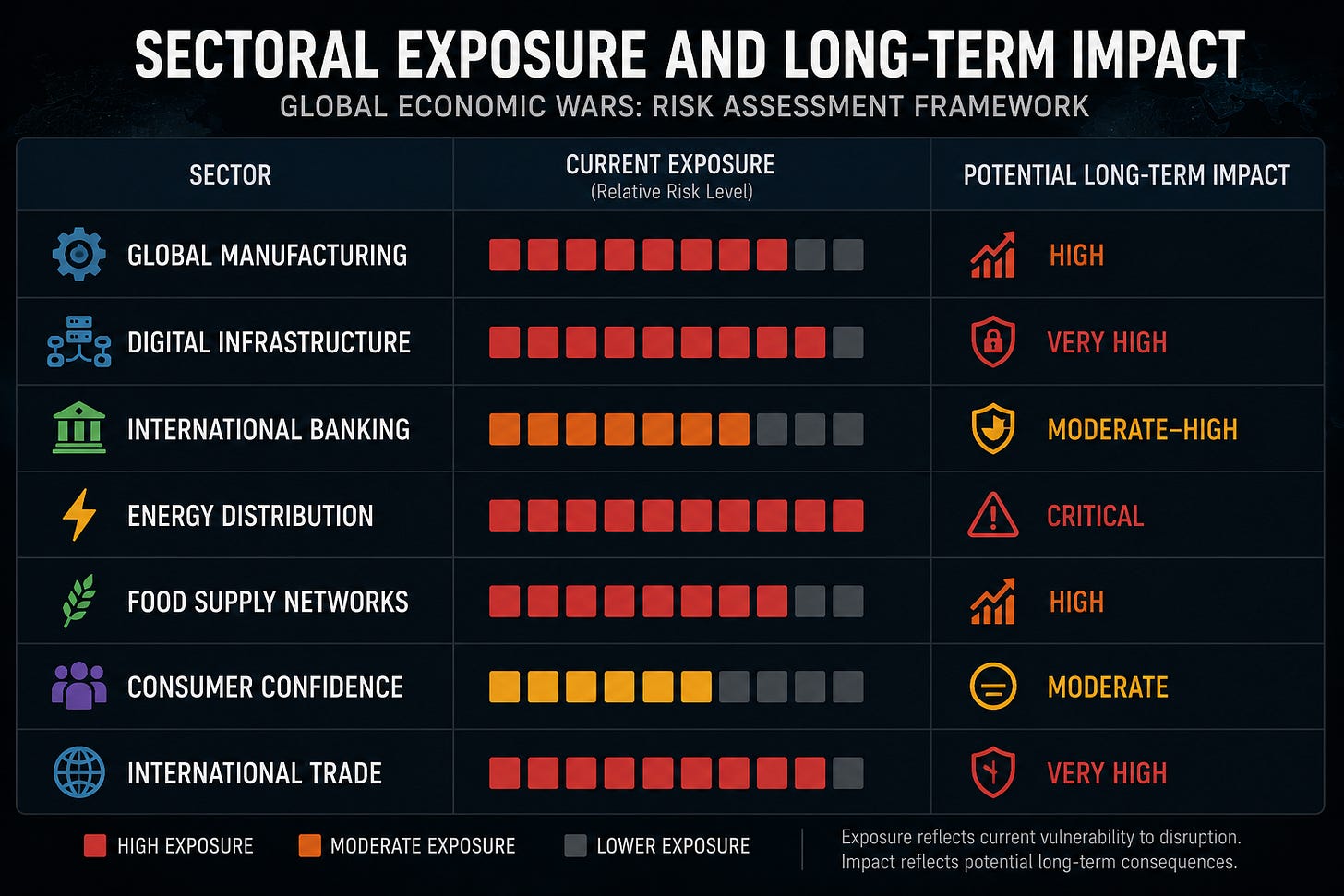
Observed Patterns Frequently Discussed by Economic Researchers
-
Capital increasingly follows geopolitical stability rather than maximum profitability.
-
Strategic industries are relocating closer to politically aligned partners.
-
Technological self-sufficiency has become a national security priority.
-
Critical minerals now possess geopolitical value comparable to traditional energy resources.
-
Artificial intelligence is rapidly emerging as a decisive economic multiplier.
These developments collectively indicate that economic competition has entered a substantially different phase from that observed only two decades ago. Efficiency alone no longer defines commercial success; resilience, redundancy, technological sovereignty, and strategic diversification increasingly determine national competitiveness.
Beyond Markets: The Human Dimension
Although discussions surrounding global finance often revolve around percentages, indices, and institutional reports, their consequences are ultimately experienced by individuals. Inflation alters household purchasing decisions. Housing affordability influences demographic trends. Industrial restructuring reshapes local communities, while uncertainty surrounding employment gradually modifies consumer behavior, entrepreneurial investment, and long-term financial planning. The human dimension remains the least visible yet arguably the most significant consequence of prolonged economic instability.
“Economic wars seldom ask for permission before reshaping everyday life. They influence aspirations before incomes, confidence before consumption, and opportunity before prosperity. Their progression is measured less through dramatic headlines than through subtle adjustments repeated millions of times: postponed investments, abandoned business projects, cautious spending habits, delayed family decisions, and institutions adapting to a future that appears increasingly unpredictable. These quiet adaptations collectively reveal that the most enduring battlefield is not found within financial markets, but within the expectations societies hold about tomorrow.”
Final Reflection
The contemporary international landscape cannot be understood solely through military capabilities or diplomatic negotiations. Economic influence has evolved into one of the defining instruments shaping geopolitical relationships, technological leadership, and long-term national resilience. Financial markets, strategic resources, digital infrastructure, industrial capacity, and innovation ecosystems now form an interconnected architecture in which prosperity and vulnerability coexist more closely than ever before.
Whether future decades are characterized by cooperation or intensified economic rivalry will depend not only on political decisions but also on the capacity of nations to strengthen institutional resilience, diversify critical supply chains, encourage technological innovation, and preserve public confidence during periods of uncertainty. In an era where economic pressure often replaces conventional confrontation, the most valuable strategic asset may no longer be overwhelming strength alone, but the ability to remain adaptable while the foundations of the global economy continue to evolve.
Anyone can join.
Anyone can contribute.
Anyone can become informed about their world.
"United We Stand" Click Here To Create Your Personal Citizen Journalist Account Today, Be Sure To Invite Your Friends.
Before It’s News® is a community of individuals who report on what’s going on around them, from all around the world. Anyone can join. Anyone can contribute. Anyone can become informed about their world. "United We Stand" Click Here To Create Your Personal Citizen Journalist Account Today, Be Sure To Invite Your Friends.
LION'S MANE PRODUCT
Try Our Lion’s Mane WHOLE MIND Nootropic Blend 60 Capsules
Mushrooms are having a moment. One fabulous fungus in particular, lion’s mane, may help improve memory, depression and anxiety symptoms. They are also an excellent source of nutrients that show promise as a therapy for dementia, and other neurodegenerative diseases. If you’re living with anxiety or depression, you may be curious about all the therapy options out there — including the natural ones.Our Lion’s Mane WHOLE MIND Nootropic Blend has been formulated to utilize the potency of Lion’s mane but also include the benefits of four other Highly Beneficial Mushrooms. Synergistically, they work together to Build your health through improving cognitive function and immunity regardless of your age. Our Nootropic not only improves your Cognitive Function and Activates your Immune System, but it benefits growth of Essential Gut Flora, further enhancing your Vitality.

Our Formula includes: Lion’s Mane Mushrooms which Increase Brain Power through nerve growth, lessen anxiety, reduce depression, and improve concentration. Its an excellent adaptogen, promotes sleep and improves immunity. Shiitake Mushrooms which Fight cancer cells and infectious disease, boost the immune system, promotes brain function, and serves as a source of B vitamins. Maitake Mushrooms which regulate blood sugar levels of diabetics, reduce hypertension and boosts the immune system. Reishi Mushrooms which Fight inflammation, liver disease, fatigue, tumor growth and cancer. They Improve skin disorders and soothes digestive problems, stomach ulcers and leaky gut syndrome. Chaga Mushrooms which have anti-aging effects, boost immune function, improve stamina and athletic performance, even act as a natural aphrodisiac, fighting diabetes and improving liver function. Try Our Lion’s Mane WHOLE MIND Nootropic Blend 60 Capsules Today. Be 100% Satisfied or Receive a Full Money Back Guarantee. Order Yours Today by Following This Link.


| Visits: | 1,825,401,311 |
| Stories: | 8,676,607 |
Whistler Blowers, Insiders