

The Board That Wanted a Country


Freddie Ponton
21st Century Wire
The private colonial administrative board that claims authority over Gaza’s future, banks with JPMorgan, and whose architect, Tony Blair, refuses to explain.
This investigation is about a body whose legal personality remains contested, whose accountability framework remains opaque, and whose money has been routed through a private JPMorgan Chase account outside the official World Bank fund created for Gaza reconstruction. The Board of Peace was announced by Donald Trump in January 2026 as the vehicle for Gaza’s post-war governance and reconstruction, with Trump as chair and Tony Blair among its founding executive members. What emerges from official filings, leaked governance drafts, congressional hearing records, financial reporting, and testimony from former insiders is not simply a reconstruction body, but an attempt to privatise the governance architecture of Gaza’s future.
The timing of this story is critical because the contracts have not yet been awarded, the official World Bank fund has received no donor money, and several of the people involved in designing or executing the system sit at the intersection of government, finance, technology, Gulf capital, and post-war reconstruction planning.
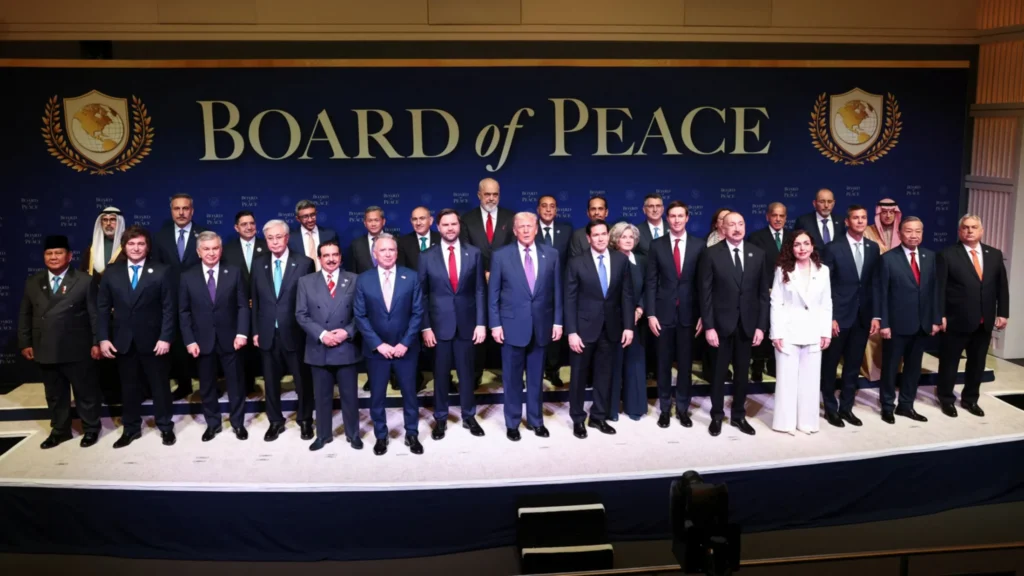
IMAGE: The Board of Peace convened its inaugural meeting on Thursday, February 19, 2026 at the Donald J. Trump Institute of Peace in Washington (Source: boardofpeace.org)
The name “Board of Peace” does not necessarily refer to some peace mechanism. The entity will be best characterized as a financial, legal, and political architecture for governing 2.3 million Palestinians through a structure Palestinians did not elect, that member-state parliaments did not ratify, and that no court or auditor has yet clearly shown it can compel.
The Mandate Returns
The piece that sparked this investigation was published by Follow the Money, which reported that Tony Blair had become “Trump’s Gaza salesman in Europe,” using his institute and his contacts to lobby European policymakers into joining the Board of Peace. That reporting was important, but the framing understates the story. Blair is not merely the salesman. He is one of the architects of the governance model that European officials were later asked to legitimise.

IMAGE: League Of Nations – Mandate For Palestine with 1933 Motor map of Palestine, Survey of Palestine in the background (Source: Created by Author via UN and Wikimedia)
According to reporting cited by IRIS, Blair sat down in Abu Dhabi in late 2023 with Jared Kushner, Israeli minister Ron Dermer, and Mohamed Dahlan, the UAE-backed Palestinian exile long discussed as a possible post-Hamas power broker. Over the following months, Blair’s circle developed a governance proposal known as the Gaza International Transitional Authority, or GITA. On September 17, 2025, the Times of Israel reported that the proposal would seek a UN mandate to act as Gaza’s “supreme political and legal authority” during a transitional period.
Twelve days later, Trump’s 20-point plan stated that Gaza would be governed by a “technocratic, apolitical Palestinian committee” under the supervision of a new international body chaired by Trump and including Blair. That is enough to say the Trump plan closely echoed Blair’s architecture. It is not enough, on the present public record, to say the language was copied “almost word for word.”
The Follow the Money investigation that first reported Blair’s European lobbying is solid work, but it leaves open the deeper question: what exactly was the Tony Blair Institute building before it began selling the Board of Peace to Europe? Internal documents obtained by Follow the Money and shared with Democracy for Sale and Lighthouse Reports show that TBI representatives told the European Commission that the EU “should not be shy” about playing a role in Gaza and that the EU had “leverage” and “money”. A TBI spokesperson denied that this was lobbying, saying the meeting was a conversation about Gaza, Trump’s peace plan, and TBI’s work to support the new government in Gaza.
A Board Without a Ballot
The financial structure makes the design clearest. When the Board of Peace was formalised through Resolution 2803, the World Bank created the Gaza Reconstruction and Development Financial Intermediary Fund, known as the GRAD Fund. Carnegie later described the World Bank’s role as that of a “limited trustee,” with “no responsibility or accountability, fiduciary or otherwise” once funds were transferred onward to the Board of Peace.
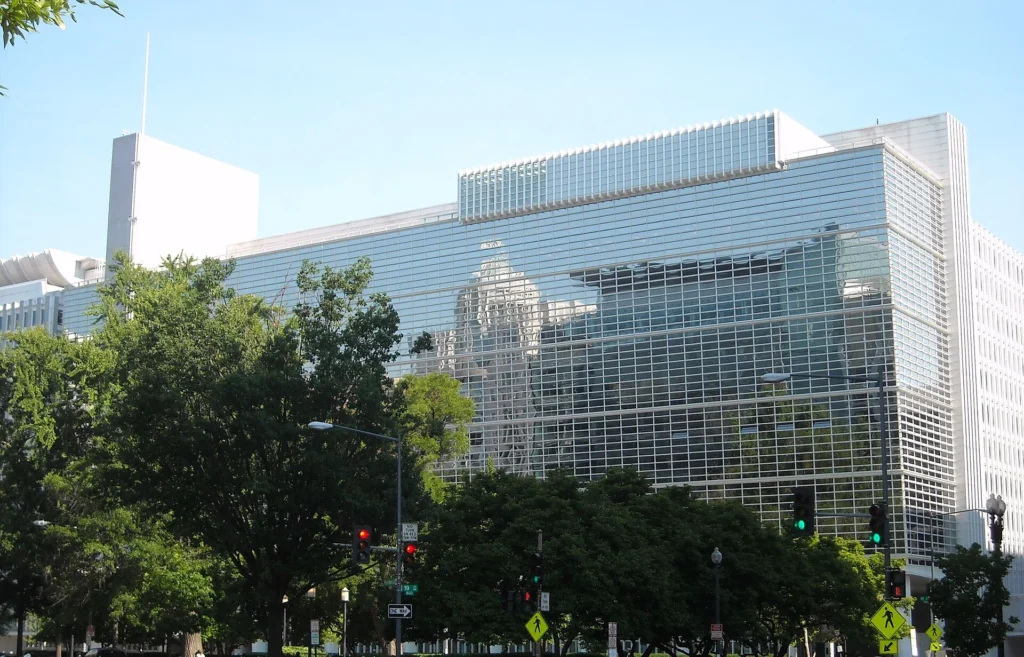
IMAGE: World Bank building (Source: Wikimedia)
That is not normal oversight. It is institutional legitimacy attached to a legal firewall. The World Bank lends its name to the reconstruction mechanism, but the Board of Peace controls how money is used after transfer, while the Bank’s own role is limited by design.
Ajay Banga sits at the centre of this conflict. His official World Bank biography confirms he is president of the World Bank Group, and contemporary reporting confirms he was previously CEO of Mastercard. In January 2026, the White House and subsequent coverage listed Banga among the founding Executive Board members of the Board of Peace.
Civil society groups have since demanded that the World Bank withdraw from the Board of Peace and terminate the GRAD Fund, warning that the arrangement risks legitimising an imposed reconstruction framework that excludes Palestinian self-determination. Banga has defended the World Bank’s role as that of a limited trustee, saying the Board of Peace would decide how money is used on the ground. That leaves him in an extraordinary dual position: president of the institution administering the official fund, and member of the board that may ultimately direct the reconstruction architecture.
Blair and the Map
The Board’s legal status remains one of the central unresolved questions. Resolution 2803 welcomed the Board of Peace and endorsed the Gaza framework, but congressional reporting shows U.S. lawmakers still lacked clarity on what legal framework applied to the body. NBC reported that the Board’s charter gave the organisation a broad mandate and raised questions about member-state commitments and legal structure. Times of Israel published the full Board charter, which shows the formal structure through which Trump chairs the organisation.
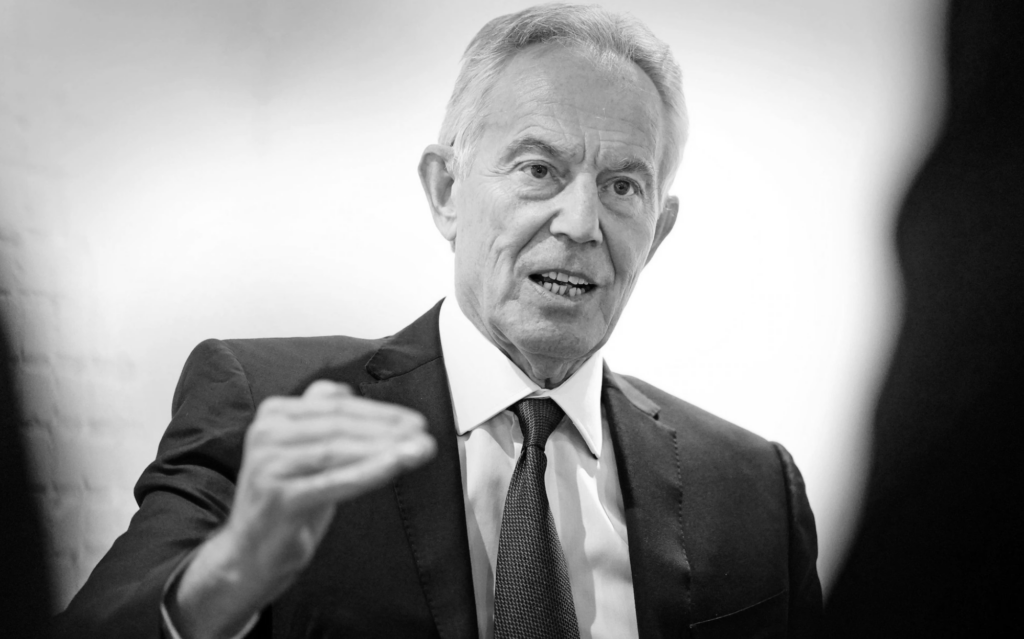
IMAGE: Former British Prime Minister Tony Blair and his Institute for Global Change have offered both paid and free advice to the UAE. (Converted to Black and White by author) (Source: Victoria Jones/PA)
The point is not that the Board has no documents. It is that none of those documents clearly answer who can sue it, audit it, discipline it, or compel disclosure. International legal analysis has questioned the Board’s personality and accountability structure, with Opinio Juris describing the charter as creating a “dubious legal personality”. Carnegie has warned that Resolution 2803 elevates a U.S.-Israeli governance framework while leaving Palestinian self-determination structurally subordinated.
The routing question begins with the officials publicly assigned to execute the Board’s mandate. On January 15, 2026, the White House appointed Aryeh Lightstone and Josh Gruenbaum as senior advisers to the Board of Peace, saying they were charged with “leading day-to-day strategy and operations” and translating the Board’s mandate into “disciplined execution”. Lightstone is especially relevant to donor diplomacy: Middle East Eye reported that he travelled to Saudi Arabia in April 2026 to press Riyadh over its unpaid $1 billion pledge to the Board of Peace.
That does not prove Lightstone instructed UAE or Moroccan officials to use JPMorgan. It does make him a necessary person to question about donor routing. The same is true of Gruenbaum, whose documented role places him inside the operational side of the Board, even if several claims previously made about him must be corrected.
Gruenbaum’s background makes the operational side worth investigating, but the record has to be stated carefully. The White House appointed him as a senior adviser charged with day-to-day strategy and operations for the Board of Peace. The Wall Street Journal reported that he moved temporarily to Israel to join the U.S. team planning Gaza’s post-ceasefire administration while still serving as Commissioner of the Federal Acquisition Service. Al Jazeera later described him as working under U.S. envoys Jared Kushner and Steve Witkoff on the Gaza stabilisation force track.
What cannot be said on the current public record is that Gruenbaum co-drafted Resolution 2803, authored the reconstruction plan, designed the JPMorgan account, or wrote Section 8.2. Resolution 2803 was a U.S.-drafted Security Council resolution, but no public source names Gruenbaum as one of its drafters. The correction matters because the story is strong enough without assigning individual authorship where the evidence does not yet support it.
JPMorgan Enters the Ruins
By May 2026, the official World Bank-administered GRAD Fund contained zero donor dollars. The Financial Times reported that donations had instead gone directly into a JPMorgan account accessible to the Board of Peace, while the World Bank fund remained empty. NPR’s interview with the Financial Times reporter confirmed the same basic structure: donor money bypassed the World Bank mechanism and went into the JPMorgan account, with the Board saying donors preferred that route but not explaining why.
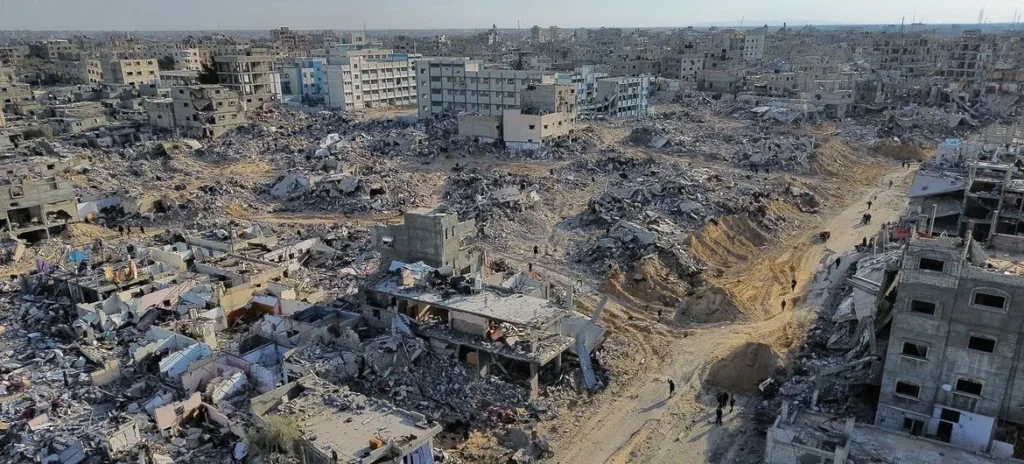
IMAGE: Gazans return home to devastation and an uncertain future (Source: UN)
That is the core accountability problem. The official multilateral fund remains unused, while actual donor money sits in a private bank account without the same independent transparency framework. The Board of Peace has described the World Bank fund as “just one of many funding mechanisms” that donors have not yet used.
The United Arab Emirates deposited approximately $20 million for operational expenses, funding Mladenov’s office and salaries for the Palestinian technocratic committee, according to reporting summarising the Financial Times account. The committee salary issue must be stated carefully: the Guardian reported that the Board’s expenditures include salaries for 12 Palestinians selected for the proposed civilian administration, and that compensation averaged between $16,000 and $17,000 a month, according to someone familiar with the committee’s operations. A Board of Peace spokesperson disputed those figures as “incorrect” and said payments were based on the Palestinian Authority salary structure, without providing further detail.
The UAE separately provided $100 million earmarked to train a Palestinian police force, but the programme had not started and the funds were frozen, according to Middle East Eye’s summary of the Financial Times reporting. The Gaza technocratic panel also separately announced a $100 million monthly budget for public-sector salaries across Gaza. These are not reconstruction projects. They are the operating costs of an administration being assembled before the official reconstruction fund has received donor money.
In early June 2026, Senator Jacky Rosen pressed Secretary of State Marco Rubio about oversight of the Board of Peace’s donor funds and whether money in the JPMorgan account could benefit Trump, his family, or associated interests. Rosen later posted video describing the account as private and lacking transparency over who oversees the funds and how they will be used. Rubio did not provide a direct public accounting of the private donor account in that exchange.
One detail on the JPMorgan arrangement deserves particular scrutiny. In January 2026, Trump filed a $5 billion lawsuit against JPMorgan Chase, alleging the bank had closed his accounts after the January 6 Capitol riot. Around the same period, negotiations were reportedly underway between the Trump administration and JPMorgan to establish a private account for the Board of Peace. That does not prove improper influence, but it does create a conflict question: the administration of the Board’s permanent chairman was suing the same bank that was being positioned to hold the Board’s private donor account.
The Board of Peace’s spokesperson has said the JPMorgan route was the donors’ choice, but no public evidence explains how that preference was communicated, who initiated it, or when. Senator Brian Schatz told the Financial Times that he had “no idea which legal framework applies” to the Board. That is a remarkable statement about an entity claiming a central role in Gaza’s governance and reconstruction.
Sovereignty by Committee
The vetting architecture itself is documented, even if its individual author is not. Drop Site News obtained a leaked Board of Peace draft resolution whose metadata pointed to the State Department and which said that only those who support and act consistently with creating a “deradicalized terror-free Gaza” would be eligible to participate in governance, reconstruction, economic development, or humanitarian assistance. That clause should be treated as a U.S.-linked Board of Peace draft provision, not as something attributable to Gruenbaum personally unless further sourcing emerges.
In mid-June 2026, Gruenbaum left the federal government. Jewish Insider reported that he would continue serving as an unpaid senior adviser to the Board of Peace and was “set to join an investment firm,” though the firm was not named. His earlier career included private equity work, and reporting has identified KKR as a former employer.
That matters because KKR was simultaneously expanding its Middle East platform. In April 2025, KKR appointed General David Petraeus as chairman of KKR Middle East and established a dedicated regional investment team. KKR’s own biography identifies Petraeus as a partner, chairman of the KKR Global Institute, and chairman of KKR Middle East. Petraeus previously served as CIA director and as a senior U.S. military commander in the Middle East, giving the firm a chairman with deep regional state, military, and intelligence relationships.
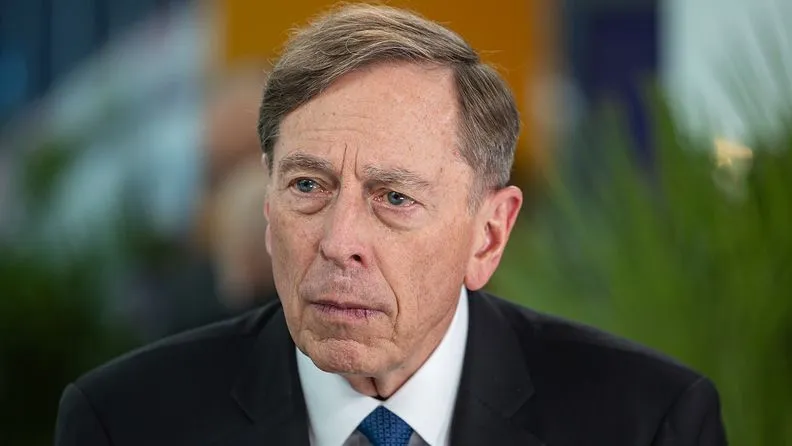
IMAGE: Former CIA Director, David H. Petraeus, Partner at KKR, Chairman of the KKR Global Institute, and Chairman of KKR Middle East (source: Crain Currency)
This does not prove that Gruenbaum is returning to KKR or that KKR will receive Gaza contracts. It does establish the revolving-door context: a former private equity figure who helped execute the Board’s operational mandate left government for an unnamed investment firm while remaining an unpaid adviser to the body overseeing Gaza reconstruction. The reconstruction contracts have not yet been awarded. That makes his next destination a legitimate reporting target.
Marc Rowan presents a different conflict question. Rowan is listed by the Board of Peace as an Executive Board member, while Apollo’s official materials identify him as the firm’s co-founder, CEO, and chair. At the Board’s inaugural meeting, Responsible Statecraft reported that Rowan described Gaza as containing roughly $115 billion in real estate and infrastructure value that needed to be “unlocked and financed”. That creates the obvious question: why is a private equity executive publicly valuing Gaza’s reconstruction economy while sitting on the body that may influence how reconstruction capital is allocated?
Martin Edelman is another underexamined node in the structure. Edelman is listed by the Board of Peace as an Executive Board member and by the Board itself as General Counsel of G42, the Abu Dhabi-based artificial intelligence company. MGX’s official leadership page also lists Edelman as a board member. MGX is chaired by Sheikh Tahnoon bin Zayed, according to MGX’s own announcement of its board meeting.
The significance is not that Edelman secretly controls the Board. It is that a lawyer embedded in Abu Dhabi’s AI and sovereign investment ecosystem sits inside the Gaza reconstruction governance structure while UAE money is funding Board operations. In a system where the official World Bank fund is empty and donor money has gone through JPMorgan, that is not a side detail. It is part of the architecture.
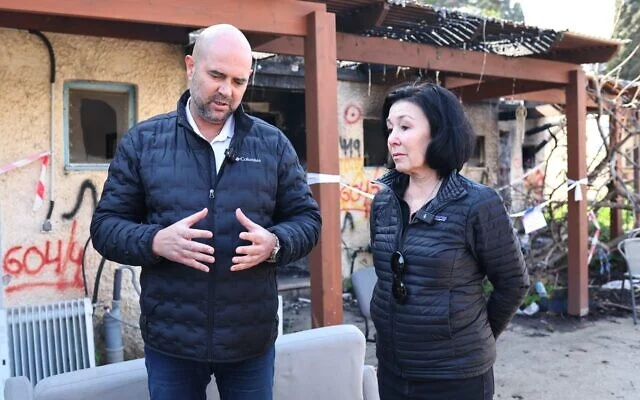
IMAGE: Oracle CEO Safra Catz (right) during a visit to Kibbutz Kfar Aza with Knesset Speaker Amir Ohana, January 2024. (Source: The Times of Israel)
That architecture runs directly into the funding structure of Blair’s institute. Lighthouse Reports found that Larry Ellison’s foundation had invested hundreds of millions of dollars in the Tony Blair Institute and that insiders described the relationship as turning parts of TBI into a tech sales and lobbying operation for Oracle. Oracle is not a neutral software vendor in this context. Business & Human Rights Resource Centre, summarising The Intercept’s reporting, states that Oracle worked on a four-year confidential project with the Israeli Air Force called “Project Menta” and describes internal allegations around pro-Israel advocacy after October 7.
Data Center Dynamics reported that Oracle’s Israel data centre is located nine floors underground, while Times of Israel reported that Oracle CEO Safra Catz reaffirmed plans for a second Israeli data centre during a wartime visit. The safer formulation is not that Ellison controls the narrative war over Gaza, but that Oracle’s Israeli state and military-linked technology relationships make Ellison’s role as a major TBI funder a serious conflict-of-interest question.
The Country That Was Not Asked
Mladenov’s UAE connection should also be stated precisely. He was Director General of the Anwar Gargash Diplomatic Academy, a UAE diplomatic institution, before becoming the Board’s High Representative for Gaza. Middle East Eye also reported that he had been teaching at the UAE’s Anwar Gargash Diplomatic Academy before his Board of Peace appointment. That does not prove the UAE controlled his appointment, but it does make the dependency chain relevant: the official administering a UAE-funded operation had just come from a senior UAE institutional role.

IMAGE: Israel’s Forced Displacement of Palestinians in Gaza (Source: HRW)
The Guardian later reported on UAE-linked planning for biometric-gated “humanitarian communities” in Gaza, where residents would submit biometric data to enter. That proposal should be read alongside the Board’s funding and personnel structure: UAE money supports Board operations, a former UAE diplomatic academy official serves as High Representative, and UAE-linked business figures sit near the reconstruction governance ecosystem. This is not yet proof of a single command structure. It is evidence of a dense Emirati influence channel running through the Board’s personnel, funding, and planning environment.
There are questions this investigation cannot yet answer and will not pretend to. No public document names a specific official giving banking routing instructions to UAE or Moroccan treasury officials. The Board of Peace says the JPMorgan account was the donors’ choice, but has provided no public evidence of how that preference was communicated, who initiated it, or when. Carnegie’s confirmation that negotiations were reportedly underway between the Trump administration and JPMorgan establishes that the routing was not spontaneous, but it does not identify the individual decision-maker.
Who has signatory authority over the JPMorgan account itself has not been publicly confirmed. Gruenbaum’s documented job description covered strategy and operations, but no source proves he designed the bank account. Lightstone’s documented role places him near donor diplomacy, but no source proves he instructed donors to route funds through JPMorgan. Both remain necessary people to question.
The architecture itself is the clearest part of the picture. A body with contested legal personality claims authority over Gaza’s post-war governance and reconstruction while donor money bypasses the official World Bank fund and moves through a private JPMorgan account. It is populated by former heads of government, private equity executives, Gulf-linked advisers, technology figures, and U.S. officials whose roles blur the line between diplomacy, finance, and reconstruction.
The governance model was shaped in part by Tony Blair’s GITA proposal, later echoed in Trump’s 20-point plan. The official World Bank mechanism remains empty while the private account receives donor money. A leaked U.S.-linked Board draft contains a vetting clause that could condition access to governance, reconstruction, economic development, and humanitarian assistance on political eligibility criteria. The Board’s High Representative came from a senior UAE institutional role, while UAE money helps fund the operation he administers.
This is what a private colonial administration looks like when it is built by people who learned, from decades of watching older versions fail, exactly how to make it look like something else.
READ MORE PALESTINE NEWS AT: 21st Century Wire Palestine Files
SUPPORT OUR INDEPENDENT MEDIA PLATFORM – BECOME A MEMBER @21WIRE.TV
VISIT OUR TELEGRAM CHANNEL
21st Century Wire is an alternative news agency designed to enlighten, inform and educate readers about world events which are not always covered in the mainstream media.
Source: https://21stcenturywire.com/2026/07/03/the-board-that-wanted-a-country/
Anyone can join.
Anyone can contribute.
Anyone can become informed about their world.
"United We Stand" Click Here To Create Your Personal Citizen Journalist Account Today, Be Sure To Invite Your Friends.
Before It’s News® is a community of individuals who report on what’s going on around them, from all around the world. Anyone can join. Anyone can contribute. Anyone can become informed about their world. "United We Stand" Click Here To Create Your Personal Citizen Journalist Account Today, Be Sure To Invite Your Friends.
LION'S MANE PRODUCT
Try Our Lion’s Mane WHOLE MIND Nootropic Blend 60 Capsules
Mushrooms are having a moment. One fabulous fungus in particular, lion’s mane, may help improve memory, depression and anxiety symptoms. They are also an excellent source of nutrients that show promise as a therapy for dementia, and other neurodegenerative diseases. If you’re living with anxiety or depression, you may be curious about all the therapy options out there — including the natural ones.Our Lion’s Mane WHOLE MIND Nootropic Blend has been formulated to utilize the potency of Lion’s mane but also include the benefits of four other Highly Beneficial Mushrooms. Synergistically, they work together to Build your health through improving cognitive function and immunity regardless of your age. Our Nootropic not only improves your Cognitive Function and Activates your Immune System, but it benefits growth of Essential Gut Flora, further enhancing your Vitality.

Our Formula includes: Lion’s Mane Mushrooms which Increase Brain Power through nerve growth, lessen anxiety, reduce depression, and improve concentration. Its an excellent adaptogen, promotes sleep and improves immunity. Shiitake Mushrooms which Fight cancer cells and infectious disease, boost the immune system, promotes brain function, and serves as a source of B vitamins. Maitake Mushrooms which regulate blood sugar levels of diabetics, reduce hypertension and boosts the immune system. Reishi Mushrooms which Fight inflammation, liver disease, fatigue, tumor growth and cancer. They Improve skin disorders and soothes digestive problems, stomach ulcers and leaky gut syndrome. Chaga Mushrooms which have anti-aging effects, boost immune function, improve stamina and athletic performance, even act as a natural aphrodisiac, fighting diabetes and improving liver function. Try Our Lion’s Mane WHOLE MIND Nootropic Blend 60 Capsules Today. Be 100% Satisfied or Receive a Full Money Back Guarantee. Order Yours Today by Following This Link.


| Visits: | 1,824,007,074 |
| Stories: | 8,674,021 |
Whistler Blowers, Insiders

