

Trump’s ‘Genocide’ Refugees Are Quietly Flying Back Home

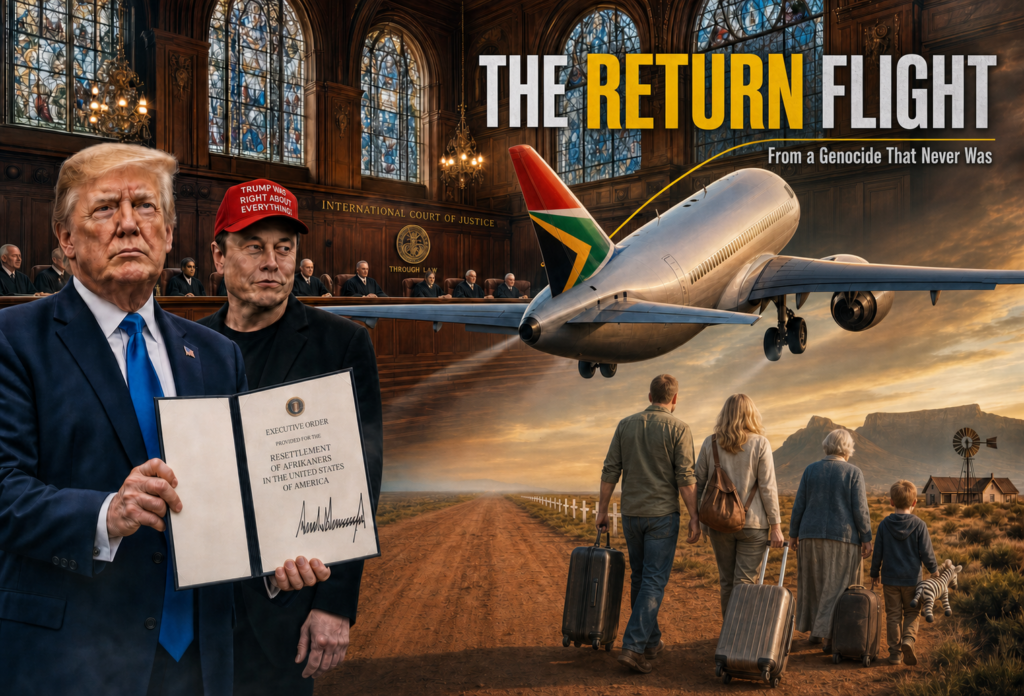
Freddie Ponton
21st Century Wire
In December 2023, South Africa took Israel to the International Court of Justice, accusing it of violating the Genocide Convention in Gaza. Fourteen months later, Donald Trump signed an executive order claiming that white South Africans faced government-sponsored racial discrimination. The order created a fast-track refugee pathway to bring them to America and directed U.S. agencies to halt assistance to South Africa. During a press conference in the White House Roosevelt Room on 12 May 2025, Trump went further, describing the supposed persecution used to justify the programme as “a genocide that’s taking place.”

IMAGE: A boy holds a stuffed zebra after arriving at Dulles International Airport on 12 May 2025 with the first group of white South Africans admitted under the Trump administration’s refugee programme. (Source: Reuters)
Within weeks of arriving in the United States, some of those admitted through Trump’s programme began returning to the country they had supposedly fled. Others found themselves in unsafe housing, struggling with rent and questioning what they had been promised. At the same time, white South Africans who had spent years or decades abroad were choosing to move home. Their experiences expose the false premise behind the programme and the political purpose it served. Washington had turned an unsupported claim of white genocide into refugee policy while punishing South Africa for bringing a real genocide case against Israel
Elon Musk, born in Pretoria, had spent years on X claiming that white people in South Africa faced genocide. The United Nations Refugee Agency was not involved in the programme. A South African court had already ruled that fears of a white genocide were “clearly imagined and not real.” Some of the people who took the refugee flights began returning home within weeks.
Many arrived believing they were escaping something unbearable. What they found was very different from the story they had been sold.
A Genocide Without Evidence
The claim that white Afrikaners were facing genocide had circulated in far-right spaces for years. It said white farmers were being systematically murdered with government encouragement. Trump promoted a version of the narrative as far back as August 2018, when he instructed his secretary of state to investigate what he called the “large scale killing of farmers” in South Africa.

IMAGE: Donald Trump displays material he presented as evidence of a “white genocide” during an Oval Office meeting with South African President Cyril Ramaphosa on 21 May 2025. Some of the material was subsequently shown to have been misrepresented, including an image taken in the Democratic Republic of Congo. (Source: Chip Somodevilla/Getty Images)
But the story found its most powerful supporter in Musk. In March 2025, he wrote that the “legacy media never mentions white genocide in South Africa” and claimed that a major South African political party was “actively promoting white genocide.” Two months later, he alleged that South Africa had more than 100 laws against white people and allowed public calls for their genocide.
Musk’s artificial intelligence chatbot began inserting claims about white genocide into answers to unrelated questions. Behind the political grievance sat a business dispute over the Black-ownership requirements affecting Starlink’s approval to operate in South Africa. Musk characterised the laws as “forcing discrimination against non-black people” and “extreme anti-White and anti-Asian racism.”
Genocide has a clear legal meaning. It requires specific intent to destroy, in whole or in part, a national, ethnic, racial or religious group. South African police recorded 6,953 murders between October and December 2024. Twelve occurred in attacks connected to farming communities. One victim was a white farmer. South Africa has an extreme violent-crime problem, but the figures do not show a campaign to destroy its white population.
A Western Cape High Court judge ruled in February 2025 that fears of a white genocide were “clearly imagined and not real.” The United Nations human rights office called Trump’s use of the term “entirely inappropriate.” A CNN fact-check reached the same conclusion. “There is a lot of violent crime in South Africa. There is not a genocide against White farmers there.”
Refugees by Political Design
On 7 February 2025, Trump signed the executive order. It accused South Africa of government-sponsored racial discrimination and directed U.S. officials to prioritise Afrikaners for refugee admission. In the same document, Trump cited South Africa’s ICJ case against Israel as part of the reason for acting. The refugee programme and the punishment of South Africa were announced together.

IMAGE: An Afrikaner refugee moves his luggage through Washington Dulles International Airport. The Trump administration expedited applications from white South Africans while the wider U.S. refugee programme remained largely suspended. (Source: Reuters/Jonathan Ernst)
The programme departed from the ordinary international refugee model. Under the 1951 Refugee Convention, a refugee is normally someone outside their country of nationality. U.S. law, however, contains a specific exception. Section 101(a)(42)(B) of the Immigration and Nationality Act allows the president, after consultation with Congress, to specify circumstances in which people may be considered refugees while still inside their own country.
The Trump administration used that authority to process applications inside South Africa at trailers on the grounds of the U.S. Embassy in Pretoria. People applied while living at home and later boarded government-chartered flights. The United Nations Refugee Agency was not involved.
By April 2026, 6,066 of the 6,069 refugees admitted to the United States since October 2025 were South African. Only three came from Afghanistan. Refugee organisations said more than 120,000 applicants from other countries who had already received conditional approval remained stranded.
The American Dream Unravels
Many South African families arrived with limited support. They received roughly $2,000 to begin their new lives. That money often disappeared quickly on rent. Reports described people being placed in mould-infested apartments and high-crime neighbourhoods.

IMAGE: A police officer overlooks a homeless encampment in Denver, where one South African refugee said his family had been placed in a high-crime neighbourhood after arriving in the United States.(Source: Denverite)
A former farmer identified only as Werner arrived in Denver with his wife and mother in September 2025. In an interview with Madeleine Rowley for The Free Press, he described the neighbourhood where a federally funded resettlement organisation had placed his family. “There were people slumped over everywhere from using fentanyl and prostitution happening on the street corners,” he said. The family’s accommodation was described as a dirty, mould-infested basement apartment in a high-crime area. He had been placed in what investigators described as a mouldy, dirty basement apartment in a high-crime neighbourhood.
Another refugee, whose name wasn’t disclosed, was resettled in Grand Rapids, Michigan. Speaking to Rowley for the same investigation, he described the contradiction between leaving South Africa in search of safety and being warned by local residents that his new neighbourhood was dangerous. “We come from a place where you have to grow a set of eyes on the back of your head, only to move to another unsafe place and be told by the locals you’re now in harm’s way” he said.
When Refugees Go Home
The programme’s problems showed themselves quickly. Internal U.S. government case notes reviewed by Reuters documented at least four early returns. The number was small compared with the thousands admitted, but the departures cut directly against the claim that those involved could not safely return to South Africa.
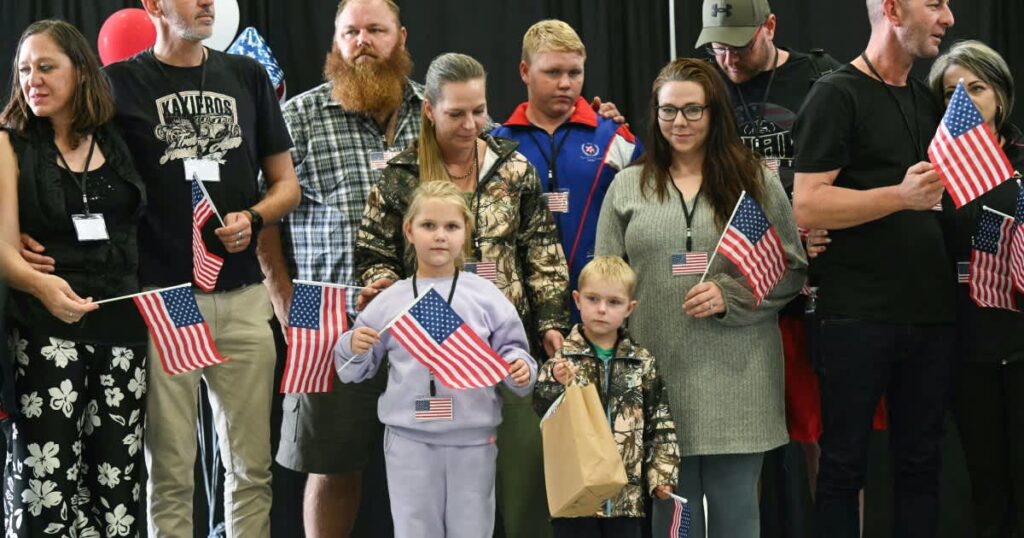
IMAGE: Afrikaner families prepare to begin new lives in the United States in May 2025. Within the programme’s first year, several participants had returned to South Africa, while reports indicated that other families were considering doing the same. (Source: Saul Loeb/AFP)
A man who arrived in Minneapolis in January 2026 left within weeks after his family’s plans fell through. A couple who landed in Twin Falls, Idaho, stayed only one week before returning because a parent back home was ill. A 66-year-old woman resettled in Moline, Illinois, in mid-March returned shortly afterwards. Her case notes said the resettlement had happened quickly, that she had not fully thought through the process and that her family had decided not to follow her.
Another woman returned to South Africa two weeks after being resettled in Iowa when her adult children were removed from the programme. A family of nine resettled in Florida was also reported to be considering a return, although its departure was not independently confirmed.
Chris Wyatt, a retired U.S. Army colonel who promoted the programme on YouTube, criticised those who chose to return. Speaking about the woman resettled in Iowa, he called the situation “heartbreaking,” but said she had “taken a seat, filled a slot and used resources that another South African could not use”.
Referring to the Florida family, Wyatt asked, “Did the USCIS not make it clear to you that you will miss the birth, the death, the illness of family members because you won’t be able to go back?” He accused some participants of treating the programme as temporary relocation rather than permanent resettlement.
Immigration lawyer Evan Gelobter, another supporter of the programme, was more direct.“What the hell’s wrong with these people? If you came here and you want to go back, why did you defraud my country? Clearly, you’re not suffering from unjust racial persecution.”
The Movement in Reverse
The confirmed returnees came through Trump’s refugee programme. Beyond them, another movement was already running in the opposite direction. White South Africans who had spent years or decades abroad were returning home, including from the United States. They had not entered America through Trump’s programme, but their decisions exposed the same problem with its premise. South Africa was being sold as a country white people had to escape to survive, while white expatriates were choosing to go back.

IMAGE: South African expatriates pack their belongings before returning home. Thousands have explored moving back to South Africa, even as the Trump administration portrays white citizens as victims of persecution. (Source: Japan Times)
A Facebook group called “Return to South Africa” grew to more than 25,000 members. An employment and relocation agency reported a 70 percent surge in enquiries from white South Africans seeking to return over the previous six months. These were not isolated cases. They formed a wider return movement unfolding while Washington was spending public money to depict white South Africans as refugees from genocide.
IMAGE: Andrew Veitch left South Africa for California in 2003 after being held at gunpoint. More than two decades later, he told Reuters that he planned to return home because he had come to regard life in the United States as more dangerous. (Source:
Andrew Veitch left South Africa for California in 2003 after being held up at gunpoint in his car. He told Reuters that he was planning to return home in 2026 because he now saw greater dangers in the United States, including mass shootings and violence involving immigration officers. “People are being shot in broad daylight. American citizens are being shot and killed. I don’t want to live in a place like this,” Veitch said.
After the first 59 Afrikaners arrived in the United States in May 2025, South African President Cyril Ramaphosa addressed their departure at the Nampo agricultural exhibition in the Free State, sating: “As South Africans, we are resilient. We don’t run away from our problems,” he said, before predicting: “I can assure you they will return soon because there is no place like South Africa.”
Gaza in the Background
Trump’s own documents place the programme inside a wider campaign to punish South Africa. His executive order listed alleged discrimination against Afrikaners alongside South Africa’s ICJ case against Israel and its relations with Iran, then used those grievances to justify both the suspension of assistance and Afrikaner resettlement.

IMAGE: A member of South Africa’s delegation at the International Court of Justice during proceedings in the country’s genocide case against Israel. The Trump administration later cited the case among its reasons for suspending assistance to South Africa and prioritising Afrikaners for refugee resettlement (Source: Reuters)
In March 2026, the United States filed a declaration of intervention at the International Court of Justice supporting Israel’s position on how the Genocide Convention should be interpreted. At the same time, Washington was expanding a refugee programme built around Trump’s claim that white South Africans faced genocide, with reports estimating that another 10,000 places could cost roughly $100 million.
Families who believed they were being rescued from something terrible instead found themselves facing unsafe housing, limited support and financial pressure. Some decided their situation back home was better. The programme sold a story of existential danger. What they encountered was hardship, followed in several documented cases by the realisation that they could return.
The confirmed returns remain limited, and there is no reliable public evidence that most programme participants want to leave the United States. Their significance lies in what they reveal about the programme’s premise. People admitted as refugees from alleged racial persecution were able to decide that America was not for them and return voluntarily to South Africa.
Two Claims of Genocide
Genocide requires evidence of an intention to destroy a protected group. South Africa’s violent crime, racial tensions and contested economic policies do not provide that evidence. South African courts found no campaign to destroy the country’s white population.
In the Gaza case, the International Court of Justice has not yet ruled on whether Israel committed genocide. It found that at least some of the rights claimed by South Africa under the Genocide Convention were plausible and ordered provisional measures to protect Palestinians from irreparable harm while the case proceeds.
This was undeniably a political operation dressed up as humanitarian rescue. Trump turned a far-right persecution narrative into government policy, and Musk supplied it with an enormous social platform, while Washington placed it inside a wider campaign against South Africa after Pretoria took Israel to court. Real people were caught in the middle, with some staying, others struggling, and a documented number returning to South Africa. The programme did not uncover a hidden genocide in South Africa. It showed how the language of genocide could be repurposed to serve American foreign policy.
READ MORE SOUTH AFRICAN NEWS AT: 21st Century South Africa Files
SUPPORT OUR INDEPENDENT MEDIA PLATFORM – BECOME A MEMBER @21WIRE.TV
VISIT OUR TELEGRAM CHANNEL
21st Century Wire is an alternative news agency designed to enlighten, inform and educate readers about world events which are not always covered in the mainstream media.
Source: https://21stcenturywire.com/2026/07/14/__trashed-3/
Anyone can join.
Anyone can contribute.
Anyone can become informed about their world.
"United We Stand" Click Here To Create Your Personal Citizen Journalist Account Today, Be Sure To Invite Your Friends.
Before It’s News® is a community of individuals who report on what’s going on around them, from all around the world. Anyone can join. Anyone can contribute. Anyone can become informed about their world. "United We Stand" Click Here To Create Your Personal Citizen Journalist Account Today, Be Sure To Invite Your Friends.
LION'S MANE PRODUCT
Try Our Lion’s Mane WHOLE MIND Nootropic Blend 60 Capsules
Mushrooms are having a moment. One fabulous fungus in particular, lion’s mane, may help improve memory, depression and anxiety symptoms. They are also an excellent source of nutrients that show promise as a therapy for dementia, and other neurodegenerative diseases. If you’re living with anxiety or depression, you may be curious about all the therapy options out there — including the natural ones.Our Lion’s Mane WHOLE MIND Nootropic Blend has been formulated to utilize the potency of Lion’s mane but also include the benefits of four other Highly Beneficial Mushrooms. Synergistically, they work together to Build your health through improving cognitive function and immunity regardless of your age. Our Nootropic not only improves your Cognitive Function and Activates your Immune System, but it benefits growth of Essential Gut Flora, further enhancing your Vitality.

Our Formula includes: Lion’s Mane Mushrooms which Increase Brain Power through nerve growth, lessen anxiety, reduce depression, and improve concentration. Its an excellent adaptogen, promotes sleep and improves immunity. Shiitake Mushrooms which Fight cancer cells and infectious disease, boost the immune system, promotes brain function, and serves as a source of B vitamins. Maitake Mushrooms which regulate blood sugar levels of diabetics, reduce hypertension and boosts the immune system. Reishi Mushrooms which Fight inflammation, liver disease, fatigue, tumor growth and cancer. They Improve skin disorders and soothes digestive problems, stomach ulcers and leaky gut syndrome. Chaga Mushrooms which have anti-aging effects, boost immune function, improve stamina and athletic performance, even act as a natural aphrodisiac, fighting diabetes and improving liver function. Try Our Lion’s Mane WHOLE MIND Nootropic Blend 60 Capsules Today. Be 100% Satisfied or Receive a Full Money Back Guarantee. Order Yours Today by Following This Link.


| Visits: | 1,827,351,282 |
| Stories: | 8,682,795 |
Whistler Blowers, Insiders

