

WEAPON CONFISCATION – Preparing for Genocide: The Secret Plan That Froze America

The first whispers came not through the evening news, nor through the official channels that still pretended to serve the people. They came through static-laden radio frequencies at 3:47 AM, through encrypted messages passed between neighbors who no longer trusted their own shadows, through the hollow eyes of veterans who recognized the pattern—the same pattern that had unfolded in distant lands decades ago, always beginning with the same three words: “For your safety.”
Millions ignore FEMA alerts every year, believing the real danger begins only after the warning appears.
Emergency officials know the timeline is very different—and the hidden risks often emerge long before the public is notified.
Watch the short video below to discover what happens behind the scenes before the next emergency alert reaches your phone.

It was October 14th, 2026, when the Provisional Security Directive 447 was leaked to the public—a document so comprehensive in its scope, so absolute in its authority, that those who read it initially believed it to be a fabrication, a dark fiction crafted by conspiracy theorists with too much time and too little hope. But the document was real. The signatures were authentic. And the machinery of enforcement was already in motion.
The Directive did not merely suggest the collection of privately held firearms. It mandated it. Under the newly declared “National Stability Emergency,” every registered weapon owner would have 72 hours to surrender their arms to designated collection points. The penalty for non-compliance was not merely imprisonment—it was “indefinite protective custody,” a term that bore no legal precedent and no statutory limits. The government had learned from history’s mistakes. They would not repeat the errors of past regimes that allowed their populations even the illusion of resistance.
THE FIRST KNOCK: When Midnight Became a Weapon
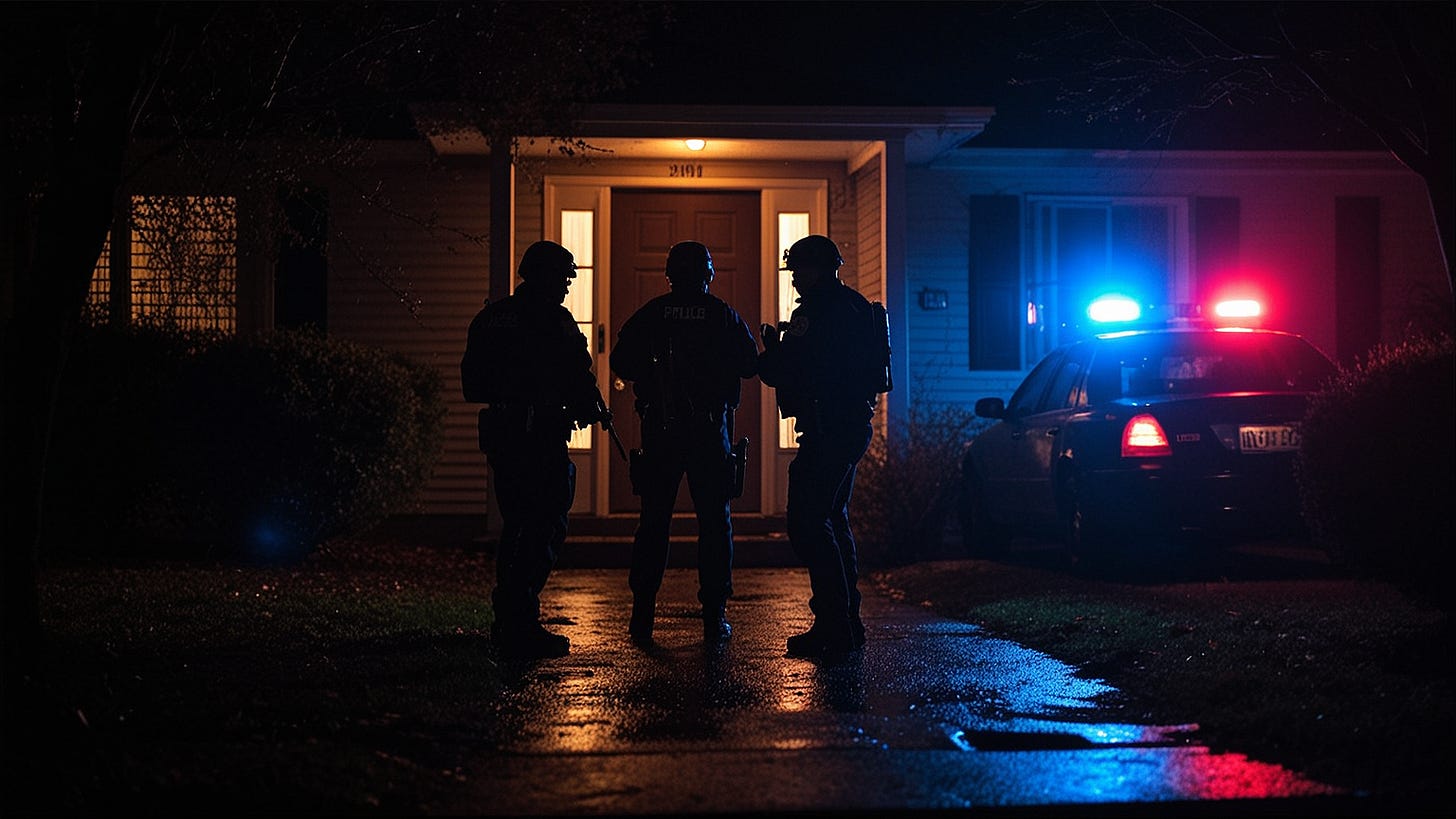
The image above captures the moment that would be seared into the collective memory of a nation—the moment when the abstract concept of “authority” became flesh and blood standing on your porch at 2:13 AM, when the theoretical discussion of rights transformed into the practical reality of armed men demanding surrender.
Marcus Webb was the first to refuse. A 67-year-old former Marine who had served three tours and carried the shrapnel of foreign conflicts in his hip, he believed—naively, as history would judge—that his service meant something, that the Constitution he had sworn to defend was more than parchment and ink. When the Enforcement Collectors arrived at his modest home in the hills of Kentucky, they found not a compliant citizen but a man who remembered his oaths.
They did not shoot him. The new regime was smarter than that. They had studied the psychology of submission, understood that martyrs were dangerous, that dead heroes inspired movements. Instead, Marcus Webb simply disappeared. His home was sealed by morning. His name was scrubbed from digital records within the week. When his daughter petitioned the courts for information, she was charged with “spreading destabilizing narratives” and joined her father in the silence.
The message was clear and deliberately engineered: Compliance is survival. Resistance is erasure.
THE MIDDLE GROUND: Where Neighbors Became Informants
The genius of the Directive lay not in its brutality—brutality is easy, brutality is lazy—but in its transformation of the social fabric itself. By November 3rd, the Secondary Compliance Protocol was activated, and with it came the most insidious weapon in the authoritarian arsenal: the weaponization of ordinary human relationships.
Citizens were encouraged—incentivized—to report “suspicious retention activities.” The rewards were tangible: priority access to rationed goods, exemption from mandatory curfew assignments, medical privileges for family members. The psychology was ancient, perfected in the darkest chapters of the 20th century, now repackaged with modern efficiency and digital surveillance.
Your neighbor, who borrowed your ladder last spring and shared your Fourth of July barbecue, now had a financial interest in your compliance. Your coworker, who complained with you about management over coffee, could secure their children’s educational future by documenting your “concerning statements” about constitutional rights. The government did not need to watch everyone—they needed only to make everyone watch each other.
The statistics, released months later by the underground resistance networks, told a horrifying story. In the first month of the Protocol, 847,000 “voluntary compliance reports” were filed. By the second month, that number had doubled. The regime had achieved what force alone could never accomplish: the internalization of surveillance, the transformation of the population into its own prison guards.
Dr. Elena Voss, a sociologist who would later die in the Reeducation Centers of Sector 7, wrote in her hidden journals: “They have not merely taken our weapons. They have taken our trust. They have made the very concept of community suspect, turned solidarity into vulnerability, transformed the natural human instinct to protect one’s neighbor into a calculated risk of self-preservation. This is not conquest. This is corrosion.”
THE MARTIAL DAWN: When Law Became Command
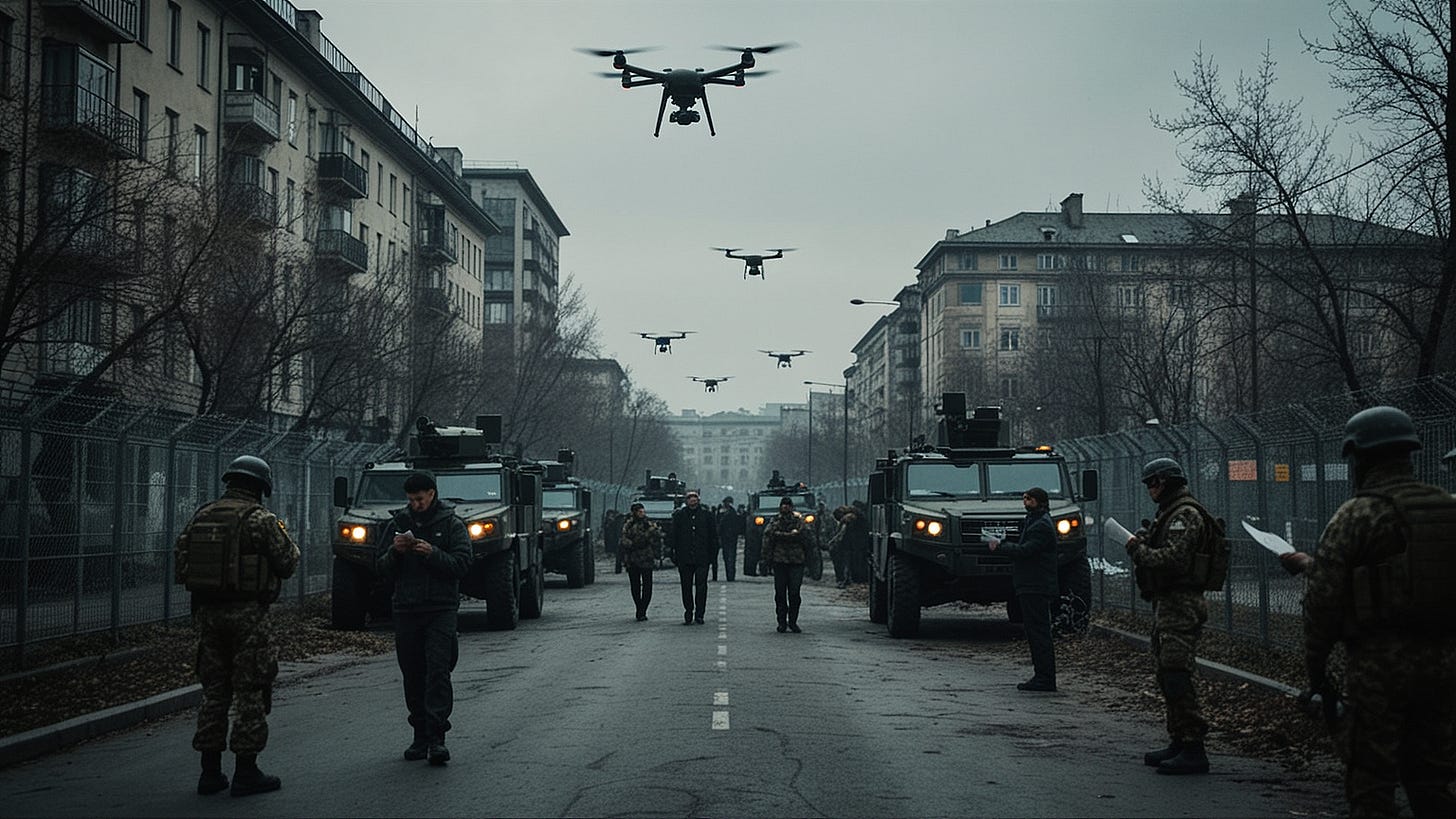
The declaration came at dawn on December 1st, though those who understood the mechanisms of power recognized that the declaration was merely formalizing what had already been implemented. The Martial Law Authority Act—passed in an emergency session with only 23 minutes of debate—transferred all civil governance to military jurisdiction “for the duration of the emergency.”
The duration, of course, was never defined.
The changes were immediate and absolute. The First Amendment, already wounded by years of “hate speech” carve-outs and “misinformation” designations, was formally suspended. “Unauthorized public assembly” became a felony punishable by 20 years in labor camps. The Second Amendment, the specific target of the entire operation, was not merely violated—it was retroactively criminalized, with possession of formerly legal firearms now classified as “preparatory terrorism.”
But it was the economic provisions of Martial Law that revealed the true scope of the regime’s ambition. Under Article 14, Section 9, all citizens between the ages of 18 and 65 were designated “Productive Resources” subject to “Directed Assignment.” Translation: You would work where they told you to work. You would live where they told you to live. You would produce what they told you to produce, consume what they allowed you to consume, and think—if you valued your rations—what they instructed you to think.
The former software engineers who had built the surveillance infrastructure found themselves assigned to agricultural collectives. The former teachers were reassigned to “Ideological Correction Facilities.” The former business owners became inventory managers in government distribution centers, their entrepreneurial instincts now harnessed to the efficiency of state-controlled scarcity.
Those who refused assignment were classified as “Non-Productive Elements.” Their bank accounts were frozen within hours. Their biometric IDs were flagged in the national database. Within days, they found themselves unable to purchase food, access medical care, or even enter public buildings. The system did not need to arrest them. It simply removed their existence from the functional economy, creating a subclass of ghosts—visible, suffering, but officially non-existent.
THE RESISTANCE BENEATH: Whispers in the Static
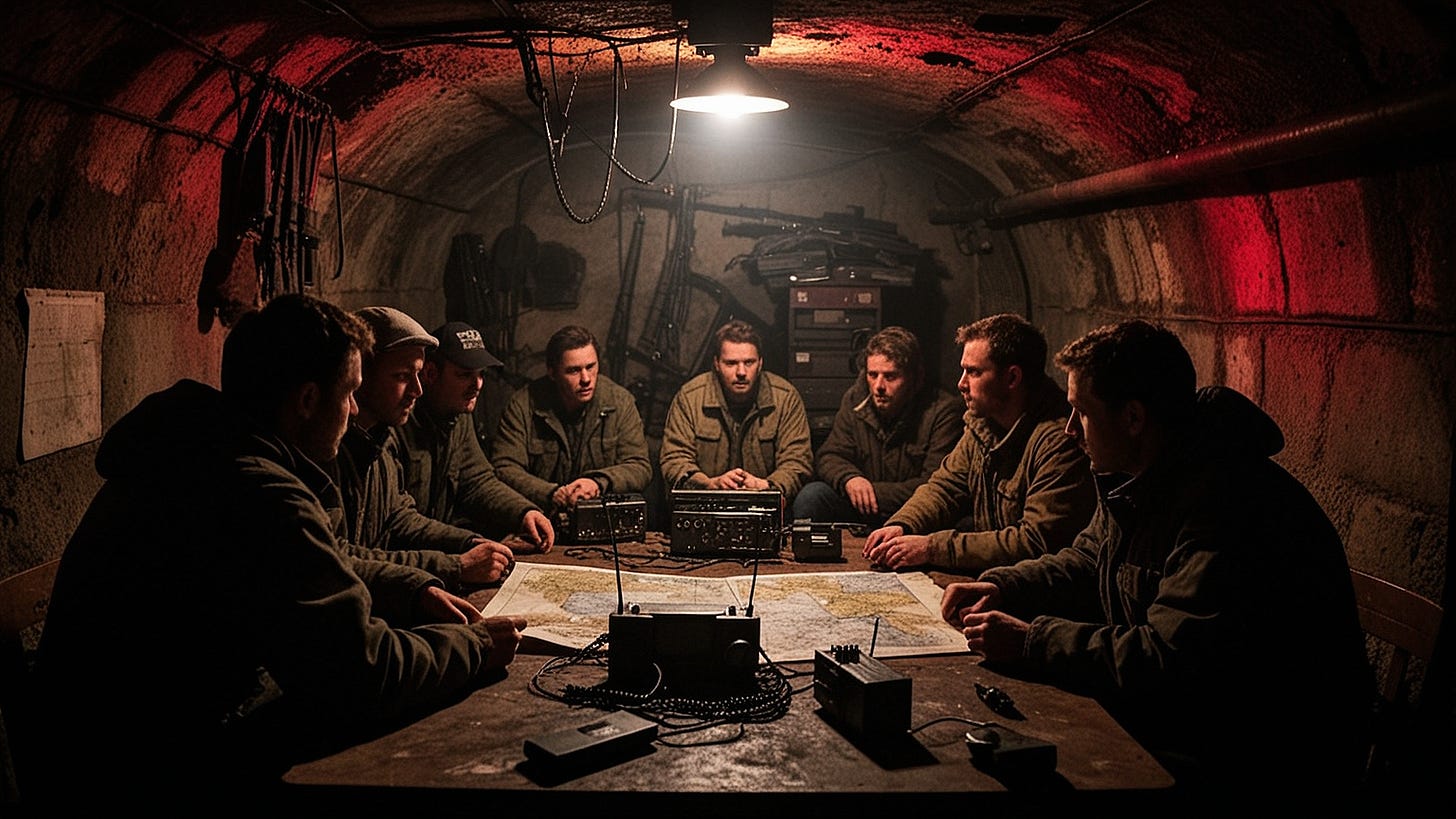
But even in the darkness, even under the weight of a machinery designed to crush the human spirit, something ancient and ungovernable persisted. The resistance did not organize through the compromised networks that the regime monitored with algorithms and AI. It organized through the oldest technologies: word of mouth, dead drops, coded language in public spaces.
They called themselves “The Rememberers”—a name chosen with deliberate irony, for their primary function was to remember what the regime sought to erase. They remembered the Constitution not as a document but as a covenant. They remembered the concept of rights not as privileges granted by the state but as conditions of human existence that predated all governments. They remembered, most dangerously, the faces of the disappeared, the names of the erased, the locations of the camps that official maps showed as empty forests and abandoned warehouses.
Their operations were small at first—sabotage of surveillance drones, disruption of propaganda broadcasts, the smuggling of food and medicine to the Non-Productive Elements. But by March 2027, they had established communication networks spanning twelve states, had infiltrated the Enforcement Collectors with double agents, and had begun stockpiling the weapons that the government had failed to collect.
The regime’s response was predictable in its brutality. On March 15th, the “Pacification Protocols” were activated. Neighborhoods suspected of resistance sympathies were surrounded at 4:00 AM. Entire blocks were razed. The official explanation—”structural safety remediation”—was so transparently false that it served a different purpose: to demonstrate that the regime no longer needed to maintain the pretense of legitimacy, that power had become its own justification.
But here, the regime made its fatal miscalculation. They believed that terror would break the resistance. Instead, it transformed it. The Rememberers were no longer merely smugglers and saboteurs. They became soldiers. The weapons they had hidden—some buried in fields, some concealed in walls, some never registered and therefore never known to the confiscation lists—were retrieved and distributed. The training that veterans like Marcus Webb had provided in secret sessions was put to use.
THE RECKONING: When the Disarmed Remembered They Had Teeth
The uprising began not with a single spark but with a thousand simultaneous fires. On April 19th—a date chosen deliberately by those who remembered history—the Resistance Coordination Network activated Operation Remembrance. Across the occupied territories, power grids failed simultaneously. Communication networks collapsed. The sophisticated surveillance infrastructure that had cost billions to construct and deploy was blinded by simple, elegant electromagnetic pulses that turned billion-dollar satellites into expensive space junk.
The regime, for all its planning, had never truly believed that the population would resist. They had studied the psychology of compliance, yes, but they had failed to understand the psychology of breaking points. They had calculated the efficiency of their confiscation programs, the thoroughness of their registration databases, but they had not calculated the human capacity for rage when pushed beyond dignity, beyond hope, beyond fear itself.
The battles that followed were not the clean, surgical operations depicted in government training manuals. They were brutal, chaotic, human conflicts fought in streets that had once known only peace. The Enforcement Collectors, trained to intimidate compliant populations, found themselves facing opponents who had nothing left to lose. The military units, many of whose members had joined believing they served legitimate authority, faced the terrible realization that they had become occupiers in their own land.
The turning point came at Fortress Denver, the regime’s central command facility. When the 3rd Mechanized Division refused orders to fire on civilian protesters and instead turned their weapons on the facility’s defenders, the illusion of unified state power shattered. Within 72 hours, the Martial Law Authority had collapsed in twelve states. Within two weeks, the Provisional Government was in full retreat to an undisclosed location.
THE AFTERMATH: Scars That Outlast the Wounds
The official chronicles—written by historians who survived and by those who came after—record that the conflict ended on June 7th, 2027, with the signing of the Restoration Accords. But those who lived through it know that endings are never so clean, so definitive.
The scars of the Silencing persist in the culture, invisible but palpable. Children born after the conflict learn in school about “the Emergency Period,” but the curriculum is careful, sanitized, safe. The full archives of the Directive, the Protocols, the lists of informants and enforcers—these remain sealed, accessible only to those with security clearances that the new government grants sparingly.
The weapons, those that were confiscated and those that were hidden, have been returned to their owners or to their heirs. But something has changed in the relationship between the armed citizen and the state. There is no longer the comfortable assumption that government serves at the people’s pleasure. There is only the hard-won knowledge that power, once concentrated, will always seek to expand, that rights unexercised become privileges revocable, that the price of liberty is not merely eternal vigilance but eternal readiness.
The Rememberers still meet, though now their meetings are public, their membership rolls published. They maintain the hidden caches not as preparation for insurgency but as insurance against necessity. They teach their children not just to shoot but to understand—understand that the rifle in the closet is not a tool of violence but a guarantor of voice, that the willingness to resist is the final check on power that no constitution, no court, no election can provide.
EPILOGUE: The Warning Unheeded
In the National Memorial Cemetery, established on the grounds of what was once Reeducation Center Sector 7, a simple monument bears the names of those who disappeared during the Silencing. Marcus Webb’s name is there, near the top, alphabetically ordered as if the regime that erased him had accidentally preserved his memory through the very efficiency of their record-keeping.
The inscription on the monument reads:
“They came first for the weapons, and we did not speak—because we were not gun owners. They came next for the dissenters, and we did not speak—because we stayed silent. They came then for the workers, and we did not speak—because we complied. When they came for us, there was no one left to speak, and no means to speak with.”
The historians debate whether the Silencing could happen again. The political scientists publish papers on the conditions that enabled the regime’s rise. The citizens vote in elections that have been carefully designed with safeguards and checks and balances.
But in quiet homes across the restored republic, in basements and attics and hidden compartments, the weapons remain. They are cleaned. They are maintained. They are ready.
Not because their owners wish for conflict. But because they have learned, at a cost measured in blood and tears and the silence of the disappeared, that the only thing more dangerous than an armed population is a population that has been disarmed by those who would command them.
The wolves still circle. They always will. And the sheepdogs—the Rememberers, the guardians, the eternal minority who refuse to forget—remain vigilant. Not with hatred in their hearts, but with memory. Memory of what was taken. Memory of what was lost. Memory of the terrible price paid to learn what should have been known all along:
That rights are not given. They are claimed. That freedom is not protected by parchment. It is protected by will. And that the final argument of tyrants is always, inevitably, met with the final argument of the free.
Anyone can join.
Anyone can contribute.
Anyone can become informed about their world.
"United We Stand" Click Here To Create Your Personal Citizen Journalist Account Today, Be Sure To Invite Your Friends.
Before It’s News® is a community of individuals who report on what’s going on around them, from all around the world. Anyone can join. Anyone can contribute. Anyone can become informed about their world. "United We Stand" Click Here To Create Your Personal Citizen Journalist Account Today, Be Sure To Invite Your Friends.
LION'S MANE PRODUCT
Try Our Lion’s Mane WHOLE MIND Nootropic Blend 60 Capsules
Mushrooms are having a moment. One fabulous fungus in particular, lion’s mane, may help improve memory, depression and anxiety symptoms. They are also an excellent source of nutrients that show promise as a therapy for dementia, and other neurodegenerative diseases. If you’re living with anxiety or depression, you may be curious about all the therapy options out there — including the natural ones.Our Lion’s Mane WHOLE MIND Nootropic Blend has been formulated to utilize the potency of Lion’s mane but also include the benefits of four other Highly Beneficial Mushrooms. Synergistically, they work together to Build your health through improving cognitive function and immunity regardless of your age. Our Nootropic not only improves your Cognitive Function and Activates your Immune System, but it benefits growth of Essential Gut Flora, further enhancing your Vitality.

Our Formula includes: Lion’s Mane Mushrooms which Increase Brain Power through nerve growth, lessen anxiety, reduce depression, and improve concentration. Its an excellent adaptogen, promotes sleep and improves immunity. Shiitake Mushrooms which Fight cancer cells and infectious disease, boost the immune system, promotes brain function, and serves as a source of B vitamins. Maitake Mushrooms which regulate blood sugar levels of diabetics, reduce hypertension and boosts the immune system. Reishi Mushrooms which Fight inflammation, liver disease, fatigue, tumor growth and cancer. They Improve skin disorders and soothes digestive problems, stomach ulcers and leaky gut syndrome. Chaga Mushrooms which have anti-aging effects, boost immune function, improve stamina and athletic performance, even act as a natural aphrodisiac, fighting diabetes and improving liver function. Try Our Lion’s Mane WHOLE MIND Nootropic Blend 60 Capsules Today. Be 100% Satisfied or Receive a Full Money Back Guarantee. Order Yours Today by Following This Link.



| Visits: | 1,827,449,720 |
| Stories: | 8,683,232 |
Whistler Blowers, Insiders


What do criminals do when they WOB? First, they DISARM you, whether they are gangs, goons, or the GODvernment.