

The 20 Pioneer Foods That Will Become Your Only Lifeline When SHTF and the Shelves Bleed Empty

Unthinkable numbers emerged from a recent agricultural consortium report—seventy-two hours separates metropolitan abundance from absolute scarcity. Not a season. Not a month. Three days of illusion before grocery stores transform from cornucopias into stripped metal skeletons. Analysts who’ve spent careers mapping supply chain fragility now whisper about older methods, buried beneath fluorescent hum and barcode scanners. Methods that predate refrigeration, globalization, chemical preservation. Methods forged by bleeding hands on the frontier.
Those iron-willed migrants who carved settlements from wilderness didn’t merely survive—they established systems of sustenance that modern palates find alien, perhaps repulsive. Yet these foods represent the only viable bridge between starvation and survival when infrastructure evaporates. Climate cascades, economic tremors, geopolitical fault lines conspire to render current food paradigms obsolete with terrifying velocity. When rupture occurs, when trucks stop running and freezers warm into silence, we won’t return as poets or philosophers. We’ll crawl back as scavengers, desperate to remember what great-great-grandmothers knew by heart.
Wrestling nourishment from decay becomes necessity. Coaxing calories from stubborn earth returns as skill. Storing summer’s abundance against winter’s starvation reemerges as survival itself.
This isn’t nostalgia. It’s archaeology of the inevitable.
Twenty Provisions That Will Outlast the Grid
Below lie staples that separated living from dead during America’s westward expansion. Each entry represents technology of survival—methods for converting time, labor, and landscape into continued existence. These aren’t comfort recipes. They’re persistence blueprints.
1. Stone-Ground Cornmeal
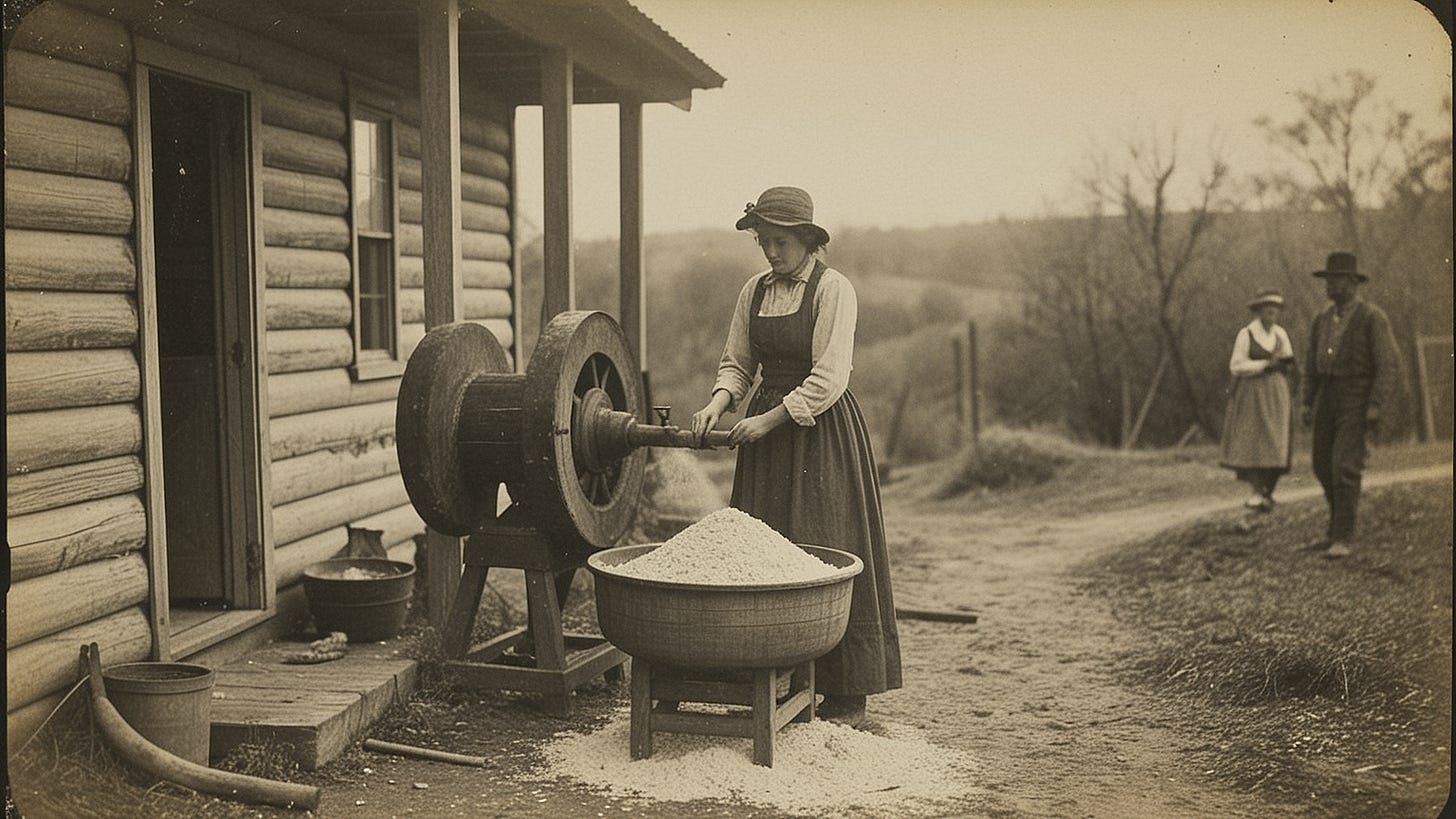
Before steel roller mills pulverized wheat into uniform dust, cornmeal sustained indigenous nations for millennia. Pioneers adopted this staple from brutal practicality, not sentiment. Corn grows where wheat withers, tolerating drought, poor soil, neglect. It ripens quickly, stores indefinitely as dried kernels.
Meal itself carries grindstone memory. Each particle retains germ fragments—that oily, nutrient-dense heart industrial processing strips away. Pioneer cornmeal lived, volatile, prone to spoiling if stored improperly. They chose nutrition over longevity, learning risk management.
In collapsed present, cornmeal resurrects as ultimate versatile carbohydrate. Mixed with water and ash, it becomes masa—foundation of tortillas and tamales. Combined with fat and salt, it transforms into cornbread, hoecakes, mush. It thickens stews, coats meats for frying, ferments into sourdough starters or moonshine mash.
Visuals are unmistakable: wooden bowls heaped with golden grit, darker germ flecks swirling like river sediment, waiting to bind with water over open flame. No other flour carries sun so completely in its chemistry. When wheat supply chains snap, cornmeal becomes yellow gold of new economies.
2. Smoke-Hardened Jerky
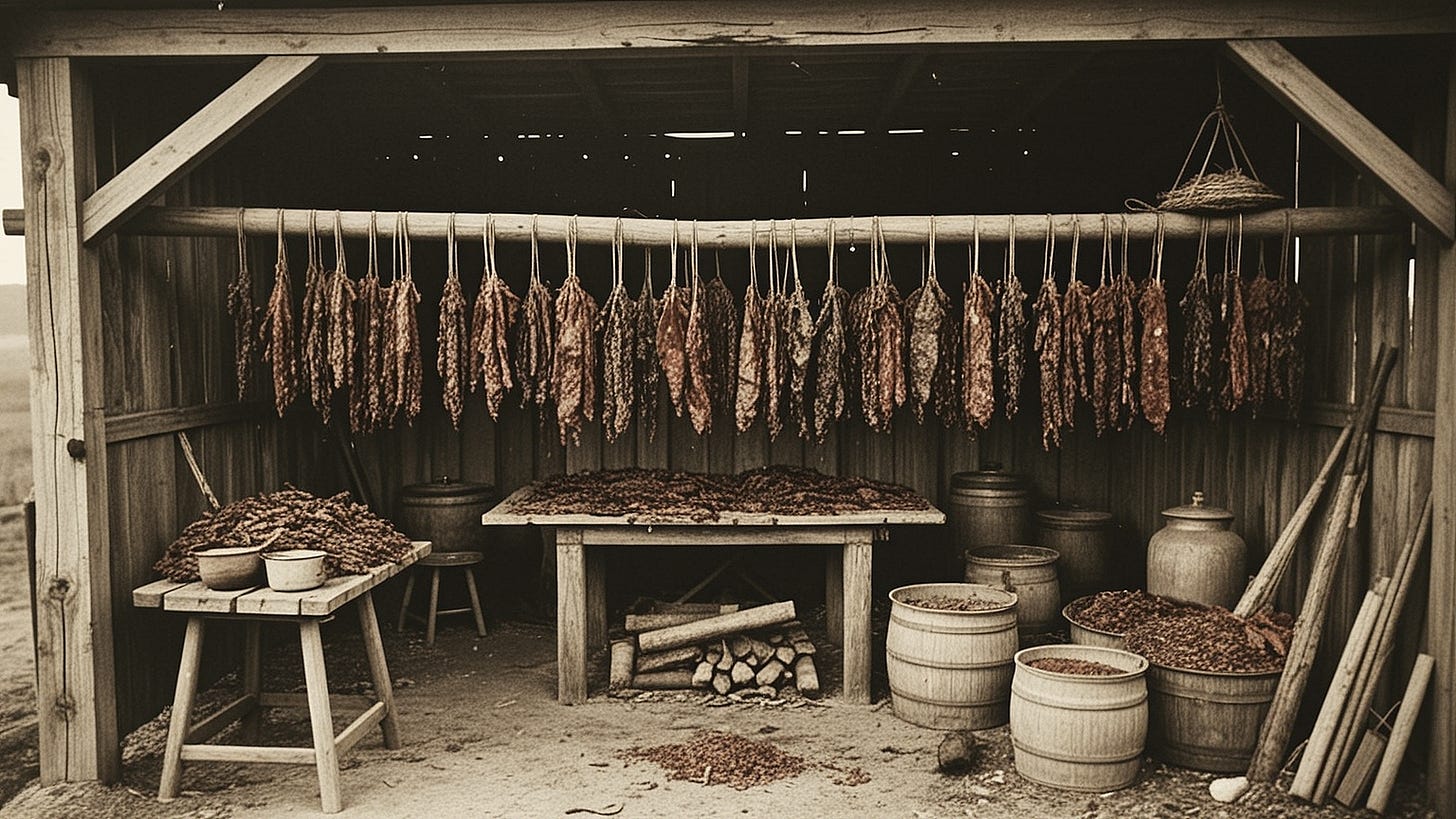
Meat preservation without refrigeration is alchemy. Pioneers understood flesh as borrowed time—muscle tissue marching toward putrefaction the moment blood stops pumping. Their answer was jerky: strips stripped of moisture through smoke, salt, and air until becoming something else entirely. Not fresh. Not cooked. Something suspended between states.
Process begins with butchering—killing at right moment, right weather, with right tools. Fat must be excised surgically, since fat goes rancid while lean meat merely dries. Strips cut with grain, never against, creating long ribbons resisting crumbling. Salt draws moisture through osmosis, creating environments hostile to bacteria. Smoke deposits creosote and phenolic compounds—natural preservatives flavoring flesh.
Result is leather. Chewy, fibrous, nearly indestructible protein stored in saddlebags for months, root cellars for years, carried across mountain passes without spoilage. It requires no cooking, no container. Calories stripped to essence—portable, dense, unapologetically tough.
Modern palates accustomed to wet-aged steaks will recoil. Texture demands effort; flavor concentrates, intensifies, sometimes harsh. But where protein becomes scarce, jerky becomes currency. Survival itself—suspended strips of preserved life hanging in smokehouses like strange fruit, waiting for teeth strong enough to claim them.
3. Cottontail and Grey Squirrel
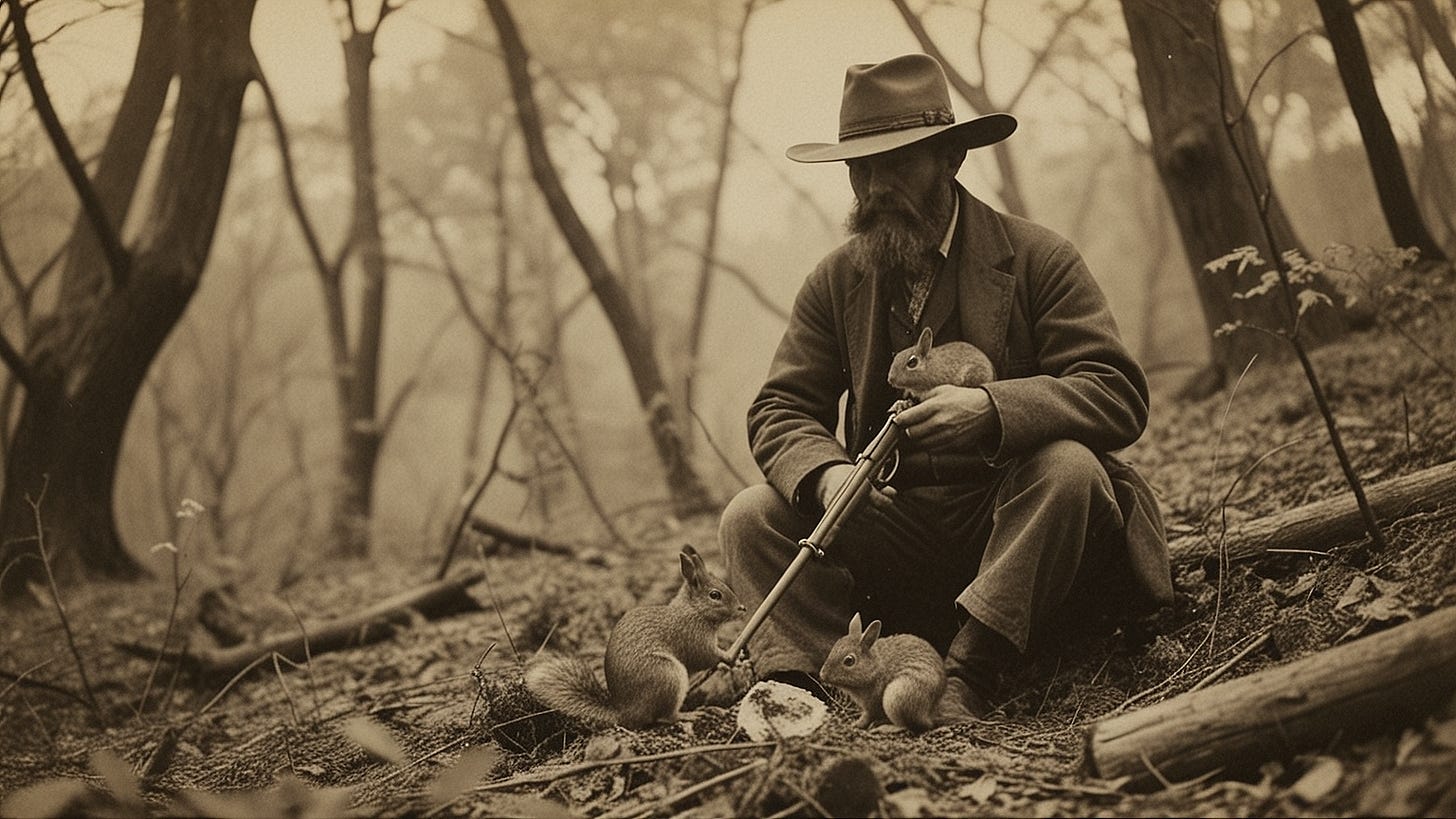
Large game is Hollywood’s survival lie. Noble hunter fantasies bringing down elk to feed families for weeks ignore processing reality, storage limitations, waste. Pioneers knew better. They hunted small—rabbits, squirrels, groundhogs, birds—because small meant manageable, immediate consumption, no leftover meat rotting before preservation.
Cottontail rabbit offers perfect effort-to-calorie ratio. Breeding rapidly, living close to human habitation, weighing just enough to feed one or two people for single days. No waste. No storage anxiety. Meat remains lean, mild, versatile—fried, stewed, roasted, ground into patties. Fur provides insulation; bones make stock.
Squirrel demands more skill. Tree-dwelling, suspicious, quick—harvesting requires patience, marksmanship. Reward is nut-fed flesh, sweetened by acorns and hickory nuts, tender from climbing lives. Grey squirrel carries enough meat to justify ammunition expenditure or snare complexity.
These aren’t pests or vermin. In coming scarcity, they become primary protein sources for those without livestock. Images crystallize: dawn light filtering through bare branches, figures crouched with .22 rifles or wire snares, waiting for movement. Shots. Retrievals. Quick field-dressing, guts steaming in cold air, fur peeled back like gloves. This becomes meat acquisition—not plastic-wrapped Styrofoam trays, but fur and feather, warm from recent life, demanding immediate attention before rigor mortis sets.
4. Stream-Caught Trout and Panfish
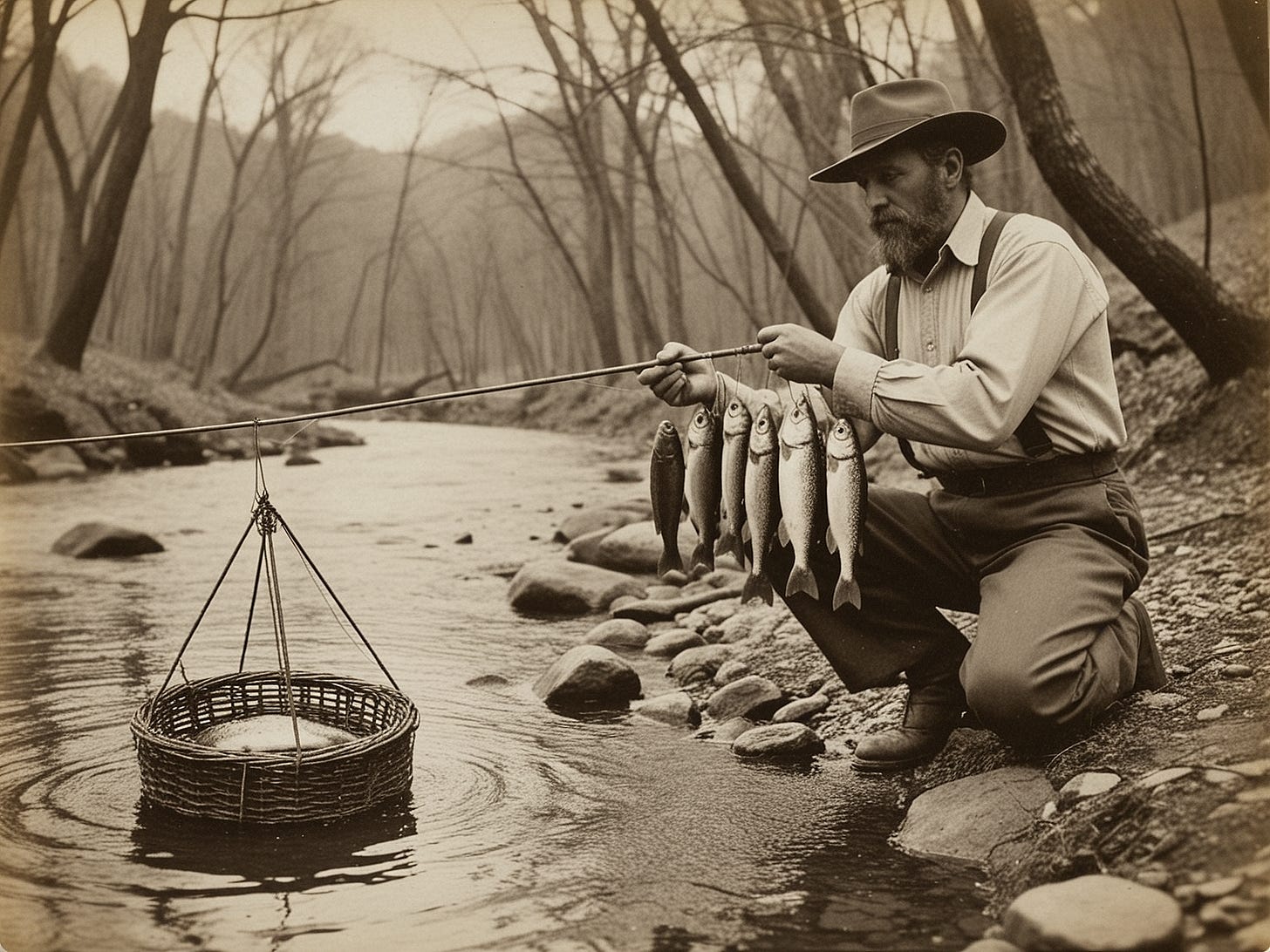
Water carries calories more efficiently than land. Single streams, properly worked, provide more protein per hour than weeks of terrestrial hunting. Pioneers knew this intimately, following waterways, establishing settlements near them, learning fish rhythms—when they ran, where they hid, what they ate.
Trout became frontier’s signature fish. Cold, clear water species demanding oxygen and pristine conditions, indicating healthy ecosystems, providing immediate water quality feedback. Brook trout, rainbow trout, cutthroat—all taken on improvised tackle, hand-woven nets, woven traps left overnight in current.
Panfish—bluegill, crappie, perch—offered less glamour but more reliability. Schooling in predictable locations, biting readily on simple bait, taken in quantity, processed rapidly—cooked immediately or smoked for later.
Shellfish entered diets where available—crayfish in Midwestern streams, freshwater mussels where legal and safe, clams along coastal migrations. Not delicacies but desperation foods, scavenged when other sources failed, providing minerals and protein in lean times.
Visuals here overwhelm senses: silver scale flashes in morning light, wet fish slaps on stone banks, metallic blood and cold water scents, scale scraping and belly gutting. Fish demand processing where caught or carrying wet—wrapped in damp cloth, kept cool, never allowed to warm in sun. Knowledge returns quickly when hunger demands.
5. Rendered Lard and Tallow
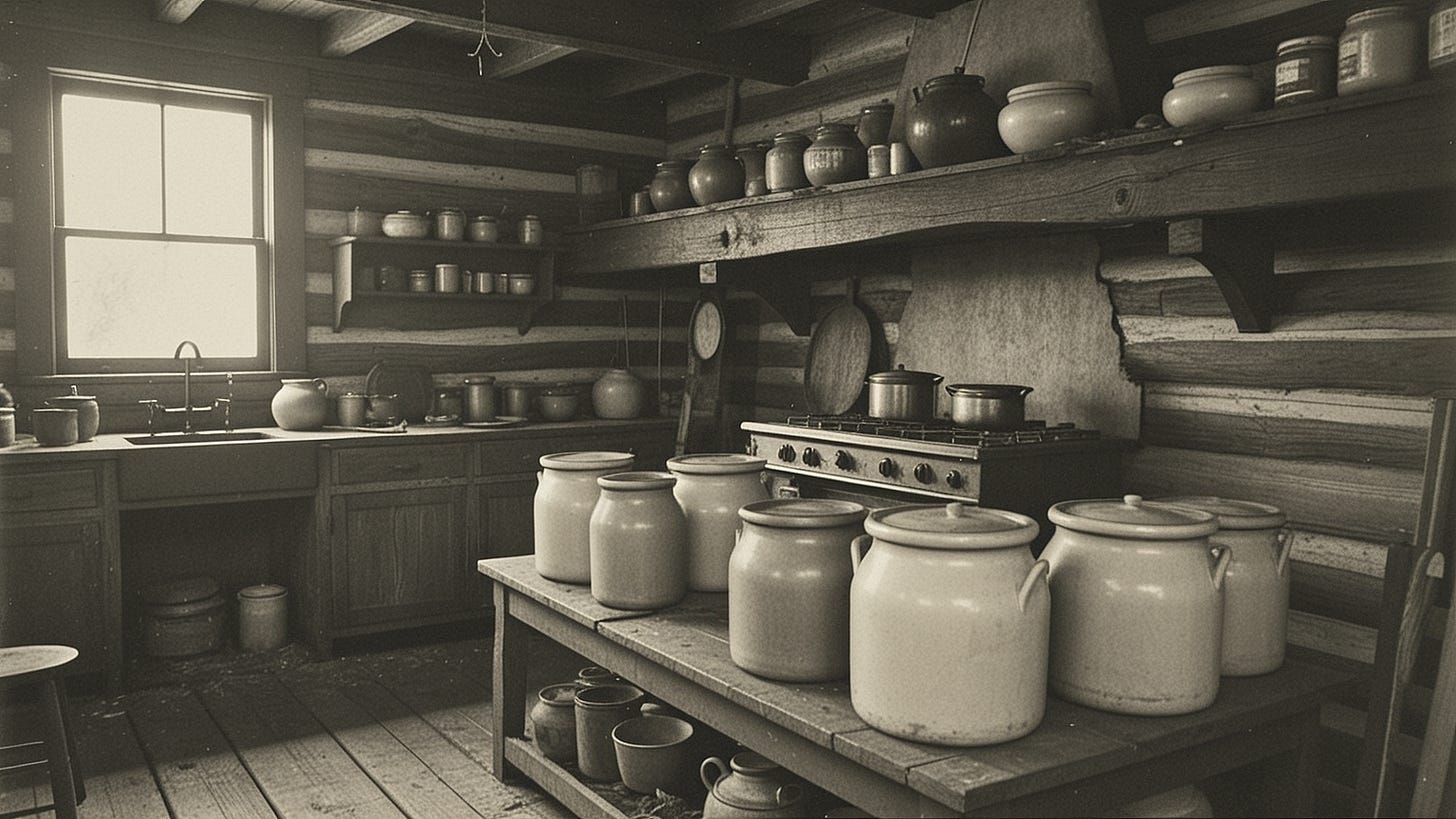
Fat remains the most precious calorie. Twice the energy per gram of carbohydrates or protein, enabling fat-soluble vitamin absorption, providing satiety—that fullness preventing overconsumption of scarce resources. Pioneers didn’t fear fat. They hoarded it, rendered it, protected it from spoilage and theft.
Lard comes from pigs—visceral fat surrounding kidneys, subcutaneous layers beneath skin, deposits within muscle. Tallow comes from ruminants—cattle, deer, elk, sheep. Both require rendering: slow heating of raw fat separating pure lipid from water, protein, connective tissue. Results are stable, white or yellow substances solidifying at room temperature, keeping for months in cool storage.
This rendered fat wasn’t merely cooking oil. It became lamp fuel, soap ingredient, boot waterproofing, leather treatment. It bound pemmican—ultimate trail food of dried meat, dried berries, and fat pounded into bricks sustaining travelers for weeks.
In coming collapse, vegetable oils—those fragile, oxidizing liquids extracted through industrial chemical processes—become unavailable or unusable. Olive oil jars from distant Mediterranean groves empty without refilling. Lard and tallow return as only viable cooking mediums, only ways to transfer heat to food without burning, only sources of essential fatty acids when grocery shelves stand empty.
Visuals become visceral: cast iron cauldrons bubbling with white fat chunks, steam carrying faint cooked meat scents, crackling skimming—those crispy remnants becoming snacks or animal feed. Cooling jars, opaque solidity, spoons leaving tracks like snow. This becomes wealth, measured not in currency but in calories keeping when darkness falls.
6. Sun-Withered Fruit Leathers
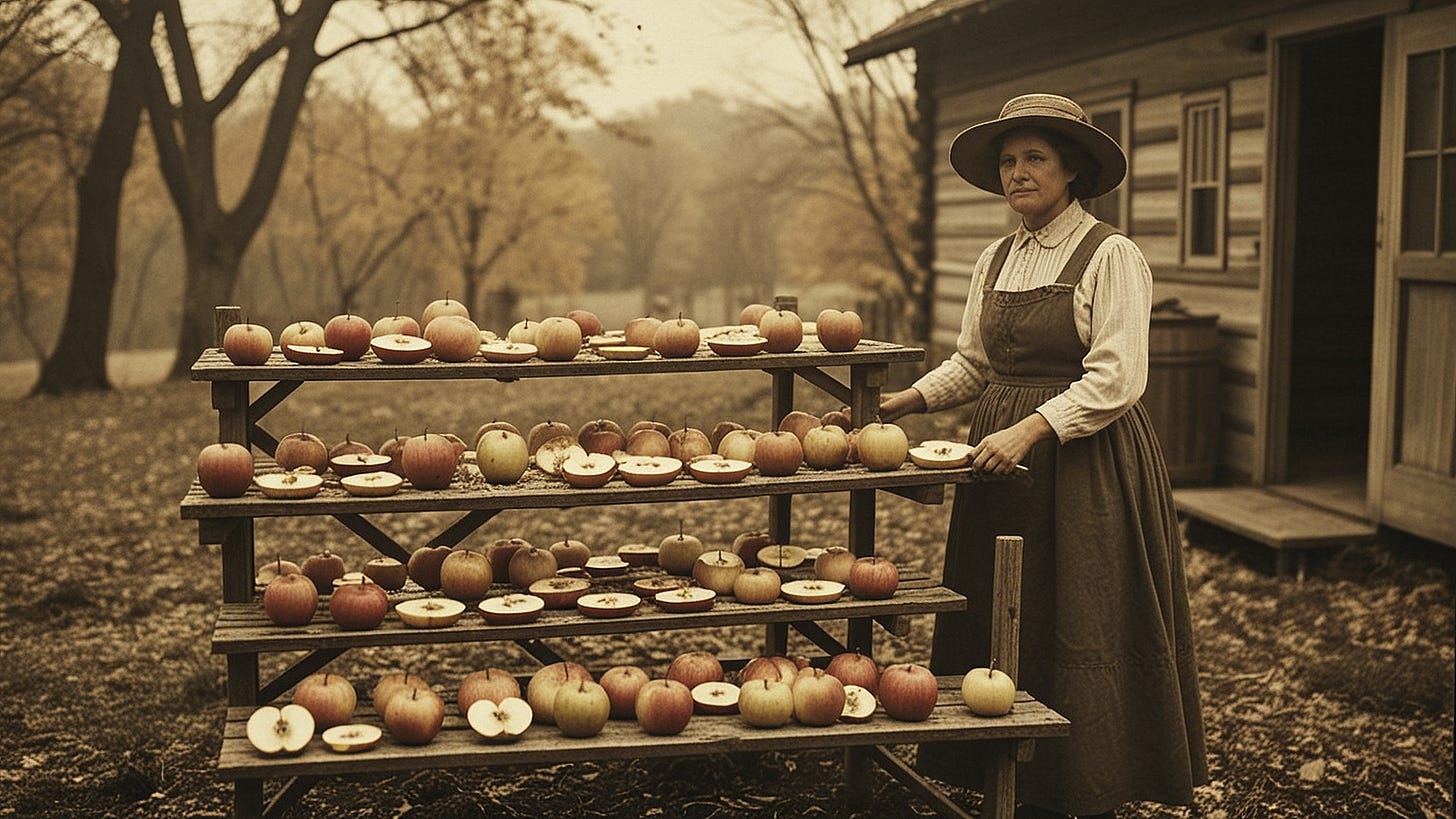
Fresh fruit is present-moment luxury. It ripens, rots, demands immediate attention. Pioneers solved this through dehydration—removing water until fruit became hostile to bacteria and molds causing decay. Results were leathery, wrinkled, concentrated sweetness stored in baskets or sacks, consumed months after harvest.
Apples were primary candidates—sliced into rings, cored, laid on racks in sun or near hearths, turned daily until snapping rather than bending. Peaches, pears, apricots followed where climate permitted. Berries—strawberries, raspberries, blackberries—were mashed, spread into thin sheets drying into fruit leather, chewy and intense.
Process required vigilance. Rain spoiled batches. Insects demanded protection—cheesecloth tents, nearby fire smoke, constant attention. Reward was winter vitamin and sweetness access when fresh produce was months away and scurvy threatened.
In futures without refrigeration, without frozen food sections, without global out-of-season produce shipping, dried fruit becomes medicine as much as food. Concentrated sugars provide quick energy. Preserved vitamins prevent deficiency diseases. Fiber maintains digestive health when diets become meat-heavy and grain-dependent.
Visuals turn autumnal: darkening fruit on wooden racks, skin wrinkling like old faces, colors deepening from bright to somber, textures transforming from yielding to resistant. Not bright, sulfured apricots of commercial production, but something darker, more honest—summer’s essence held in suspended animation, waiting for snow.
7. Desiccated Root Vegetables
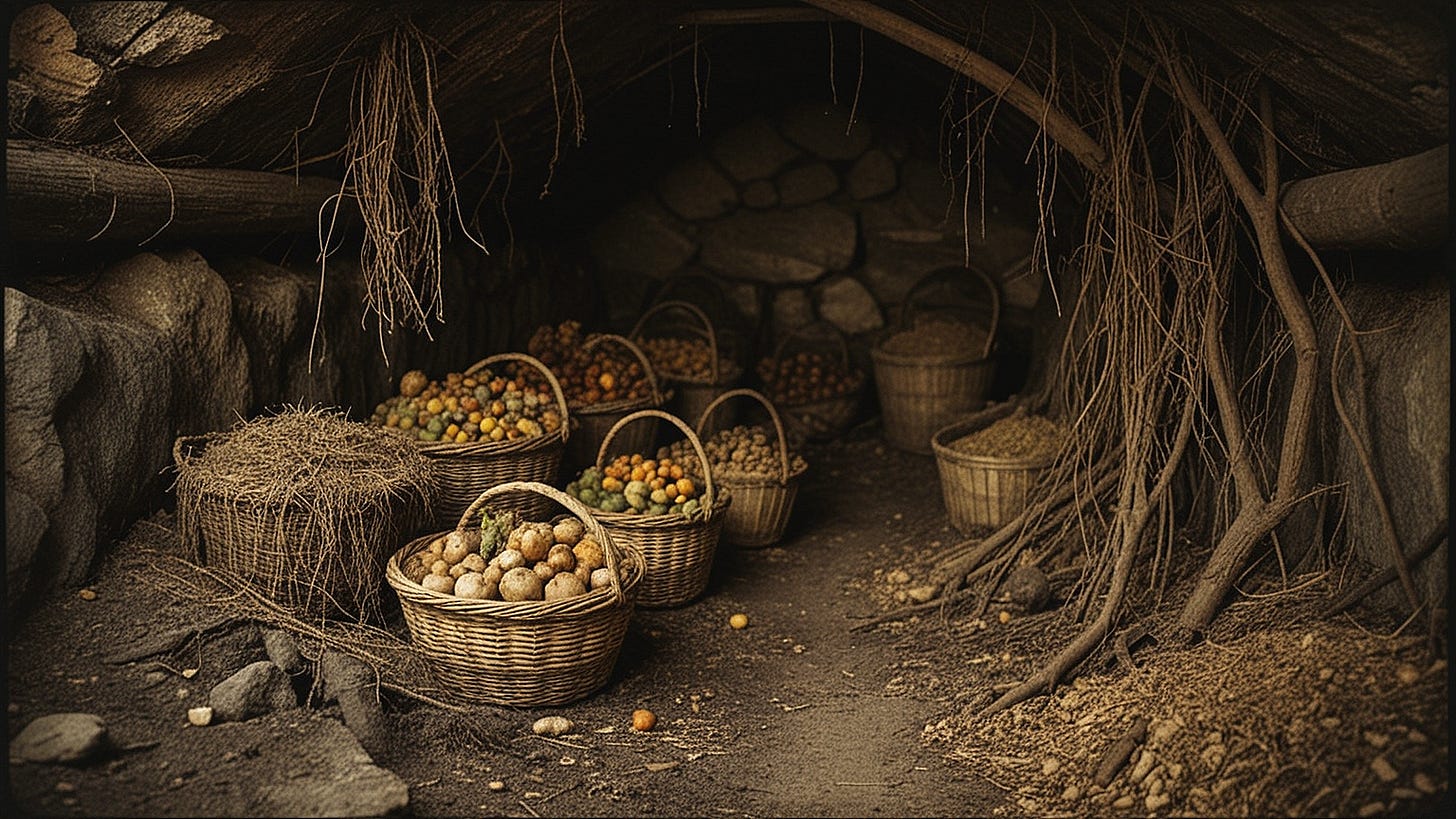
Beneath soil lies storage requiring no technology. Root vegetables—carrots, parsnips, turnips, beets, potatoes—evolved specifically to hoard energy underground, protected from frost and foraging animals. Pioneers extended this natural preservation through dehydration, creating lightweight, shelf-stable provisions traveling or waiting.
Potatoes sliced thin, blanched in boiling water stopping enzymatic browning, then dried until brittle. Carrots scrubbed, diced, dehydrated into wrinkled orange cubes. Beets cooked, peeled, sliced into leather. Each vegetable responded differently, losing moisture while concentrating sugars and starches.
Resulting pieces stored in cloth bags, ceramic crocks, or wooden boxes, rehydrated with water when needed, or added directly to stews where they absorbed liquid and expanded. They took fraction of fresh produce space, weighed little, provided vegetable matter necessary to prevent dietary diseases.
In coming scarcity, when gardens cannot produce year-round and greenhouses require unavailable energy inputs, these desiccated roots bridge hungry months. They represent abilities to convert autumn abundance into spring survival, smoothing jagged edges of seasonal availability.
Visuals prove humble: wrinkled orange and purple fragments in woven baskets, light as paper, hard as stone, waiting for water to resurrect them into something resembling food. Not beautiful. Not appetizing. But persisting when everything fresh surrendered to rot.
8. Dried Legumes: The Patient Protein
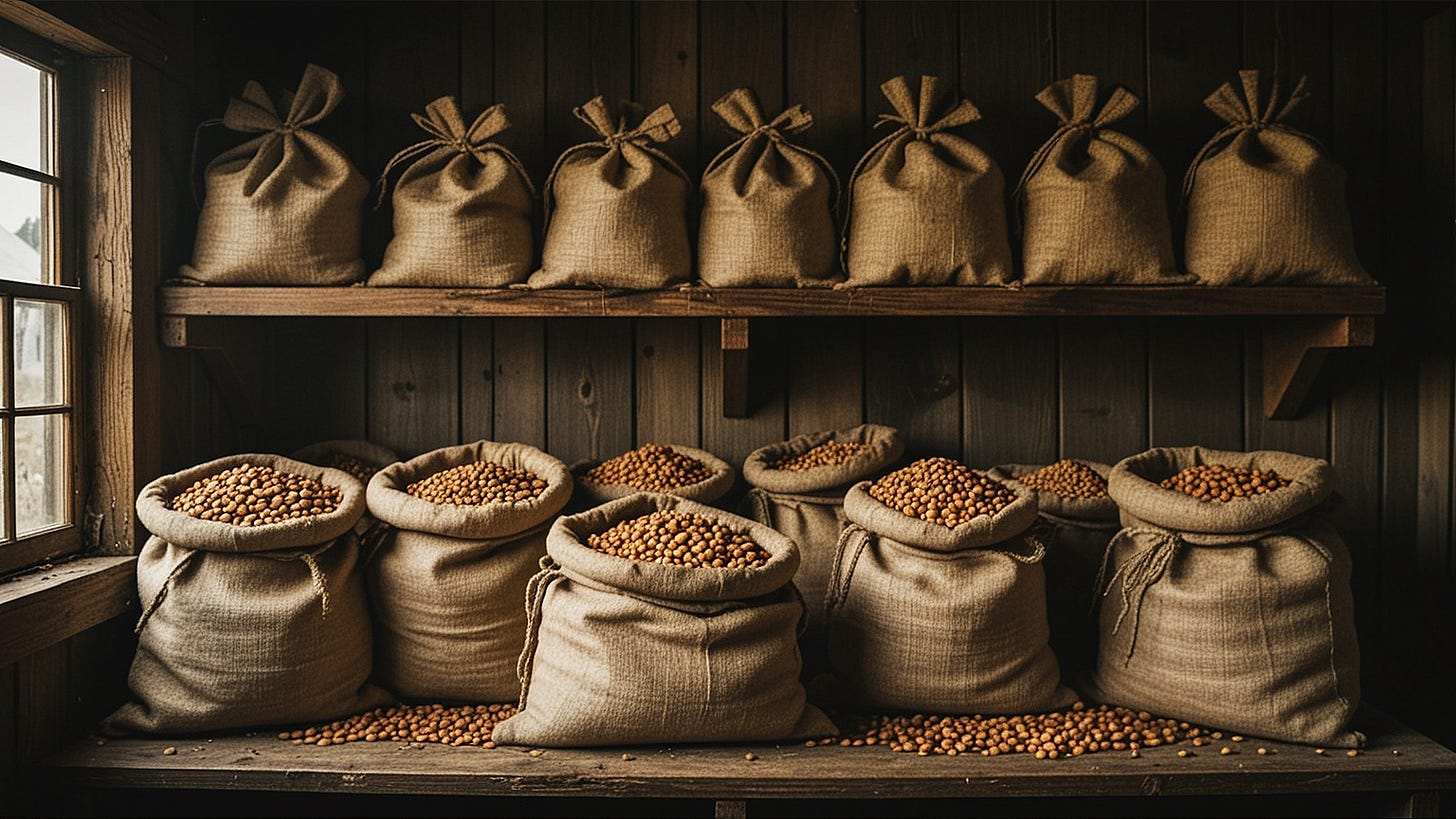
Beans refuse to hurry. They sit in pods, on vines, waiting for harvest, then sit in storage, waiting for water, waiting for heat, waiting for patience required to transform stone-hard pellets into edible nourishment. This patience made them perfect for pioneers, making them essential for survivors.
Drying process is simple: leave pods on vines until rattling, then thresh—beat them to release beans, winnow to remove chaff, store in breathable containers preventing mold while discouraging pests. Results are protein sources keeping for years, even decades, losing only minor nutritional value while remaining completely edible.
Preparation requires foresight. Dried beans must be soaked—overnight, or for hours in hot water—to rehydrate before cooking. Then boiling, simmering, tending. Process cannot be rushed without consequences: undercooked beans contain toxins causing severe digestive distress. But properly prepared, they provide complete protein combined with grains, fiber satisfying hunger, versatility spanning cultures and continents.
Kidney beans, navy beans, black beans, pinto beans, lentils, split peas—each variety offers slightly different cooking properties, flavors, nutritional profiles. Diversified bean storage provides insurance against crop failure, pest infestation, palate fatigue.
In post-collapse landscapes, where meat becomes scarce and refrigeration nonexistent, beans become primary protein sources for settled communities. Grown in small spaces, harvested by hand, stored without technology, prepared with minimal equipment. They demand only water, heat, and time—three resources remaining available even when complex infrastructure fails.
Visuals become archaeological: clay pots or wooden barrels filled with smooth, hard seeds, each variety distinct in color and shape, clicking against each other when moved, waiting for water and fire alchemy to transform them into sustenance.
9. Winter-Keeping Squash
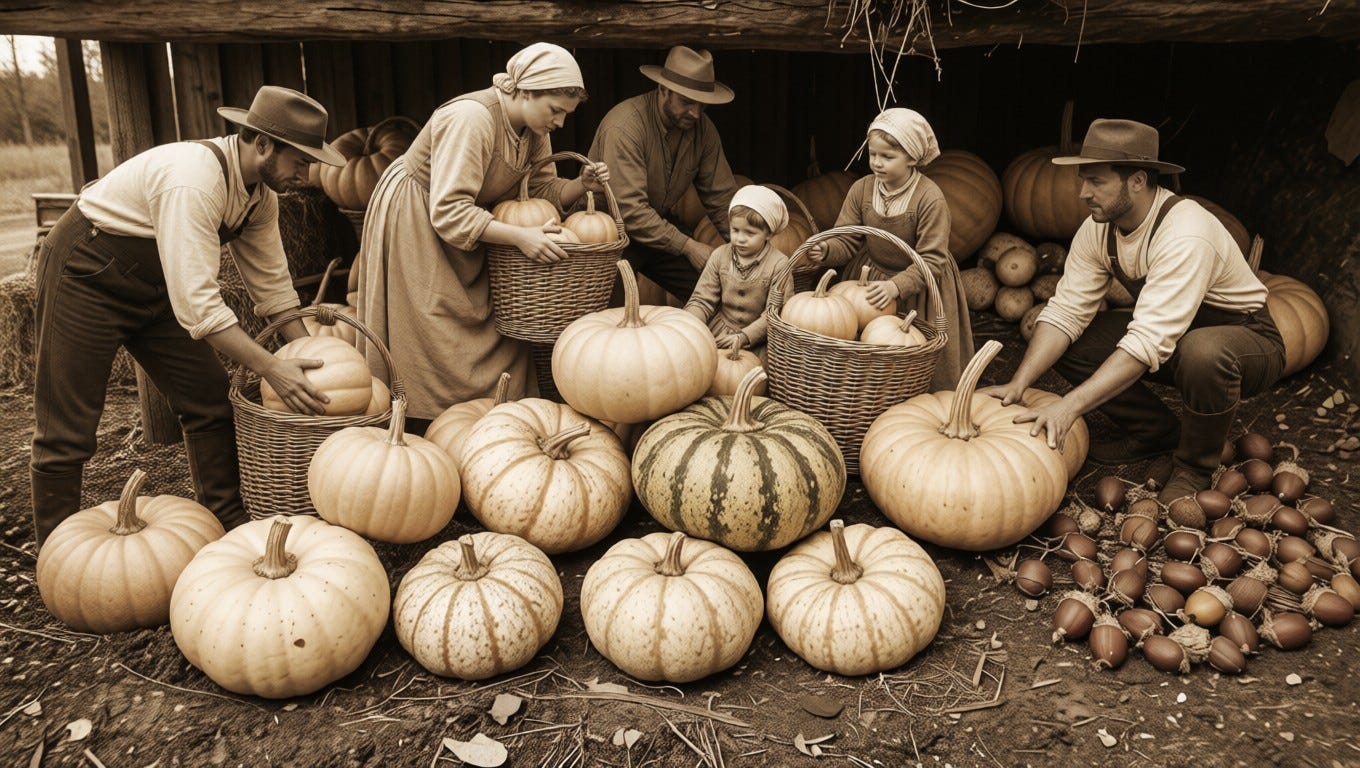
Not all squash are created equal. Thin-skinned summer varieties—zucchini, yellow crookneck, pattypan—are present-moment gluttons, producing abundantly but storing poorly. Thick-skinned cousins—Butternut, Hubbard, Blue Hubbard, Acorn, Spaghetti, massive Pink Banana—evolved for endurance. Hard rinds form natural preservation chambers, protecting sweet orange flesh for months after harvest.
Pioneers learned reading squash for storage readiness. Stems must be fully dried, corky, detached from vines by nature rather than knife. Skin must resist fingernail pressure, indicating sufficient lignin development. Squash must be cured—held at warm temperatures for two weeks hardening skin and healing minor wounds—before moving to cool, dry storage.
Properly kept, these squash last six months, sometimes longer. They require no canning, freezing, drying, or salting. They ask only for darkness, moderate humidity, occasional rot inspection. When opened, they reveal dense, sweet flesh roasted, mashed, pureed into soup, or dried into flour.
Seeds, too, prove valuable—roasted for snacks, pressed for oil, saved for next year’s planting. Nothing is wasted. Rinds feed livestock or compost. Flesh feeds humans. Cycles continue.
In worlds without refrigeration, these living storage units become precious beyond weight. Single Hubbard squash feeds families for days. Cellars full represent insurance against winter starvation, against crop failure, against darkness falling when snow covers ground and fresh food becomes memory.
Visuals become almost sculptural: massive, warty, irregular forms stacked in root cellars, mottled skin—orange, blue, grey, striped—catching dim light, heavy with stored sunlight, waiting to be split open with axes when pantries grow bare.
10. Earth-Buried Tubers
Potatoes and sweet potatoes occupy unique categories: foods improving with improper storage. While most vegetables demand cool, dry conditions, these tubers prefer darkness, humidity, slight fermentation from being buried in earth or sand. Pioneers created root cellars—underground chambers maintaining stable temperatures through soil’s insulating properties.
Process begins with curing. Freshly dug potatoes must rest at warm temperatures, unwashed, allowing skins to suberize—forming protective barriers against pests and decay. Then moved to darkness, layered with straw or sand or dry leaves, kept humid enough to prevent shriveling but not so wet as to encourage rot.
Sweet potatoes demand even more specific conditions: warm curing initially, then cooler storage, never below 50 degrees Fahrenheit lest starches convert to sugars and ruin cooking properties. Complexity of these requirements meant successful tuber storage separated thriving homesteads from starving ones.
Properly stored, potatoes last until spring, sprouting in darkness, their eyes opening to produce next plant generations. They can be eaten at any stage—firm and starchy in autumn, slightly softened and sweetened by winter storage, sprouted and planted when soil warms.
In collapse, when grains become scarce or impossible to mill, potatoes become primary carbohydrates. They grow in poor soil, produce abundantly, store without technology. Families with root cellars full of potatoes survive winters that starve others. Visuals become primordial: hands plunging into cool darkness, pulling out smooth, earthy spheres, brushing off soil, faint fermentation and life-held-in-suspension scents.
11. Braided Alliums
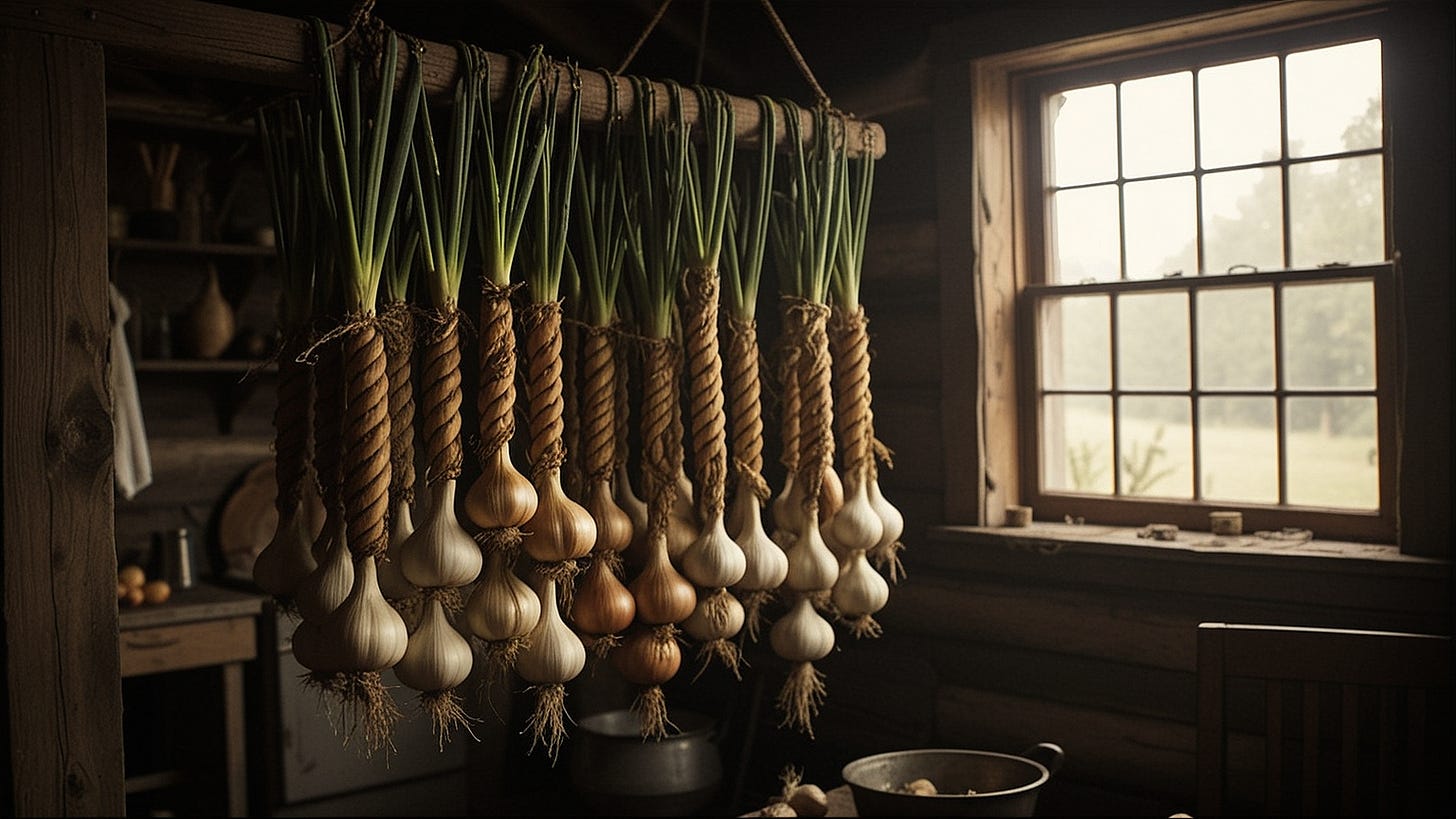
Onions and garlic are cuisine’s punctuation marks—exclamation points of flavor transforming bland sustenance into desirable food. Pioneers grew them in quantity, developing methods preserving harvest through dark months.
Onions are harvested when tops fall over, cured in sun until outer skins rattle like paper, then braided by dried tops into long ropes hanging from rafters. This storage serves dual purposes: keeping onions dry and ventilated, preventing rot from moist surface contact, while creating visual inventory—easily seen, easily accessed, beautiful in utilitarian ways.
Garlic follows similar protocols but with greater longevity. Properly cured hardneck garlic stores for eight months, softneck varieties even longer. Braids are tighter, bulbs more protected, flavors intensifying as months pass.
These alliums do more than flavor food. They provide antimicrobial compounds helping preserve other foods and protect human health. They offer psychological comfort—sharpness reminding eaters that food can still be pleasurable even in hardship. They serve as medicine—garlic particularly, treating infections, respiratory ailments, circulatory issues.
In coming scarcity, when diets become monotonous and vitamin deficiencies threaten, onions and garlic become more than condiments. They become necessities—trading commodities, medicinal stores, last defenders of culinary dignity when salt and spices become unavailable.
Visuals become domestic and ancient: rust-colored ropes hanging from dark beams, papery skins rustling in drafts, sharp scents released when bulbs are twisted free, promising flavor in worlds growing increasingly bland.
12. Cellared Apples
Not all apples store equally. Modern supermarkets sell varieties bred for appearance, refrigerated distribution shelf stability, transport durability. Pioneers grew different apples—winter keepers like Winesap, Arkansas Black, Rome Beauty, Northern Spy—improving in storage, developing complex flavors, maintaining firm texture for months after harvest.
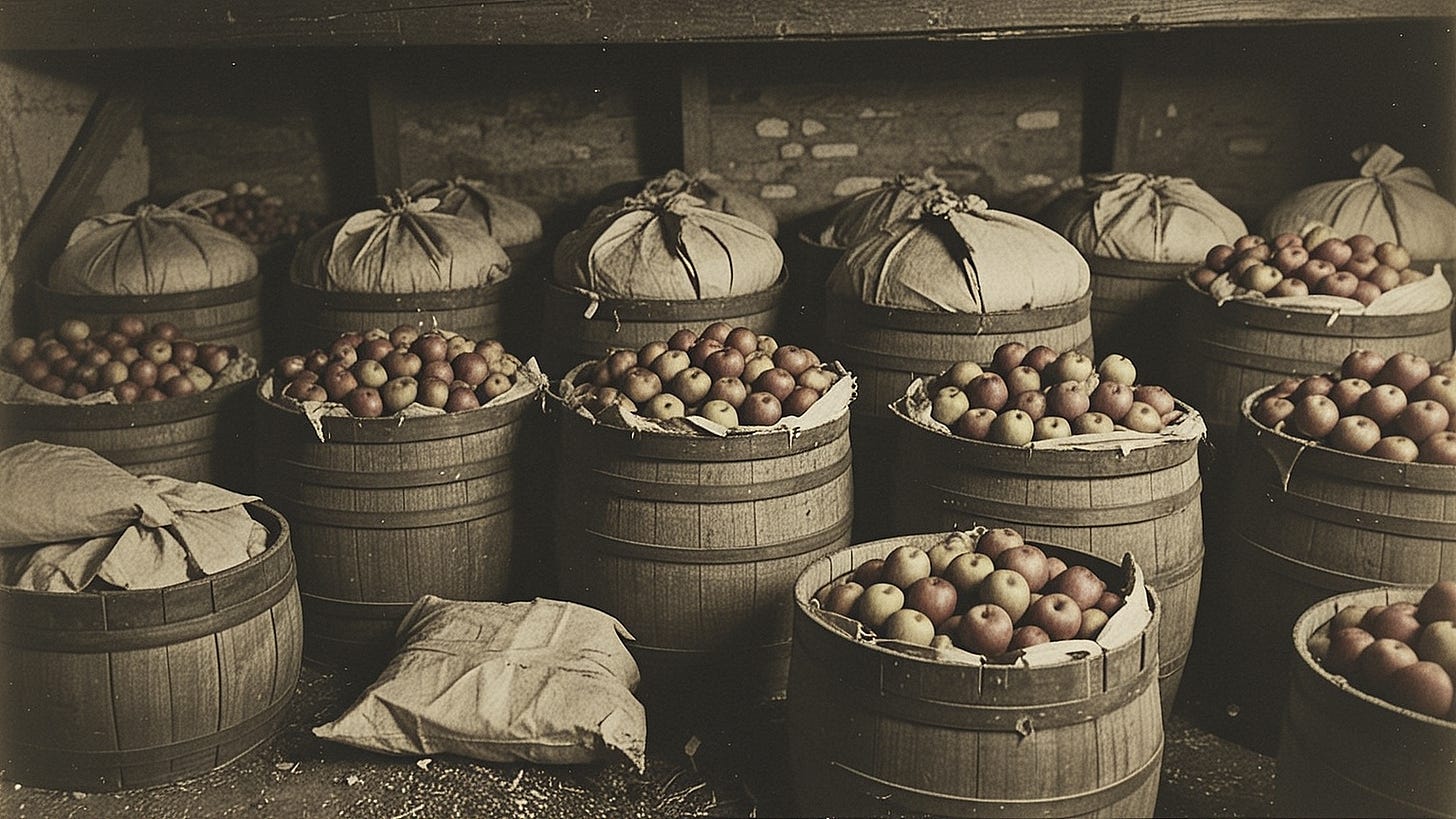
Storage methods were specific: perfect fruit, unbruised, unwashed, wrapped individually in paper or straw preventing contact and rot spread, packed in barrels or boxes in root cellars where temperatures hovered just above freezing. Humidity had to be high enough preventing shriveling, ventilation sufficient preventing carbon dioxide buildup, darkness absolute preventing sprouting and greening.
Under these conditions, apples became living storage—respiring slowly, converting starches to sugars, developing honey and spice notes that fresh apples never achieved. Properly stored Winesaps eaten in March tasted of winter itself—concentrated, winey, almost fermented in intensity.
Utility extends beyond fresh eating. Stored apples can be pressed for cider when beginning to soften, cooked into sauces when growing mealy, dried into rings when threatening to turn. Peels and cores feed livestock or ferment into vinegar. Nothing is wasted.
In worlds without Florida oranges, without Central American bananas, without global fruit trade stocking supermarkets year-round, stored apples become only fresh fruit sources through winter. They prevent scurvy. They provide sweetness without processed sugar. They remind us that patience—waiting for right moments, storing against futures—can be rewarded with flavors impossible to rush.
Visuals become almost painterly: dark barrels in dim cellars, paper-wrapped spheres nestled like eggs, occasional rot inspections, chosen apples split open revealing flesh still white or cream, still crisp, still holding autumn’s memory against spring’s encroachment.
13. Tree-Tapped Syrup
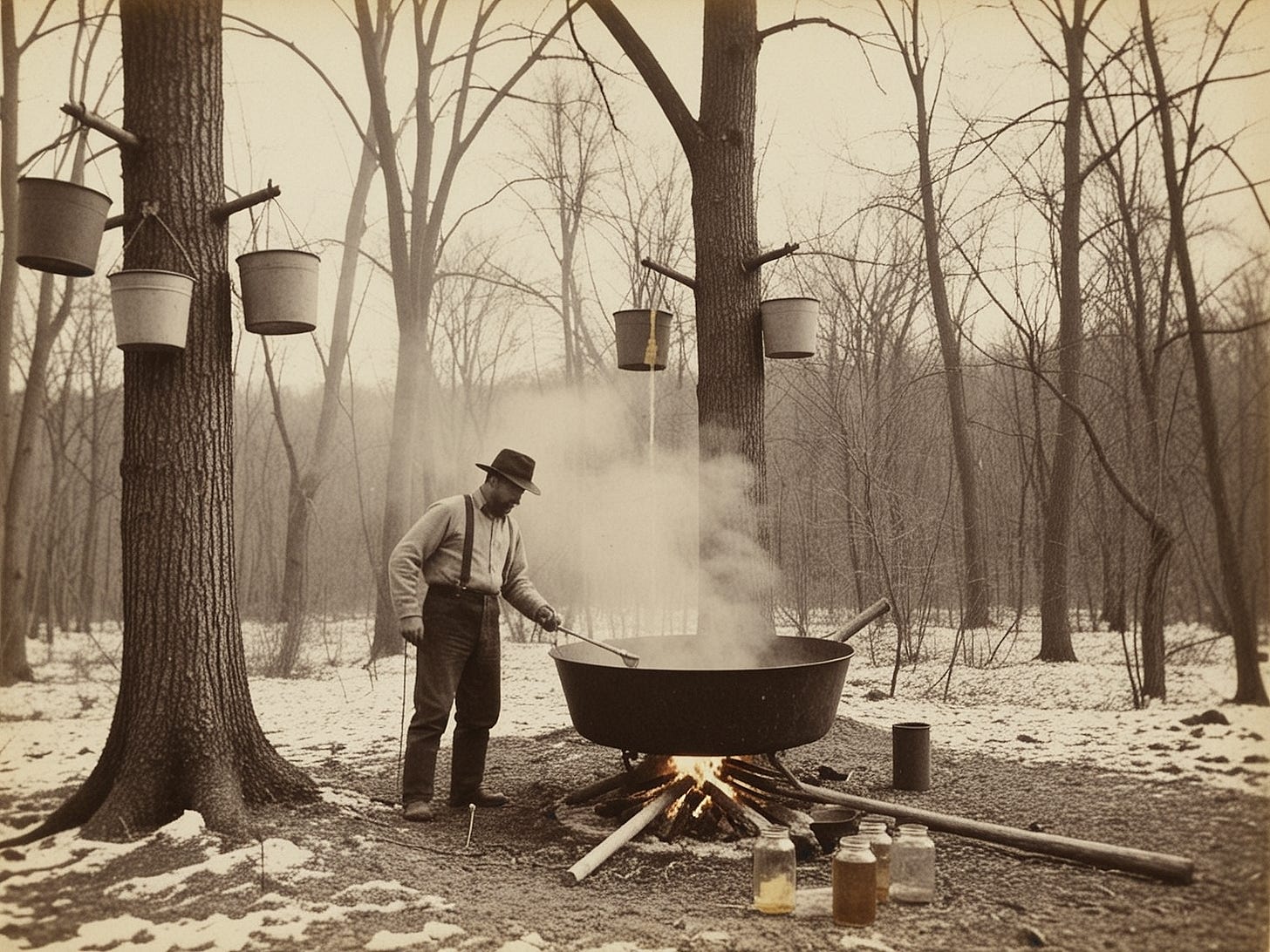
Sugar is modern addiction. White crystals filling pantries come from industrial processing—sugar cane crushed and boiled in distant refineries, beets chemically extracted in factories. Pioneers had no such infrastructure access. Their sweetness came from trees, specifically sugar maples, whose sap rises in early spring carrying last summer’s photosynthesis stored energy.
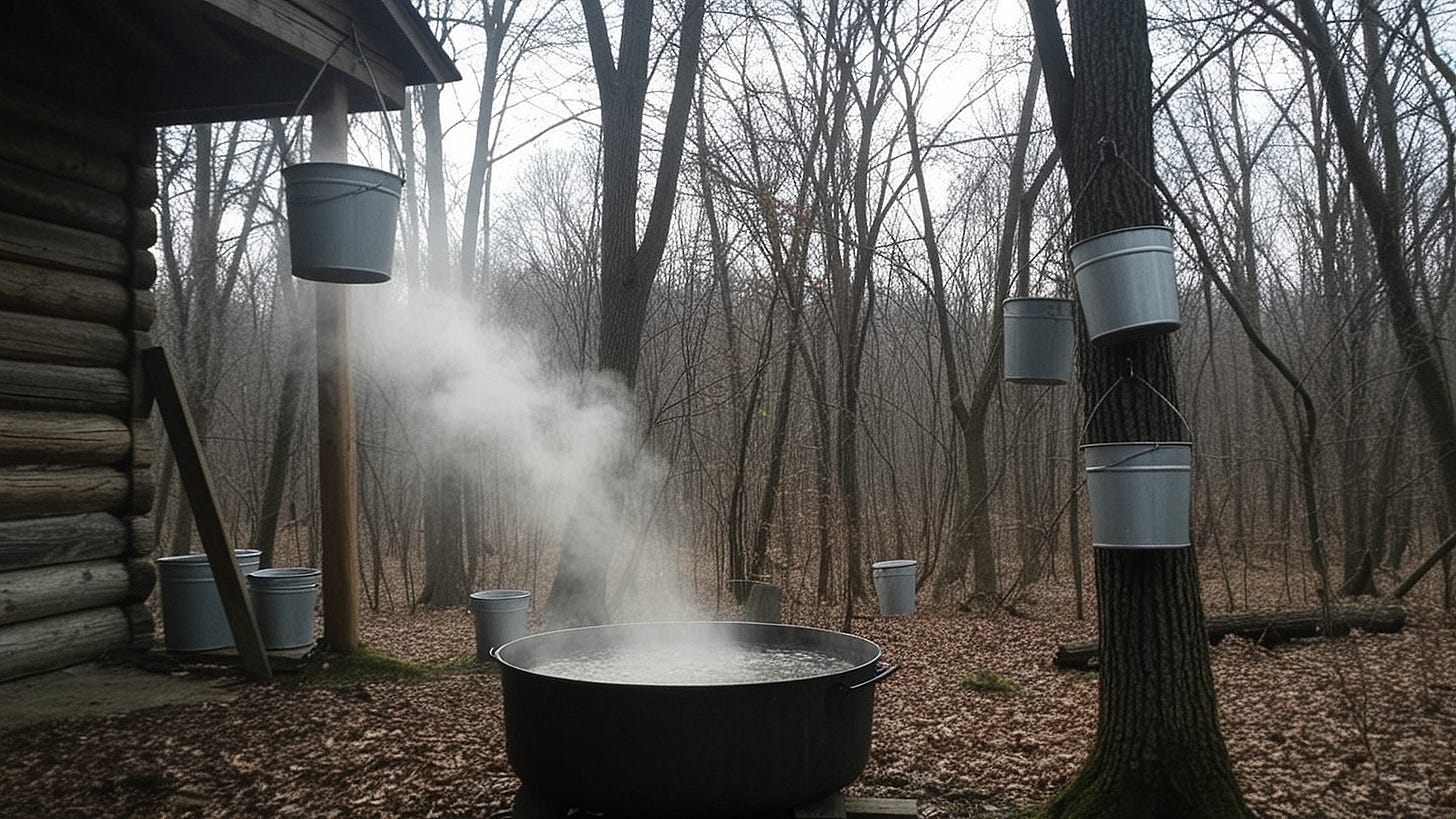
Tapping requires knowledge: identifying sugar maples by bark and bud, drilling holes at correct angles allowing gravity flow, inserting spiles—wooden or metal tubes—directing sap into buckets or troughs. Sap itself is barely sweet, watery liquid requiring forty-to-one boiling to produce syrup. This demands firewood, time, constant attention—full boiling days producing few precious quarts.
But results are unlike any other sweetener. Maple syrup carries forest essences—minerals from deep soil, particular northern hardwood chemistry, forty gallons of tree blood concentrated into one golden liquid. It keeps indefinitely, sealed in glass or ceramic, providing not just sweetness but nutrition—calcium, potassium, manganese, antioxidants.
Other trees can be tapped in extremity: birch for thinner, more acidic syrup, walnut for darker, more intense versions. Box elder, even certain conifers in desperate times. But maple remains gold standard, benchmark against which other wild sweeteners are measured.
In coming collapse, when processed sugar becomes unavailable or prohibitively expensive, those with maple trees and tapping knowledge possess currencies more valuable than gold. Sweetness is psychological necessity, markers of safety and abundance soothing human minds. Maple syrup provides this without industrial infrastructure producing white sugar.
Visuals become seasonal and specific: metal buckets hanging from tree trunks, steam rising from outdoor boiling pans, amber liquids tested for proper densities, poured hot into jars sealing as they cool. Tastes of endurance, of patience, of forests converted into comfort through fire and time.
14. Hive-Robbed Honey
Bees are livestock feeding themselves. Unlike cattle or hogs demanding daily attention and fodder, bees forage across miles of territory, converting nectar and pollen into honey through enzymatic alchemy. Pioneers quickly recognized their value, capturing wild swarms or purchasing hives to establish apiaries near settlements.
Honey is the only food that never spoils. Archaeologists found edible honey in Egyptian tombs three thousand years old. Low moisture content, acidic pH, natural antibiotic compounds create environments hostile to bacteria and mold. It can be stored in any container, in any conditions, indefinitely.
But harvesting is not without risk. Wild bees nest in tree hollows, rock crevices, underground cavities—locations demanding climbing, excavation, or destruction to access. Domesticated hives, kept in straw skeps or wooden boxes, require smoke to calm bees, careful handling to avoid crushing colonies, strength to lift heavy honey-filled combs.
Rewards are worth dangers. Honey provides immediate energy—simple sugars requiring no digestion. It treats wounds—antibiotic properties preventing infection. It ferments into mead—intoxicating drinks preserving water through alcohol’s antimicrobial effects. It substitutes for sugar in baking, though with different chemical properties demanding recipe adjustments.
In collapsed worlds, wild bees will persist, their hives hidden in forests and fields, waiting for those brave enough to find and rob them. Domesticated hives will require protection from thieves—both human and animal—making beekeeping skills combining animal husbandry with security consciousness.
Visuals become primeval: smoke rising from torches, hums of thousands of angry insects, bare hands pulling sticky combs from dark cavities, golden liquids dripping onto leather or wood, sharp sweetness cutting through smoke and fear. This is food fighting back, demanding respect, offering itself only to the bold.
15. Foraged Fungi
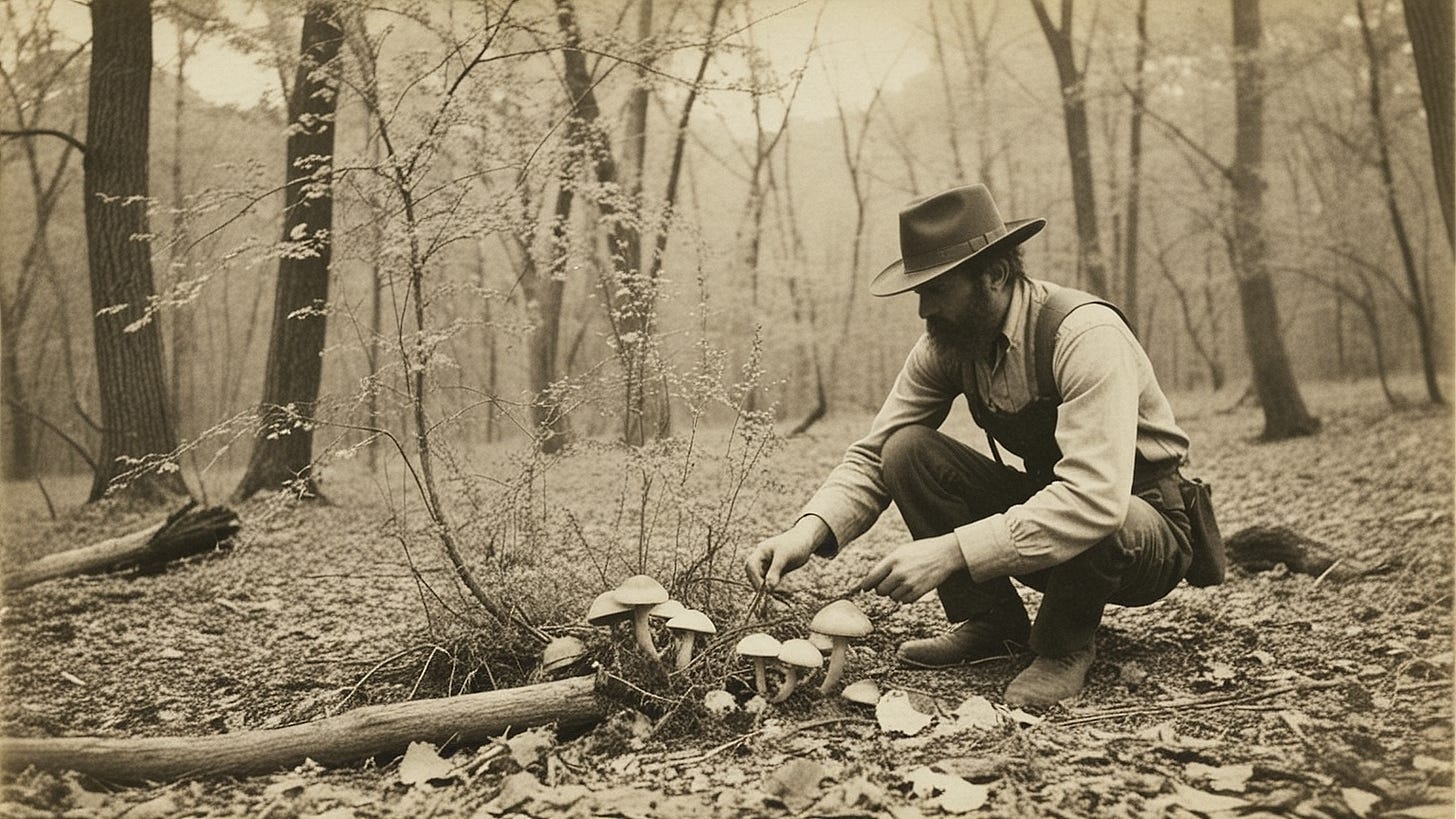
Mushrooms are survival cuisine’s wild cards. Some nourish. Some heal. Some kill with agonizing slowness. Pioneers learned navigating this spectrum through mentorship, trial, and error—knowledge passed through generations about which caps to harvest and which to avoid.
Morels, chanterelles, puffballs, chicken-of-the-woods, oyster mushrooms—these were safe bets, recognizable species appearing reliably in particular seasons and habitats. Morels followed spring fires and elm trees. Chanterelles fruited in summer oak forests. Puffballs grew in open meadows, white globes visible from yards away.
Edibility tests were rigorous: checking gills versus pores presence, examining spore prints, noting habitat and season, and always—always—cooking thoroughly, since even edible mushrooms cause gastric distress when eaten raw.
Drying extended seasons. Sliced thin and hung in sun or near hearths, mushrooms lost moisture and concentrated flavors, becoming rehydratable months later into soups and stews. Some—like porcini—improved with drying, developing nutty, intense flavors that fresh specimens never achieved.
In coming scarcity, when cultivated crops fail and stored provisions dwindle, foraged fungi bridge hunger gaps. They provide protein, minerals, that elusive umami flavor making food satisfying. But they demand expertise. Wrong identifications mean poisoning—sometimes immediate and violent, sometimes delayed and insidious, destroying livers or kidneys days after consumption.
Visuals become furtive and alert: eyes scanning forest floors, particular shapes catching attention, careful excavations with knives removing whole fruiting bodies, inspections for worms and rot, baskets slowly filling with strange shapes and colors. This is gambling with survival, where knowledge serves as only protection against catastrophe.
16. Hardtack and Ship’s Biscuit
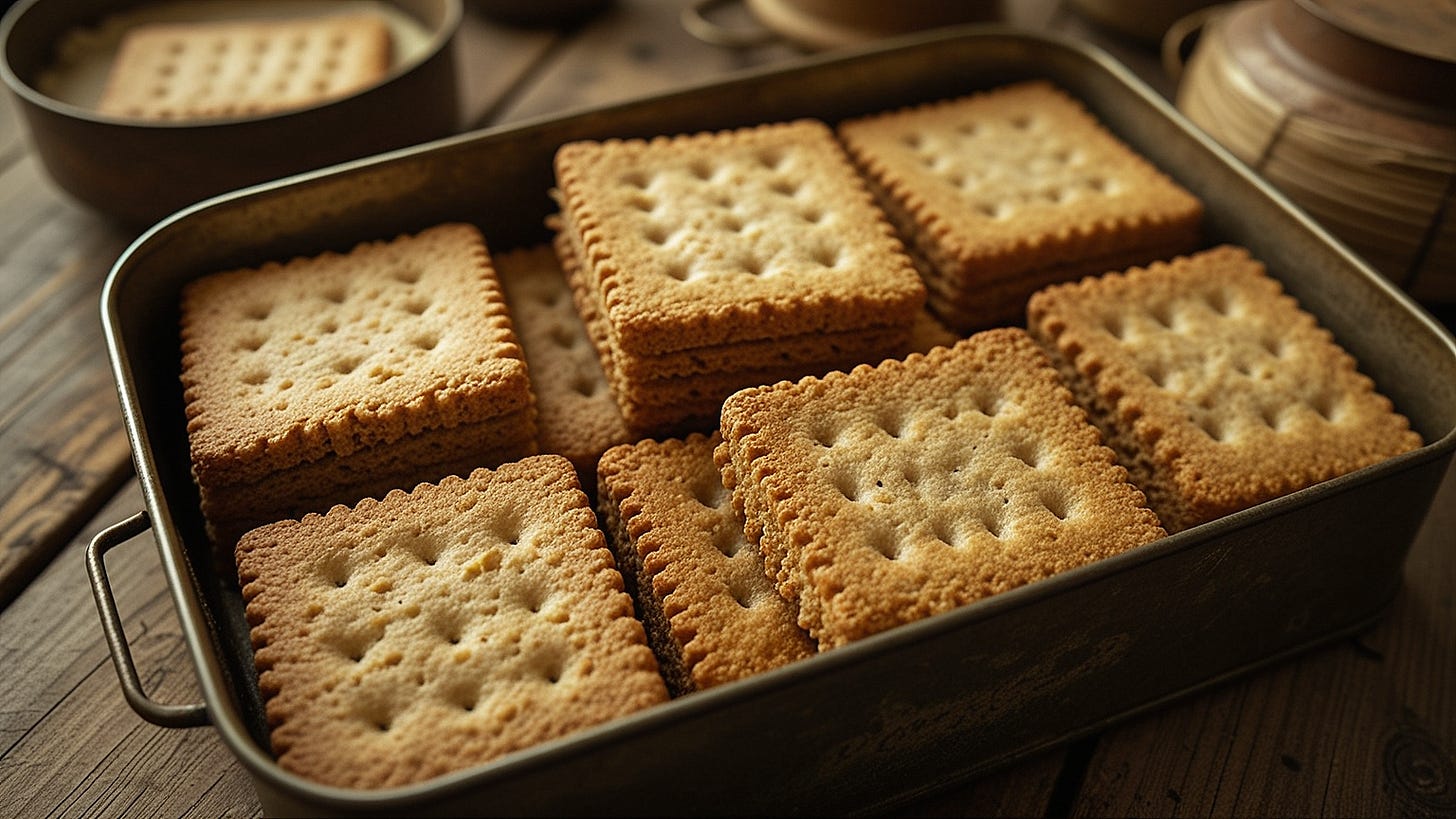
Bread without moisture is not bread. It is something else entirely—stone-like provisions defying decay through sheer hostility to life. Hardtack, also called pilot bread or ship’s biscuit, was the solution to long-term bread storage in eras before chemical preservatives and plastic packaging.
Recipes are brutally simple: flour, water, salt. Mixed into stiff dough, rolled flat, cut into squares, pierced with holes allowing moisture escape during baking, then dried in low heat until achieving seasoned oak textures. Properly made hardtack keeps for years, even decades, becoming slightly softer with age but remaining edible.
Eating it requires strategy. Biscuits are too hard for teeth alone—they must be soaked in liquids, whether water, coffee, soup, or fat, until softening enough to chew. Pioneers carried them in pockets and packs, breaking off pieces to dunk in whatever liquids were available, providing carbohydrates when fresh bread was impossible.
Soldiers called them “worm castles” or “sheet iron,” referencing both durability and weevils sometimes infesting stored supplies. But even weevils didn’t render them inedible—protein is protein, and hungry men ate around infestations or simply consumed extra nutrition.
In collapsed futures, when wheat must be stored against years of uncertainty and baking fresh bread daily becomes impossible, hardtack returns as traveler’s provisions, emergency rations, insurance against starvation that can be cached and forgotten until needed.
Visuals become monastic and severe: pale squares stacked in tin boxes, rattling like ceramic tiles, breaking sounds requiring tools or extreme force, transformations in liquids from weapons to food. Bread stripped of pleasure, reduced to pure utility, waiting to be resurrected by water.
17. Fermented Cabbage
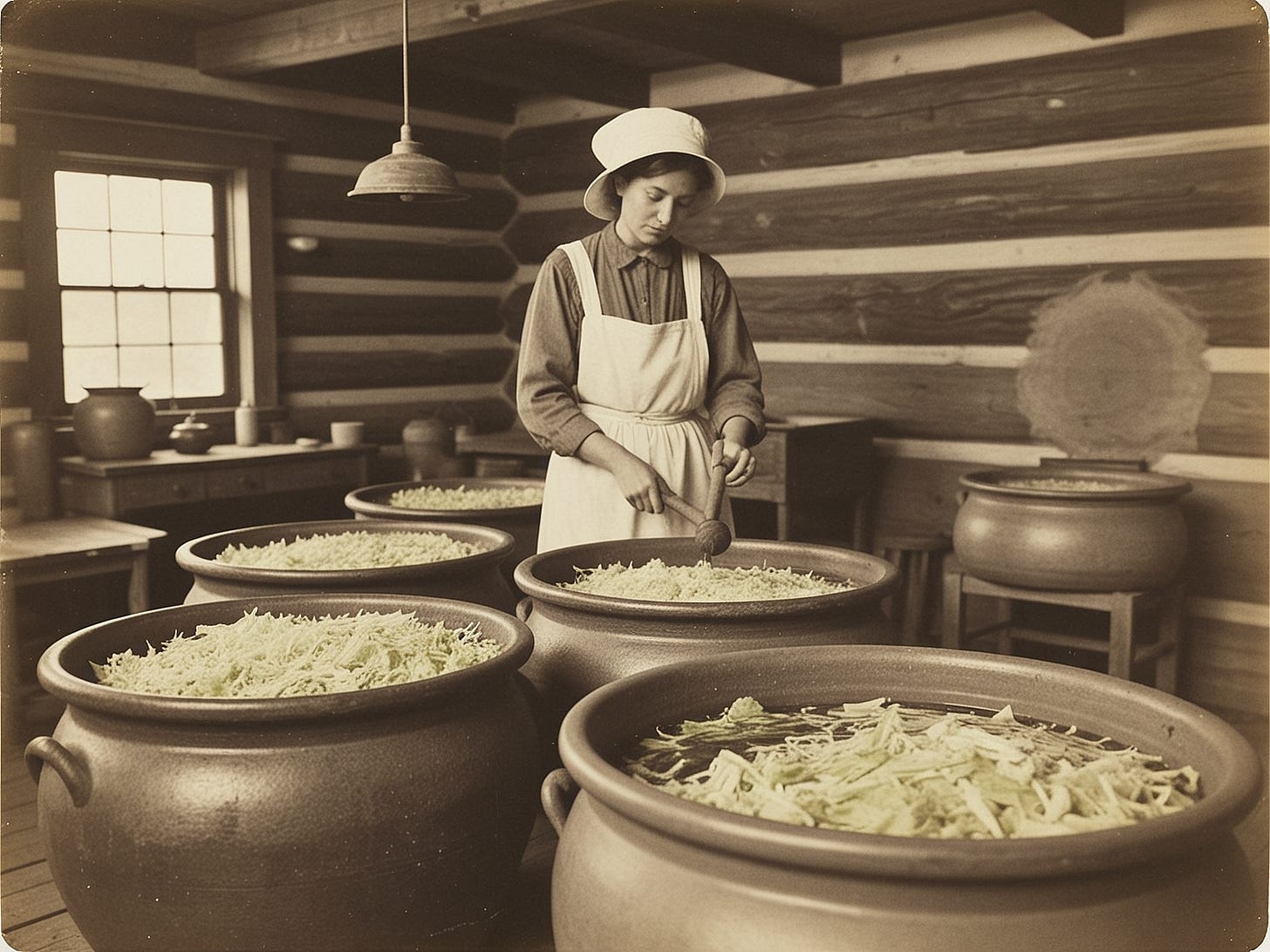
Preservation through life rather than death. Where drying kills microorganisms to prevent decay, fermentation cultivates specific bacteria outcompeting rot-causing species. Results are foods improving with age, developing complex flavors and probiotic benefits that fresh vegetables cannot provide.
Sauerkraut—fermented cabbage—became signature preservation methods of German and Eastern European immigrants bringing techniques to American frontiers. Processes are simple: shred cabbage, salt heavily, pack into crocks, wait. Natural lactobacillus bacteria on cabbage leaves consume sugars, producing lactic acid pickling vegetables and creating environments hostile to spoilage organisms.
Fermentation takes weeks or months, depending on temperature. Results are tangy, crunchy, long-lasting, and vitamin-rich—particularly vitamin C, preventing scurvy during winter months when fresh produce is unavailable. Captain Cook carried sauerkraut on voyages specifically for this purpose, recognizing its ability to maintain crew health during long passages.
Other vegetables can be fermented similarly: cucumbers into pickles, beets into kvass, carrots and turnips into various relishes. Each culture develops its own variations—kimchi in Korean tradition, cortido in Central America, curtido in the Balkans.
In worlds without refrigeration, without vinegar for pickling, without canning equipment, fermentation becomes primary methods for preserving vegetables beyond fresh seasons. It requires only salt, containers, and time—resources available even in scarcity.
Visuals become biological and active: crocks bubbling with gas, sour lactic acid smells, scum that must be skimmed, transformations of crisp vegetables into something else entirely—alive, complex, preserving not just materials but cultures that created them.
18. Nut-Meal and Acorn Flour
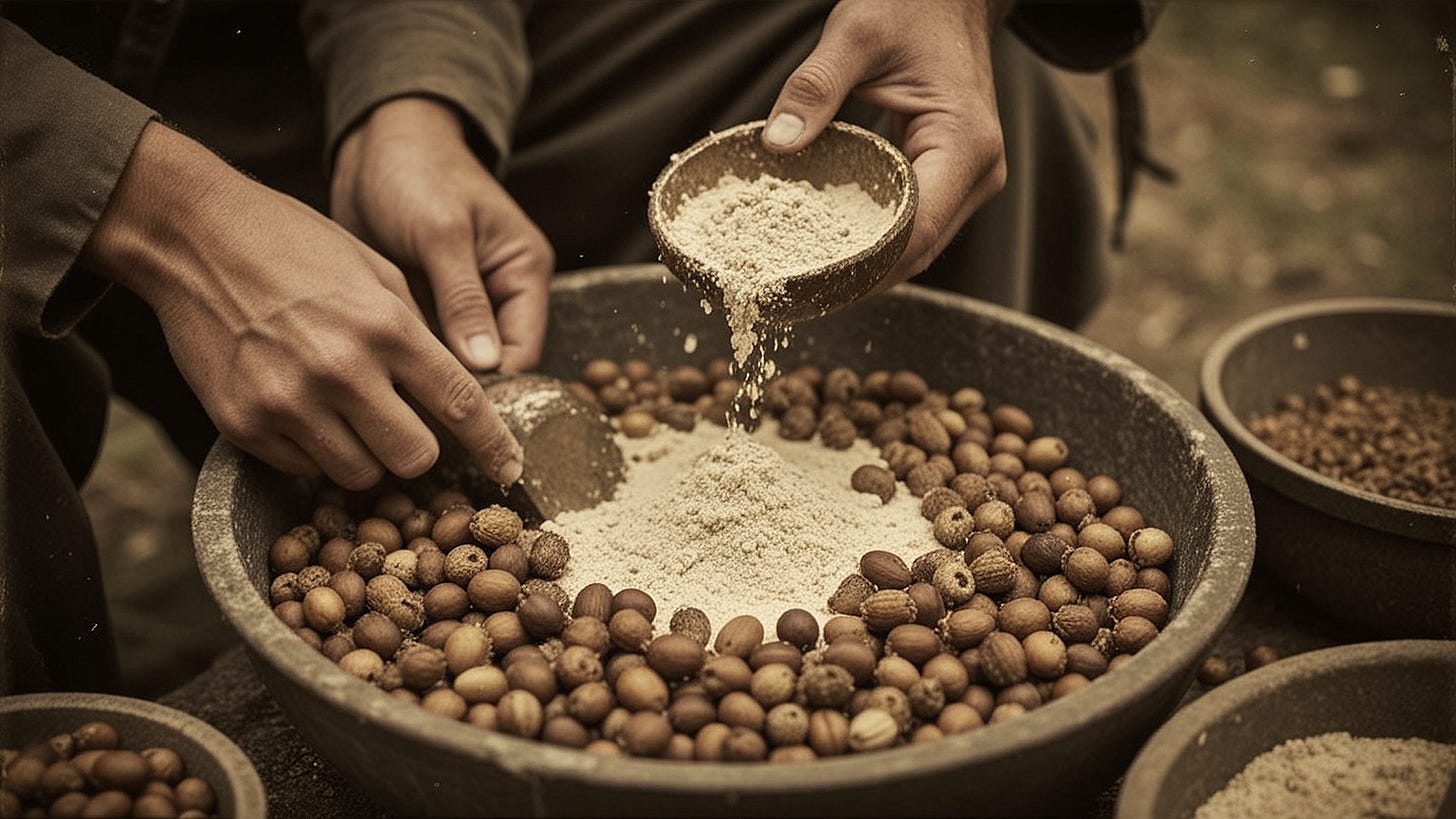
Oak trees produce abundance without cultivation. Single mature oaks can drop thousands of acorns in good years—more calories per acre than wheat, requiring no planting, no irrigation, no fertilizer. Indigenous peoples knew this intimately, developing complex processing methods converting bitter, tannic acorns into edible flour.
Processes are laborious. Acorns must be gathered, shelled, nutmeats ground or pounded, then leached repeatedly with water removing tannins—compounds tasting bitter and causing digestive distress. Resulting meals can be dried into flour, cooked into porridge, or baked into bread sustaining entire communities through winter.
Other nuts provided similar resources: hickory nuts, walnuts, butternuts, pecans in southern regions, chestnuts in eastern forests. Each required different processing—hickory nuts could be boiled extracting their oils, leaving meal as byproducts. Walnuts needed curing to develop flavors and reduce bitterness.
Nutritional profiles are exceptional—high in fat, protein, and carbohydrates, providing complete sustenance in compact forms. Nut trees can be planted, wild stands managed, or simply foraged from existing forests, making them renewable resources improving with age as trees mature.
In coming collapse, when annual crops fail or cannot be protected, nut trees provide backstops against starvation. They require no annual labor, no defense against raiders beyond their height, no storage technology beyond drying and pest protection. Communities with oak or hickory forest access possess food sources predating agriculture and outlasting it.
Visuals become ancient and industrious: baskets of gathered nuts, stones for pounding, water running through fiber bags carrying away tannins, pale meals drying in sun, heavy bread tasting of forests and work and patience.
19. Sprouted Seeds
When stored grains become monotonous, when fresh vegetables are months away, when vitamin deficiencies threaten with bleeding gums and night blindness, sprouts offer salvation. Any seed—grain, legume, or vegetable—carries nutrients necessary to construct plants. Soaking and sprouting unlocks this nutrition, converting stored starches into sugars and producing vitamins that dry seeds lacked.
Pioneers knew this intuitively, though lacking biochemical vocabulary. They sprouted wheat berries in jars producing sweet, grassy shoots eaten fresh or added to stews. They sprouted mung beans, lentils, peas—any seeds responding to water and warmth by breaking dormancy.
Processes require minimal infrastructure: jars or cloth bags, water, and darkness followed by light. Seeds are soaked overnight, then rinsed twice daily, kept moist but not wet, protected from mold through ventilation. In three to seven days, depending on species, sprouts emerge—pale, crisp, alive with enzymes and vitamins.
Sprouts bridge gaps between stored provisions and fresh food. They provide vitamin C preventing scurvy, enzymes aiding digestion, and psychological benefits of green, growing things when outside worlds are brown and dormant. They can be grown indoors, in any season, requiring only stored seeds and basic hygiene.
In collapsed futures, when diet varieties have collapsed to stored grains and preserved meats, sprouts become only fresh food sources during winter months. They require no soil, no sunlight beyond minimal greening, no transportation or preservation. They are instant agriculture, available to anyone with seeds and water.
Visuals become hopeful and delicate: jars lined on windowsills, white roots tangling in darkness, first pale greens of chlorophyll emerging, crisp snaps between teeth reminding eaters what freshness tastes like. Life persisting in death’s face, seeds’ stubborn refusals to remain merely stored.
20. Pemmican: The Ultimate Trail Food
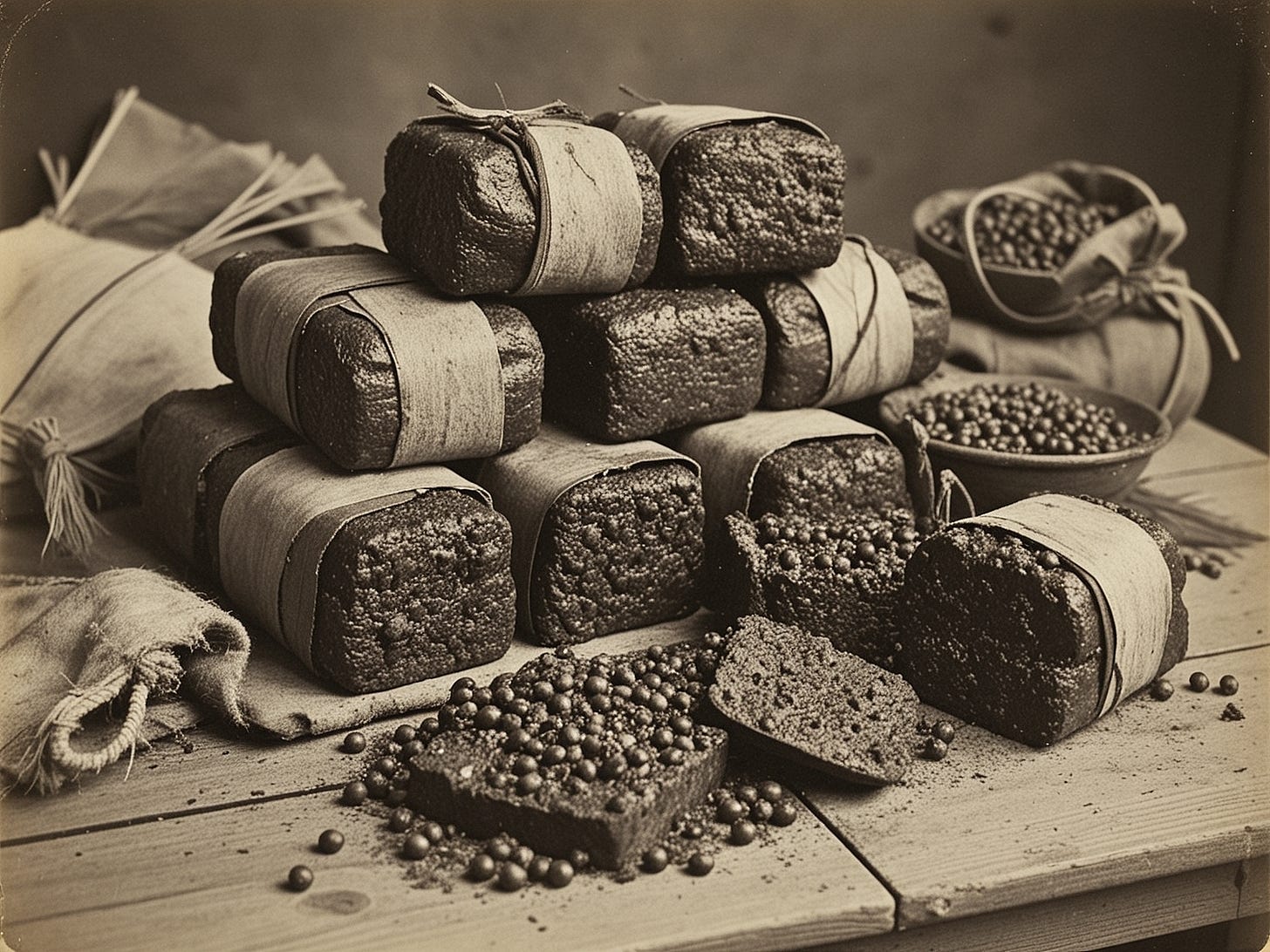
If survival had flagship foods, pemmican would be them. Invented by indigenous North American peoples, adopted by fur traders, explorers, and pioneers, this concentrated provision contains everything human bodies need in forms keeping indefinitely and traveling lightly.
Recipes vary by region and availability, but basics remain constant: dried lean meat, rendered fat, and dried berries. Meat—usually bison, elk, or deer—is dried until brittle, then pounded into powder. Fat is rendered removing water and impurities. Berries—chokecherries, cranberries, blueberries, saskatoons—are dried and crushed. These three ingredients combine in ratios balancing protein, fat, and carbohydrates, then packed into rawhide bags or containers.
Results are dense, calorie-rich foods requiring no cooking, no preparation, no water. Handfuls of pemmican provide enough energy for hard labor days. They keep for years without refrigeration, protected by rendered fat’s antimicrobial properties and other ingredients’ low moisture contents. They can be eaten as is, boiled into soup, or fried into hashes.
Pemmican represents food preservation technology’s pinnacle before industrialization. It converts perishable fresh foods into permanent, portable provisions. It sustained fur trades, enabled Arctic explorations, and kept pioneers alive during hardest winters. No other foods offer such complete nutrition in such compact, durable forms.
In coming collapse, when movement becomes necessary—fleeing disasters, seeking resources, migrating to better climates—pemmican becomes food enabling travel. It is original energy bars, prototypes for all concentrated nutrition, proofs that humans can solve sustenance problems through ingenuity and labor.
Visuals become stark and efficient: greasy, dark bricks wrapped in cloth or leather, fat sheens catching light, knowledge that within unappetizing masses lies everything needed to keep walking, keep working, keep living when nothing else is available. Food reduced to essence: fuel for survival machines.
The Weight of Provisions
These twenty items aren’t nostalgia. They aren’t romanticized simpler-time memories. They’re technologies—tested, refined, proven through generations of use when failure meant death. Each represents solutions to specific problems: storing calories without refrigeration, preserving protein without canning, maintaining health without pharmaceutical supplements, surviving when infrastructure evaporates.
Pioneers carrying these foods westward weren’t seeking simplicity. They sought survival, finding it in methods seeming primitive only because they’re visible—because we can see work, time, knowledge embedded in each dried bean, each smoked strip, each fermented crock. Modern food hides complexity behind industrial processes and global supply chains, making us dependent on systems we cannot see or understand.
When those systems fail—and consensus among fragility students is that they will, perhaps sooner than imagined—these ancient methods return not as choices but as necessities. Knowledge of rendering fat, drying meat, storing tubers, tapping trees—these become survival skills as critical as any others.
Questions aren’t whether we’ll need this knowledge. Questions are whether we’ll remember it in time, whether skills passed through generations were preserved or lost, whether we can relearn what ancestors knew by heart before shelves bleed empty and seventy-two hours expire.
Food is waiting. Knowledge is waiting. Only variables are time.
Anyone can join.
Anyone can contribute.
Anyone can become informed about their world.
"United We Stand" Click Here To Create Your Personal Citizen Journalist Account Today, Be Sure To Invite Your Friends.
Before It’s News® is a community of individuals who report on what’s going on around them, from all around the world. Anyone can join. Anyone can contribute. Anyone can become informed about their world. "United We Stand" Click Here To Create Your Personal Citizen Journalist Account Today, Be Sure To Invite Your Friends.
LION'S MANE PRODUCT
Try Our Lion’s Mane WHOLE MIND Nootropic Blend 60 Capsules
Mushrooms are having a moment. One fabulous fungus in particular, lion’s mane, may help improve memory, depression and anxiety symptoms. They are also an excellent source of nutrients that show promise as a therapy for dementia, and other neurodegenerative diseases. If you’re living with anxiety or depression, you may be curious about all the therapy options out there — including the natural ones.Our Lion’s Mane WHOLE MIND Nootropic Blend has been formulated to utilize the potency of Lion’s mane but also include the benefits of four other Highly Beneficial Mushrooms. Synergistically, they work together to Build your health through improving cognitive function and immunity regardless of your age. Our Nootropic not only improves your Cognitive Function and Activates your Immune System, but it benefits growth of Essential Gut Flora, further enhancing your Vitality.

Our Formula includes: Lion’s Mane Mushrooms which Increase Brain Power through nerve growth, lessen anxiety, reduce depression, and improve concentration. Its an excellent adaptogen, promotes sleep and improves immunity. Shiitake Mushrooms which Fight cancer cells and infectious disease, boost the immune system, promotes brain function, and serves as a source of B vitamins. Maitake Mushrooms which regulate blood sugar levels of diabetics, reduce hypertension and boosts the immune system. Reishi Mushrooms which Fight inflammation, liver disease, fatigue, tumor growth and cancer. They Improve skin disorders and soothes digestive problems, stomach ulcers and leaky gut syndrome. Chaga Mushrooms which have anti-aging effects, boost immune function, improve stamina and athletic performance, even act as a natural aphrodisiac, fighting diabetes and improving liver function. Try Our Lion’s Mane WHOLE MIND Nootropic Blend 60 Capsules Today. Be 100% Satisfied or Receive a Full Money Back Guarantee. Order Yours Today by Following This Link.



| Visits: | 1,834,981,055 |
| Stories: | 8,720,907 |
Whistler Blowers, Insiders


I wouldn’t touch the non-kosher food but the rest look good.