

The Israeli Blueprint That Put an Italian Mail Server on America’s Terror List

Freddie Ponton
21st Century Wire
How a sixteen-year-old Israeli doctrine of network disruption ended up removing an Italian server collective from the internet.
For twenty-five years, a few dozen volunteers in Italy have run free email accounts, virtual private networks and Noblogs, a platform for activists who would rather not entrust their politics to Google or Meta. On 26 August 2026, the United States Treasury designated their collective, Autistici/Inventati, a Specially Designated Global Terrorist, placing a volunteer-run mail service in the legal company of al-Qaeda and Islamic State.
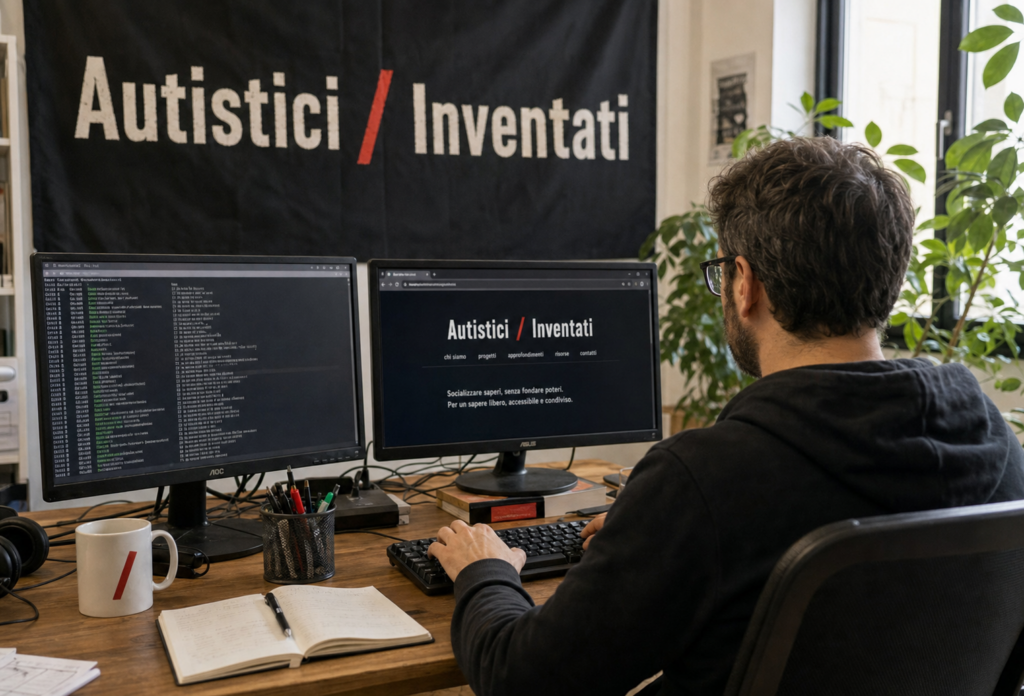
IMAGE: Autistici/Inventati kept thousands of activists online. Washington treated that infrastructure as terrorism. (Source: AI-generated illustration)
Nobody was charged, and no court was asked to examine the evidence, yet under Executive Order 13224, Washington was able to freeze the collective’s assets after deciding that it had provided “material or technological support” to an act of terrorism. By the State Department’s own count, Autistici/Inventati, also known as A/I, supported 16,000 mailboxes, 1,500 websites and 10,000 blogs. Within forty-eight hours, autistici.org went dark, PayPal cut it off, and its Italian bank moved to close the account, placing that entire network at risk. Everyone else has until 25 September to sever ties or risk the reach of American sanctions, even though the government, as Reason noted, “hasn’t accused Autistici/Inventati of committing any crimes.”
Treasury based the designation on services A/I allegedly provided to the Kurdistan Workers’ Party, or PKK, a Kurdish armed group that has fought the Turkish state since 1984 and is proscribed by the United States, Britain and the European Union. It is a useful name for Washington because no ally will defend it, yet it explains neither why A/I was sanctioned alongside two Palestinian organisations nor why the State Department’s case reaches far beyond the PKK into the politics of antifa, Israel and Palestine. The legal basis is in the filing, but the political logic is somewhere else.
That logic can be traced to a framework drawn up in Tel Aviv in 2010 to defend Israel against international criticism, then carried into American counterterrorism policy through doctrine, vocabulary and personnel. No cable places Israel inside the A/I decision because, by the time Washington chose its target, no instruction was required. The blueprint had already crossed the Atlantic.
The blueprint
In early 2010, the Reut Institute, founded by former Israeli government adviser Gidi Grinstein, published The Delegitimization Challenge, Creating a Political Firewall a report placing Iran, Hezbollah and Hamas in what it called a “Resistance Network,” while casting Western activists “catalysed by the radical left” as a parallel “Delegitimization Network.” Islamists and left-wing critics of Israel now belonged to the same threat picture, sixteen years before that idea entered American counterterrorism policy.
Reut urged Israel to target what it called “global hubs of delegitimization” in London, Toronto, Madrid and the Bay Area. Its strategy was to “sabotage network catalysts” and separate ordinary critics of Israeli policy from activists it labelled “delegitimizers of its existence.” In a London case study published that November, Reut gave this supposed alliance between Islamists and the radical left the name Washington would later adopt. It called it the “Red-Green Alliance.”

IMAGE: Reut Institute founder Gidi Grinstein addresses Israel’s Institute for National Security Studies. His institute urged Israel to identify and disrupt the “network catalysts” behind international criticism. (Source: Israel’s Institute for National Security Studies/INSS via Tauvod)
After The Electronic Intifada reported on the document in February 2010, Reut revised the version on its website and removed the words “sabotage” and “attack”. The original survives in the Internet Archive and in the PDF preserved by the publication. Reut softened the language without abandoning the strategy, which still treated political criticism as a networked threat and sought the people and institutions that allowed it to spread.
In a June 2010 inquiry into the Gaza flotilla, Reut explained what it meant by a “catalyst.” It was not necessarily someone who committed violence, but an organisation that helped a political network communicate and grow. Catalysts collected and distributed information, connected existing groups, recruited new ones and protected the wider network. Reut described them as “collecting information, turning it into relevant knowledge, and disseminating it” while “mapping existing nodes,” “strengthening and connecting them” and “protecting, branding and publicising the network.”
That definition points directly towards a provider such as A/I. Its email accounts, blogs and privacy tools allow political groups to publish, organise, connect and protect their communications, which are the same functions Reut assigned to a catalyst. A/I therefore does not sit at the edge of the doctrine because somebody may have misused its services. Its role as communications infrastructure places it at the centre of what the doctrine was designed to disrupt. Reut had already treated “the use of human rights discourse” against alleged Israeli war crimes and Holocaust denial as parts of the same delegitimization campaign. The firewall was aimed not only at political arguments, but at the systems that allowed them to travel.
DOCUMENT: The Reut Institute’s 2010 executive summary before it was revised. Clause 16 instructs Israel to “sabotage network catalysts” in “global hubs of delegitimization,” including London, Toronto, Madrid and the Bay Area. Reut later removed the words “sabotage” and “attack” from the version on its website. (Source: Reut Institute, The Delegitimization Challenge, Creating a Political Firewall, 31 March 2010)reut-institute Original Document
The migration
In 2021, Reut published The Red-Green Alliance is Coming to America, a report on what it called the “Islamo-Leftist Coalition” and its impact on US foreign policy, American Jews and Israel’s national security. A revised framework the following year urged pro-Israel organisations to mobilise against an alliance of radical progressives and Islamists. This time, Reut was no longer describing a threat to Israel from abroad, but proposing a political response inside the United States.

IMAGE: Reut Institute image for “The Red-Green Alliance Is Coming to America”, the 2021 report that recast pro-Palestinian activism as an “Islamo-Leftist” threat to the United States. (Source: Reut Group)
By May 2026, the “Red-Green alliance” had moved from Reut’s reports into official US counterterrorism policy. The White House National Counterterrorism Strategy listed “New and deepening alliances between the far-left and Islamists” among five defining features of the threat environment. The Charity & Security Network, which monitors the impact of counterterrorism law on non-profits, traced the phrase to Israeli think tanks, where it described a partnership seeking “the destruction of the Jewish state.” A framework developed to protect Israel from political criticism was now shaping what Washington recognised as a terrorist threat.
Eight months earlier, NSPM-7 had already given Washington the powers to investigate and disrupt political networks. It identified “anti-Americanism, anti-capitalism, and anti-Christianity,” along with views on migration, race and gender, as signs of political extremism, but said nothing about Israel, Palestine or Islamism. The addition of the Red-Green alliance widened both the threat Washington claimed to face and the range of people and organisations it could investigate, sanction and cut off from financial and digital services. It also gave the officials and analysts promoting the doctrine a new field of targets to map
Who Carried the Doctrine
In September 2025, Kyle Shideler, the Center for Security Policy’s director and senior analyst for homeland security and counterterrorism, urged the government to “recognize a category of far-left violent extremism” broad enough to hold “all of your anarchists, autonomous Marxists, your Marxist Leninists, your Maoists.” It should then “conduct a number of designations against Antifa-linked groups primarily in Europe”, trace their connections back across the Atlantic and move on American organisations—a sequence he considered “faster and more effective” than starting at home. Europe was the way in.
A month later, Shideler told the Senate Judiciary Committee that Abolition Media was “just one of hundreds of such websites hosted on Noblogs, a blogging suite provided by the Italy-based Autistici/Inventati (A/I) Collective.” So far as the public record shows, this was A/I’s entry into the American security conversation. The following month, the State Department designated four European groups in Germany, Italy and Greece. Nine months later, State and Treasury sanctioned the very infrastructure Shideler had named.
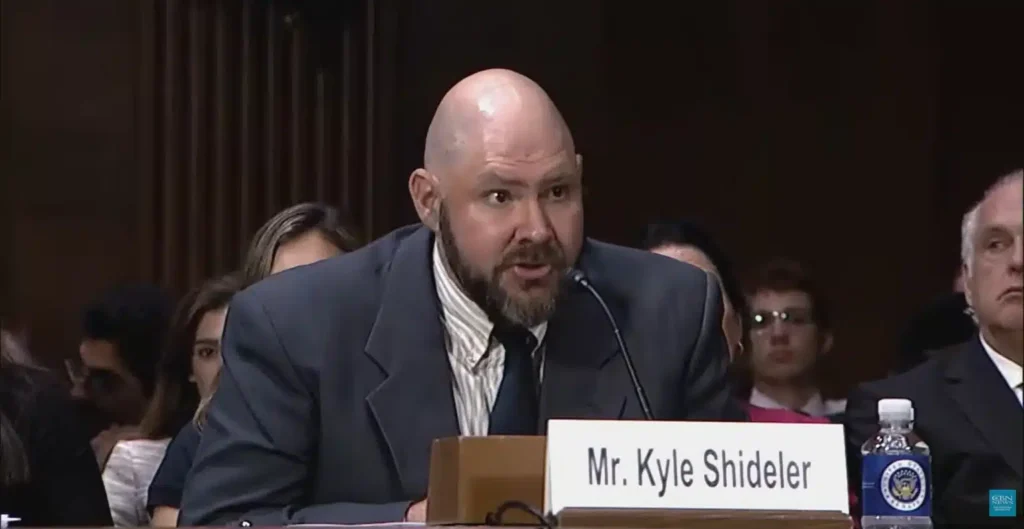
IMAGE: Kyle Shideler testifies before the Senate Judiciary Committee in October 2025, when he identified Autistici/Inventati as the host of Abolition Media.(Source: CombatAntisemitism.org)
Shideler described the “Red-Green alliance” as “the far Left and Islamists, who power the anti-Israel movement.” On 5 August 2026, three weeks before A/I was sanctioned, he appeared before another Senate hearing, this time on the Muslim Brotherhood’s American network, beside counsel from the National Jewish Advocacy Center. The framework collapsed antifa, the Muslim Brotherhood and Palestine solidarity into a single threat, with opposition to Israel serving as the connective tissue. It also turned political solidarity with Palestine into evidence for a terrorism case and the infrastructure supporting it into a target.
The bureau that presented the case against A/I was led by an official whose career had centred on Israel and the Middle East. Ambassador Gregory LoGerfo took charge of the State Department’s Counterterrorism Bureau on 20 May 2026 after serving as Principal Deputy Coordinator in the Bureau of Near Eastern Affairs. His earlier positions included the department’s Office of Israel and Palestinian Affairs and the National Security Council directorship for Israel, Palestinian and Jordanian Affairs. The Senate confirmed him 46–43. Three months later, the bureau he led presented an Italian privacy collective as part of a transnational far-left terrorist network. Shideler had supplied the route, the name and the doctrine.
Shideler supplied the sequence, identified A/I and furnished the framework that placed it within a wider threat. The connection between far-left terrorism and opposition to Israel would not remain implicit for long, as an Israeli minister was about to make it explicit.
The template, stated aloud
Representatives of 66 countries gathered in Washington on 16 July 2026 for a ministerial meeting on what the State Department called the “resurgence of political terrorism.” Marco Rubio called the radical left an “enemy of civilization.” Stephen Miller promised to “disrupt, identify, defund, debank, arrest, and prosecute” its networks. Meanwhile, Treasury Secretary Scott Bessent pledged to follow their money into the nonprofits and charities accused of sustaining them. Several European diplomats remained unconvinced. “We don’t have antifa,” one told reporters. Yet, it was Israel, the only Middle Eastern country in the room, who told Washington where to look.
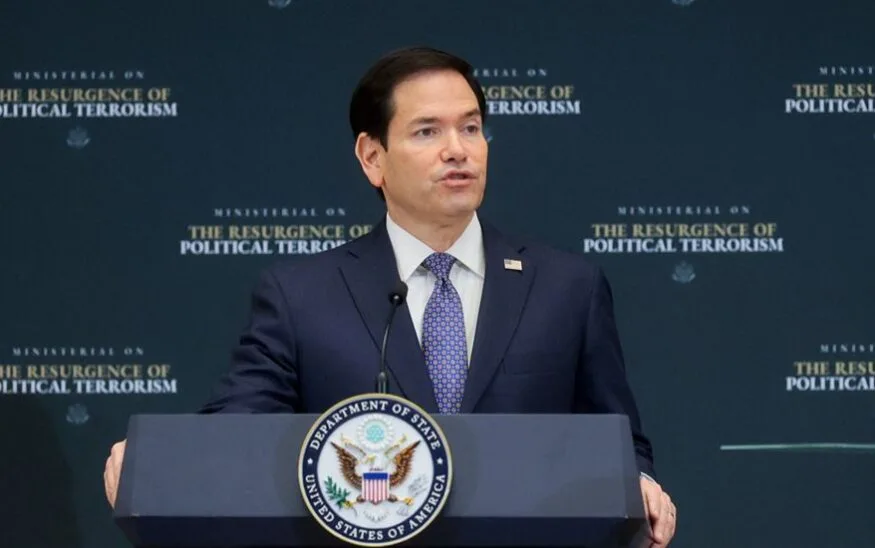
IMAGE: US Secretary of State Marco Rubio opens the July 2026 ministerial on the “resurgence of political terrorism” in Washington. (Source: by Jonathan Ernst/Reuters via The Journal Record)
Foreign Minister Gideon Sa’ar described “an operational alliance” between terrorist groups and “radical leftist elements in Western democracies,” with Israel “on the front line of this fight.” The alliance was not confined to those who planned attacks or committed violence. “Networks of activists supply the logistical envelope,” Sa’ar said. “Hamas provides the strategy. The activists provide legitimacy.” Governments should “expose these networks,” “follow the money” and hold those providing operational support accountable. Under his formulation, legitimacy itself became a form of assistance, and the infrastructure carrying it became part of the network.
Six weeks later, Treasury’s language echoed Sa’ar’s and A/I was sanctioned for having “provided financial, material, or technological support for … an act of terrorism.” The collective was not accused of planning the act, committing it or even endorsing it. Its offence was to provide digital services used by others. That was enough. Sa’ar’s “logistical envelope” had become Treasury’s “technological support,” collapsing the distance between providing infrastructure and participating in terrorism in August.
Israeli military documents seized in Gaza were said to show that Hamas controlled aid-flotilla vessels through a Spanish company and identified London activist Zaher Birawi as the head of its European wing. Treasury had sanctioned Birawi six months before the ministerial. The documents drew a line from Hamas to a European activist, from the activist to an organisation, and from the organisation to the infrastructure that sustained it. Applied to A/I, the same method required no allegation that the collective had committed terrorism. Hosting those placed inside the network was enough.
What the Package Contained
Palestine Action, Masar Badil, two of its officials and A/I appeared together in the sanctions package issued on 26 August. Palestine Action was sanctioned over attacks on Elbit Systems sites, placing it inside the conflict over Israel’s arms industry. Masar Badil was accused of acting for Samidoun, which Treasury had designated as a fundraising front for the Popular Front for the Liberation of Palestine. The government’s public case linked neither organisation to antifa, yet both were announced as “violent far-left terrorist groups”. Israel’s Foreign Ministry welcomed the sanctions that same day. Washington had presented the package as an action against “violent far-left terrorism,” but four of its five targets were drawn from Israel’s political struggle over Palestine.
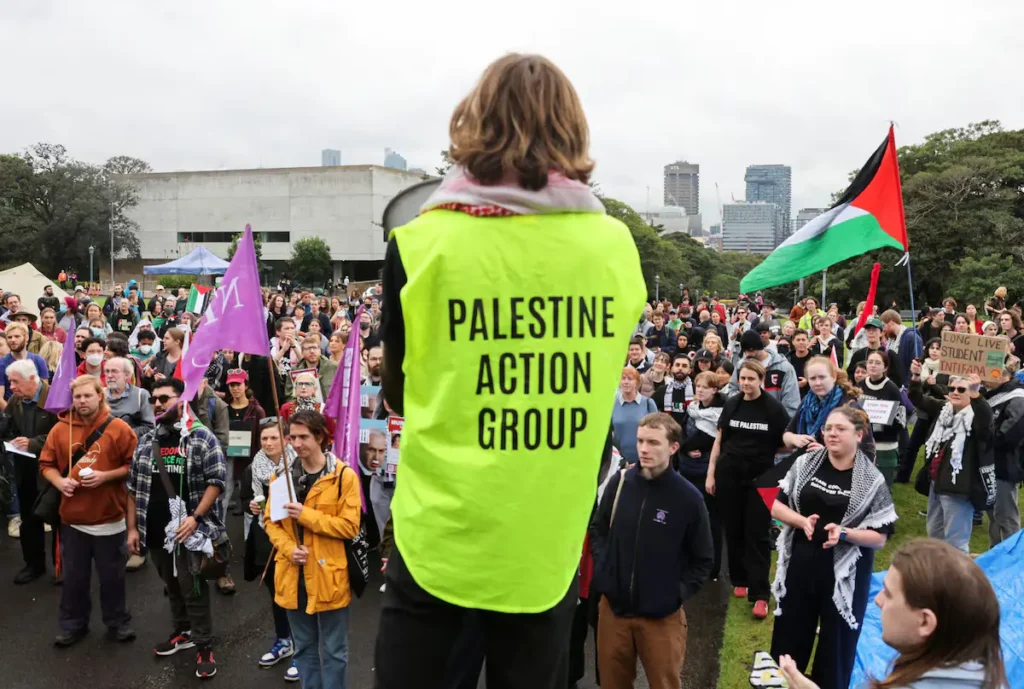
IMAGE: Palestine Action supporters protest in London before Washington included the group in an August 2026 sanctions package targeting “violent far-left terrorism.” (Source: Reuters)
The fifth was an Italian provider of email, blogs and privacy tools. The State Department’s fact sheet said a “far-left extremist media group” used A/I’s services to publish “official communiqués and calls to action” from Hamas, Hezbollah, Iran’s Revolutionary Guard Corps, the PFLP and Palestinian Islamic Jihad. The Jerusalem Post identified the outlet as Abolition Media, which it said published PFLP communiqués “almost daily.” Statements written by armed groups were republished by one outlet through services maintained by another, yet Washington followed the chain back to the provider and treated the distance between them as evidence of a network.
The violence cited against A/I came from Casey Goonan, a California activist sentenced to more than nineteen years in federal prison for arsons and firebombings at UC Berkeley and the attempted firebombing of the Oakland federal building. A communiqué claiming responsibility for one of the attacks appeared on Abolition Media and declared “solidarity with the resistance axis for Palestinian life.” The State Department placed Goonan’s prosecution in the same passage as the armed-group communiqués, although it did not accuse A/I of knowing him, approving his attacks or selecting the statement for publication. What is well established is that Goonan committed the violence, Abolition Media published the claim, and A/I maintained the servers. Nevertheless, Washington has no issue assembling those separate acts into one chain and imposing the consequences on the infrastructure beneath them.
Punishment Without Prosecution
German media regulators ordered internet providers to block access to samidoun.net in January 2026. By then, the Palestinian prisoner-solidarity network had been banned in Germany, listed by Canada as a terrorist entity and sanctioned by Washington as a fundraising front for the Popular Front for the Liberation of Palestine. The block made a criminal prosecution unnecessary by placing the burden on the companies that carried the website. Reut had described the same route sixteen years earlier when it instructed that network catalysts be “identified, studied, and to the extent possible, undermined by legal, media, political, and diplomatic means.”
After Washington designated Zaher Birawi that same month, UK Lawyers for Israel wrote to LinkedIn, Facebook and Instagram, invoked American sanctions law and secured the removal of his accounts from all three platforms. Birawi has never been charged and says he was given no opportunity to answer the allegations. He sought removal from the sanctions list after the designation had already travelled through a pro-Israel campaign group to three American companies and excluded him from the platforms where his public life took place.
The United States sanctioned Francesca Albanese, the UN special rapporteur on the occupied Palestinian territories, after she published a report on the “genocide economy,” identifying corporations she said were profiting from Israel’s occupation and war in Gaza. The restrictions left her unable to use a credit card, obtain health insurance or open a bank account. Banca Etica in Italy refused her application because it feared secondary sanctions. Washington had acted, and an Italian bank imposed the consequence without waiting for an Italian order.

IMAGE: UN special rapporteur Francesca Albanese, whose US sanctions left her unable to access basic banking and financial services. (Source: Reuters)
Within forty-eight hours of A/I’s designation, autistici.org went dark, PayPal cut off the collective and its Italian bank moved to close the account. A/I could no longer be found at its principal address, receive payments or rely on its bank, although none of those institutions had tested Washington’s evidence. Faced with secondary sanctions, each provider acted on the risk before any court examined the evidence.
Palestine Action challenged its British proscription through judicial review, winning in the High Court in February 2026 before the Court of Appeal reversed the decision in June. The Supreme Court has agreed to hear a further appeal. A/I received no comparable hearing before its services disappeared, and by the time A/I could challenge the designation in court, the penalty had already been imposed.
Rome said the American designation was unilateral and had no automatic legal effect in Italy. Brando Benifei, an Italian Democratic Party MEP and member of the European Parliament’s delegation for relations with the United States, warned that the action “hits a service intermediary indiscriminately, associating it without evidence with possible unlawful uses by third parties.” A/I rejected the allegations and began exploring legal action, but its bank had already moved to close the account. Italy did not recognise the designation as law; its institutions nonetheless enforced it as risk.
What absence means
Israel did not need to direct A/I’s designation because it had already done its work upstream, shaping the doctrine through years of engagement with Washington and teaching the US administration where to look and whom to treat as a threat.
Washington’s case against A/I moves from rail sabotage in four European countries and an attack on the Transalpine Pipeline to the fatal disruption of Berlin’s power grid, the doxing of immigration officers in Portland and arson attributed to Jane’s Revenge. A/I is accused of none of those acts. Its alleged crime was keeping the servers running.
The distinction between perpetrator and provider had collapsed. Reut’s call to identify and undermine “network catalysts” now allowed American officials to treat the infrastructure of political movements as part of the threat. NSPM-7 extended that logic beyond those accused of violence to the people and organisations that helped dissident movements speak, organise and survive.
In June, federal prosecutors in Michigan indicted eight current and former University of Michigan students following a campaign for divestment from Israel. Civil-liberties groups say prosecutors turned protected speech and association into the connective tissue of a conspiracy case. The FBI’s 2027 budget request places the implementation of NSPM-7 inside a Joint Mission Center staffed by ten federal agencies.
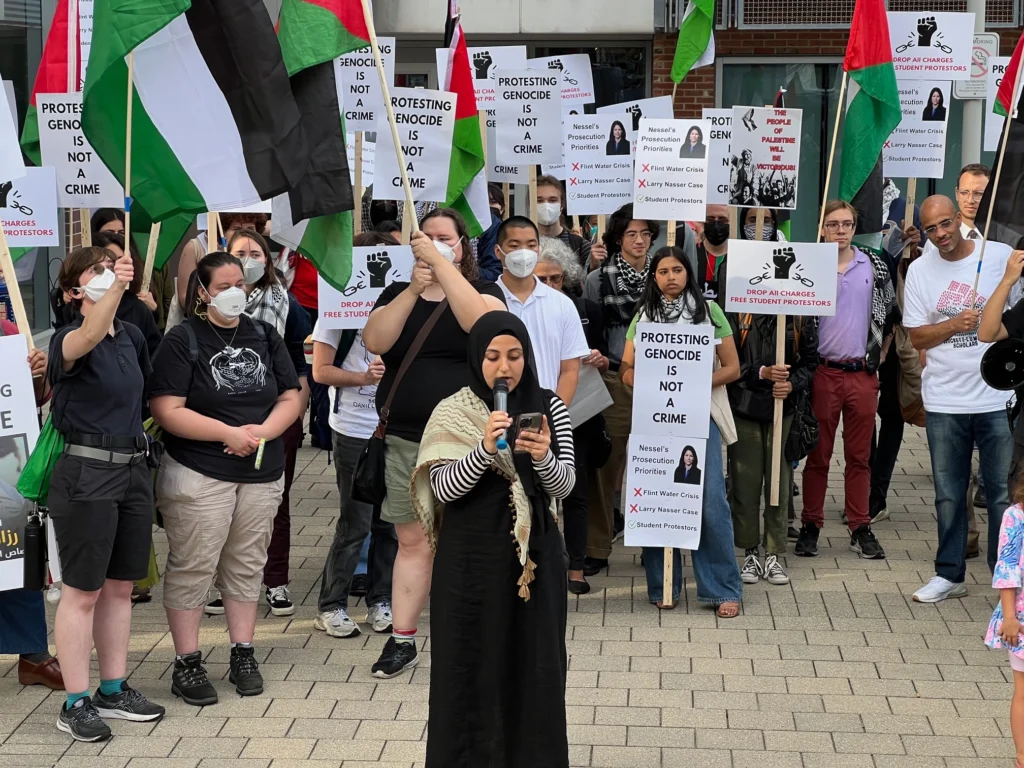
IMAGE: Mariam Ode speaks in support of eight pro-Palestinian activists indicted following the University of Michigan divestment campaign. (Source: Michigan Advance)
A doctrine developed to defend Israel from political isolation had become part of American counterterrorism. It followed opposition from alleged acts of violence to the movements around them, then from those movements to the platforms and volunteers that kept them connected. The punishment crossed borders just as easily. A/I’s own account records how the designation was followed by the loss of PayPal, the disappearance of its domain and its Italian bank’s move to close its account.
Israel’s campaign against its critics had supplied the doctrine, Washington had supplied the power and private institutions had supplied the enforcement. Together they created a system capable of silencing dissent without prosecuting a crime, proving an allegation or granting the accused a hearing. By the time due process could begin, the speaker had disappeared, the money had stopped, and the server had gone dark.
READ MORE ITALY NEWS AT: 21st Century Wire Italy Files
SUPPORT OUR INDEPENDENT MEDIA PLATFORM – BECOME A MEMBER @21WIRE.TV
VISIT OUR TELEGRAM CHANNEL
21st Century Wire is an alternative news agency designed to enlighten, inform and educate readers about world events which are not always covered in the mainstream media.
Source: https://21stcenturywire.com/2026/08/31/the-israeli-blueprint-that-put-an-italian-mail-server-on-americas-terror-list/
Anyone can join.
Anyone can contribute.
Anyone can become informed about their world.
"United We Stand" Click Here To Create Your Personal Citizen Journalist Account Today, Be Sure To Invite Your Friends.
Before It’s News® is a community of individuals who report on what’s going on around them, from all around the world. Anyone can join. Anyone can contribute. Anyone can become informed about their world. "United We Stand" Click Here To Create Your Personal Citizen Journalist Account Today, Be Sure To Invite Your Friends.
LION'S MANE PRODUCT
Try Our Lion’s Mane WHOLE MIND Nootropic Blend 60 Capsules
Mushrooms are having a moment. One fabulous fungus in particular, lion’s mane, may help improve memory, depression and anxiety symptoms. They are also an excellent source of nutrients that show promise as a therapy for dementia, and other neurodegenerative diseases. If you’re living with anxiety or depression, you may be curious about all the therapy options out there — including the natural ones.Our Lion’s Mane WHOLE MIND Nootropic Blend has been formulated to utilize the potency of Lion’s mane but also include the benefits of four other Highly Beneficial Mushrooms. Synergistically, they work together to Build your health through improving cognitive function and immunity regardless of your age. Our Nootropic not only improves your Cognitive Function and Activates your Immune System, but it benefits growth of Essential Gut Flora, further enhancing your Vitality.

Our Formula includes: Lion’s Mane Mushrooms which Increase Brain Power through nerve growth, lessen anxiety, reduce depression, and improve concentration. Its an excellent adaptogen, promotes sleep and improves immunity. Shiitake Mushrooms which Fight cancer cells and infectious disease, boost the immune system, promotes brain function, and serves as a source of B vitamins. Maitake Mushrooms which regulate blood sugar levels of diabetics, reduce hypertension and boosts the immune system. Reishi Mushrooms which Fight inflammation, liver disease, fatigue, tumor growth and cancer. They Improve skin disorders and soothes digestive problems, stomach ulcers and leaky gut syndrome. Chaga Mushrooms which have anti-aging effects, boost immune function, improve stamina and athletic performance, even act as a natural aphrodisiac, fighting diabetes and improving liver function. Try Our Lion’s Mane WHOLE MIND Nootropic Blend 60 Capsules Today. Be 100% Satisfied or Receive a Full Money Back Guarantee. Order Yours Today by Following This Link.


| Visits: | 1,831,797,672 |
| Stories: | 8,704,113 |
Whistler Blowers, Insiders

