

France’s Yanbu Deployment and the Water Saudi Arabia Cannot Lose

Freddie Ponton
21st Century Wire
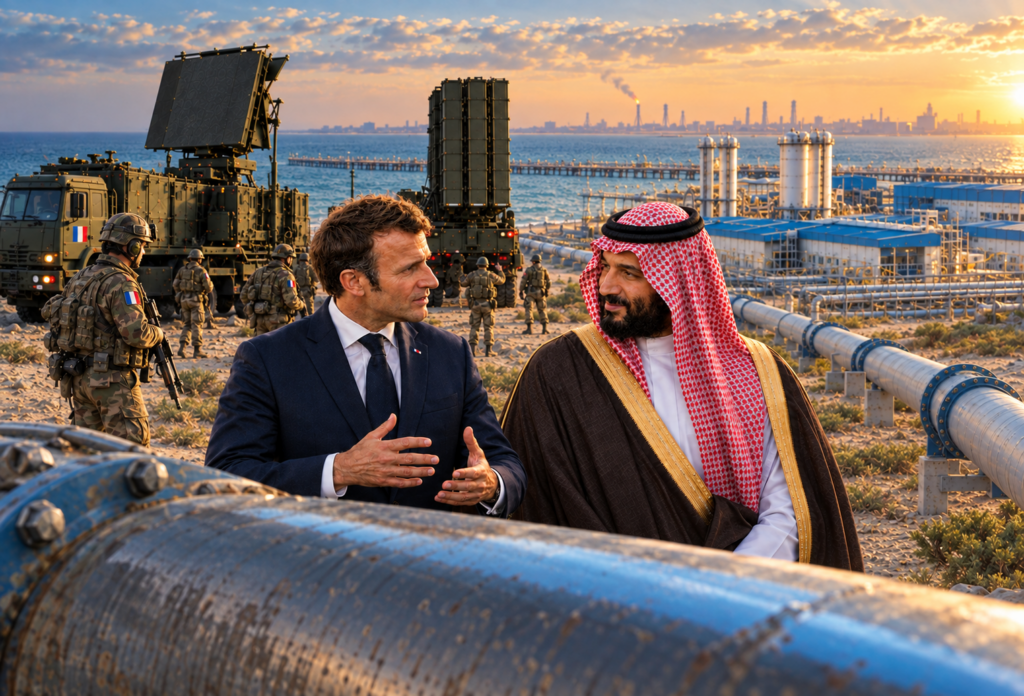
On 24 September, France said it would help defend Saudi Arabia’s Red Sea energy corridor. President Emmanuel Macron announced soldiers, radars and defence systems for Yanbu, the industrial port through which crude carried across the kingdom by the East–West Pipeline reaches the sea. The mission was presented as the protection of Saudi energy infrastructure and the oil-export corridor centred on Yanbu.
VIDEO: Macron Announces the Deployment of French Soldiers to Saudi Arabia (Source Le Parisien)
.
What Macron did not mention was that the same short stretch of coast is being rebuilt as a strategic water system whose pipes, tanks and pumping stations now bind Yanbu to Madinah, Rabigh and Makkah. At Ar Rayyis, immediately south of the port, Yanbu 4’s desalination and storage facilities are being joined with the Rayis–Yanbu and bidirectional Rayis–Rabigh transmission systems to form a single water interchange linking the Madinah/Yanbu and Makkah/Rabigh networks. By describing the mission entirely through oil and energy infrastructure, the announcement left this increasingly important water network outside the public account. That omission is where this investigation begins.
Saudi Arabia does not water its inland cities from great rivers; it takes seawater on the coast, strips out the salt and pushes the drinking water hundreds of kilometres inland—a dependence reflected in the General Authority for Statistics’ 2023 water accounts, which put desalinated water at 50% of the country’s distributed supply
Iran has already treated that dependence as a military fact, warning that Gulf desalination plants could be struck if the United States or Israel were to attack Iranian energy infrastructure. Later attacks on a power-and-desalination facility in Kuwait showed that this class of key critical infrastructure is no longer a hypothetical target.
The National Water Strategy makes continuous access to safe water, in ordinary conditions and in emergencies, a central aim of the state. Saudi figures put national water production at some 12.8 million cubic metres a day, while the pipelines moving desalinated water extend for about 11,000 kilometres. A failure at a coastal desalination plant could disrupt the flow of drinking water through the pumping stations and reservoirs that supply inland cities, where alternative sources may be limited. The Saudi Water Authority states that Vision 2030 treats water security as an integral part of the Kingdom’s national security.
Today, the risk can no longer be perceived as merely a contingency on Saudi planning maps. In a renewed threat to escalate the war against Iran, President Donald Trump signalled that the United States could take the conflict to a new level. That makes the Iranian retaliation already threatened against Gulf energy and desalination infrastructure a live possibility rather than a background assumption.
The interchange at Ar Rayyis
The production centre at Ar Rayyis is Yanbu 4, a seawater reverse-osmosis plant capable of 450,000 cubic metres a day, with storage for roughly two days of output and a pumping link towards Yanbu. Its conveyor line capacity is estimated at around 600,000 cubic metres per day. The French energy company ENGIE owns 40 per cent of the project company, while the Saudi firms Nesma and Mowah own 30 per cent each. ENGIE leads the consortium and operates the plant under a long-term contract to sell water to the Saudi state.
Around that plant, the Saudi Water Partnership Company’s seven-year plan describes two transmission systems meeting at Rayis and, through that meeting, joining regional networks serving Madinah and Makkah that used to be treated as separate. The Rayis–Yanbu line is only 39 to 42 kilometres long, but it can carry up to 630,000 cubic metres a day into Yanbu’s industrial area. The newer Rayis–Rabigh Independent Water Transmission Pipeline is the larger junction, with some 150 kilometres, 500,000 cubic metres a day, and built to work in both directions so that, once reverse flow is fully commissioned, water held at Ar Rayyis can be sent towards Rabigh and the Rabigh–Jeddah–Makkah network, or pulled back again if one region is short.
A strike on Yanbu 4 would stop production at one plant, but a strike on the junction forming around Ar Rayyis would hit something much larger. Storage, pumping, and the new ability to move water between Madinah and Makkah would sit on the same node. Those two regions were planned as separate systems. However, they are now being joined at a single coastal interchange before spare capacity, and the other safeguards meant to limit that shared exposure are ready. For Saudi Arabia, that is no longer a local outage risk. It is a single point that can constrain supply to both networks at once.
An unfinished margin
On 9 September 2026, the Spanish contractor Tedagua, which is leading Rayis–Rabigh, said the pipeline had entered preliminary testing and was moving towards commercial operation, a step it presented as strengthening water security between Makkah and Madinah, without claiming that full service or emergency reverse flow was already available. The Juranah reservoir, intended for the Makkah region, is designed to hold 2.5 million cubic metres, with two million allocated to strategic reserve, but is not scheduled to enter commercial operation until 2027.
A United Nations Panel of Experts has examined weapons debris from earlier Houthi attacks on Yanbu and other Saudi targets; Reuters reported ballistic missiles directed at Yanbu’s oil installations in July 2026, and in September the movement again claimed strikes on the city with missiles and drones. Saudi confirmation of particular claimed impacts has sometimes been absent, yet the group’s ability to reach the corridor is no longer in doubt.
There is no public evidence that the Houthis have chosen Yanbu 4 or the water works at Ar Rayyis. But Iran has already put desalination plants into the vocabulary of war, a comparable Gulf facility has been hit, and the weapons that can reach Yanbu’s oil tanks can reach the same narrow coastal strip on which the western water junction is being assembled—the very coast France has now said it will help defend.
A shield across the corridor
Macron presented that defence as an energy-security mission and identified neither the systems, the battery positions nor the outer perimeter, leaving open whether Ar Rayyis falls inside the shield or merely beside it. In May, the French Defence Ministry said that several SAMP/T Mamba medium-range air-defence batteries had already been deployed elsewhere in the Middle East and described Mamba as a 360-degree bubble, stretching several tens of kilometres, against aircraft, drones, cruise missiles and ballistic missiles.
The Aster 30 interceptor that the battery fires has a published engagement range of more than 100 kilometres; the water corridor from Ar Rayyis to Yanbu’s industrial area is about 39 kilometres long. Coverage still depends on what is sent, where it is placed, the terrain, the radars around it and the orders given to the unit. But a Mamba-class system posted in the Yanbu corridor could, on the numbers France itself publishes, cover both the energy installations named in Paris and most parts of the water interchange that were not named at all.
Officially, France is guarding an oil outlet, but on the ground, it would be arriving beside an unfinished water interchange whose loss would hit the west of the Kingdom as hard as a burning terminal. Macron said the soldiers, radars and defence systems were to protect an energy site, not to enter the conflict, yet the site now carries a strategic drinking water network as well as oil.
France’s stake
At the accompanying roundtable, France’s Saur and Nesma & Partners agreed to pursue recycled-water infrastructure in Riyadh, part of a wider collaboration covering desalination, municipal and industrial systems, construction, long-term operations and reuse. No clause in that bargain guaranteed Yanbu 4, and a separately reported Bpifrance package concerned electricity grids rather than water. But defence, water and state-backed finance were no longer separate conversations—and ENGIE already operates the plant.
After the company’s February 2026 capital increase, the French state held 22.64 per cent of ENGIE and about a third of its voting rights, making Paris the largest shareholder in the firm that runs Yanbu 4 under a long-term water-purchase contract. The French public does not own the Saudi plant, and the disclosed construction lenders were international. Yet an attack at Ar Rayyis would still cut at western supply, expose personnel working under a French-led operation, damage a long ENGIE concession and complicate France’s wider pursuit of Saudi infrastructure work.
The 2025 National Strategic Review gives the armed forces the task of defending French interests and supporting partners; the Defence Ministry’s history of overseas operations lists economic interests, maritime routes, regional security and the protection of nationals among the reasons France stations forces abroad.
The question for Parliament
If that wider purpose has to be spoken, it will be spoken in the French Parliament. Article 35 of the Constitution requires the government, once it begins a military intervention abroad, to inform Parliament within three days, state its objectives and obtain authorisation if the operation lasts more than four months.
Troops pre-positioned under defence agreements, and some limited missions, have been kept outside that procedure, so the label given to Yanbu will decide how much definition follows.
Should Article 35 apply, the notice may be the first official text that has to say whether France is protecting an oil outlet or a strip of coast that now carries oil and desalinated water, and that Saudi Arabia is trying to keep standing when the next blow comes. Officially, the deployment remains an energy-security mission, but on the ground, it will arrive on a coast that no longer keeps those two systems apart.
READ MORE SAUDI ARABIA NEWS AT: 21st CENTURY WIRE SAUDI FILES
SUPPORT OUR INDEPENDENT MEDIA PLATFORM – BECOME A MEMBER @21WIRE.TV
VISIT OUR TELEGRAM CHANNEL
21st Century Wire is an alternative news agency designed to enlighten, inform and educate readers about world events which are not always covered in the mainstream media.
Source: https://21stcenturywire.com/2026/09/28/frances-yanbu-deployment-and-the-water-saudi-arabia-cannot-lose/
Anyone can join.
Anyone can contribute.
Anyone can become informed about their world.
"United We Stand" Click Here To Create Your Personal Citizen Journalist Account Today, Be Sure To Invite Your Friends.
Before It’s News® is a community of individuals who report on what’s going on around them, from all around the world. Anyone can join. Anyone can contribute. Anyone can become informed about their world. "United We Stand" Click Here To Create Your Personal Citizen Journalist Account Today, Be Sure To Invite Your Friends.
LION'S MANE PRODUCT
Try Our Lion’s Mane WHOLE MIND Nootropic Blend 60 Capsules
Mushrooms are having a moment. One fabulous fungus in particular, lion’s mane, may help improve memory, depression and anxiety symptoms. They are also an excellent source of nutrients that show promise as a therapy for dementia, and other neurodegenerative diseases. If you’re living with anxiety or depression, you may be curious about all the therapy options out there — including the natural ones.Our Lion’s Mane WHOLE MIND Nootropic Blend has been formulated to utilize the potency of Lion’s mane but also include the benefits of four other Highly Beneficial Mushrooms. Synergistically, they work together to Build your health through improving cognitive function and immunity regardless of your age. Our Nootropic not only improves your Cognitive Function and Activates your Immune System, but it benefits growth of Essential Gut Flora, further enhancing your Vitality.

Our Formula includes: Lion’s Mane Mushrooms which Increase Brain Power through nerve growth, lessen anxiety, reduce depression, and improve concentration. Its an excellent adaptogen, promotes sleep and improves immunity. Shiitake Mushrooms which Fight cancer cells and infectious disease, boost the immune system, promotes brain function, and serves as a source of B vitamins. Maitake Mushrooms which regulate blood sugar levels of diabetics, reduce hypertension and boosts the immune system. Reishi Mushrooms which Fight inflammation, liver disease, fatigue, tumor growth and cancer. They Improve skin disorders and soothes digestive problems, stomach ulcers and leaky gut syndrome. Chaga Mushrooms which have anti-aging effects, boost immune function, improve stamina and athletic performance, even act as a natural aphrodisiac, fighting diabetes and improving liver function. Try Our Lion’s Mane WHOLE MIND Nootropic Blend 60 Capsules Today. Be 100% Satisfied or Receive a Full Money Back Guarantee. Order Yours Today by Following This Link.


| Visits: | 1,835,445,775 |
| Stories: | 8,723,320 |
Whistler Blowers, Insiders

