

The Ghost Army That Lost Bab al-Mandeb

Freddie Ponton
21st Century Wire
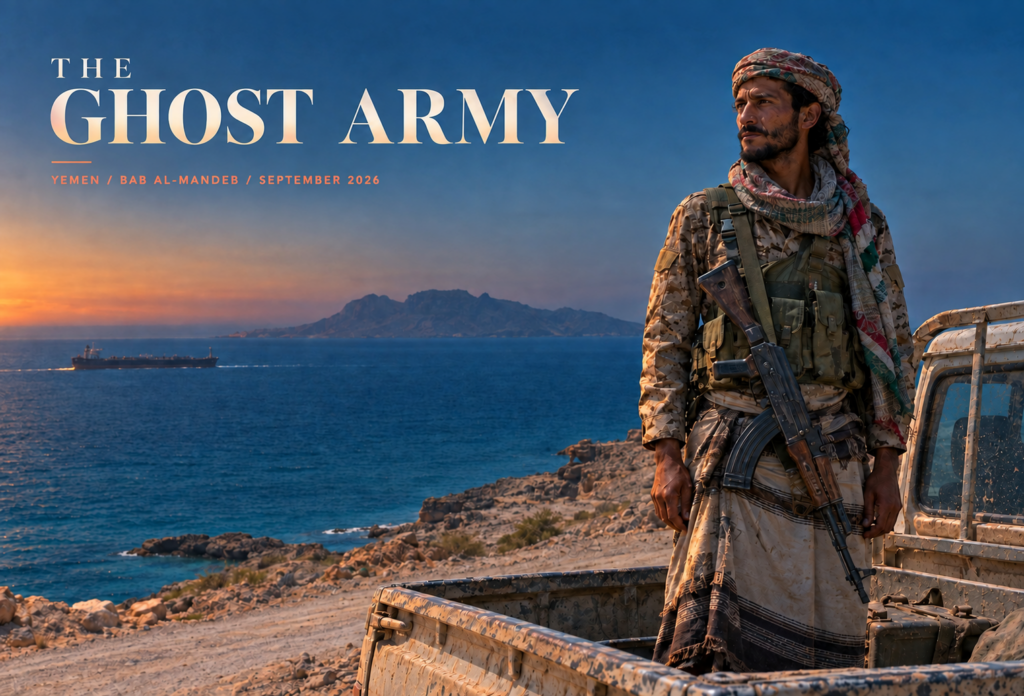
For years Yemen’s war appeared trapped in a bloody stalemate, its front lines barely moving, while the world’s attention stayed on Iran and the Strait of Hormuz. Then the war moved on to the Red Sea. Saudi-backed forces withdrew from Mocha as Ansar Allah entered the port. The group, known outside Yemen as the Houthis, swept south along Yemen’s western Red Sea coast as government-aligned positions that had held for years rapidly gave way. By the time government troops left Mayyun, a volcanic outcrop at the southern mouth of the Red Sea, their fighters were arriving by boat without meeting resistance.
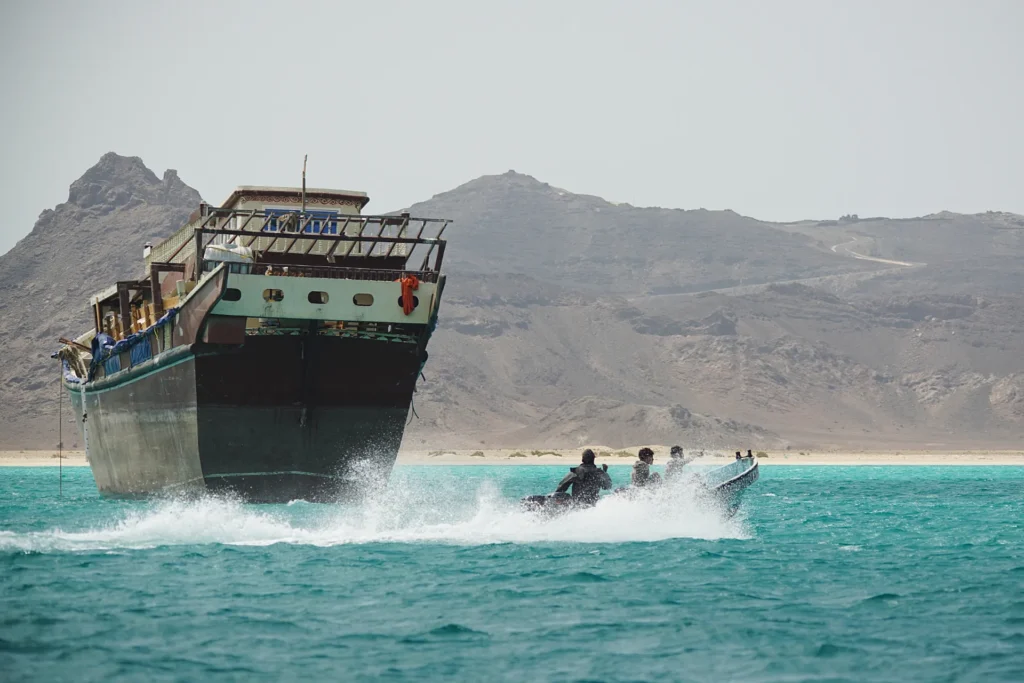
IMAGE: Small boats move through the waters off Mayyun in Bab al-Mandeb, the narrow southern entrance to the Red Sea. (Source: Euronews)
Mayyun is barely thirteen square kilometres, but it sits in Bab al-Mandeb, where the water narrows between Yemen and the Horn of Africa. Tankers and cargo ships coming from the Indian Ocean divide around the island before running north to the Suez Canal and Europe with Gulf oil and the trade that links Asia to European markets. Iran holds the Strait of Hormuz, so Saudi crude has to move west toward Red Sea terminals and that same channel. With Mayyun taken and Yemen’s west coast behind them, Ansar Allah now stands on the passage Riyadh had used as an escape route.
For more than a decade the Kingdom had paid Yemeni units along the eastern side of the strait to prevent exactly that—a shifting collection of local commanders, brigades and armed groups that Saudi Arabia and the United Arab Emirates armed separately, paid separately and presented as Yemen’s legitimate military. When the coast began to fall, the men those patrons had financed offered very little resistance; dozens of Giants Brigades personnel were captured, and Saudi military equipment was seized. In the rout, Saudi- and Emirati-backed forces lost Al-Omari camp, Jabal Dhubab and the commanding heights above Bab al-Mandab. Soon after, Zuqar Island fell, and large quantities of weapons passed into Houthi hands.
In the days that followed, Ansar Allah moved to turn the military collapse into permanent control, reopening roads and sending security, health, fuel and civil-service officials into Hays, Al-Khawkhah and Mokha. It offered amnesty and safe passage to fighters who surrendered their weapons, seeking to absorb the coast before its displaced rivals could regroup.
Five months earlier, Saudi Arabia had told soldiers in its allied Yemeni units to report in person before collecting their salaries. Each was asked for a fingerprint and an iris scan. More than 33,000 names reportedly failed to appear. The missing men had ranks, units and monthly wages, and their commanders had been paid to keep them armed. When Riyadh called them forward, nobody came. Five months later, as Ansar Allah came down the coast, they were still missing—the latest absence in a system that began decades earlier, when Yemeni sheikhs crossed the Saudi border, met the Kingdom’s rulers and left with money after a handshake.
The Handshake
Saudi Arabia had been paying Yemenis who never needed to show up long before the Kingdom asked 33,000 of them to put an eye to a scanner. The older method was a handshake in a royal reception, where a Yemeni sheikh offered the greeting required of a guest and left with 1.5 million Saudi riyals after a committee created by royal order had reviewed “allocations and aids” to tribal leaders. Interior, General Intelligence, Foreign Affairs, Defence and the Special Committee of the Council of Ministers all sat on that committee.
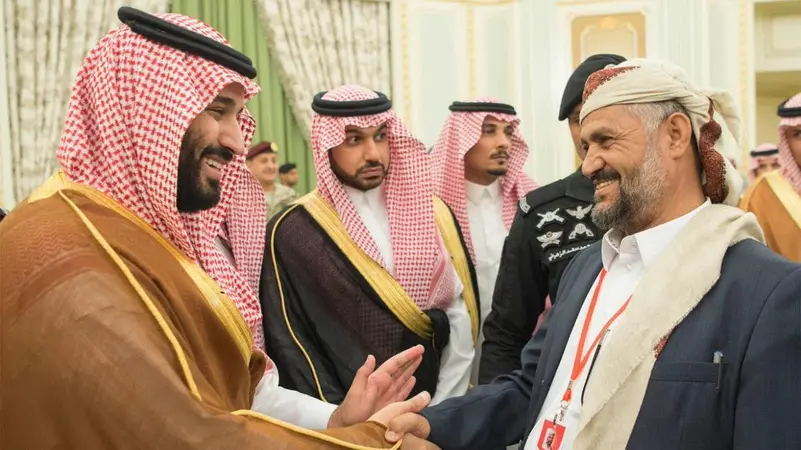
IMAGE: Mohammed bin Salman receives Yemeni tribal leaders in Saudi Arabia in 2017. The meeting reflects the personal audiences through which Riyadh cultivated influence among Yemeni power brokers. (Source: Al Arabiya)
These tribal leaders collecting the money could move families, villages and armed followers, open a road, protect a convoy or pull a community toward the side Riyadh favoured. It was this very service the Kingdom had been buying for generations.
The transfer was not entered as a bribe, a political retainer or a military subsidy. Officials called it “annual assistance” for sheikhs who visited the Kingdom, a new label introduced after the regular stipends to senior sheikhs had supposedly been stopped. The audiences did not stop, and neither did the payments.
The committee issuing the payments, the Special Committee of the Saudi Council of Ministers, had been running since 1962. That year, republican officers backed by Egypt’s Gamal Abdel Nasser overthrew northern Yemen’s thousand-year-old Zaydi imamate. Riyadh responded to the new order on its southern border by creating a body to manage “all matters related to Yemeni affairs.”
It kept files on tribal sheikhs, religious leaders, military commanders and politicians on both sides of Yemen’s political divide. Influence was graded, requests were logged, and monthly payments kept powerful men close to Riyadh. The Saudi ambassador in Sana’a sat on the committee. It reported directly to the Saudi Prime Minister’s Office, yet its name did not appear in official media in either country. The archive contains its classified cables from 2010 to 2012.
The confession
In January 2012, one of those cables, marked “Extremely Secret, Very Urgent,” carried instructions from Prince Salman bin Abdulaziz, Saudi Arabia’s defence minister, who later became king. Officials were told to deepen the rift around Ansar Allah, to stop the fighting from looking like a war between Sunni and Shia Muslims, and to hide any sign that Saudi Arabia stood behind it. Religious tension already existed in northern Yemen. The cable ordered that the fracture be sharpened and the Kingdom’s involvement concealed.

IMAGE: Prince Salman bin Abdulaziz, then Saudi crown prince and defence minister, inspects Saudi forces in 2014. Two years earlier, a classified cable carried instructions to intensify divisions around Ansar Allah while concealing Saudi Arabia’s role. (Source: Alamy)
The committee paying the sheikhs had already written down the limit of what the money could buy. Yemeni tribal custom condemned a man who helped an outside power attack another tribe, which meant a sheikh could take a Saudi payment and still refuse to be seen fighting the Kingdom’s enemies. Paid figures, the files observed, might support one side against another, but only “in an undeclared manner.” Riyadh had bought an allegiance that could not be shown in public. The money bought quiet dependence, but did not buy a man who would stand in the open and fight for the donor who paid him.
Yet, that dependence was still useful. The payroll held rival leaders in place, spread favour through their networks and made Saudi money a condition of political survival. Two years after the cable, fighting around the northern town of Dammaj forced roughly 10,000 people onto about 300 buses and out of their homes. The rift written in Riyadh left columns of families on Yemen’s roads.
The army on paper
A commander’s budget rose with the number of men he claimed to lead, so each extra name brought salaries plus fuel, weapons and vehicles drawn in the unit’s name and collected by him. A soldier invented on the roster still produced cash in that collection, and the cash could leave the camp entirely. Researchers following Yemen’s war economy found tribal leaders paid for security forces through the same device, which meant money raised on nonexistent troops could reach sheikhs who held no military post.
In Marib, Saudi Arabia reportedly financed about 50,000 fighters, a figure researchers treated as almost certainly inflated and read part of it as tribal support bought through an army wage. The older system paid influential men directly, while the new one paid commanders, who passed the surplus through fighters, families, tribes and political clients. Money from a soldier who never entered a camp could now buy the loyalty of one who did.

IMAGE: Yemeni tribal fighters trained with Saudi backing during the war against Ansar Allah. The forces Riyadh financed often depended on local patronage networks as much as on a formal military chain of command. (Source: Reuters)
The incentive grew when the Emirates paid alongside the Kingdom. Two patrons produced overlapping payrolls and competing formations, which turned the same loyalty into more than one market.
Transparency International estimated that more than a third of roughly 100,000 Yemeni soldiers were fictional, a proportion that made a biometric programme launched in 2006 look almost futile. By 2010, it had removed only 3,792 duplicate names from an estimated 60,000.
Three paymasters
In January, the Emirates abandoned the units they had been paying and left Saudi Arabia to take them over. Riyadh put billions of dollars into pulling those forces under its own hand and committed $346.6 million toward government salaries and operations, then required the roster of every major formation before the money moved. One soldier on those lists could reportedly draw three salaries, one from the government, another from the southern separatists and a third from a commander running his own force, while thousands of other wages belonged to nobody at all.
A soldier now had to arrive in person, give a fingerprint and submit to an eye scan before he could collect. Eleven years into a war it had financed, Riyadh was building that database to learn whether the men on its books were real. The national audit reportedly rejected more than 33,000 names after nobody came to verify them. On the western coast, military sources estimated that roughly 6,000 people had remained on payrolls for six years, though they were dead, dismissed or absent.
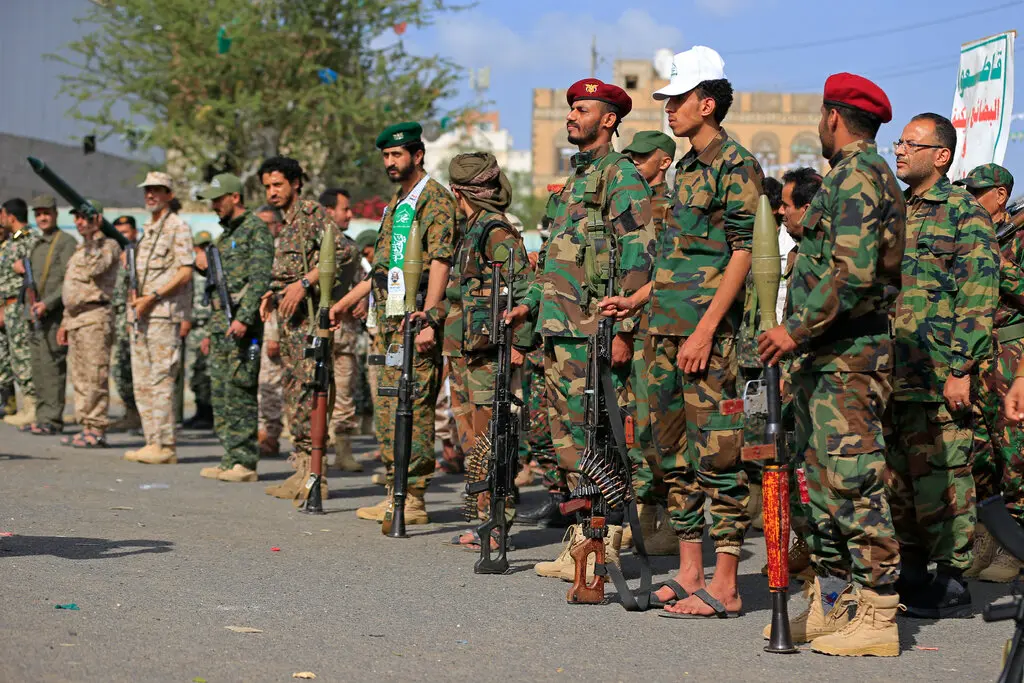
IMAGE: Yemeni troops in formation on the Red Sea coast. Saudi Arabia and the United Arab Emirates funded overlapping armed formations, but their payrolls did not always correspond to men available to serve. (Source: The New York Times)
Their allowances still moved, carrying millions of riyals each month. The commander responsible for that coast reportedly told sources the Emirates had paid him about one billion Saudi riyals a year. Each name on his roster carried a wage, a share of supplies and a piece of the authority that would vanish with the name.
Riyadh’s next move was to stop paying the commander for the list and send each salary to the soldier who could prove he existed.
Taking away the payroll
In August Yemen’s defence ministry announced that salaries would no longer pass through unit commanders or their representatives. The new system was to wipe ghost names off the books, stop men holding more than one military job and, in the ministry’s own words, “determine the true size of the armed forces.” After more than a decade of war and billions of dollars, the coalition’s principal sponsor still did not know the size of the army it claimed to command.

IMAGE: A Yemeni military officer takes part in an online administrative meeting. The 2026 payroll reform required personnel to verify their identities before salaries could be sent directly to them. (Source: Al Estiklal)
The reform made theft harder and gave actual soldiers a better chance of receiving their wages, while stripping commanders of the surplus attached to those lists. Direct payment cut the false names out of the transfer and took the discretionary money with them. The names erased from the roster may never have belonged to real soldiers, but the authority their wages created did.
Plans for a central database had stalled for years because politicians and unit leaders benefited from the disorder. When biometric registration became unavoidable, their opposition moved into the open. Control of the wage was control of whether an armed group still obeyed.
Six weeks before Mocha fell, a Yemeni research centre warned that unpaid salaries and uncertain loyalties could “short-circuit” the restructuring process. The Emirates had secured those loyalties with regular and competitive payments. Saudi Arabia was trying to fuse forces built by different sponsors, paid at different rates and run through personal relationships. The database promised one army, and the men waiting for their salaries knew there were several.
The men who existed
In the spring, a soldier stationed outside Marib spent his free hours calling anyone who might lend him money. An officer said his troops had gone five months without pay and still reported for duty while the government promised arrears it could not reliably deliver. A regular Yemeni soldier earned between roughly $38 and $116 a month when the wage arrived. Fighters in better-funded coalition formations could take as much as $320, and men left poorer units for whichever commander still held foreign money.
A brigade representative in Taiz said soldiers abandoned their positions for formations that paid enough to survive. His men earned a fraction of those salaries, and even that fraction was five months late. Commanders began levying a local tax to issue partial payments, rebuilding an informal purse under the army Riyadh was trying to place on one ledger.
Men had already followed that purse to Mocha. The port had been a fishing town before it became headquarters for the forces holding Yemen’s western coast, and recruits travelled from areas controlled by Ansar Allah to enlist because the salaries came in Saudi riyals. Three weeks before the city fell, a fisherman said some of his colleagues had left the sea for military work paying four times their former income. Missile strikes and security restrictions kept the remaining boats ashore while armed units filled the town, and the water that had fed their families was already a battlefield.
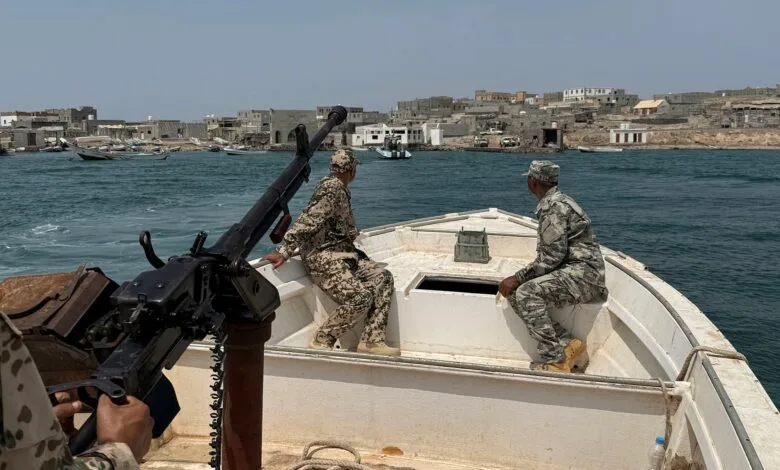
IMAGE: Armed Yemeni men patrol in a small boat off Yemen’s Red Sea coast. In Mocha, fishing livelihoods gave way to military work as local recruits followed wages paid in Saudi riyals. (Source: CNN)
One fighter had left Houthi territory and enlisted seven months earlier. He moved his wife and three children inland because he did not trust the war to separate a military post from a family house. By mid-August, attacks had stopped work at the port and cost more than 1,500 workers their livelihoods. Riyadh then audited the names, centralised salary payments and required each soldier to prove he existed before collecting his wage, as Ansar Allah pushed south.
The road to Mayyun
Ansar Allah entered Mocha on 10 September after government forces withdrew, opening the coastal road toward Bab al-Mandeb. The remaining units abandoned Dhubab, the last major position facing the island inside the strait, then left Mayyun. Houthi fighters reached the island once those units were gone. Mayyun splits Bab al-Mandeb into two shipping channels on the route between the Red Sea and the Gulf of Aden. In roughly a week, Ansar Allah held Yemen’s entire Red Sea coast and the island above the passage.

IMAGE: Houthi fighters enter Mocha after Saudi-backed government forces withdrew, 10 September 2026. The capture of the Red Sea port opened the coastal route toward Dhubab and Mayyun. (Source: International Business Times Japan)
Commercial shipping still moved, and Ansar Allah was quick to confirm that navigation remained safe for vessels not linked to Saudi Arabia. The force Riyadh had spent eleven years trying to defeat now stood at the maritime gateway between the Indian Ocean and Suez.
The commander responsible for that coast issued an official statement describing a planned repositioning agreed with Saudi-led coalition officials and Yemen’s presidential authorities, after which his forces would regroup at a safer command centre. In an audio message to his fighters, he spoke of betrayal from within and abandonment by “the brothers.” No safer command centre appeared, and nothing clear followed about where he was or what remained of his units. The presidential authorities, the defence ministry and the joint command offered no account that matched the claim of an orderly manoeuvre with the camps being stripped behind him.
Headquarters were looted as armed groups fought over abandoned equipment. Saudi military hardware was left in place. Allied formations reportedly obstructed one another during the retreat, and Houthi broadcasts offered amnesty to anyone who surrendered. Within hours, the coastal commander sent his remaining troops into a coalition-run operations room and gave up direct command. The repositioning he had announced was a collapse.
At the beginning of the year, thirty brigades had been folded into five divisions under direct Saudi supervision. Five months of that reform found no coherent army under the lists. When the personal control and informal payments holding that arrangement together were removed, much of the force those lists had described ended up leaving the coast with them.
What the audit revealed
Ansar Allah entered Mocha, Dhubab and Mayyun as the government units assigned to hold the coast withdrew ahead of them. The national audit had rejected more than 33,000 names that never appeared, while the western coast had kept thousands of dead, dismissed or absent men on the books. Direct payment removed the surplus that had allowed unit commanders and their intermediaries to hold the coastal positions together. As that system gave way, the road south opened.

IMAGE: Ansar Allah fighters celebrate on Yemen’s Red Sea coast during the September 2026 advance. (Source: Video still from Al-Masirah via Al Jazeera English)
Ansar Allah had come through bombardment, blockade and years of Saudi-led war with a command structure and a reason for moving south. Riyadh had paid for names, commanders and allegiance that could not be stood up in public.
READ MORE YEMEN NEWS AT: 21st Century Wire Yemen Files
SUPPORT OUR INDEPENDENT MEDIA PLATFORM – BECOME A MEMBER @21WIRE.TV
VISIT OUR TELEGRAM CHANNEL
21st Century Wire is an alternative news agency designed to enlighten, inform and educate readers about world events which are not always covered in the mainstream media.
Source: https://21stcenturywire.com/2026/09/13/the-ghost-army-that-lost-bab-al-mandeb/
Anyone can join.
Anyone can contribute.
Anyone can become informed about their world.
"United We Stand" Click Here To Create Your Personal Citizen Journalist Account Today, Be Sure To Invite Your Friends.
Before It’s News® is a community of individuals who report on what’s going on around them, from all around the world. Anyone can join. Anyone can contribute. Anyone can become informed about their world. "United We Stand" Click Here To Create Your Personal Citizen Journalist Account Today, Be Sure To Invite Your Friends.
LION'S MANE PRODUCT
Try Our Lion’s Mane WHOLE MIND Nootropic Blend 60 Capsules
Mushrooms are having a moment. One fabulous fungus in particular, lion’s mane, may help improve memory, depression and anxiety symptoms. They are also an excellent source of nutrients that show promise as a therapy for dementia, and other neurodegenerative diseases. If you’re living with anxiety or depression, you may be curious about all the therapy options out there — including the natural ones.Our Lion’s Mane WHOLE MIND Nootropic Blend has been formulated to utilize the potency of Lion’s mane but also include the benefits of four other Highly Beneficial Mushrooms. Synergistically, they work together to Build your health through improving cognitive function and immunity regardless of your age. Our Nootropic not only improves your Cognitive Function and Activates your Immune System, but it benefits growth of Essential Gut Flora, further enhancing your Vitality.

Our Formula includes: Lion’s Mane Mushrooms which Increase Brain Power through nerve growth, lessen anxiety, reduce depression, and improve concentration. Its an excellent adaptogen, promotes sleep and improves immunity. Shiitake Mushrooms which Fight cancer cells and infectious disease, boost the immune system, promotes brain function, and serves as a source of B vitamins. Maitake Mushrooms which regulate blood sugar levels of diabetics, reduce hypertension and boosts the immune system. Reishi Mushrooms which Fight inflammation, liver disease, fatigue, tumor growth and cancer. They Improve skin disorders and soothes digestive problems, stomach ulcers and leaky gut syndrome. Chaga Mushrooms which have anti-aging effects, boost immune function, improve stamina and athletic performance, even act as a natural aphrodisiac, fighting diabetes and improving liver function. Try Our Lion’s Mane WHOLE MIND Nootropic Blend 60 Capsules Today. Be 100% Satisfied or Receive a Full Money Back Guarantee. Order Yours Today by Following This Link.


| Visits: | 1,833,930,649 |
| Stories: | 8,715,202 |
Whistler Blowers, Insiders

