

Yemen and the Revolution of the Two Souths

Freddie Ponton
21st Century Wire
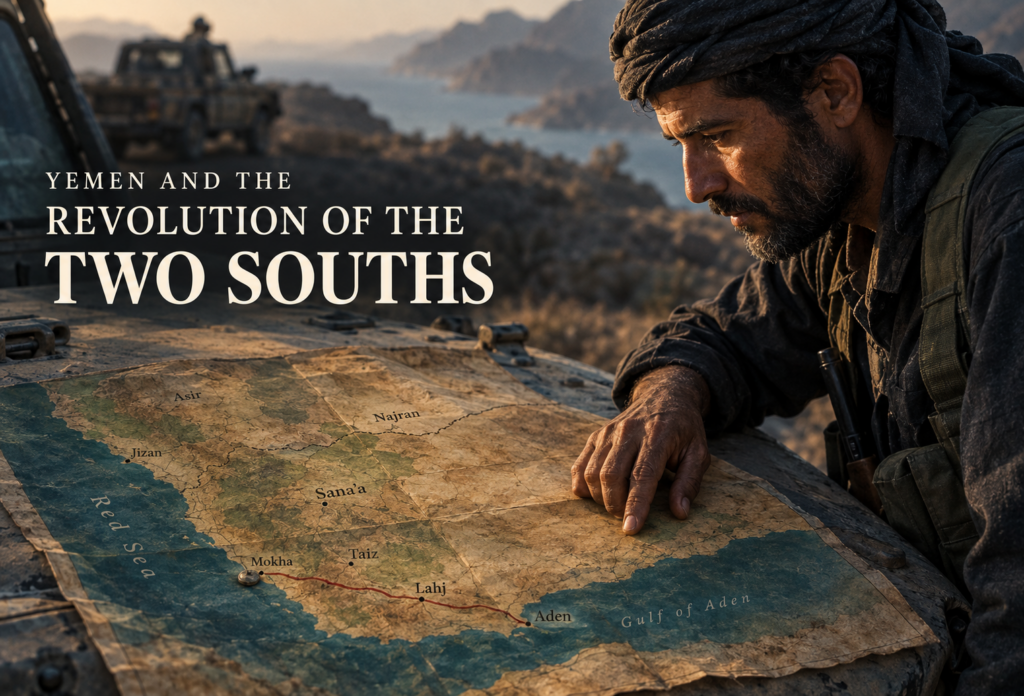
Ansar Allah, the armed northern movement known as the Houthis that holds Sana’a, entered the Red Sea port of Mokha on 10 September after the Saudi-backed National Resistance, which had held the western shore, withdrew before dawn. The offensive continued along the coast, reached islands in Bab al-Mandab, the strait at the entrance to the Red Sea, and climbed into the Kahboub mountains of Taiz and Lahj, the high ground separating the captured shoreline from Aden, southern Yemen’s main city. Saudi-backed units and local tribes have since driven the assault from the ridgeline, but they have not retaken the port. Aden is no longer a distant name in a frozen war but a destination on a road now visible from the hills.
What some call the revolution of the two souths has already reached that ridge. The first south is southern Yemen, where Saudi power is being tested and Aden must decide whether it still possesses a politics of its own as Houthi fighters on the Kahboub heights look towards the road into the city. The second lies across the border in Jizan, Najran and Asir, the three Saudi provinces adjoining Yemen whose incorporation into the kingdom was consolidated through the conflicts and settlements culminating in 1934. There, Riyadh’s failure to hold the coast may give old grievances a political life of their own, turning resentment over displacement, discrimination and rule from Riyadh into a public challenge to the Saudi state.
This is the southern storm gathering beneath the House of Saud. The fall of Mokha has forced both souths to confront the political project carried by Ansar Allah’s advance. Saudi and Emirati-backed forces kept the movement out of Aden for nine years, but it may now return with the aim of unifying Yemen under Sana’a. Yet military victory would not settle what governing the South would require from Sana’a, since grievances over land, power and political standing will survive the foreign systems of patronage that have shaped its politics.
The coast moved, and the coalition did not
Mokha had stood as proof that the west remained under control. In 2017, a Saudi and Emirati-backed campaign pushed Houthi forces off that shore, and for nine years the port kept Bab al-Mandab beyond Sana’a’s reach. That position collapsed overnight as units withdrew towards Dhubab, the next district south, followed by families fleeing the retreat while Houthi fighters entered the abandoned line. Fighting was also intensifying around Marib, the government’s last major oil city, leaving Riyadh’s Yemeni allies to defend two fronts without the Saudi and Emirati partnership that had built and held the coastal order.
After the port fell, Saudi Arabia asked the United States for strikes and received intelligence instead. Only a month earlier, it had signed the Mecca agreement with Türkiye and Pakistan, a defence pact that treats an attack on one as an attack on all, yet neither ally joined the battle when Riyadh appealed for military help. The United Arab Emirates, which built much of the South’s separatist order, no longer fights this war as Riyadh’s second command. Saudi aircraft can still operate from their bases, but Saudi power could neither hold nor retake the port that was supposed to prove the coalition still existed as a military force. Southern commanders in Lahj can now see what that failure has brought to their doorstep.
Southern Yemen has to say what it is defending
In Aden, the collapse of the coastal line has brought the prospect of Ansar Allah’s return closer to the centre of southern political life. The city is the South’s main port, the seat of its remaining ministries and the place where memories of the 2015 fighting survive street by street. When Ansar Allah entered Aden that year, many southerners saw its fighters as another northern army. Fadi Baoum of the Hirak, the older southern movement that opposes both Gulf patronage and rule from Sana’a, later called the decision to fight for Abdrabbuh Mansur Hadi, Yemen’s president at the time, a grave mistake. His judgement drew on an older history, since the 1990 merger promised one country while the 1994 war ended with northern forces taking control of southern land and state institutions. The fighting at Kahboub has put that history back on the road to Aden as the military and political order built to keep Ansar Allah out begins to break apart.
The Southern Transitional Council built its political and military power with Emirati support, although it also operated for years inside the wider Saudi-led coalition. Alongside its Security Belt forces, the Council once controlled large parts of the South and could pursue independence with an armed force and a powerful foreign patron behind it. Hani bin Brik, a senior Council leader and former commander of the Security Belt forces, can still rally fighters against an Ansar Allah advance, and some will answer because their memories of the 2015 battle for Aden carry more weight than any statement from Abu Dhabi. Yet the Council can draw fewer fighters from areas it once governed after its confrontation with Saudi-backed forces weakened its administration and exposed the limits of Emirati support just as the fighting returned to the mountains.
The Presidential Leadership Council, the internationally recognised authority based in the South, still presents a unified Yemen under Riyadh’s protection as the alternative to Ansar Allah, even though the Saudi funded forces aligned with it belong to the camp that lost Mokha. The Hirak rejects both Saudi and Emirati patronage but lacks the military strength to hold the ridge. The demand for southern independence rested on Emirati military support, while the defence of a unified Yemen depended on Saudi-backed forces. Both projects have lost the power needed to sustain their claims as Ansar Allah has advanced within sight of the road to Aden.
Factions moving towards Lahj must now do so without Emirati military support, either under a Saudi command they have less reason to trust or in defence of a statehood claim that Abu Dhabi is no longer willing to support. Ansar Allah offers none of them a separate southern country, since its project begins with a unified Yemen governed from Sana’a. Yet that project would still need terms capable of governing a South whose grievances predate Abu Dhabi and will survive its departure. The political pressure created by Ansar Allah’s advance does not end at Yemen’s southern front, since it is also testing Riyadh’s authority across the border.
Jizan, Najran and Asir have to say how far their grievance goes
The same week that put Houthi fighters on the hills above Aden brought missile strikes and damage to southern Saudi Arabia, where families had already been displaced from the frontier during earlier fighting. This is the other south, not a hidden Yemeni army but the three Saudi provinces bordering Yemen, Jizan, Najran and Asir, whose incorporation into the Saudi state was consolidated through the conflicts and settlements culminating in 1934. Ansar Allah invokes that history and presents Jizan, Najran and Asir as occupied Yemeni territories placed under Saudi rule through the war of 1934 and the treaties that followed.
Jizan is the easiest to see. It is the coastal plain where the Red Sea lowlands of Saudi Arabia meet those of Yemen. For a long time, the border there existed more clearly on paper than in daily life. Families married across the border, farmed land on both sides and maintained ties that the boundary never fully severed. When the war came, the state cleared parts of that belt, leaving households without fields, access and, in many cases, a settlement they still dispute. Ansar Allah’s advance does not make those communities supporters of Sana’a, but it weakens the bargain imposed on them by Riyadh. They lost homes, fields and cross-border access in the name of securing a frontier that the kingdom has again failed to protect from war.
Najran lies inland, across the border from Yemen’s far north, where Saudi Civil Defence issued emergency alerts on 21 September and instructed residents to remain indoors because of a potential danger. Press TV reported that air-raid sirens and explosions followed the purported launch of ballistic missiles by the Yemeni armed forces, although the cause of the explosions remained unclear. The city and province have a large Sulaymani Ismaili population, a Shia community distinct from the Zaydi tradition from which Ansar Allah emerged, while the Yam is the province’s dominant tribe.
Grievances in Najran have centred less on territory than on the treatment of Ismailis, who report discrimination in employment, education, worship and the courts. Families still remember the 2000 confrontation with Saudi security forces, and Houthi media has drawn on that history by presenting visits from Yam members as evidence of wider support in Najran. Prominent Yam leaders have rejected that claim, showing that the cross-border ties that remain give Sana’a a route into Najran but not the authority to speak for it. Ansar Allah’s advance may give that appeal greater weight, but Najran’s grievances remain rooted in the province’s own relationship with the Saudi state.
Asir, the highland province between Jizan and Najran, has a strong regional identity and longstanding disputes over development policies set in Riyadh, but there is less evidence of political engagement with Sana’a. No public leadership linked to Ansar Allah has emerged from the province.
Yemen’s defeat in 1934 led to the Treaty of Taif, while the Treaty of Jeddah formally established the border between Yemen and Saudi Arabia in 2000. What remains unsettled is the relationship between Riyadh and the communities living along that border. Ansar Allah did not create the loss of land and cross-border access in Jizan or the memory of discrimination and confrontation in Najran, but its advance makes both harder for the Saudi state to contain as local grievances. Sana’a has already created a place where those grievances can be recast as opposition to the kingdom.
Sana’a has built a shelter
Saudi opponents have been given a public platform and a place to organise in Houthi-held territory. In 2024, Ali Hashim Salman al-Hajji, a Saudi dissident, reached Sana’a, pledged himself to Abdul-Malik al-Houthi and began speaking publicly against the monarchy. Later reports of meetings in Haddah, a district of the capital, described exiles discussing a military council and assigning tasks across different regions. No charter has appeared, no membership has been verified and no attack inside the kingdom has been linked to those meetings. The reporting establishes Sana’a as an external base for Saudi dissent, not the existence of an organised army.
Whatever the status of the reported council, Sana’a’s broader method is visible. Houthi media keeps the territorial settlement of 1934 in public debate, tribal contacts maintain a route into Najran and sanctuary in the capital gives Saudi defectors a platform outside the kingdom. The fall of Mokha and the failure of Riyadh’s allies to intervene have given that platform greater political weight, allowing Ansar Allah to present the grievances of both souths as consequences of the regional order it seeks to replace.
Both souths are being asked to answer the same advance
Ansar Allah did not advance towards Aden to grant the South a separate country or adopt every grievance from Najran as its own. Its objective is a unified Yemen governed from Sana’a and an end to the foreign-backed order that divided the country. Defeating Gulf-backed forces, raising the cost for Riyadh and speaking across the border established in 1934 all serve that objective, but military victory would not by itself produce stable rule.
A southern movement seeking independence would confront a movement committed to one sovereign Yemen, leaving Sana’a to show whether unity could accommodate southern claims over land, resources, political standing and local authority without reproducing the centralisation and political exclusion that strengthened the demand for secession. Communities in Jizan and Najran may seek redress from Riyadh without looking to Sana’a, but Ansar Allah can use their grievances to revive the wider Yemeni argument that the treaties settled the border without resolving the dispossession, discrimination and divided ties left along it.
Ansar Allah’s advance is more than a movement of men and weapons towards Lahj. It is forcing both souths to revisit histories that Saudi power had kept politically separate. Southern Yemen must decide whether its future lies with the foreign-backed order now retreating before Sana’a, with separation, or with a new settlement inside a reunited Yemen. Jizan and Najran must decide whether their grievances remain contained within the kingdom or acquire a political life across the border, while Asir has so far shown less evidence of such a turn. The 2000 settlement remains the legal basis of the border, but Mokha has changed the balance of power around it. The two souths are not one movement, yet both must now answer questions that Riyadh’s military order had allowed them to postpone.
READ MORE YEMEN NEWS AT: 21st Century Wire Yemen Files SUPPORT OUR
INDEPENDENT MEDIA PLATFORM – BECOME A MEMBER @21WIRE.TV
VISIT OUR TELEGRAM CHANNEL
21st Century Wire is an alternative news agency designed to enlighten, inform and educate readers about world events which are not always covered in the mainstream media.
Source: https://21stcenturywire.com/2026/09/22/yemen-and-the-revolution-of-the-two-souths/
Anyone can join.
Anyone can contribute.
Anyone can become informed about their world.
"United We Stand" Click Here To Create Your Personal Citizen Journalist Account Today, Be Sure To Invite Your Friends.
Before It’s News® is a community of individuals who report on what’s going on around them, from all around the world. Anyone can join. Anyone can contribute. Anyone can become informed about their world. "United We Stand" Click Here To Create Your Personal Citizen Journalist Account Today, Be Sure To Invite Your Friends.
LION'S MANE PRODUCT
Try Our Lion’s Mane WHOLE MIND Nootropic Blend 60 Capsules
Mushrooms are having a moment. One fabulous fungus in particular, lion’s mane, may help improve memory, depression and anxiety symptoms. They are also an excellent source of nutrients that show promise as a therapy for dementia, and other neurodegenerative diseases. If you’re living with anxiety or depression, you may be curious about all the therapy options out there — including the natural ones.Our Lion’s Mane WHOLE MIND Nootropic Blend has been formulated to utilize the potency of Lion’s mane but also include the benefits of four other Highly Beneficial Mushrooms. Synergistically, they work together to Build your health through improving cognitive function and immunity regardless of your age. Our Nootropic not only improves your Cognitive Function and Activates your Immune System, but it benefits growth of Essential Gut Flora, further enhancing your Vitality.

Our Formula includes: Lion’s Mane Mushrooms which Increase Brain Power through nerve growth, lessen anxiety, reduce depression, and improve concentration. Its an excellent adaptogen, promotes sleep and improves immunity. Shiitake Mushrooms which Fight cancer cells and infectious disease, boost the immune system, promotes brain function, and serves as a source of B vitamins. Maitake Mushrooms which regulate blood sugar levels of diabetics, reduce hypertension and boosts the immune system. Reishi Mushrooms which Fight inflammation, liver disease, fatigue, tumor growth and cancer. They Improve skin disorders and soothes digestive problems, stomach ulcers and leaky gut syndrome. Chaga Mushrooms which have anti-aging effects, boost immune function, improve stamina and athletic performance, even act as a natural aphrodisiac, fighting diabetes and improving liver function. Try Our Lion’s Mane WHOLE MIND Nootropic Blend 60 Capsules Today. Be 100% Satisfied or Receive a Full Money Back Guarantee. Order Yours Today by Following This Link.


| Visits: | 1,835,066,905 |
| Stories: | 8,721,406 |
Whistler Blowers, Insiders

