

10 US Places That Will Outlast the Grid — and Still Have Water When the Bottles Run Dry

EDITOR’S NOTE
Reliability filings from the North American Electric Reliability Corporation have now carried the same warning through two consecutive assessment cycles, and the wording has barely changed: a growing share of the continent’s bulk power system no longer holds enough reserve margin to cover a bad peak. Not a catastrophe, in most of the scenarios. Just a bad peak — a polar vortex arriving with three forced outages already stacked behind it. NERC’s own ten-year projection puts peak demand growth near seventy-eight gigawatts, most of that new load from data centers that appeared on no planning chart a decade ago. In the PJM interconnection, the capacity auction cleared at $28.92 per megawatt-day for 2025/26, then at $269.92, then at $329.17 for the year after. Firm capacity has become scarce, and the auction is where that shows up in public.
Three events from the last eighteen months belong on the wall above every planning desk in the country. Spain and Portugal went dark across a working afternoon on 28 April 2025; rail stopped, hospitals went to generators, mobile networks thinned inside four hours. Chile lost its whole grid in February of the same year. Then there is the one American utilities had feared quietly for a long time. On 26 September 2024, Hurricane Helene destroyed Asheville’s water rather than its wires, taking the treatment plant and the distribution network out together under flood and debris, and leaving roughly seventy thousand people to draw from tankers and spring-fed filling points for weeks.
The quieter file runs alongside. CISA has confirmed that a Chinese state-linked actor, Volt Typhoon, pre-positioned inside US critical infrastructure, water utilities included, with an emphasis on staying quiet rather than taking anything. Lead service lines still number in the millions. Transformer lead times for some equipment classes have stretched past two years.
This piece started as a list of American places with defensible geography and then asked each one a harsher question: whether it could keep its people alive with no grid and no pressure in the pipes. What follows is reporting and reasoning rather than prophecy. Published data gets stated as data; inference from terrain, hydrology and infrastructure gets flagged as inference. (As water vanishes, some are already preparing for the unthinkable. Watch this video to discover what they know—and how they plan to survive.)
FIRST THREE DAYS BELONG TO PLUMBING
The pumps go first and everything downstream of them follows in a fixed order.
An American town lives on pressure rather than on current, since pressure is what electricity produces here and pressure is the one thing a town cannot manufacture any other way. A station lifts water into a standpipe or a tank on legs, and gravity carries it down through the mains into kitchens and into the two fixtures nobody thinks about, the hydrant and the sewer. Cut the feeder to that station and the loss is not a convenience. Water stops moving uphill. Hoses stop holding. The collection system begins filling behind lift stations that are now dead, and the treatment works sits dark with its screens clogging and its digesters cooling toward the temperature of the ground.
Taps run for a day and then spit. Hydrants on the low ground stop drawing by the second day. Basements take sewage through the floor drains by the third, because the mains are still full and nothing is moving the volume along. Within a week the emergency department is seeing gastroenteritis, the pharmacy has run out of insulin and metformin, and every grocery in the county has lost its cold chain at once, leaving a hundred million dollars of protein rotting in the same aisles where people are queuing for bottled water. Diesel governs all of it, and diesel is finite, and the whole region drinks from the same tank.
As water supplies begin to disappear, some are already preparing for a future most people refuse to imagine. Watch the video below to discover what they know—and how they plan to survive.
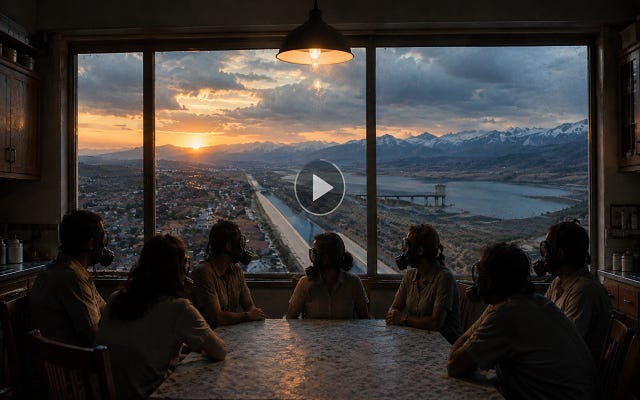
Put the electrical failure next to the water failure and the sewage failure is what you get. Put that beside the food problem and you are back in typhoid’s old postal district. Set all three beside a population that has never carried a bucket up a stairwell and the shape of the thing appears.
● Around 42 million Americans draw from private wells, most of them through submersible pumps wired to the same dead grid.
● Water utilities are the least hardened nodes in the system — thousands of small plants, thin crews, no cyber cover worth the name.
● A 100-bed hospital burns roughly 2,000 gallons of diesel a day on standby. Most hold 72 hours or less.
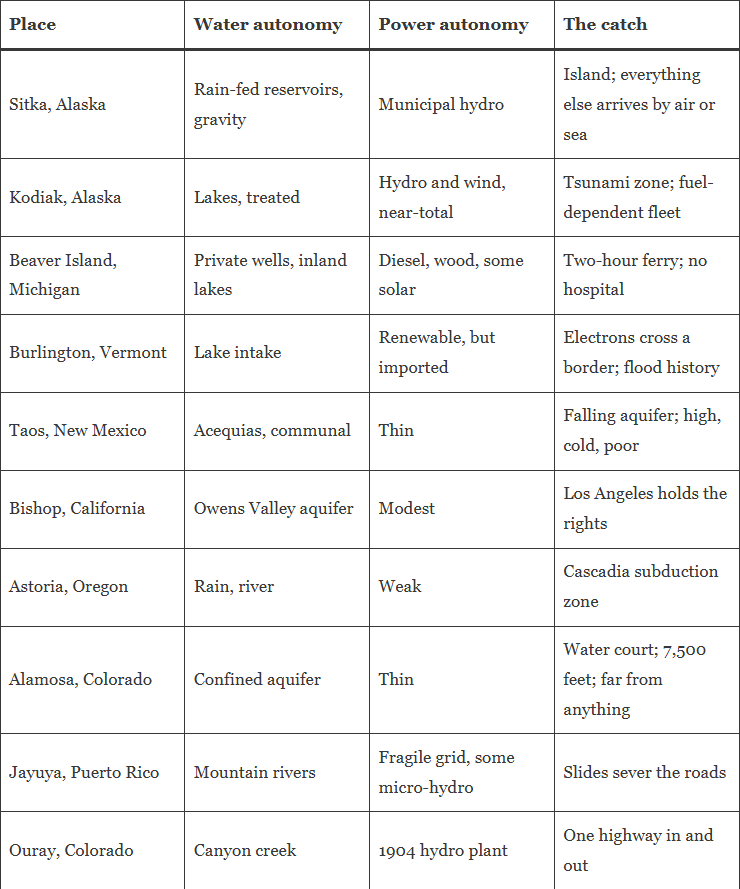
Nothing below is immune. What separates these ten places is that in each of them some link in the chain has been kept alive deliberately: a gravity source, a penstock, a turbine on a hill, a well field, a horse, a ditch, a boat, a canyon wall. Several hold assets the rest of the country abandoned in the 1950s and could not now rebuild. Others are merely hard to walk to, and that counts for more than it sounds. Not one feeds itself indefinitely. Every one would buy the same commodity — time — and the same secondary one, a reason for the neighbors to stay put.
The ledger is worth reading before the tour. Take the right-hand column as seriously as the middle.
1. SITKA, ALASKA
Blue Lake lies at the head of a valley on Baranof Island behind a concrete arch dam that the town raised in 2014, more than doubling its generating capacity in a single construction season, and the water falls from it through a penstock into a powerhouse where it leaves as roughly twenty-two megawatts of firm municipal power. The plant belongs to the citizens rather than to a holding company in Houston, and nobody in Sitka finds that arrangement strange. Hydro has run the place since the 1950s, and it is why a town of eight and a half thousand on the outer coast heats its homes and lights its harbor on falling water while the rest of Southeast Alaska burns diesel flown in at ruinous cost.
Rain does the rest of the work, somewhere north of eighty-six inches a year and most of it between October and March, filling the reservoir whether anyone is watching or not. Household supply comes off upland sources with enough head that gravity carries a good part of it, so the treatment plant needs pumps but the raw water arrives at the door on its own. Sewage is the soft joint in the whole arrangement, since both the collection system and the secondary plant want power and the standby generator wants diesel, and a winter outage in a town full of wood stoves and spruce is an inconvenience rather than a crisis only for as long as the woodpile lasts.
The fleet is real, and it is the reason the town could feed itself for a while: longliners, trollers, pot boats, a summer seine fleet, a processing row that freezes and cans halibut and salmon by the ton. The water gives up black cod, rockfish, Dungeness, shrimp and herring roe in spring; the alpine gives up deer and the muskeg gives up berries. A town that can land a thousand pounds of protein in an afternoon lives on fish and stored potatoes, and a subsistence tradition that never quite lapsed does the rest. Wheat it cannot grow and dairy it does not have. The produce aisle is a barge that arrives on Thursdays.
That barge is the fault line running under all of it. Fourteen miles of pavement end at a beach in one direction and a hatchery in the other, with no highway to anywhere, so fuel, flour, batteries, cement, ammunition and every pharmaceutical on the shelf come in by ferry or by cargo flight onto a runway that is itself on an island reached by a causeway over a tidal channel. Sitka Community Hospital folded into the SEARHC regional system in 2019 after years of bleeding money; the clinic handles what it can, and anything serious becomes a medevac to Juneau or Anchorage — a turbine, a weather window and a flight paramedic, none of which survive a fuel shortage.
Worth noticing is that nobody built the dam out of fear. Sitka chose hydro because diesel is expensive when you live on an island in a rainforest, and the cheapest electricity turned out to be the creek. The places that hold are rarely the ones that prepared for the end of the world; they are the ones that never stopped doing things the hard way because the hard way was cheaper. What that buys in practice is a harbor full of boats with no fuel dock and a medevac that waits on weather, which in a Southeast Alaska winter is most of the time.
2. KODIAK, ALASKA
Kodiak Electric Association runs a system on an island the size of Connecticut that takes better than ninety-nine percent of its annual energy from hydro and wind, with Terror Lake carrying the base load from the mountainous interior, three turbines on Pillar Mountain above town supplying the rest, and a flywheel and battery installation smoothing the transient whenever a gust drops out and the diesels have to catch. The co-op expanded Terror Lake again in 2023. Oil stays on the books for roughly the reason a careful man keeps a spare tire: he does not intend to use it, and he does not care to be without it.
Kodiak sits on the Gulf of Alaska, five hundred miles of open water from any significant market and exposed to the worst weather the North Pacific assembles, and every gallon of diesel on the island arrived by ship. The renewable buildout was a hedge against freight cost. It hardened the town as a by-product, thoroughly enough that utility engineers from the lower forty-eight now fly up to study it.
Water comes from Lily Lake and a handful of upland sources, chlorinated and pushed through a municipal system with real institutional competence behind it, the kind that shows up in dull documents about valve exercising and cross-connection control. There is a hospital, a daily jet to Anchorage, a state ferry link, and a Coast Guard base whose air station flies MH-60s and whose presence keeps the harbor surveyed and the runway maintained to a standard no fishing village would fund alone.
Then there is the fleet. It lands more value than all but three or four ports in the country: draggers, longliners, tenders, crabbers, processors, a shipyard, cold storage, and a workforce that can break down a hundred thousand pounds of cod in a shift. In a long breakdown those boats are both the food system and the merchant marine, and the first thing they lose is the fuel to run them.
The liability is written into the seabed. Kodiak sits over the Alaska-Aleutian subduction zone, the same fault that produced the 1964 Good Friday earthquake and the wave that flattened Crescent City, California, from three thousand miles away, and a near-field rupture gives the town perhaps twenty minutes. Downtown is largely on high ground, since the 1964 wave killed people and took the harbor rather than the hillside, but the harbor, the canneries, the fuel farm and the airport all lie in the run-up. Every one of those assets is a single event away from being scrap. What is left is an almost unbreakable electrical spine, an abundant sea, and twenty minutes of warning on a wave nobody can outrun.
3. BEAVER ISLAND, MICHIGAN
From Charlevoix the ferry runs a little over two hours across open water, and when the harbor at St. James ices in a hard winter the boats stop, the strip gets plowed for a small aircraft, and in a bad enough year the only arrival is a ski plane onto the frozen lake. Beaver Island is the most remote inhabited island in Lake Michigan and holds around six hundred year-round residents — one of the smallest communities here.
Every household draws from its own shallow well and sand point on a lens of fresh groundwater in the island’s glacial till, lifted by a submersible pump that most families have thought about and a few have already replaced with a hand cylinder. The septic fields are individual enough that the outhouse never entirely left the outbuildings. Nothing central exists to fail.
Feeding itself happens the way rural Michigan has always done it, through gardens, chickens, a few beef cattle, whitefish and perch out of the lake, deer in the state forest, and the freezers a reliable grid made standard. Wood is everywhere and most houses have a stove or an insert. Two general stores between them carry a month of shelf-stable goods, supplied by the same boat that brings everything else.
Six hundred people is not a labor pool. It is a village where the volunteer fire chief is also the plumber and the school board chair, and the clinic has a nurse practitioner and no hospital, so a heart attack is a helicopter and a childbirth is a scheduled trip off in the eighth month. Fuel and propane arrive by tanker truck on the ferry, the electrical feed crosses the lake on a submarine cable that anchors and ice have cut before, and each repair is a barge and a crew and a week.
Summer cottaging cuts both ways. In July the population quintuples and the shelves empty themselves; in February it is six hundred people who all know which neighbor keeps a generator and which keeps a woodlot. The island has been iced in and cut off many times, and the habit of handling it is old.
4. BURLINGTON, VERMONT
McNeil generating station burns wood chips on the Burlington waterfront, the Winooski River turns a few turbines of its own, and Hydro-Québec’s lines come south under the international boundary carrying reservoir power; together that makes the city’s portfolio nominally close to fully renewable and about two-thirds imported. An import is only as good as the line that carries it and the relationship at the far end, and both of those are somebody else’s decision.
Water and dirt are where the city pulls ahead. Champlain supplies the intake through a treatment plant upgraded at real expense, and the surrounding valley is shallow soil and dairy country where the farm stands are a working food economy rather than decoration: the Intervale floodplain holds vegetable farms inside the city limits, there are more cows than people within twenty miles, and apples, corn, hay and maple all sit within a tank of gas. Density helps too. Burlington is walkable and organized, has run cold-weather shelters every January for decades, and has the institutional reflex of moving vulnerable people indoors before the night kills them.
Failure comes through water, twice. In July 2023 the Winooski left its banks and put several feet of brown river through the downtown, filling basements and the Intervale fields and lower floors that had never flooded, and Champlain has since risen to record spring levels. The drinking water plant sits at lake level, as lake plants must, so in a long outage its chemical feed, its filters and its pumps all stop with the raw water lapping the intake.
Buried in the renewable portfolio is a second dependency wearing the first one’s clothes. McNeil consumes on the order of a hundred thousand tons of chips a year, trucked from surrounding counties, and in a fuel crisis every logging truck in Vermont is bidding for the same diesel while the forests stay close and the skidders do not become free.
5. TAOS, NEW MEXICO
Every spring, before the snowmelt comes down, the mayordomo of each acequia calls the parciantes out with shovels and the ditches get cleaned, and it has been done this way since long before there was a United States, in an unbroken line running back through the Pueblo and Hispano communities that cut the mother ditches off the Rio Grande del Norte. An acequia is a sloping channel of earth and stone carrying water to fields by nothing but fall, governed by a weekly assembly where the mayordomo allocates turns and settles quarrels and everyone can see precisely who stands upstream.
Irrigation water that needs no pump, no meter and no utility is the most important fact about Taos in a grid failure, and allocation decided by people who live at the end of the ditch and will face their neighbors the next morning is the second. A suburb whose sprinklers depend on a booster station in another county has nothing comparable. Drinking water is less elegant, since the town system pumps from wells and the mutual domestic associations pump from theirs, though a handful of households still hold hand-dug shallow wells and cisterns and the thousand-gallon roof tote has spread through the county across two decades of drought.
Seven thousand feet of high desert brings hard freeze from October and a wood-heat culture that predates the grid by centuries, with piñón and cedar stacked in cords along every fence line in the county. Beans, chile, corn, squash and orchard fruit grow here, so do sheep and goats, and the matanza is still a calendar event. Food and warmth, in other words, are things this valley produced unaided for four hundred years, and Taos Pueblo has its own ditches and its own long discipline about water while adobe walls hold heat and cold in a way frame housing cannot.
Groundwater has been drawn down through drought and subdivision and the state engineer’s models have been unkind; deepening a well costs five figures. If the pumps stop, the shallow wells are the ones that survive and the deep ones are the ones that matter, and that inverts the usual logic of wealth. Santa Fe is ninety minutes of two-lane away, the county hospital is small, and stored fuel is a luxury at local income levels.
Acequias also have a ceiling. They water fields; they do not pressurize a fire main and cannot be drunk from unboiled. The valley would eat. Whether it could keep itself clean is a different question.
6. BISHOP, CALIFORNIA
Owens Valley water is the most famous theft in the American West, and Bishop sits in the middle of the proceeds. Agents of the City of Los Angeles began buying ranch land and its appurtenant rights in 1905 and then built the aqueduct that still carries the valley’s surface flow four hundred miles south, the lake went, the dust blew, and the county has been in litigation ever since with resentments that are hereditary.
That history is also the reason the arrangement, bitter as it is, can be read. Bishop’s water is metered, adjudicated, monitored and contested in open court rather than hoped for, the town and the surrounding ranches hold rights Los Angeles must respect under the 1991 Long Term Water Agreement, and the aquifer is watched by a permanent monitoring network. Paper would matter less than the physical fact underneath it in a breakdown. Water lies close to the surface in a valley floor irrigated for a century, and a good deal of it can be reached with a shallow pump or a hand auger.
Agriculture is real and not decorative: cattle, alfalfa, onions, garlic, fruit, an auction yard moving thousands of head a year, packing sheds, cold storage, and generations who know how to put up a winter. The Sierra wall stands to the west and the White Mountains to the east with the whole valley threaded by a single highway, US 395, running north to Reno and south toward the Mojave.
That wall cuts two ways, keeping much of the traffic out in a crisis and making Bishop a chokepoint for anyone trying to cross the range, since the eastern Sierra has been a corridor since the cattle drives and a fuel shortage turns a corridor into a funnel. The town also sits in a live seismic belt along the Sierra’s eastern front, and the aqueduct is a gravity concrete channel that a decent shaker will crack.
At four thousand feet with single-digit humidity a carcass hangs, a roof does not rot and disease travels badly. Los Angeles will want its water back, and the aqueduct runs south.
7. ASTORIA, OREGON
Sixty-five to seventy inches of rain a year fall on Astoria, which sits at the mouth of the Columbia where the discharge is second only to the Mississippi’s in the lower forty-eight, so water is not the constraint here; water is the atmosphere.
The town climbs a steep hillside above the river in tight tiers of Victorian frame houses, with a commercial spine along a waterfront of piers, canneries and a trolley line. Fishing founded the place and fishing survives in it, through salmon, tuna, Dungeness and a charter fleet, alongside the largest concentration of cold storage between San Francisco and Seattle. Cisterns and roof catchment are common enough in Clatsop County that the hardware stores stock the fittings, and the surrounding hills are second-growth spruce and hemlock with a great deal of deadfall.
The river is a highway as well as a fishery — the reason Astoria exists at all — and barges, gillnetters and tugs give the town a working relationship with waterborne freight that most coastal towns lost a century ago. Anything that floats reaches Astoria from the interior without touching a road.
The last full Cascadia rupture came in January 1700, and the average interval runs between two and six centuries, which leaves the current gap at three hundred and twenty-six years and counting. Models put the shaking high enough to take the older unreinforced masonry downtown and much of the hillside’s unbraced foundation housing, while the riverfront, built on fill and old pilings, liquefies. A local tsunami arrives twenty to thirty minutes after the shaking stops and the Youngs Bay and Columbia bridges would be suspect for weeks. Landslide is the more frequent hazard; the hillside gives way in ordinary wet winters and has killed people.
Everything needed to live is here — water, fish, wood, boats, soil, a temperate climate — arranged on ground that may rearrange itself in half an hour. Survival would come down to which tier of the hillside a person was standing on when it opened.
8. ALAMOSA, COLORADO
Seven thousand five hundred feet up in the San Luis Valley, Alamosa is a town of nine thousand in a high desert basin the size of Connecticut, ringed by the Sangre de Cristo to the east and the San Juans to the west, with a growing season short enough that the nights stay cold in July. Potatoes, barley and alfalfa dominate the fields and the valley ships seed potatoes nationally while growing a great deal of its own calories.
Water arrives from the Rio Grande and from the confined aquifer under the valley floor, and that aquifer is the valley’s entire argument with itself. State rules require the basin to retire enough pumping to restore the river and the unconfined system, thousands of irrigated acres have been dried up under the resulting plans, wells are metered and the water court stays busy. None of the paperwork reassures anyone during an outage, though the physical endowment beneath it is enormous and the knowledge of ditch irrigation, pivots and gravity has not been lost.
Denver is three and a half hours over two passes. There is a small university, a regional medical center and a rail line, and empty country in every direction. Cold is enemy and friend together, killing the unprepared while preserving the harvest in cellars and sheds built for hard frost long before refrigeration.
Something else lives here that no brochure mentions. The valley absorbed the farm crisis of the 1990s, the adjudications and the slow strangling of the acequia commons, and it kept its mutual-aid culture through the churches and the old mutualistas without ever believing the state would ride in. The altitude does the rest of the work in both directions.
9. JAYUYA, PUERTO RICO
Hurricane Fiona came ashore on the southwest coast in September 2022 and crossed the island diagonally, and in the Cordillera Central it did what saturated mountains do, sending the slopes above Jayuya down in slides that took out roads, buried houses and cut the municipality off for days. It was not the first time and will not be the last. The whole island lost power in a single cascading failure in April 2025, and Puerto Rico has lived with a brittle, under-maintained grid and a privatized operator since the old authority handed over.
Jayuya sits in the heart of that range around fifteen hundred feet up, in green country of coffee, plantain and citrus threaded by the Rio Grande de Jayuya and its tributaries off the ridgeline. Rivers run fast and clean above the town and small intakes and gravity lines serve the rural barrios, springs break out of the mountainsides, the shade canopy over the coffee holds soil, and the hillsides have been planted in a way that has kept them from washing away for two centuries.
The old hydro works in the Cordillera are small and battered but they exist, and micro-hydro on a private intake never died out among the campesinos who could afford a penstock and a turbine. Solar with battery spread after Maria, rain catchment is universal, and a pig, a few hens and a plantain patch are the pantry rather than a lifestyle.
Barrio-level mutual aid moved within hours in 2017 and again after Fiona, ahead of any official response: the church, the junta de vecinos, the informal network of people with a generator and people with a chainsaw. In a grid failure that network is the actual government.
Two mountain two-lanes come in, both with cut slopes above them, and both close in heavy rain. A slide is a maintenance event rather than an abstraction. Cut off, the town has food, water and neighbors, and no hospital, no fuel, and a coffee harvest that has to move downhill somehow.
10. OURAY, COLORADO
The Ouray Hydroelectric Plant went into service in 1904 on Canyon Creek and has run, with interruptions, ever since, one of the oldest continuously operating stations in the country and the reason a town of a thousand people at the head of a box canyon had electric light before most cities did. The penstock comes down the canyon wall, and the water is the Uncompahgre River, which is also the town supply and also, in spring, its flood.
Ouray sits at 7,800 feet in a canyon tight enough that the main street is the highway and the highway is the only way in or out, with US 550 climbing south over Red Mountain Pass at 11,018 feet toward Silverton and running north to Ridgway, both directions closing for avalanche control in winter and sometimes for days. A hot-springs resort and an ice-climbing destination, the town keeps a Victorian core of brick and stone and a hillside of frame houses.
Two things make it more than a pretty trap. Hot springs at 150 degrees feed the municipal pool and could feed a district heating loop, with the wells and plumbing already in place. The plant is small but firm and does not care what the grid is doing.
Winter closes the pass while stacking the following summer’s water supply into the creek. Avalanche paths reach the edge of the built area and the state fires howitzers on Red Mountain every storm cycle, and the 2018 fire above town stripped the watershed until the debris flows came the next summer.
When Red Mountain closes, the town is a thousand people and a creek, and the road that would carry anything in is under six feet of snow.
WHAT THE BRIDGE LEAVES STANDING
The photograph shows the arithmetic without arguing it. Lamps dead in a line going away, black water moving underneath, roofs on the far shore with nothing behind the glass, and nobody arriving today to put any of it right. Somewhere on that island a man has a hand pump and a case of water. Somewhere else a woman is filling five-gallon buckets from a bathtub she filled on the first morning because she remembered, and a third person who did not remember is walking to the school to see whether the gym has been opened.
Everyone in this list is a variation on those three. A penstock, a flywheel, a sand point, a ditch bank, an auger, a skiff, a turbine — none of it is heroism and none of it arrived by foresight. It is maintenance, the residue of decisions taken while the grid was fine by people who still chose to keep the gravity feed, the well, the boat, the woodlot, the roster of who owns a generator.
The rest of the country traded that residue for convenience across seventy years and called the trade progress, which was true for as long as the pumps ran. The bill comes at the pump, the tap and the floor drain in the basement, in the order the water fails, and hydraulics does not negotiate the order.
What these ten places actually prove is narrower than safety and more useful than a promise. The knowledge still exists here, scattered and unglamorous, in fishing towns and farming valleys and mountain villages where nobody got around to centralizing the water. A person can learn most of it in an afternoon, and a town can keep it running with a wrench and a stubborn streak.
Anyone can join.
Anyone can contribute.
Anyone can become informed about their world.
"United We Stand" Click Here To Create Your Personal Citizen Journalist Account Today, Be Sure To Invite Your Friends.
Before It’s News® is a community of individuals who report on what’s going on around them, from all around the world. Anyone can join. Anyone can contribute. Anyone can become informed about their world. "United We Stand" Click Here To Create Your Personal Citizen Journalist Account Today, Be Sure To Invite Your Friends.
LION'S MANE PRODUCT
Try Our Lion’s Mane WHOLE MIND Nootropic Blend 60 Capsules
Mushrooms are having a moment. One fabulous fungus in particular, lion’s mane, may help improve memory, depression and anxiety symptoms. They are also an excellent source of nutrients that show promise as a therapy for dementia, and other neurodegenerative diseases. If you’re living with anxiety or depression, you may be curious about all the therapy options out there — including the natural ones.Our Lion’s Mane WHOLE MIND Nootropic Blend has been formulated to utilize the potency of Lion’s mane but also include the benefits of four other Highly Beneficial Mushrooms. Synergistically, they work together to Build your health through improving cognitive function and immunity regardless of your age. Our Nootropic not only improves your Cognitive Function and Activates your Immune System, but it benefits growth of Essential Gut Flora, further enhancing your Vitality.

Our Formula includes: Lion’s Mane Mushrooms which Increase Brain Power through nerve growth, lessen anxiety, reduce depression, and improve concentration. Its an excellent adaptogen, promotes sleep and improves immunity. Shiitake Mushrooms which Fight cancer cells and infectious disease, boost the immune system, promotes brain function, and serves as a source of B vitamins. Maitake Mushrooms which regulate blood sugar levels of diabetics, reduce hypertension and boosts the immune system. Reishi Mushrooms which Fight inflammation, liver disease, fatigue, tumor growth and cancer. They Improve skin disorders and soothes digestive problems, stomach ulcers and leaky gut syndrome. Chaga Mushrooms which have anti-aging effects, boost immune function, improve stamina and athletic performance, even act as a natural aphrodisiac, fighting diabetes and improving liver function. Try Our Lion’s Mane WHOLE MIND Nootropic Blend 60 Capsules Today. Be 100% Satisfied or Receive a Full Money Back Guarantee. Order Yours Today by Following This Link.


| Visits: | 1,836,497,797 |
| Stories: | 8,728,816 |
Whistler Blowers, Insiders

