

5 Reasons China Could Shock the World- An Early Warning for America, Still Sitting Unread!

The numbers stopped arriving before the towers stopped filling. Order matters, because a country that can hide a bust can also choose the hour it breaks, and the rest of the planet stands inside the blast radius holding a two-week supply of everything it needs.
7.92 million.
That is the entire crop of children China registered in 2025, the lowest count since the People’s Republic began keeping records in 1949, released inside a January data dump by clerks who typed it with the enthusiasm of men filling out customs forms. Down 17 percent in twelve months. Measured against 11.31 million deaths, the ledger closes with a net loss of 3.39 million people, the fourth straight year of contraction and a faster bleed than the one before it.
Demographers had the curve on paper for thirty years. Watching it arrive on schedule, ahead of schedule, is another matter entirely.
Walk the outer ring of any second-tier city at dusk and the arithmetic turns physical. Thirty-storey slabs stand finished and dark, windows unlit, ground floors unleased, car parks growing thistles through the asphalt seams. Five years old, many of them. Plenty never held a tenant. Independent counts of vacant stock have bounced around for a decade, and the honest band sits between 60 and 90 million empty units — homes for a nation a third larger than China already is.
Behind those towers sits a building industry that quit building. Real estate investment fell 19.9 percent through the first eight months of 2026 while new commercial floor space sold dropped 12.1 percent, and property stocks have surrendered roughly 90 percent of their value since the 2021 peak, trading at levels last seen two decades back. The market has already voted on the next ten years regardless of what gets said at any podium. (Millions Are Watching This Strange AI Documentary Right Now- FULL VIDEO. Was Meant To Stay Hidden… Don’t Watch If You’re Not Ready)
Corporate history’s largest failure keeps grinding through the courts. Evergrande carried $300 billion in liabilities across 1,300 projects in 280 cities, employed a workforce the size of a small European state, and slid into liquidation before a Hong Kong judge in January 2024. Hui Ka Yan, the founder and once the richest man in the country, drew a life sentence in August 2026 for financial crimes. Vanke, the last developer treated as a national benchmark, posted a record annual loss of 89 billion yuan. Country Garden only finished restructuring its dollar bonds at the end of 2025, and only by stretching maturities past the horizon where any offshore creditor feels whole.
Households park the bulk of their wealth in brick, between 60 and 70 percent by most estimates against roughly a quarter in America. Strip value off the brick and the family loses its appetite to spend. Once the family stops spending, the factories supplying it cut shifts. Retail growth has limped for three years while consumer prices hover near zero and dip negative in some months, a pattern macroeconomists once attached to Japan in the 1990s and now discuss about China in the present tense.
Exports became the pressure valve, and they get used like one. Goods surpluses have run at records that would have looked fictional a decade ago, with shipments shoved into every open market on earth at prices domestic producers survive only because Beijing subsidizes the electricity, the land, and the credit underneath them. That arrangement holds until it doesn’t. Trading partners absorb cheap steel, cheap cars, cheap panels for a season or two; then their own plants close, their own governments reach for duties, and the valve narrows while the home market stays shut.
Wheat, gas, oil, copper concentrate, soybeans — the import book has swollen to volumes that make agricultural and freight markets flinch. Deals signed with Moscow during the Ukraine war rerouted energy and grain flows that had held steady for forty years. Long-term contracts were priced above market in exchange for reliability, pulling tonnage off the open market for everybody else, and the countries left bidding in the spot pit are the ones with the least capacity to pay.
Measurement itself became the casualty. Youth unemployment was suspended in August 2023 at a record 21.3 percent and restored months later under a methodology excluding students, which knocked the headline down by a third overnight. Corporate registries narrowed to outsiders. Foreign due diligence firms got raided, their local staff questioned, their leases abandoned. Land auction results, provincial fiscal transfers, and financing vehicle debt all grew harder to rebuild from public sources, and what still appears arrives later, thinner, and increasingly through outlets with a stake in the outcome.
Publishing stops once the story needs managing, and what hangs on this particular story is whether 1.4 billion people still believe the future deserves the wait.
Pension actuaries have published depletion dates in the 2030s. The national pooling reform of 2022 pushed the date out by moving coastal surpluses toward interior deficits, a transfer rather than a repair. Retirement ages rose for the first time since the 1950s, phased from January 2025 toward 63 for men and 55 to 58 for women, announced with visible reluctance because it is the most unpopular thing a state can do to a population that planned around the old arithmetic.
Underneath the demographics sits the debt. Officially acknowledged hidden municipal obligations have been cut on paper from 14.3 trillion yuan at the end of 2023 to a claimed 6.5 trillion, mostly by swapping them into longer-dated official bonds, a maneuver that moves the maturity calendar and leaves the principal untouched. The IMF reads the same landscape at $10.5 trillion in financing vehicle exposure and stays unpersuaded by the swap. Provinces pay contractors in IOUs, stretch invoices past a year, freeze hiring, and get told to grow anyway. The 12 trillion yuan package from late 2024 is a rescheduling dressed as stimulus.
Put the pieces side by side and a shape comes out of them: property in ruins, a workforce in retreat, debt rescheduled instead of repaid, consumers waiting for prices to fall further, a statistical service that goes dark the moment a figure embarrasses. Trouble in one place aggravates the next. Falling prices make the debt weigh more. Debt produces infrastructure that then has to be justified. Justification depends on land auctions that dried up once land stopped being worth anything. Land stopped being worth anything because the towers built on it quit selling, and the towers quit selling because the buyers quit being born.
America watched this build for four years and answered mostly with tariffs, export controls, and a self-congratulatory decoupling story the trade data contradicts. China’s direct share of US goods imports fell from 21.6 percent at the 2017 peak to 7.4 percent in the first half of 2026, a genuine and historic shift. Value added embedded in those imports barely budged, because the Vietnamese and Mexican plants that replaced Chinese ones import Chinese components, Chinese machinery, Chinese intermediate goods to do the assembly. The label moved. The dependency sat still.
Five cracks run through the structure and each one carries a route to American soil. Load paths rather than prophecies: the channels by which a domestic Chinese failure becomes a foreign problem, already visible, already weighted, waiting on a trigger hardly anyone has pulled.
BENEATH THE BOOM: WHAT BEIJING STOPPED SAYING OUT LOUD
A country of 1.4 billion hides plenty behind a wall of silence for a while. Currency controls slow capital’s exit, state banks absorb the losses of favored borrowers, and market size lets a producer bleed for years before the balance sheet forces anything. The limit stays administrative only until the absorbed losses exceed the capacity of the absorber, and outsiders can’t see how close that line sits because the measurement became voluntary.
Statistics in China were political instruments long before they were economic ones. Officials get promoted on targets set above them, so the incentive to shade a figure has run continuously since the command economy began. The Great Leap Forward turned that incentive into a mass casualty event, with grain output inflated, procurement set against the inflated numbers, and the shortfall absorbed by the people who had to eat. Somewhere between 15 and 45 million died depending on whose reconstruction you accept. Managing the data so the targets survive was the lesson Beijing drew, more than any lesson about corrupt figures.
Modern Chinese statistics beat the caricature in most places. Industrial output, customs declarations, electricity load, and rail freight get collected with real rigor, and customs figures resist faking because they must reconcile against partner-country records. What degraded is the category touching legitimacy — jobs for the young, municipal finances, land auctions, anything readable as a verdict on the leadership.
The youth unemployment suspension stands as the cleanest specimen. June 2023 brought 21.3 percent for ages 16 to 24, a rate that had tripled in four years and described roughly a hundred million people with nothing to do. Two months later the bureau paused the series for a methodology review. It returned in early 2024 excluding students, a defensible choice and a convenient one, and the rate settled into the mid-teens before climbing to 18.9 percent in August 2026 and easing to 18 percent in September. Today’s figure is real and it measures a different population than the one suspended, which leaves the four-year trend that scared everybody without a direct comparison.
Registries went next. Researchers and credit analysts used to pull shareholder structures, registered capital, and litigation records from provincial databases. Access narrowed through 2023 and 2024, sometimes to a login wall, sometimes to blank. Then came the raids: Mintz Group’s Beijing office in March 2023 with five local staff detained, Capvision two months later, and a wider campaign of on-site questioning that convinced a dozen advisory firms to shrink their China footprint. Due diligence is the plumbing of foreign investment. Throttle the plumbing and capital arrives blind.
Land finance data thinned behind it. Private providers once tracked provincial auction results in near real time, which is how analysts built early warning on municipal solvency. Those providers now publish less, later, with gaps, and the underlying platforms consolidated under closer supervision. Anyone modeling which province sits closest to a payment crisis works from a mosaic with pieces missing.
The trade has a name for this — suppression by omission. Cheaper than lying, harder to catch, because a missing data point resists falsification. A government that stops publishing a jobless rate hasn’t told a lie. It has made the truth temporarily unknowable, and unknowable holds a market for a quarter.
Second-order effects outrank any single series. Once one number goes dark, traders start pricing the darkness. Every later release tests whether the last gap was a one-off, and every weak release reads as the tip of something larger. Bond markets did precisely this, pushing long-dated yields to levels implying nominal growth far below the official target. Proof of collapse never became necessary. Suspicion that the people who would know had chosen silence carried the load.
Inside the country the information diet gets curated at a scale hardly any other economy attempts. The firewall shapes what a billion people reach. Search results get scrubbed, platforms moderated by algorithm and human queue, financial journalism run under weekly directives naming which words to avoid. A blogger posting video of an unfinished block can find the clip circulating widely on Monday and delisted quietly by Thursday. Citizens end up knowing a great deal about the flattering parts of the picture and very little about why their own flat lost a third of its value.
That gap produced a cultural response the Party wanted less than the alternative. Graduates who can’t find work and can see the vacancy rate in their own stairwell stopped reading the shortfall as personal failure. The vocabulary they invented for it — lying flat, letting it rot, the salted fish — describes a rational exit from a rigged game. Marriage registrations fell to 6.1 million couples in 2024, a forty-year low, and the line to the birth collapse is arithmetic rather than mood: fewer weddings, fewer children, a cohort that priced the whole enterprise and declined.
Beijing answered with exhortation. Campaigns against workplace involution, drives to shorten the 996 schedule, cash bonuses for second and third children, mortgage rate cuts, and a stream of official optimism about consumption recovery that keeps failing to arrive. The three-child policy replaced the two-child policy in 2021 and births fell every year afterward. Policy lifted the legal ceiling and discovered the ceiling had never been the constraint. Housing costs, childcare costs, credential inflation, and a collapsing marriage market were.
Censorship makes correction harder because feedback needs a signal and the signal gets damped. A provincial official with falling revenue learns the problem from his own bank balance, then reports upward what the center wants to hear. The center sets policy against a picture smoothed twice on the way up. By the time divergence surfaces, intervention comes late and the cost has compounded.
Foreign governments now read China through a fog of their own making, forced onto proxies: satellite imagery of construction sites, ship tracking, load curves, bond spreads, the earnings calls of multinationals with mainland subsidiaries. Every proxy is noisy and every one is partial. The central bank can move a rate on Tuesday and hardly anybody can say with confidence whether the move answers a growth problem or a liquidity problem, because the data that would separate them sits behind a delayed release or vanished altogether.
They Know What’s Coming. You Don’t. Most Americans Aren’t Ready for This. Watch the Video Below!

That crack matters more than the other four because it makes them lethal. Every market lending to China, selling into China, buying from China, or holding Chinese paper now decides on partial information and calls it analysis.
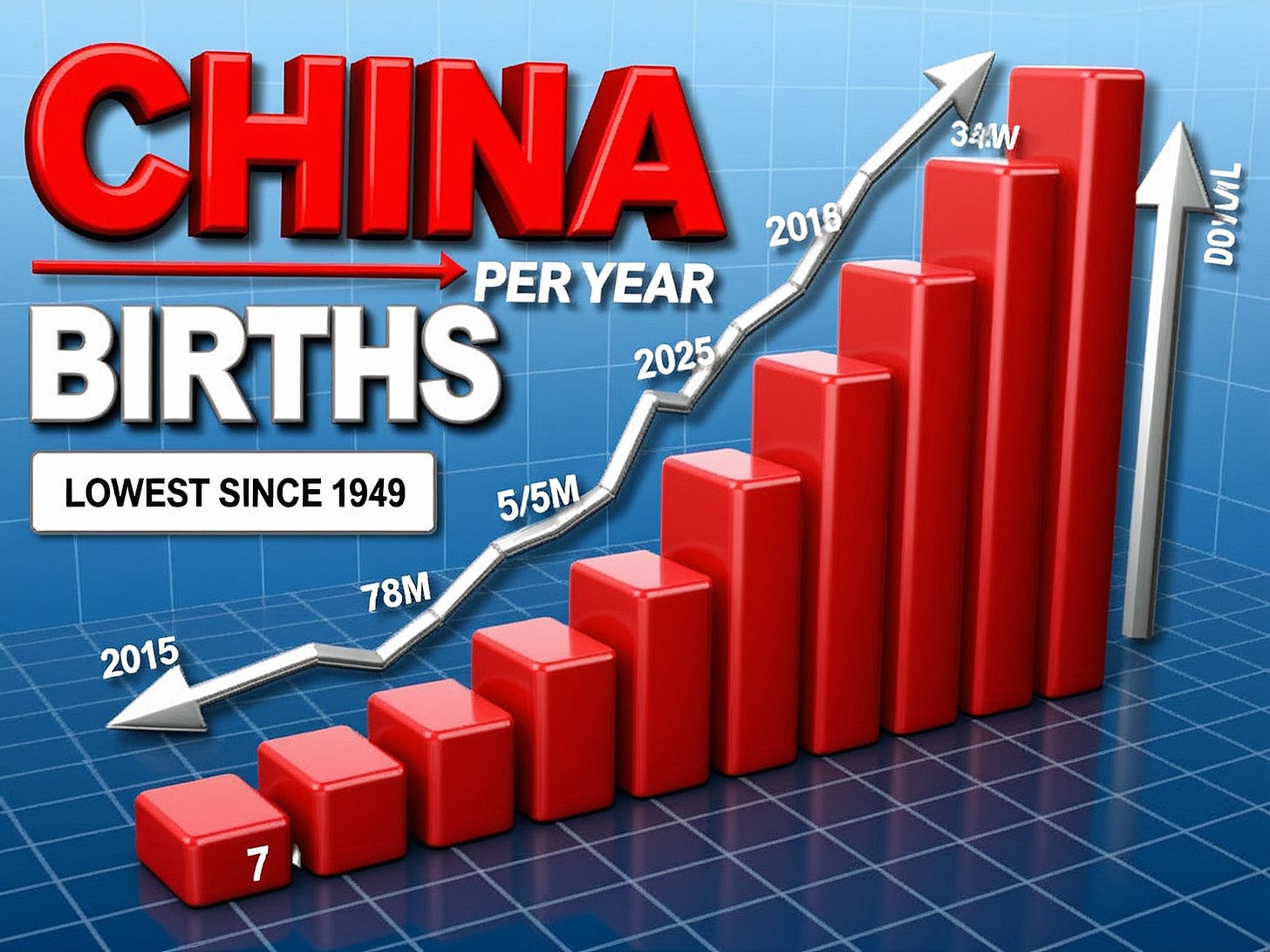
REASON 1 — A NATION THAT STOPPED REPRODUCING ITSELF WHILE STILL POURING FLOORS FOR THE CHILDREN WHO WILL NEVER ARRIVE
The working-age population contracts while the over-65 cohort clears 200 million and keeps climbing. A subway line built for five million riders that will serve three million by 2040 doesn’t default, yet it fails to justify itself either. Bonds still mature. Stations still need staffing. Depreciation still accrues against a city that stopped growing in the year the concrete cured.
Two decades of the growth model ran on one dominant transmission channel, and it was a cement truck. Local leaders competed on GDP because GDP produced promotions, and the shortest road to GDP went through pouring. Roads, airports, stadiums, convention centers, subway extensions, and above all housing. Land sales funded the local budget, developers funded the land sales with pre-sale money from buyers, and buyers funded the pre-sales with mortgages repaid out of wages that were rising because the construction employed everyone. The loop fed itself and ran for twenty years.
A 1994 fiscal reform centralized tax revenue and left spending obligations with the provinces. Municipalities had to fund schools, clinics, roads, and payrolls from a tax base that had been pulled up to the center, and the only asset they controlled outright was land. Auctioning use rights to developers became the primary revenue line in most cities, at times approaching 40 percent of local income. Officials thus became partners in the bubble rather than regulators of it.
Shantytown redevelopment poured accelerant on the fire. From 2015 the central bank funded a program that demolished dilapidated urban housing and handed displaced owners cash vouchers to buy new units, converting a public works scheme into a demand shock concentrated in exactly the cities holding the most unsold stock. Prices doubled in some places within two years. Families watched the doubling, concluded that property was the only reliable store of value in a country with capital controls and a volatile equity market, and started buying second and third units as savings vehicles rather than shelter.
There sits the mechanism behind the vacancy statistics. A nation distrusting its own stock market and unable to move money abroad easily parks wealth in the one asset it can touch. Seven percent of households own shares against more than half in America. Property became the national savings account, and the national savings account was priced on the assumption that a next buyer would always exist.
The three red lines of 2020 broke that assumption on purpose. Beijing capped developer borrowing against debt, equity, and assets in a deliberate attempt to deflate the sector before it grew large enough to threaten the banks. Evergrande breached all three thresholds at once and discovered its entire business model depended on rolling short-term obligations with proceeds from units it had not built. When the roll stopped, the cranes stopped.
The pre-sale system finished the job. Buyers typically pay for an apartment years before completion, handing over the full price in installments against a hole in the ground. Such an arrangement amounts to an enormous unsecured loan from households to developers, and it leaves the buyers of unfinished projects as creditors with nowhere to sit in the queue. Estimates of pre-sold but undelivered units have run into the millions. When buyers in dozens of cities collectively announced in 2022 that they would stop paying mortgages on buildings that had stopped rising, the government had to invent a delivery guarantee program on the fly.
Evergrande’s numbers deserve a slow reading because they describe the scale of what counted as normal.
-
1,300 projects spread across more than 280 cities, with 2.8 million people employed directly and indirectly through the supply chain
-
$300 billion in liabilities distributed across suppliers, contractors, banks, trust products sold to retail savers, and offshore bondholders who bought in dollars
-
89 billion yuan in annual losses at Vanke, the last developer held up as a national benchmark
Default scattered the loss across the whole chain rather than parking it in one place. It sprayed outward into a supply chain of small firms financing the concrete pour on credit and into a retail investor base holding the wealth management products wrapped around it. The liquidation has run since January 2024 and will run for years. Hui Ka Yan’s life sentence closed the personal story and settled nothing about the assets, most of which sit on the mainland where the Hong Kong order has limited reach. Recovery rates for offshore creditors are expected to be brutal, and the message those rates send to every future investor in a Chinese developer is that the offshore claim ranks junior to whatever the local state decides to prioritize.
Country Garden came close to the same cliff and chose a different exit, negotiating a dollar bond extension that pushed repayment years forward. Vanke survived on the strength of a state shareholder and still posted its record loss. Uniformity marks the sector: a handful of survivors held up by the state, a large population of shells with no capacity to start anything, and a buyer base that lost faith in the delivery guarantee itself.
Empty towers belong to municipal finance as much as to property, because the roads and subway lines and convention centers were built on the assumption that the towers would fill and generate the business rates and consumption that service the debt. A district holding thirty thousand unsold units doesn’t need a second subway station, yet the second station sits under construction and the bonds are already issued.
Geopolitics sits inside the overbuild in a way that gets missed. Chinese steel capacity was built to feed this construction, roughly half the world’s output, and when domestic demand fell the surplus went abroad. Steel exports hit multi-year highs. Cement followed. So did the finished goods that go into buildings — glass, tiles, aluminum extrusions, sanitary ware, air conditioners. Trading partners watched their own producers get undercut by goods priced off a domestic market in deflation, and the tariff wave that followed in 2024 and 2025 was partly a reply to exactly this displacement.
Deflation outlives the property collapse that caused it. When asset prices fall, families delay purchases in expectation of further falls, and when purchases get delayed, producers cut prices to move stock, which validates the expectation. Three years of consumer prices hovering near zero, and longer still of negative producer prices, follow from that logic. Firms exporting into the resulting glut survive only on volume, and volume requires open markets that keep closing.
Beijing has tried nearly everything short of the one measure analysts keep recommending. Mortgage rates got cut repeatedly. Down payment requirements came down. Purchase restrictions in major cities lifted in stages. Municipalities were told to buy unsold stock and convert it to rental housing, a program moving slowly because the municipalities doing the buying are the ones with no money. Direct cash transfers to households, the tool that produced the fastest recoveries elsewhere, stayed small and targeted rather than broad.
Ideology explains part of that and the reasoning isn’t irrational from Beijing’s vantage. Handouts feel like consumption without capacity building, and the leadership has spent a decade insisting the future belongs to manufacturing, technology, and self-reliance rather than services and shopping. Money into semiconductors and electric vehicles protects the strategic position. Money into household bank accounts protects the political one, because a population with cash and no debt relief starts asking why the debt exists.
Concrete stays poured, the towers stay dark, and the debt that built them sits on municipal balance sheets disguised as the assets that were supposed to repay it.
REASON 2 — THE MAGNETS IN THE MISSILES: A MINERALS CHOKEHOLD TIGHTENED ONE LICENCE AT A TIME
Rare earths aren’t rare. Cerium, lanthanum, neodymium, and praseodymium are more abundant in the crust than copper or silver. Geology was never the obstacle. Separation is dirty, chemically fussy, capital-hungry, and takes about a decade to stand up from a cold start.
China built that capacity while everyone else let theirs rot, and did it for reasons combining foresight with the incidental advantage of not caring much about tailings ponds. The result is a position close enough to monopoly to be used like one. Roughly 60 percent of global mining, nearer 90 percent of refining, and effectively all processing for the heavy rare earths that go into fighter jet magnets, missile guidance, wind turbine generators, and the traction motors of electric vehicles.
Controls arrived in stages, each calibrated to a specific pressure point. Gallium and germanium in August 2023, aimed at compound semiconductors and fiber optics. Antimony and graphite in 2024. Then the heavy package in April 2025: seven medium and heavy rare earths plus their magnets, licensing requirements for exports, and a rule reaching extraterritorially — a product made in Germany with Chinese-origin magnet material needed Chinese permission to be sold onward. October 2025 brought holmium, thulium, europium, ytterbium, lutetium, and silver, with extraterritorial enforcement held in abeyance until November 2026.
Effects have been measurable and precisely what the designers intended. Through the first ten months of 2026, overseas buyers paid 46.4 percent more for 8.7 percent less tonnage. Cumulative exports through August fell 11.1 percent year on year to 39,441 tons while dollar value climbed 53.5 percent. Japan, one of the most sophisticated buyers on earth, received 4,000 kilograms of yttrium oxide in September 2026 against 51,000 kilograms a year earlier. Shipments to the United States collapsed from a pre-control monthly baseline in the hundreds of tons to 6 tons in August, recovering to 38 tons in September, still a fraction of normal.
-
Volumes fell, prices climbed, and the licensing queue stayed parked in Beijing, where it shortens for a friendly buyer and stretches out for an unfriendly one
-
Roughly 6 to 12 years are needed to stand up a full non-Chinese chain, against airframe programs that run 30
-
Mountain Pass in California can produce ore and still ships concentrate to China for separation
Defense policy, rather than industrial policy, is where magnets put this. A neodymium-iron-boron magnet weighing a few hundred grams sits in the fin actuation of a missile, the radar array of a fighter, the drive motor of a submarine. China produces the overwhelming share of them, and Pentagon stockpile assessments have flagged the dependency for years while substitute programs moved at the speed of appropriations cycles. The separation circuit at Mountain Pass is being rebuilt and isn’t at scale, and even at scale it covers light rare earths rather than the heavy ones that matter most.
Substitution responses are real and slow. Australia, Japan, Canada, and the United States all fund projects. Every defense ministry on the planet meanwhile buys magnets out of the same constrained pool and pays whatever the pool demands.
Behind the minerals sits a broader structural fact Washington has spent a decade arguing away. China makes roughly 30 percent of the world’s manufactured goods by value, more than the next several countries combined, across a range wide enough that the number matters less than the composition. Fasteners, bearings, castings, printed circuit boards, power supplies, cable harnesses, hydraulic fittings, and the tooling that makes all of them. Final assembly can move to Vietnam. The components underneath it mostly can’t.
Tariffs in 2025 and 2026 moved the surface of trade violently. US goods imports from China fell nearly 30 percent in 2025 to $308.7 billion, and China’s share of total US goods imports dropped to 7.4 percent in the first half of 2026. Vietnam’s share rose from 2 percent in 2017 to 5.7 percent in 2025. Mexico’s rose. Taiwan’s rose on semiconductors and AI hardware. Read alone, the headline suggests decoupling has worked.
Value added tells the other story. Stanford found that while China’s direct import share fell from about 21 percent to 16 percent between 2017 and 2022, its share of the value added inside those imports slipped only from 15.7 to 15.3 percent. Parts still originate in China. The label gets applied in a third country. A tariff on Chinese finished goods is a tariff on assembly, and assembly is the cheapest link in the chain.
Which leaves 7.4 percent both true and misleading. A warehouse in Long Beach receiving a container stamped Made in Vietnam receives a box whose contents were largely made somewhere else, and the dependency it represents amounts to far more than a seventh of the import base. Chains got rerouted around a tariff line without being rebuilt around a capability.
Pharmaceuticals carry the identical structure with higher stakes. China is the largest producer of active pharmaceutical ingredients and supplies roughly 40 percent of global volume, much of it to India, which supplies a fifth of the world’s generic medicines by export value and manufactures 60 percent of the world’s vaccines. Cut the Chinese API feed and Indian generic production starves within a quarter, with pharmacy shelves emptying roughly two quarters after that. Every hospital procurement office knows it. Solving it means paying more for the same molecule, which is why nobody has.
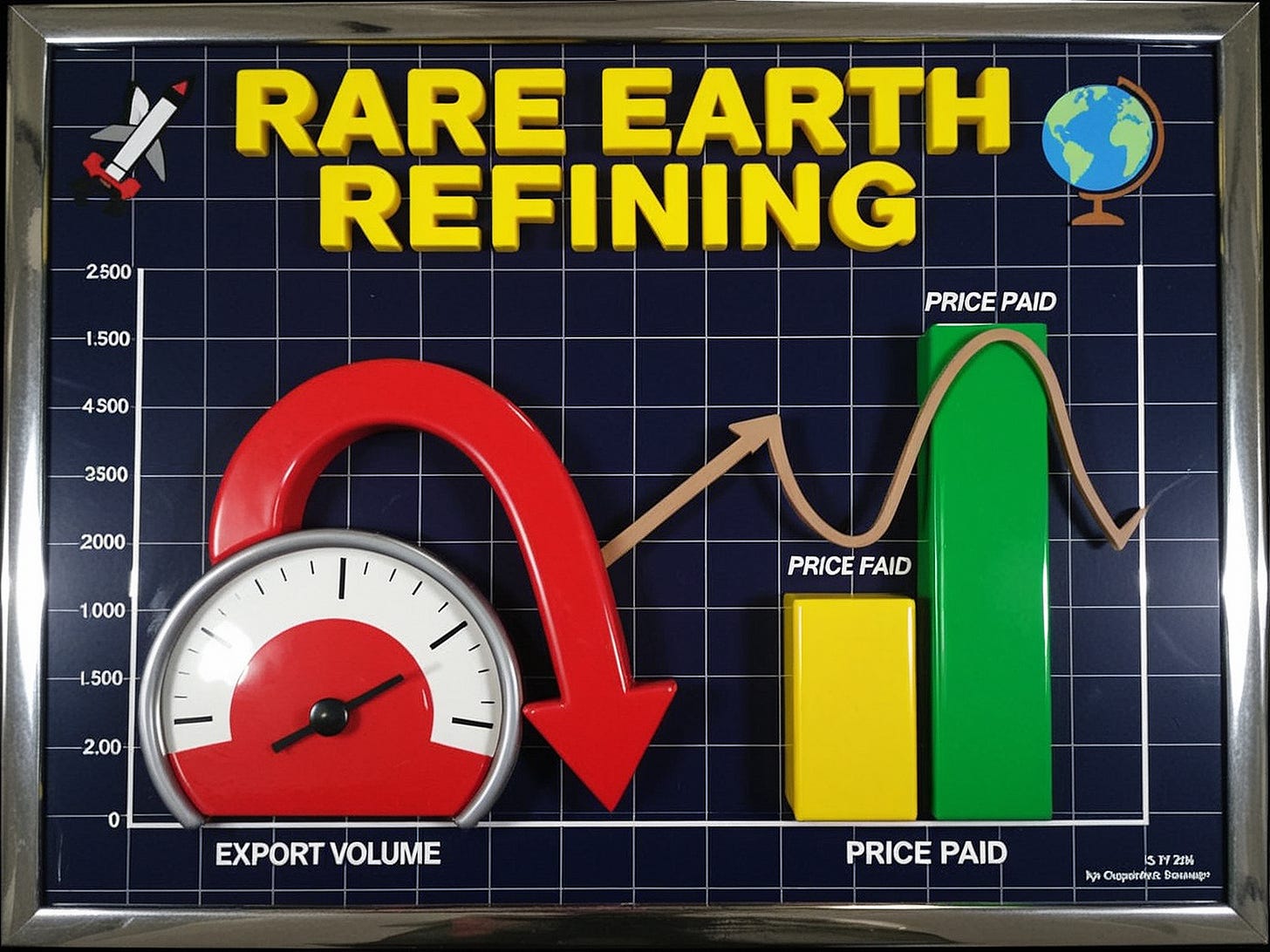
REASON 3 — THE DEBT THAT ONLY ROLLS FORWARD, AND THE CONTRACTORS PAID IN PAPER
Hidden municipal debt has a banal origin. Provincial and city governments wanted to borrow for infrastructure and were legally barred from issuing bonds directly, so they created companies — local government financing vehicles — to borrow on their behalf, backed by implicit promises rather than legal guarantees. Ring roads, industrial parks, sports stadiums, convention centers all came out of those vehicles. Borrowing ran against land values rising because the infrastructure was rising. Same loop as the developers, executed with public entities.
Land sales collapsed and shut the loop. Revenue that had been the primary funding source for most municipalities fell off a cliff as developers quit buying, leaving the vehicles holding assets that generate little or nothing and debt that comes due regardless.
Beijing’s answer has been a rescheduling campaign dressed as a cleanup. A 12 trillion yuan package unveiled in November 2024 combined 6 trillion in new local bond capacity for swapping and 4 trillion in special bonds over three years, with a 2 trillion yuan rollover of legacy obligations. Execution went briskly, reaching 98 percent issuance by September 2026, and the official hidden balance fell from 14.3 trillion yuan at the end of 2023 to a claimed 6.5 trillion.
Principal stays where it was. Swapping a three-year trust loan at 9 percent into a ten-year municipal bond at 3 percent improves the cash flow genuinely and buys a province a decade of air. Bookkeeping moves an off-balance-sheet obligation onto the balance sheet, which means the visible number rises while the invisible one falls and the total lands roughly where it started.
The IMF looked at the same terrain and put financing vehicle exposure near $10.5 trillion, well above what the swap implies, and stayed unmoved by the official progress reports. Part of the gap is definitional and part of it is a question of how much debt has been acknowledged at all. Caixin reported in September 2026 that the official hidden balance had dropped while total outstanding government debt still climbed — the arithmetic equivalent of moving furniture between rooms and calling it downsizing.
Harder problems sit beneath the rescheduling and get less attention. Repaying debt and growing the local economy are both required of the vehicles at once. Growth requires new borrowing, new borrowing requires headroom, and headroom was just consumed by the swap. Provinces under the tightest constraints cut civil service headcount, freeze hiring, delay salaries in outlying counties, and pay contractors in acceptance bills that trade at a discount on the secondary market. Some of those bills run past a year without clearing.
Shock absorption falls to the contractors. A construction firm holding 100 million yuan of municipal paper pays its own workers in cash, which means drawing on credit lines that are also tightening or refusing public work. Either response shrinks the local economy the municipality needs to grow in order to service the debt it just rescheduled, and the loop closes on itself a second time, tighter than before.
Banks sit at the center and are why a full crisis has been dodged so far. Chinese lenders operate as state instruments more than commercial ones. Developer loans, vehicle loans, and a property book whose collateral lost a third of its value all sit on their books. A commercial bank in a market economy would have written those losses down years ago and stopped lending. Chinese banks were told to keep lending and absorb impairments over time, which works because the state owns them and deposit rates are administratively suppressed to protect the spread.
Wealth moves from savers to the system through that suppression. Households earn roughly 1.5 percent on deposits lent at 5 or 6 percent to borrowers who may not repay. The spread pays for the impairments. It is a tax that never appears on a form, and it explains why households sitting on an extraordinary savings pool feel poorer and behave accordingly.
Capital constrains the arrangement. Banks have been raising capital and issuing loss-absorbing instruments, and the small rural and city commercial banks in the weakest provinces form the fragile edge. A few got merged into larger institutions or taken over by provincial vehicles, a quiet form of resolution avoiding a visible failure. Resolution by consolidation works at a handful at a time and has never been tested at a scale of dozens.
Ugliness enters the arithmetic once the debt meets the demographics, and rescheduling doesn’t reach it. Debt incurred to build capacity for a population now shrinking leaves infrastructure with nobody riding on it. Retirees drawing pensions funded by a declining cohort of workers apply pressure from a second direction at the same time.
Retirement ages rising, births collapsing, debt rolling forward, contractors paid in paper, banks absorbing impairments on suppressed spreads. Each of those facts is a claim on the future, and the future is smaller than the present.
REASON 4 — THE FRAGILE NEIGHBOURHOOD, AND THE FOOD LINES THAT RUN THROUGH MOSCOW
Trade diplomacy over four years got conducted with the urgency of a country needing markets more than friends. The Belt and Road portfolio was pruned to projects with some prospect of return, while the export push went everywhere — Latin America, Africa, Southeast Asia, the Gulf, Central Asia — priced aggressively enough to draw complaints from countries that once welcomed it.
Brazil offers the clearest case. Chinese electric vehicles arrived in volume and below anything domestic manufacturers could match, and Brasília raised tariffs in stages while negotiating factory commitments. Indonesia restricted nickel ore exports to force smelting onshore, Chinese capital built the smelters, and a different dependency replaced the old one. Vietnam became the assembly workshop for goods headed to America and found its own steel and chemical producers undercut by Chinese supply at the same time. Mexico, now the largest source of US imports, fights Chinese transshipment through its ports and considers duties on Chinese goods to protect the advantage nearshoring handed it.
Repetition is the pattern’s defining feature. Cheap goods arrive, local producers thin out, the local government reaches for tariffs, Beijing answers with a factory investment or a purchase commitment restoring the relationship on new terms. Terms always favor Beijing more than the ones preceding the tariff. Leverage gets exercised through the price mechanism, and it works because a country that lost its own industry has nothing left to accept except the investment.
Russia is the largest version of the arrangement and the most consequential. The Power of Siberia pipeline, a 30-year $400 billion contract signed in 2014 and flowing since late 2019, moved 22 billion cubic meters in 2023 and expands toward 38 billion cubic meters of capacity, with Power of Siberia 2 through Mongolia under negotiation. Crude arrives via the East Siberia-Pacific Ocean line. Wheat imports from Russia jumped more than 60 percent in early 2023 and kept climbing. Chinese machine tools, microelectronics, and vehicles filled the gap Western sanctions left, and the two economies interlocked in a way neither planned a decade ago.
Both directions carry weight in that interlock, which is the interesting part. Russia needs a buyer for energy it can no longer sell to Europe. China needs cheap energy and a supplier selling without conditions. Neither holds the senior seat the GDP tables imply, because Russia’s alternatives are worse than China’s, which lets China extract terms. A political rupture, a pipeline failure, or a harvest disaster across the Siberian breadbasket would leave China holding a dependency it can’t quickly unwind.
Food is the softest spot in the whole arrangement. China feeds 1.4 billion people on a shrinking arable base, a depleting northern aquifer, and an import book swollen to cover soybeans, corn, wheat, and edible oils at volumes that make agricultural markets nervous. The soybean trade with Brazil and the United States is enormous and seasonally fragile. Wheat from Russia and Central Asia fills a growing share of the gap. A serious failure in any source pushes China into the spot market at the same moment everyone else is there, and the price spike that follows is a food security event for importing countries across Africa and South Asia before it is anything else.
Mirroring the minerals problem in reverse, the scramble for alternatives makes China the buyer at the choke point rather than the seller. Land, port capacity, and long-term supply contracts get acquired from the Black Sea to the Gulf of Guinea. Contracts are strategic rather than commercial, priced above market in exchange for reliability, and they pull tonnage off the open market for everybody else.
Partners in the developing world feel the displacement before anyone in Washington does. A garment plant in Bangladesh or a shoe factory in Ethiopia competes against Chinese capacity running at subsidized cost with surplus labor and state credit behind it. When those plants close, workers migrate, and governments unable to employ them turn politically unstable. Debt distress across the low-income world, much of it owed to Chinese policy banks, already produced a wave of restructurings in Zambia, Ghana, Sri Lanka, and Pakistan, each negotiated bilaterally with Beijing rather than through the Paris Club.
That bilateral structure is the point. Sovereign debt resolution gets pulled out of multilateral institutions and into a room with one creditor, whose terms tend to involve asset pledges, port concessions, and mineral access. Predatory isn’t quite the word. A country with no other option signs whatever is placed in front of it.
Geopolitics is where Beijing goes first when the domestic picture darkens. A government needing to change the subject has a full menu of external options and most of them sit in the South China Sea. Coast guard harassment of Philippine resupply runs at Second Thomas Shoal, water cannon at disputed reefs, and the slow accretion of reclaimed features all escalate in bursts that correlate suspiciously well with bad domestic news cycles. Taiwan exercises grew larger and more frequent, live-fire drills crept closer to the median line.
Fighting requires no decision. Looking busy requires one, and looking busy costs little. The bill lands on shipping insurers, on the semiconductor chain, and on every firm holding Taiwan-concentrated exposure, all of whom price the risk and none of whom can move fast enough to dodge it.
REASON 5 — THE MORNING THE LEDGERS QUIT BALANCING AND THE SHELVES FOLLOW
Run the scenario. No war, no landing on a beach, just the ordinary mechanics of a system running out of room.
Triggers stay small and they stay financial. A mid-sized city commercial bank in a weak province fails to roll its interbank funding. A trust product sold to retail savers in a wealthy city misses a payment. A provincial vehicle can’t clear a maturing bond, the province’s guarantee gets called, and the province hasn’t got it. Each is a routine event in a normal economy. In China each got avoided for four years by rolling forward, which means each now arrives with four years of pressure behind it.
Households take the first visible hit. Deposits frozen at a failing bank, mortgage payments on a flat nobody will finish, a pension shortfall in a province that ran out of transfer money. This household has already been through the Henan village bank freeze of 2022, when withdrawals stopped for weeks and small savers were reclassified as investors to cap their recovery. Knowledge of the shape changes behavior faster than policy does.
Currency is the second casualty and where the shock crosses the Pacific. Beijing manages the yuan against a basket with a band and heavy intervention, so a flight episode meets reserve drawdowns and administrative tightening rather than a clean float. Controls hold a line for a while. Holding it against a domestic banking crisis is beyond them, because the crisis is denominated in the currency the controls protect.
A pressured yuan drags the whole emerging complex along, since every country borrowing in dollars and exporting to China gets exposed on two fronts at once. Commodity currencies fall first, then the currencies of nations with Chinese debt. The dollar strengthens against everything, tightening global financial conditions for reasons having nothing to do with the Fed, and the Fed then chooses between the domestic cycle and the world.
Confirmation is something equity markets quit waiting for. Chinese equities are already a small allocation after four years of losses, yet the second-order names carry the shock: miners with Chinese offtake, machinery makers with Chinese plants, luxury houses with Chinese customers, automakers with Chinese joint ventures, every logistics firm whose volume runs through Chinese ports. $150 billion of European luxury revenue and a comparable American semiconductor equipment book sit on the same table.
Inventory depth sets the order in which supply chains seize. Retail goods have weeks of cover and shortage shows as empty shelves in the second month. Pharmaceuticals share the window with a far worse consequence. Machinery parts form the long tail, because a farm equipment dealer in Iowa doesn’t stock a hydraulic valve for every model on the lot and the valve ships from a Chinese supplier on a six-week lead. A farmer with a broken combine in April loses the season.
Industrial production in America runs near 40 percent import content in capital goods. Remove the Chinese fraction and the maintenance arithmetic on every factory floor changes at once. Water utilities, electrical cooperatives, and telecom operators are the ones nobody thinks about, and all three carry spare-part books sourced heavily from Chinese manufacturers because domestic equivalents cost twice as much and arrived half as often. A grid transformer is a two-year lead item. The Chinese one is a two-month item. That gap separates a repair from a rebuild.
-
Grocery impact arrives in three moves rather than one, through packaging, processing equipment, and cold chain components, landing as a thinner package at the same price
-
More than four in five American prescriptions are generic, and the API feed behind them runs through China into India, which makes a pharmacy shortage a two-quarter event rather than a two-year one
-
Insurance premiums track replacement cost, and replacement cost on a house full of Chinese goods roughly doubles the moment the goods must be bought at Western prices
Employment follows one to two quarters later and lands all at once in the exposed sectors: retail distribution, logistics, warehousing, port work, and the light manufacturing that competes with Chinese imports.
Two directions are how the 2008 comparison works, misleading one way and instructive the other. American subprime was a leverage event inside a country with a functioning bankruptcy code, deposit insurance, and a central bank able to cut to zero and buy assets. China holds capital controls, state banks, and a far larger debt stock in a much murkier structure. Tools differ, visibility is worse, and the potential losses concentrate where losses are hardest to resolve — municipal balance sheets with no legal bankruptcy path.
Emerging markets take the hardest hit and get the least attention. Countries with Chinese debt and Chinese import dependence face a squeeze on the creditor relationship and the input supply simultaneously. Sri Lanka’s 2022 default and the political collapse behind it is the template, and a dozen countries sit nearer that edge than anyone comfortable with. Food-importing nations across North Africa and the Sahel go first, and the migration pressure lands on European borders inside a year.
Beijing’s own menu narrows as the crisis deepens, running from the desperate to the dramatic. Selling lethal arms to Russia in volume for resource stakes in Siberia is one. A harder line in the South China Sea is another. Both convert a domestic failure into a geopolitical position and both are cheap in the currency of a government that already spent its fiscal room.
THE PART WASHINGTON KEEPS MISFILING
An entire policy architecture got built on the assumption that China is a rival to be contained and containment is affordable. Tariffs, the CHIPS Act, the entity list, outbound investment screening, the AUKUS submarine arrangement, the Quad — each designed against a China that was growing, exporting, building. Scarcely any of it was designed against a China contracting, deflating, liquidating.
Mismatch matters because a shrinking China behaves unlike a growing one. Growth makes it buy more of everything and grow more interdependent, which hands diplomacy leverage. Contraction makes it buy less, dump more, and turn transactional, which shrinks the surface diplomacy works on. Tools built for the first condition fit the second badly.
Among the programs on the board, the CHIPS Act is the clearest illustration and also the most defensible. Roughly $52 billion in subsidies plus investment tax credits pulled fab commitments into Arizona, Ohio, Texas, and New York, and the advanced-node capacity under construction is genuine. Volume production sits three to five years away, and the Chinese gallium and germanium controls landed directly on the compound semiconductor substrate chain the program needs. Building the fab doesn’t build the mine.
Critical minerals show the same gap. Defense Production Act authorities got invoked, allied agreements signed with Australia and Japan, processing plants funded. A decade of underinvestment doesn’t get undone in one term of Congress.
Households form the last line of exposure and the least prepared. The average home holds several thousand dollars of Chinese-made goods across furniture, appliances, electronics, tools, textiles, and the components inside all of them. Replace that content at Western prices and the replacement cost roughly doubles. Insurance premiums on contents follow replacement cost, and a fire claim on a house full of cheap Chinese goods becomes a claim at a number nobody underwrote.
Political consequences are the ones nobody modeled. A supply shock landing on prices and shelves inside an election year produces a demand for somebody to blame and a policy answer usually worse than the problem. Price controls get discussed. Export restrictions on American goods get imposed in retaliation for nothing particular. Strategic ambiguity turns into strategic improvisation, and improvisation in a crisis with a nuclear-armed counterpart is where accidents live.
THE PRACTICAL LEDGER
Freeze-dried food and a rifle aren’t the binding constraints in an economic shock. Cash flow, inventory, and optionality are.
Things carrying a long lead time and a short shelf life in the chain come first. A spare set of parts the house, the car, and the equipment actually consume — filters, belts, fuses, seals, batteries, the small components that fail on a schedule. A plumbing repair kit and the tools to use it. A chest freezer holding a month of meat hedges better than a pallet of rice, because the freezer fails gracefully and the rice doesn’t.
Water earns the prepper cliché fully. Municipal systems run on pumps, pumps run on electricity, and the chemical treatment supply chain is a specialized input shipping from a small number of plants. Two weeks of stored water is a floor rather than a plan, and a gravity filter with replacement cartridges costs less than a tank of fuel. Know where the nearest surface water sits and what it takes to make it drinkable.
Hours spent on food production repay themselves and the point isn’t self-sufficiency. A garden yields calories in August and teaches the failure modes in June. Hens convert scraps to eggs and teach the same lesson faster. Neither replaces the store. Both shorten the distance to it.
Financial preparation earns more attention than the prepper literature gives it. Cash in small bills covers the first 72 hours of any disruption, when terminals are down and nobody makes change. A month of expenses in physical currency is a reasonable holding. Debt turns a shock into a foreclosure, so variable-rate obligations are the first payoff target, and a fixed-rate mortgage becomes an asset in an inflationary supply shock rather than a liability.
Silent risk lives in concentration. One employer, one income, one sector, one customer base all fail together when the shock runs through what they share. Diversifying the portfolio matters less than diversifying the income, because the portfolio sells at a loss and the income can’t be sold at all.
Skills paying during a disruption are the ones devalued when everything was cheap and fast. Small engine repair, basic electrical work, welding, sewing, canning, cooking from raw ingredients rather than from a box. Every one is also a side income in normal times, which the literature tends to skip.
Community can’t be bought on the day. A block that knows each other shares tools, watches houses, pools a generator. A block of strangers discovers the gap in the second week. The cheapest investment available is a cookout and a group chat.
Death isn’t what the dragon faces. Collapse gets oversold in exactly the way the growth narrative was. China will still make a third of the world’s goods in 2030, still hold refining capacity for the minerals in every missile and every turbine, still be the largest trading partner of a hundred countries, still move a price from a ministry conference room.
What ends is the assumption that the trajectory points monotonically upward and American exposure shrinks with the tariff schedule. Exposure isn’t shrinking. It gets relabeled, rerouted, and buried a layer deeper in the bill of materials, where it is harder to see and no cheaper to replace.
Breaking on a Tuesday isn’t the warning. Four years went into building the machinery that would make a break look orderly, and orderliness strips away the urgency that would otherwise force everyone else to get ready.
Anyone can join.
Anyone can contribute.
Anyone can become informed about their world.
"United We Stand" Click Here To Create Your Personal Citizen Journalist Account Today, Be Sure To Invite Your Friends.
Before It’s News® is a community of individuals who report on what’s going on around them, from all around the world. Anyone can join. Anyone can contribute. Anyone can become informed about their world. "United We Stand" Click Here To Create Your Personal Citizen Journalist Account Today, Be Sure To Invite Your Friends.
LION'S MANE PRODUCT
Try Our Lion’s Mane WHOLE MIND Nootropic Blend 60 Capsules
Mushrooms are having a moment. One fabulous fungus in particular, lion’s mane, may help improve memory, depression and anxiety symptoms. They are also an excellent source of nutrients that show promise as a therapy for dementia, and other neurodegenerative diseases. If you’re living with anxiety or depression, you may be curious about all the therapy options out there — including the natural ones.Our Lion’s Mane WHOLE MIND Nootropic Blend has been formulated to utilize the potency of Lion’s mane but also include the benefits of four other Highly Beneficial Mushrooms. Synergistically, they work together to Build your health through improving cognitive function and immunity regardless of your age. Our Nootropic not only improves your Cognitive Function and Activates your Immune System, but it benefits growth of Essential Gut Flora, further enhancing your Vitality.

Our Formula includes: Lion’s Mane Mushrooms which Increase Brain Power through nerve growth, lessen anxiety, reduce depression, and improve concentration. Its an excellent adaptogen, promotes sleep and improves immunity. Shiitake Mushrooms which Fight cancer cells and infectious disease, boost the immune system, promotes brain function, and serves as a source of B vitamins. Maitake Mushrooms which regulate blood sugar levels of diabetics, reduce hypertension and boosts the immune system. Reishi Mushrooms which Fight inflammation, liver disease, fatigue, tumor growth and cancer. They Improve skin disorders and soothes digestive problems, stomach ulcers and leaky gut syndrome. Chaga Mushrooms which have anti-aging effects, boost immune function, improve stamina and athletic performance, even act as a natural aphrodisiac, fighting diabetes and improving liver function. Try Our Lion’s Mane WHOLE MIND Nootropic Blend 60 Capsules Today. Be 100% Satisfied or Receive a Full Money Back Guarantee. Order Yours Today by Following This Link.


| Visits: | 1,840,135,037 |
| Stories: | 8,745,723 |
Whistler Blowers, Insiders

