

Israel’s Architecture of Control in Paraguay: When Surveillance Becomes Infrastructure


Freddie Ponton
21st Century Wire
When Ueno Bank, a digital bank in Paraguay, collapsed in early November 2026, the failure did more than freeze the accounts of nearly three million customers. It exposed a network connecting politically influential Paraguayan businesses to Israeli suppliers of identification and security technology with recorded ties to Israel’s intelligence and military research institutions.
President Santiago Peña was removed from office four days after the Central Bank’s resolution order. Peña had held shares in Ueno Holding until 2025.

IMAGE: Congress president Basilio Núñez places the presidential sash on Pedro Alliana following Santiago Peña’s removal from office, Asunción, 6 November 2026. Photograph: Jorge Sáenz/AP. (Source: KSAT / Associated Press)
Grupo Vázquez, the group behind Ueno, publicly presented its licenses for Corsight’s facial-recognition software as an investment in security and customer experience. The supplier’s investment network openly described intelligence-agency collaboration as part of its route from technology development to market. During the banking investigation, prosecutors recovered a planning document from the group’s controlling shareholder listing Israeli firms for interception equipment and other security contracts.
Paraguay had joined the U.S.-led Pax Silica initiative to build AI infrastructure across the Americas and received an invitation from Benjamin Netanyahu to join the Isaac Accords, an effort to expand Israel’s political, economic and security partnerships in Latin America. Technology officials were also outlining smart-city systems that would begin in Asunción and spread to other cities. The promise was modernization. But who would own, operate and ultimately control the systems Paraguayans would come to depend on?
The local group that controlled the gateway
At the home of Miguel Vázquez, the businessman behind Ueno and Grupo Vázquez, prosecutors reportedly recovered a planning sheet listing prospective government contracts, suppliers and actions to secure the business. Intelligence equipment for Paraguay’s anti-drugs agency was marked as a priority. The named supplier for interception capabilities was Israel’s Septier.

IMAGE: Miguel Vázquez, founder of Ueno Bank and president of Grupo Vázquez (Source: Bloomberg Línea; photograph originally published in Grupo Vázquez’s 2022 annual report)
The sheet stated that the agency and the Technology Ministry had already agreed on the full specifications. It called for pressure on the Itaipú technology park to issue a tender for the complete package. Other entries covered electronic-monitoring bracelets, radars, government-building infrastructure and army telecommunications. Prospective partners included Elbit, Fennix Global and GETS Systems. A radar entry contemplated an association with Darío Karmel, described in the document as representing Italy’s Leonardo.
Vázquez’s group already had businesses through which identification technology could reach Paraguayan customers. Grupo Vázquez, the group behind Ueno, had expanded from consumer lending into banking, payments, insurance and ticketing. Through its technology company, ITTI, it supplied the software that operated the bank and offered identification tools.

IMAGE: ITTI’s illuminated branding inside its offices. The Grupo Vázquez technology company supplied Ueno’s banking software and became Corsight’s local commercial partner (Source: La Nación)
In September 2024, Grupo Vázquez announced that it had acquired licenses for Corsight’s facial-recognition software. ITTI would integrate the system into the group’s companies and sell it to other public and private clients in Paraguay. The company supplying the bank’s operating software was also becoming a distributor of technology for identifying people.
Control of the group was concentrated in Vázquez’s hands. Its April 2026 disclosure showed he held three-quarters of its capital and nearly all its voting rights. ITTI’s July 2025 bond documents listed Grupo Vázquez and Ueno Holding as its largest shareholders. ITTI also held 60% of Red UTS Paraguay, the ticketing business rebranded as Tuti. Several executives held positions across multiple companies in the group.
An earlier agreement showed how banking, ticketing and identification could be sold together. Under a multi-year sponsorship signed with the sports ministry in October 2023, ITTI committed hundreds of thousands of dollars annually, while Ueno received naming rights. The agreement covered banking access, ticket microcredit, identity-validation cameras, cashless payments and marketing. It also included spectator profiling and real-time reports on behavior and consumption.
The political connections reached both the presidency and the banking regulator. In December 2024, El Surti reported that Peña’s asset declarations listed ITTI bonds and Ueno Holding shares. Peña has said he sold the shares in 2025. The report also identified Central Bank president Carlos Carvallo’s previous leadership of the Ueno financial institution.
The group therefore offered foreign technology suppliers more than a local sales representative. It had a bank using its software, a ticketing business, a sports-ministry agreement and a plan for pursuing government security contracts. For Corsight, the company behind the facial-recognition software licensed by Grupo Vázquez, the deal offered a route into that network.
The Israeli firm whose lead investor works with intelligence agencies
Corsight appointed Giora Eiland, a retired major general in the Israel Defense Forces and former head of Israel’s National Security Council, to its board in January 2021. The company explicitly linked his security experience to its expansion into international homeland-security markets.
Corsight’s board also lists Igal Raichelgauz, chairman of Cortica Group and CEO of Cartica; Yaron Ashkenazi, founder and CEO of Awz Global; and Osher Shapira, chief strategy and technology officer at Awz Ventures. Shapira previously led the Dual-Use Technology Unit at Israel’s Defense Ministry and served as deputy chief technology officer at MAFAT, its research and development directorate.
Awz Ventures led Corsight’s US$5 million seed round in April 2020. Ashkenazi, who sits on Corsight’s board, spent a decade in the Israel Security Agency, known as Shin Bet, leading teams that protected Israeli prime ministers before founding Awz. Awz’s board chairman, Edward Sonshine, founded the Canadian real estate investment trust RioCan and previously served as a Royal Bank of Canada director. Former Canadian prime minister Stephen Harper is a partner and president of Awz’s advisory committee, and also chairs the Friends of Israel Initiative.

IMAGE: Yaron Ashkenazi, Awz’s founder and a Corsight board member, in a photograph released for the 2021 launch of the X-Seed technology hub, established in partnership with Israel’s defense research directorate, MAFAT. Photograph: Tomer Jacobson (Source: Cision / Awz Ventures)
Awz operates X-Seed, which funds early-stage startups and supports them through a 12-to-24-month residency in Tel Aviv. Awz says design partners from Israeli intelligence agencies help companies move from concept to commercial product. It describes a partnership with MAFAT, Israel’s defense research and development directorate, that includes collaboration with Mossad, Shin Bet and the military technology units 8200 and 81, the Intelligence Corp’s Technological Unit, which provides training in cutting-edge technologies to Israeli elite commando forces and spies.
Awz’s 2021 X-Seed announcement named Ashkenazi and Canadian investor Daniel Mak as the hub’s leaders, alongside Roni Alsheich and Sharon Gal, formerly head of technology innovation at the Israeli prime minister’s office. Its named advisers included Ehud Schneorson, a former commander of Unit 8200.
Several of Awz’s senior figures came from the leadership of Israel’s intelligence services. Tamir Pardo ran Mossad from 2011 to 2016. Haim Tomer, now a venture partner, headed its intelligence, counterterrorism and international divisions. At X-Seed, former Shin Bet deputy director and Israeli police commissioner Roni Alsheich is a general partner. Awz also brought in former military chief of staff Aviv Kohavi as an executive partner.
Venture partner Erez Kreiner previously directed Shin Bet’s Cyber Security Authority and Israel National Cyber Security Agency under Shin Bet. Strategic adviser Gary Barnea headed Shin Bet’s protection and security division from 2012 to 2016 and served as deputy director of Mossad’s special-operations division.
Awz’s advisers also include figures from diplomacy, finance and research: Yuval Rotem, former director-general of Israel’s Foreign Ministry; Jacob Frenkel, former governor of the Bank of Israel; and Peretz Lavie, chairman of Israel’s National Council for Civilian Research and Development and a former president of the Technion–Israel Institute of Technology.
Within Awz’s management and investment team, Jonathan Karten served in Israeli Air Force intelligence and David Amsalem was a special-operations intelligence officer. Itai Rotem held financial posts in the Israeli military and Defense Ministry, while retired colonel Avishay Derhy held senior roles in the military’s technology and logistics directorate.
The firm’s international advisers include Richard Fadden, former director of the Canadian Security Intelligence Service; Buck Revell, former FBI associate deputy director; and Michael Day, former commander of Canada’s special-operations forces.
Corsight was already present at an ITTI conference months before the license announcement. ITTI’s April 2024 conference, supported by Ueno, brought together Peña, technology minister Gustavo Villate and tourism minister Angie Duarte. Corsight was among the participating brands, according to ITTI’s account.

IMAGE: ITTI’s Exponential Paraguay Conference in April 2024. The Ueno-supported event brought together government officials and technology businesses; ITTI listed Corsight among the participating brands (Source: ITTI
Corsight’s published leadership includes chief executive Shai Toren; president and chief strategy officer Rob Watts; and vice-president of product Kai Mizrahi, who previously oversaw the creation of Cortica’s facial-recognition product. Its chief privacy officer, Tony Porter, is an intelligence specialist who previously served as Britain’s Surveillance Camera Commissioner and, as a police commander, led counterterrorism investigations for the 2012 London Olympics.
Security agreements and government contracts
A year after the licensing announcement, Israel and Paraguay formalised cooperation on defense and security. During Israeli foreign minister Gideon Sa’ar’s November 2025 visit, the two countries signed a memorandum covering information exchange, the purchase and sale of defense equipment and services, joint military training and industrial cooperation. Paraguay’s foreign minister, Rubén Ramírez, said it would take effect immediately.
Paraguay’s defense minister Óscar González and Israeli ambassador Amit Mekel signed the memorandum in the presence of Sa’ar and Paraguayan foreign minister Rubén Ramírez Lezcano. The foreign ministers also signed a separate agreement covering training in public diplomacy, crisis communications and artificial intelligence. By February 2026, the Paraguayan-Israeli Chamber of Commerce, led by Alejandro Laufer, and Israel’s embassy were planning a public-private mission to Israel and promoting the arrival of Israeli technology in Paraguay. Cybersecurity and technology applied to production were among their target sectors.

IMAGE: Israeli and Paraguayan officials during Gideon Sa’ar’s November 2025 visit to Asunción, when the two countries announced expanded cooperation in defense and security (Source: Agencia AJN)
Israeli advisers had worked with Paraguay’s presidency years before these agreements. Reporting in 2018 described Ari Harow, Yechiel Leiter and Meir Klifi advising then-president Horacio Cartes through the Global H3 consultancy. Harow had served as chief of staff in the Israeli prime minister’s office; Leiter was a former adviser to Benjamin Netanyahu and had been a director of Global H3. Klifi, a retired general and former military secretary to Israeli prime ministers, reportedly advised Cartes on defense and intelligence reforms and a new national-security doctrine.
In February 2026, representatives of Israel Aerospace Industries (IAI) and its ELTA subsidiary presented software, radars and signals-intelligence equipment intended to strengthen command and control to Paraguay’s army leadership. Army commander General Manuel Rodríguez described the equipment as one of several modernization options under consideration. Chief of staff José Santander also attended.
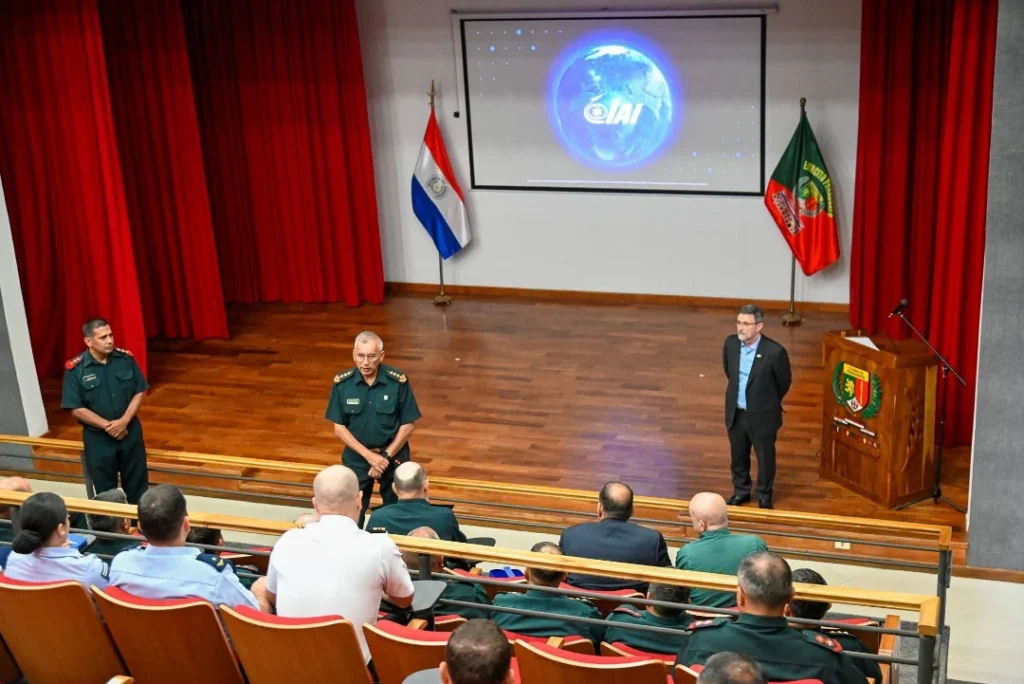
IMAGE: IAI and ELTA representatives present defense technology to Paraguayan Army personnel in February 2026. The offerings included software, radars and signals-intelligence systems; the army described them as options under consideration (Source: Zona Militar)
A separate procurement process for surveillance and interception equipment had begun a year earlier. In February 2025, Fundación Parque Tecnológico Itaipu–Paraguay issued procurement documents for equipment destined for Paraguay’s National Anti-Drug Secretariat, Senad. The offer forms divided the equipment into two packages. One covered communications interception, cellular equipment, forensic analysis including facial recognition, open-source intelligence and satellite monitoring. The other covered video surveillance, signal inhibition and acoustic control. Bidders had to identify makes and models and provide catalogues and sales authorisations.
In April 2025, Última Hora reported concerns from prospective bidders that parts of the technical specifications matched Corsight’s Fortify software. Deputy Mauricio Espínola alleged that the tender favored ITTI. Senator Rafael Filizzola questioned the legal basis for intercepting communications and the limited public information about the surveillance equipment.
The procurement controversy also involved Septier, an Israeli supplier of cellular intelligence, communications-interception and mobile-location systems. In April 2025, Última Hora quoted Deputy Mauricio Espínola alleging that Septier executive Daniel Sztuden had met Itaipú’s directors on March 21. Espínola identified ITTI as Septier’s representative in Paraguay. Septier’s founder and chief executive, Yaron Baratz, also co-founded Cellebrite, an Israeli supplier of digital-forensics and intelligence-gathering tools.
Corsight’s technology had already reached the Paraguay–Brazil border years before the ITTI licensing deal. In 2020, Israeli company Juganu announced a lighting upgrade at the Friendship Bridge, a busy crossing linking Ciudad del Este in Paraguay with Foz do Iguaçu in Brazil. The installation incorporated cameras, sensors and Corsight’s facial-recognition technology. Juganu said the system automatically transmitted facial-recognition and vehicle-plate information to border officials. Chief strategy officer Eran Efrati described a joint demonstration with Corsight. In a contemporary interview, chief executive Eran Ben-Shmuel identified Brazil’s Federal Police as the customer and said users could add applications to the installed platform, including social-distancing and temperature-monitoring features.
Juganu later employed Dubi Lavi in defense and homeland-security, international sales, and customer-success roles between October 2020 and March 2025. He had previously directed Israel’s Defense Export Control Agency and the Defense Ministry’s North America mission. His move brought a former defence-export regulator into the management of a company selling lighting infrastructure with integrated surveillance capabilities.
In February 2021, Brazil’s industrial development agency (ABDI) announced that the national intelligence agency ABIN would gain access to information generated by FronteiraTech. The border program was already operating at the Friendship Bridge to strengthen customs controls. Its information would now also be available to an intelligence agency. Corsight had been named as a recognition partner in that installation years before ITTI obtained licenses to commercialize its software in Paraguay.

IMAGE: Officials sign a February 2021 cooperation agreement between Brazil’s industrial development agency, ABDI, and intelligence agency, ABIN. The agreement provided ABIN with access to information generated by FronteiraTech, already operating at the Friendship Bridge (Source: ABDI)
The Paraguayan records showed a route from commercial planning toward government business. The planning sheet named surveillance suppliers for state projects and the procurement forms sought the same categories of equipment. The Brazilian border installation showed how access to the resulting information could expand after deployment. The question was not only which companies supplied the technology but which institutions could use the information it generated.
Who paid for the technology and who is building the AI centers
Ueno’s role extended beyond supporting ITTI’s technology conference. A rating report assessing ITTI’s finances at December 2024 identified customer advances, predominantly from Ueno Bank, as its principal funding source. Payments made ahead of delivery were helping finance the operations of the company that held the Corsight licenses.
Ueno’s financing also reached ITTI through other companies. Citing Central Bank documents, Última Hora traced a US$10 million loan that Ueno granted Technoma in June 2026. Technoma used the money to buy ITTI and Ueno bonds. The proceeds reached ITTI both directly and through Grupo Vázquez. ITTI subsequently transferred US$4.68 million to Vinanzas, which bought a portfolio of Ueno loans. The same reporting described ITTI employees operating online bank accounts for several companies that borrowed from Ueno.
The Senate asked the Central Bank to trace the funds and determine whether the bond transactions constituted outright sales or indirect financing. In October 2026, Ueno acknowledged an administrative proceeding over alleged indirect financing of a loan-portfolio sale but maintained that the transaction complied with the law. ITTI was therefore more than the group’s technology supplier and Corsight’s local commercial partner. The reported transactions placed it at the center of financing that moved from Ueno through other companies and helped fund the purchase of the bank’s own loan portfolio.
Beyond surveillance equipment, Paraguay’s hydroelectricity was attracting companies such as Crusoe, an American AI-cloud operator that builds computing infrastructure near abundant power supplies. In October 2026, Crusoe announced a partnership with Paraguayan developer Araico, led by Alejandro Zuccolillo, to build a facility powered by Itaipú hydroelectricity. Araico would develop the site beside the Itaipú substation while Crusoe would operate the computing infrastructure for customers in the United States and Latin America. The first deployment was planned for mid-2027. Founders Fund had led Crusoe’s US$600 million financing round in December 2024. The venture-capital firm counts Palantir and Anduril among its investments, and its partner Peter Thiel also co-founded Palantir.

IMAGE: Itaipú hydroelectric dam, the planned power source for Crusoe and Araico’s AI-cloud project in Paraguay. Announced in October 2026, the project’s first deployment was scheduled for mid-2027 (Source: Crusoe)
Peña had met Thiel and, separately, Crusoe co-founder Cully Cavness in May 2026 as his government promoted Paraguay as a location for AI data centres. Thiel’s involvement in defense technology extended beyond investment. In January 2024, Bloomberg reported that Palantir had agreed to a strategic partnership with Israel’s Defense Ministry to supply technology for war-related missions. The agreement followed a meeting in Tel Aviv between Israeli defense officials and Palantir co-founders Thiel and Alex Karp.
Crusoe’s own engineering business also had an Israeli connection. In August 2025, it acquired Atero, an Israeli startup founded by Alon Yariv and Omer Landau whose technology improves the efficiency of the processors used for AI. The acquisition brought Atero’s engineers into Crusoe and established its Tel Aviv office. Landau became a Crusoe engineering vice president. His career history records 6 years of research and development leadership in Israeli military intelligence Unit 8200, followed by a senior role at KayHut where he says he developed covert cyber products.

IMAGE: Atero’s team, photographed for coverage of Crusoe’s August 2025 acquisition. The Israeli GPU-optimization company became the foundation of Crusoe’s Tel Aviv development operation. Photograph: Omer HaCohen (Source: CTech / Calcalist)
The Tel Aviv team contributed to the technology behind Crusoe’s AI-cloud services. Landau and research manager Omri Berkovitch co-authored a technical explanation of MemoryAlloy, a system that lets AI processors reuse previously computed information rather than repeat work. Product executive Erwan Menard credits the Israeli and US teams with delivering Managed Inference, a service that runs customers’ AI models while Crusoe manages the computing infrastructure.
The Paraguay project also received US diplomatic backing. The State Department said Crusoe and Araico finalized their partnership during Deputy Secretary Christopher Landau’s October 2026 trade delegation. The visit also produced an airspace-security agreement, counterterrorism commitments and a memorandum of intent to deploy the US PISCES border-management and passenger-screening system in Paraguay.
Building AI centers also required securing electricity from Paraguay’s state supplier ANDE. In October 2026, ANDE signed a 15-year supply contract with Kuntur, a Paraguayan company that its president, Miguel Báez, linked to Araico. The contract committed an initial 6 MW from December 2026, rising to 286 MW by April 2029. Yet Báez gave conflicting accounts of the corporate relationship. He described Kuntur first as owned by Araico and then as one of its shareholders. ABC Color reported that the interview did not establish whether Kuntur had submitted the required corporate documentation before signing.
The technology businesses depended on more than software and foreign investment. Ueno’s advance payments helped finance ITTI, while the computing expansion required long-term commitments of public electricity. According to Báez, the Kuntur contract left approximately 464 MW available for other projects. Paraguay was allocating a limited national resource to an emerging industry while basic questions about the contracting company’s ownership remained publicly unresolved.
The U.S. and Israeli frameworks surrounding these deals
That electricity supply was also becoming part of an international technology strategy. In October 2026, foreign minister Rubén Ramírez Lezcano signed the Pax Silica declaration in Washington. The US-led initiative seeks to secure supply chains spanning minerals and energy through semiconductors and AI infrastructure. The State Department said cooperation with Paraguay would draw on its critical minerals and hydropower to build advanced AI infrastructure in the Americas. Israel is a fellow signatory.
The Pax Silica declaration treats technology supply chains as a matter of economic and national security. It encourages participating countries to mobilize private companies across the AI economy from minerals and electricity to processors, software and data centers. Its organizing principle is a shared ecosystem of “trusted” developers, vendors and infrastructure. The declaration links access to technology and investment with efforts to reduce excessive dependencies and protect sensitive systems from outside influence or control.
The Isaac Accords seek closer political and security ties between Israel and Latin America. Israel and Argentina launched the initiative in April 2026 after President Javier Milei had promoted it as a route to political and economic integration.
In September 2026, Netanyahu invited Peña and the presidents of Panama and Bolivia to join the Isaac Accords during a meeting in New York. According to his office, he also urged them to withdraw from the International Criminal Court and described their countries as partners against threats he attributed to Iran and its allies. The invitation thus went beyond cooperation in technology and trade. Netanyahu was seeking support for Israel’s security agenda and its opposition to the court.

IMAGE: From left, Bolivia’s Rodrigo Paz, Panama’s José Raúl Mulino, Israel’s Benjamin Netanyahu and Paraguay’s Santiago Peña in New York, 24 September 2026. Netanyahu invited the three Latin American countries to join the Isaac Accords. Photograph: EFE / Presidency of Paraguay (Source: RTVE)
Paraguay signed Pax Silica but had only been invited to join the Isaac Accords. The initiatives are distinct but both place commercial cooperation within a security agenda. Pax Silica positions Paraguay’s energy and minerals as inputs for AI infrastructure. The Isaac Accords seek closer political alignment with Israel alongside technology and trade. Local business groups provide commercial channels into Paraguay’s institutions and services.
Identification at the gate and on the phone
For football supporters, the proposed link between identification and access took physical form at the stadium entrance. In September 2025, biometric turnstiles equipped with facial-recognition scanners were being installed at Asunción’s Defensores del Chaco stadium before Paraguay’s World Cup qualifier against Ecuador. The structures carried ITTI branding. Tuti was responsible for ticket sales and access control. Both companies belonged to Grupo Vázquez.
Fernando Villasboa, a licensing official at the Paraguayan Football Association, said the system would track people entering and leaving the stadium and that its data would eventually be administered jointly with the police. But Asunción police chief Juan Agüero said the force had not been consulted before installation and lacked detailed knowledge of the proposed handling of biometric data. The equipment was withdrawn for the match because of concerns that it would obstruct entry and cause delays.
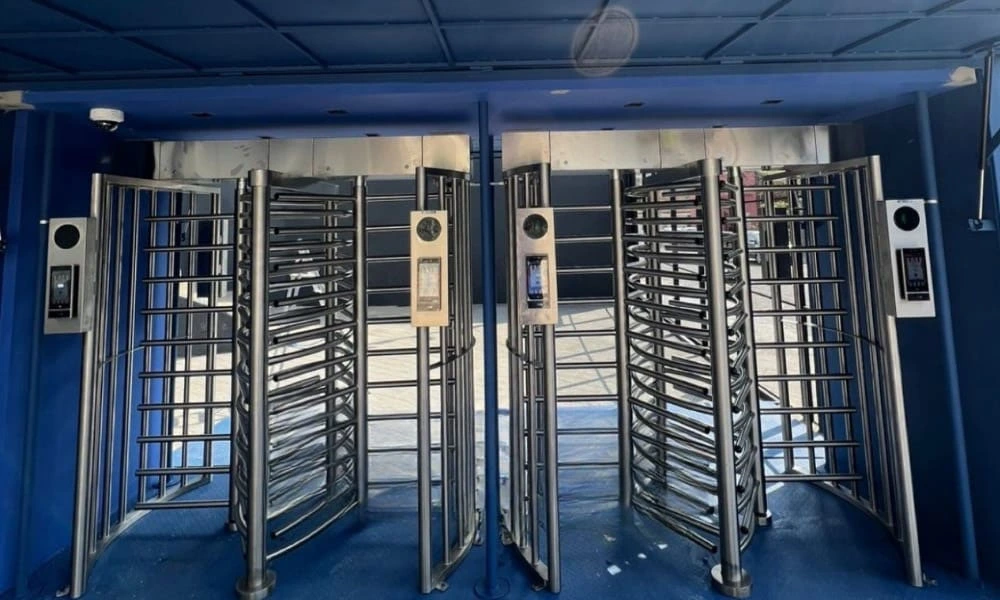
IMAGE: Biometric turnstiles installed at Asunción’s Defensores del Chaco stadium in September 2025. The equipment was withdrawn before Paraguay’s match against Ecuador following concerns over crowd safety and a lack of coordination with police (Source: OviedoPress)
In July 2026, police cybercrime chief Diosnel Alarcón described plans for a separate stadium registration system requiring supporters to submit identity details and a selfie for biometric validation. The platform was to be integrated with ticket sellers, notifying them when a buyer was barred from attending. Implementation still depended on funding and coordination between the institutions involved.
Research by digital-rights organization TEDIC documented uncertainty over implementation and institutional responsibilities. These accounts describe proposed systems and an aborted installation, not proof that facial recognition was operating at stadium entrances.
The group also sought to link access to its services through a single digital identity. In August 2025, Ueno announced UNID as an ITTI initiative allowing users to access banking, brokerage and football applications with one username and password. Tuti and other services were listed for later integration.
UNID’s published terms identify ITTI USA, LLC as the company behind the platform. They treat registration as express authorization to store, process, use for commercial or non-commercial purposes, and transfer to third parties information, including financial data, images and biometric data. The listed purposes range from fraud prevention and risk assessment to ticket transactions and marketing.
Tuti’s privacy notice also names ITTI USA, LLC as responsible for processing personal data. It describes a unique identifier combining identity and contact details with biometric identity-validation data and information about the devices used to access services. The notice provides for commercial profiling and data sharing with group companies and other partners, as well as access by technology providers under confidentiality and data-protection agreements. It also says information may be stored abroad. These provisions describe the uses and transfers envisaged by the documents, rather than establishing what had occurred in practice.
ITTI’s biometric offerings drew on international suppliers. A September 2024 partnership announcement said Grupo Vázquez had acquired Corsight facial-recognition software licences, with ITTI responsible for implementation across the group’s portfolio. ITTI also appears in a listing of FaceTec software distributors. Geraldo Sanga, the Corsight sales director quoted in the partnership announcement, subsequently joined FaceTec in March 2025, according to his public career history.
Supplying the software did not necessarily give its developer access to the information it processed. Corsight’s current licence terms describe deployment on the customer’s own infrastructure and state that Corsight does not access or process operational personal data. They also describe an optional feature through which customers can send notifications containing biometric information over third-party communication services. Its 2021 terms separately provide for activation and support through an authorized distributor or reseller, and allow perpetual accounts to remain active after maintenance expires.
Ueno’s crisis made the custody of that information an immediate concern. On 6 November 2026, engineer Luis Benítez, secretary of the Paraguayan Society of Artificial Intelligence, urged prosecutors to secure biometric databases during the investigation of ITTI and associated businesses. He distinguished banks running ITTI software on their own infrastructure from biometric records held on systems administered by businesses in the group. He warned that those records needed protection against unauthorized access.

IMAGE: Luis Benítez, secretary of the Paraguayan Society of Artificial Intelligence (SOPAIA), who urged prosecutors on 6 November 2026 to secure biometric databases held by businesses linked to Grupo Vázquez against unauthorized access (Source: Central Radio 1140 AM)
Who controls the infrastructure?
Paraguayans were promised better services, safer transactions and more secure borders. They are entitled to know who controls the systems being built around their lives.
The Israeli suppliers and former intelligence officials involved in these projects bring expertise in collecting information, identifying people and selling those capabilities. In Paraguay, they found willing partners among companies close to political power. Contracts sold to the public as improvements to everyday services gave these businesses a foothold in the country’s infrastructure.
Once banks and public agencies build their operations around a supplier’s technology, that supplier becomes expensive and difficult to replace. It gains leverage over institutions that cannot afford to interrupt their services. Decisions about who can access information, where it is stored and how it can be used are set out in contracts that most of the people affected will never see. A person who needs a bank account or must cross a border has little room to refuse.
As prosecutors examine the documents seized from Miguel Vázquez, Peña and the officials responsible for these arrangements must answer for how much control they placed in private hands. Who authorized it? Who benefited? And what power does Paraguay retain to withdraw access or end a contract without disrupting the services its people need?
Recovering the money will not undo that dependence. Paraguayans could pay to rescue the financial system and still find their identities held in infrastructure they cannot scrutinize, by companies they cannot hold to account. That would leave the people financing this technological transformation with the least say over what it does to them.
READ MORE SOUTH AMERICA NEWS AT: 21st Century Wire South America Files
SUPPORT OUR INDEPENDENT MEDIA PLATFORM – BECOME A MEMBER @21WIRE.TV
VISIT OUR TELEGRAM CHANNEL
21st Century Wire is an alternative news agency designed to enlighten, inform and educate readers about world events which are not always covered in the mainstream media.
Source: https://21stcenturywire.com/2026/11/11/israels-architecture-of-control-in-paraguay-when-surveillance-becomes-infrastructure/
Anyone can join.
Anyone can contribute.
Anyone can become informed about their world.
"United We Stand" Click Here To Create Your Personal Citizen Journalist Account Today, Be Sure To Invite Your Friends.
Before It’s News® is a community of individuals who report on what’s going on around them, from all around the world. Anyone can join. Anyone can contribute. Anyone can become informed about their world. "United We Stand" Click Here To Create Your Personal Citizen Journalist Account Today, Be Sure To Invite Your Friends.
LION'S MANE PRODUCT
Try Our Lion’s Mane WHOLE MIND Nootropic Blend 60 Capsules
Mushrooms are having a moment. One fabulous fungus in particular, lion’s mane, may help improve memory, depression and anxiety symptoms. They are also an excellent source of nutrients that show promise as a therapy for dementia, and other neurodegenerative diseases. If you’re living with anxiety or depression, you may be curious about all the therapy options out there — including the natural ones.Our Lion’s Mane WHOLE MIND Nootropic Blend has been formulated to utilize the potency of Lion’s mane but also include the benefits of four other Highly Beneficial Mushrooms. Synergistically, they work together to Build your health through improving cognitive function and immunity regardless of your age. Our Nootropic not only improves your Cognitive Function and Activates your Immune System, but it benefits growth of Essential Gut Flora, further enhancing your Vitality.

Our Formula includes: Lion’s Mane Mushrooms which Increase Brain Power through nerve growth, lessen anxiety, reduce depression, and improve concentration. Its an excellent adaptogen, promotes sleep and improves immunity. Shiitake Mushrooms which Fight cancer cells and infectious disease, boost the immune system, promotes brain function, and serves as a source of B vitamins. Maitake Mushrooms which regulate blood sugar levels of diabetics, reduce hypertension and boosts the immune system. Reishi Mushrooms which Fight inflammation, liver disease, fatigue, tumor growth and cancer. They Improve skin disorders and soothes digestive problems, stomach ulcers and leaky gut syndrome. Chaga Mushrooms which have anti-aging effects, boost immune function, improve stamina and athletic performance, even act as a natural aphrodisiac, fighting diabetes and improving liver function. Try Our Lion’s Mane WHOLE MIND Nootropic Blend 60 Capsules Today. Be 100% Satisfied or Receive a Full Money Back Guarantee. Order Yours Today by Following This Link.


| Visits: | 1,838,175,137 |
| Stories: | 8,735,726 |
Whistler Blowers, Insiders

