

Ukraine’s Hidden Detention Sites And The Abuse Left Unanswered

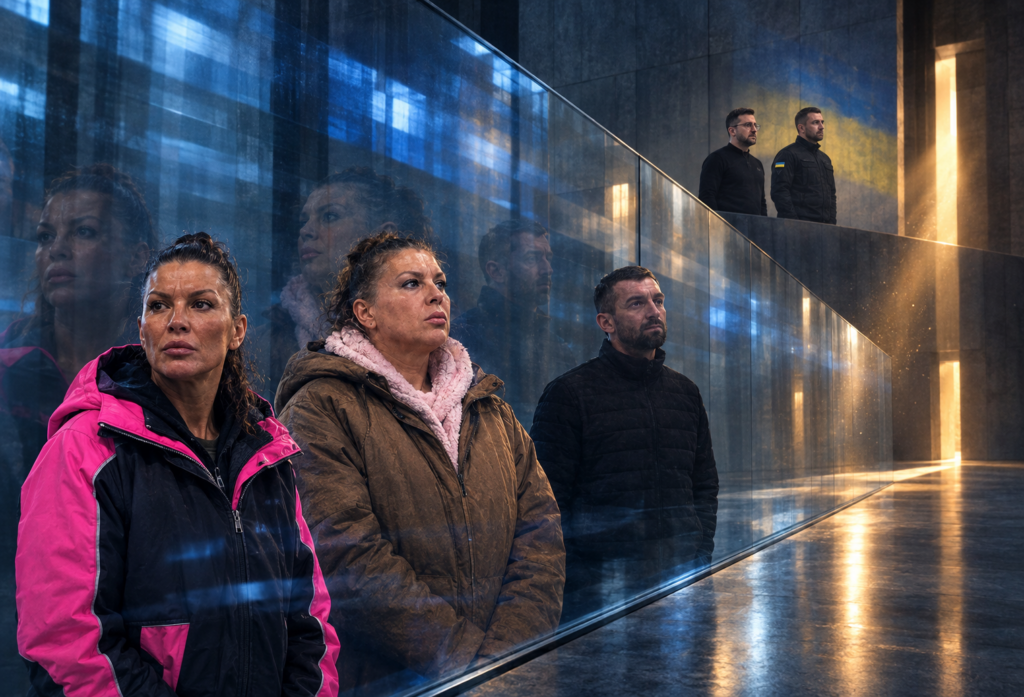
Freddie Ponton
21st Century Wire
On November 2, 2026, Valentyna Moloda arrived in medical clothing outside a private house in Petropavlivska Borshchahivka, a village near Kyiv. She said men inside were being held against their will and abused. Within days, she was in custody. Courts ordered her and Tatiana Kireeva held for 60 days without bail. Ambulance driver Viktor Yen received the same detention order on November 5. Moloda faces allegations of obstructing the military, disclosing military locations and organising mass disorder. She said she would appeal, according to courtroom reporting cited by Ukrainska Pravda.
Official attention has centred on her actions and credentials, but those questions do not answer the claims she made. Four soldiers were hospitalised after the confrontation. Ukrainian MP Anna Skorokhod, who spoke to them in hospital, said all four reported beatings at the National Guard’s temporary location. She described seeing bruises and haematomas, and her account included allegations of punitive beatings and demands for money. She rejected claims that a spinal injury and a stoma resulted from violence at the house—yet the reports of beatings remained.
Among them was Andriy Kulishov, who said he was struck on the head, back and face, pressed to pay a fine for leaving his unit and denied another assessment by a military medical commission. He said he had not been held in a basement and had some telephone contact with relatives. Skorokhod could not explain why he had been kept at the location for weeks.
Ukrainian security institutions have previously held people whose confinement the authorities refused to acknowledge. Former prisoners described abuse, journalists found corroborating evidence, and UN investigators documented failures of accountability. The November 2 allegations raise the question of whether elements of that pattern persist at the National Guard location.
They said he was never there
Viktor Ashykhmin, a separatist-referendum organiser from Ukrainsk, was taken in December 2014. He told the Kyiv Post that armed men took him to the Security Service of Ukraine, known as the SBU, in Kramatorsk. He described three days of torture, including blows to his heels with tubes filled with lead shot. His captors made him write a confession and recorded it on camera.
An investigator later told Ashykhmin that his case would not withstand a lawyer’s scrutiny and that he would instead be used in a prisoner exchange. Proposed exchanges repeatedly passed him by. He spent almost twenty months in confinement without appearing before a court or seeing a lawyer, while his wife, Nelia Shchogoleva, searched for him.
She wrote to law-enforcement bodies and human-rights organisations. Police listed him as missing and once asked her to identify a body. The SBU said it had no information about his whereabouts, but released captives told her he was in Kharkiv. When he finally returned home in July 2016, roughly 600 days had passed. Officers gave him travel money and told him to say he had been working abroad.
Mykola Vakaruk, also from Ukrainsk, was taken two days after Ashykhmin on suspicion of helping separatist artillery. He denied involvement in a conspiracy. He told the newspaper he agreed to sign anything after his captors threatened to make his wife scream like a woman he could hear in another room.
In October 2015, he said he developed kidney failure and was taken to a Kharkiv hospital under the false name Sergiy Ivanov. Doctors removed a kidney. Back in confinement, a fellow prisoner who was a dentist helped care for his surgical wounds. When Vakaruk returned home in July 2016, he had to introduce himself to his three-year-old son. The boy no longer recognised him.
The hospital staff recognised him
Journalists from hromadske interviewed former detainees, gained access to the Kharkiv premises and checked the interior against the men’s descriptions. They found holes in shutters that prisoners said they had made to see outside. Former detainees also recognised an alleged guard in footage filmed inside the building.
The journalists also took Vakaruk back to the hospital, where staff recognised him, corroborating his account of having been treated there.
The SBU maintained that the premises had served as officers’ accommodation. Its spokesperson suggested Hromadske’s evidence could have been fabricated, but offered no specific explanation in her reported response for the matching interior details, the holes in the shutters or hospital staff’s recognition of Vakaruk. Journalists also found that military prosecutors had closed their investigation and the SBU had closed its internal inquiry.
Dentist and councillor Kostyantyn Beskorovaynyi had spent approximately fifteen months in unacknowledged SBU custody, first in Kramatorsk and Izium, then mainly in Kharkiv. The joint Amnesty International and Human Rights Watch investigation recorded guards telling him and other prisoners “you don’t exist” and “we don’t even have a budget for you”.
Beskorovaynyi’s fight continued after his release. His status as a plaintiff was restored in February 2018, and a court ordered the criminal investigation reopened the following month. Investigations into four other former detainees’ complaints remained stalled. By then, all eighteen civilians had been unofficially freed from the Kharkiv facility, the last by the end of 2016, without the SBU acknowledging their detention, according to Human Rights Watch’s review of 2018.
What happens when no one is watching
In May 2016, the UN Subcommittee on Prevention of Torture suspended its Ukraine visit after inspectors were denied access to detention locations. Delegation head Malcolm Evans said they had been prevented from entering places associated with serious allegations of detention and torture. He called the refusal a violation of Ukraine’s obligations under the Optional Protocol to the Convention against Torture.
Beskorovaynyi described how guards concealed the prisoners. Before one visit, they moved the inmates upstairs with bags over their heads. Hours later, the prisoners returned to cells that had been cleaned and made to appear uninhabited. He said he overheard guards discussing a visit by representatives of an international organisation.
He also described the violence that preceded his long confinement. Interrogators accused him of planning to poison a water supply. He said they punched him, struck him with a heavy object and threatened rape, execution and retaliation against his family. After becoming seriously ill, he agreed to confess to anything. Interrogators dictated a confession and filmed him reading it.
Under the UN Convention against Torture, torture means the intentional infliction of severe physical or mental pain or suffering for purposes such as extracting a confession, punishment, intimidation or coercion, with the involvement, consent or acquiescence of an official. The definition does not require a permanent injury. Threats against a prisoner’s family and violence used to force a confession therefore concern more than the injuries left on the body. The severity of the suffering, the purpose of the acts and official responsibility are central.
The treatment documented in Beskorovaynyi’s case matches those elements. He described assaults and threats against his family during interrogation at an SBU facility, followed by a dictated confession filmed by his interrogators. His account connects the suffering inflicted to a specific coercive purpose—extracting a confession—and to official involvement.
In its 2021 thematic report, the Office of the UN High Commissioner for Human Rights estimated that approximately 1,500 conflict-related detainees had suffered torture or ill-treatment by Ukrainian government actors between April 14, 2014, and April 30, 2021. It identified the SBU as the most common government perpetrator of arbitrary detention, torture and ill-treatment. The report documented violence used to extract confessions, force cooperation, punish, intimidate and extort money or property.
The report found that arbitrary detention became substantially less prevalent from 2016. From late that year through the end of its reporting period, investigators no longer observed long-term confinement in unofficial locations. They continued to document shorter periods, usually lasting several days in rented apartments or hotel rooms, before detention was formalised and prisoners transferred to recognised facilities.
Investigations were closed without victims being interviewed. Courts ordered cases reopened, only for investigators to close them again. Judges routinely ignored torture allegations in conflict-related trials. The report described prevailing impunity.
Journalists who documented the Kharkiv facility were listed as “enemies of Ukraine” on the Myrotvorets website and subsequently harassed by unidentified individuals, according to the UN. Investigations arising from former detainees’ complaints had not progressed since 2017.
DOCUMENT: The UN identified the SBU as the most common perpetrator of arbitrary detention, torture and ill-treatment among Ukrainian government actors in the eastern conflict, and described “prevailing impunity”. Much of the abuse predated Zelensky; the unresolved investigations and failures of accountability extended into his presidency. July 2021 (Source: UN Human Rights Office)UN Human Rights Office Doc 3
The findings under Zelensky
During President Volodymyr Zelensky’s administration, UN investigators again documented civilians held in unofficial locations. A report published in June 2023, covering February 24, 2022, to May 23, 2023, recorded 65 such cases. Detention lasted from several hours to four and a half months, often without outside contact. The practice was reportedly used to coerce confessions or other incriminating statements.
Fifty-seven per cent of the detainees interviewed described torture or ill-treatment by Ukrainian authorities, predominantly in unofficial locations. Investigators also documented enforced disappearances in which officers, mainly from the SBU, detained people without court authorisation, denied them access to lawyers and withheld information about their whereabouts from relatives.
By the report’s May 23, 2023 cutoff, the UN knew of no completed criminal investigations into the relevant allegations of arbitrary detention or enforced disappearance by Ukrainian state actors.
DOCUMENT: Unofficial detention, coerced confessions and enforced disappearances involving mainly SBU officers—documented during Zelensky’s presidency. By the reporting cutoff, the UN knew of no completed criminal investigations into the relevant allegations of arbitrary detention or enforced disappearance by Ukrainian state actors. June 2023 (Source: UN Human Rights Office)UN Human Rights Office Doc 2
A follow-up published on September 23, 2025, again documented torture and ill-treatment by Ukrainian authorities and limited accountability. It drew on information collected between June 1, 2023, and September 10, 2025, including confidential interviews, observations, witness accounts, court documents and official records.
DOCUMENT: Continued documentation of torture and ill-treatment by Ukrainian authorities, alongside limited accountability, shows that abuses during Zelensky’s presidency were not confined to the period covered by the UN’s 2023 investigation. September 2025 (Source: UN Human Rights Office)
UN Human Rights Office Doc 1
Four men at the house near Kyiv
The National Guard announced an internal investigation after the November 2 events. The four soldiers’ accounts, relayed by Skorokhod, describe their treatment at the house, a separate matter from the allegations against Moloda.
Oleksandr Perminov said he left immediately after mobilisation because he did not want to serve in the Ukrainian military formation Azov. He said he was caught, taken to the location and beaten for leaving. Oleksandr Pavliuchenko distinguished a vertebral injury sustained during training from a subsequent beating at the house. Ivan Yareshko also reported being beaten.
Kulishov said two representatives of his unit demanded money as a fine for his absence. He sometimes received a telephone to contact relatives, but said he was not taken to hospital or allowed another military medical assessment.
Moloda’s qualifications and actions have received extensive scrutiny. That scrutiny does not establish what happened to the four soldiers or explain why Kulishov was kept at the house for weeks.
When Vakaruk returned home in 2016, he wanted accountability “so that it doesn’t happen to others”. A decade later, four hospitalised soldiers have reported beatings at a National Guard location near Kyiv, while people who publicised allegations about the house are in pretrial detention. Kulishov’s account raises questions about confinement, demands for money and access to medical care. Announcing an inquiry does not answer them.
READ MORE UKRAINE NEWS AT: 21st Century Wire Ukraine Files
SUPPORT OUR INDEPENDENT MEDIA PLATFORM – BECOME A MEMBER @21WIRE.TV
VISIT OUR TELEGRAM CHANNEL
21st Century Wire is an alternative news agency designed to enlighten, inform and educate readers about world events which are not always covered in the mainstream media.
Source: https://21stcenturywire.com/2026/11/06/ukraines-hidden-detention-sites-and-the-abuse-left-unanswered/
Anyone can join.
Anyone can contribute.
Anyone can become informed about their world.
"United We Stand" Click Here To Create Your Personal Citizen Journalist Account Today, Be Sure To Invite Your Friends.
Before It’s News® is a community of individuals who report on what’s going on around them, from all around the world. Anyone can join. Anyone can contribute. Anyone can become informed about their world. "United We Stand" Click Here To Create Your Personal Citizen Journalist Account Today, Be Sure To Invite Your Friends.
LION'S MANE PRODUCT
Try Our Lion’s Mane WHOLE MIND Nootropic Blend 60 Capsules
Mushrooms are having a moment. One fabulous fungus in particular, lion’s mane, may help improve memory, depression and anxiety symptoms. They are also an excellent source of nutrients that show promise as a therapy for dementia, and other neurodegenerative diseases. If you’re living with anxiety or depression, you may be curious about all the therapy options out there — including the natural ones.Our Lion’s Mane WHOLE MIND Nootropic Blend has been formulated to utilize the potency of Lion’s mane but also include the benefits of four other Highly Beneficial Mushrooms. Synergistically, they work together to Build your health through improving cognitive function and immunity regardless of your age. Our Nootropic not only improves your Cognitive Function and Activates your Immune System, but it benefits growth of Essential Gut Flora, further enhancing your Vitality.

Our Formula includes: Lion’s Mane Mushrooms which Increase Brain Power through nerve growth, lessen anxiety, reduce depression, and improve concentration. Its an excellent adaptogen, promotes sleep and improves immunity. Shiitake Mushrooms which Fight cancer cells and infectious disease, boost the immune system, promotes brain function, and serves as a source of B vitamins. Maitake Mushrooms which regulate blood sugar levels of diabetics, reduce hypertension and boosts the immune system. Reishi Mushrooms which Fight inflammation, liver disease, fatigue, tumor growth and cancer. They Improve skin disorders and soothes digestive problems, stomach ulcers and leaky gut syndrome. Chaga Mushrooms which have anti-aging effects, boost immune function, improve stamina and athletic performance, even act as a natural aphrodisiac, fighting diabetes and improving liver function. Try Our Lion’s Mane WHOLE MIND Nootropic Blend 60 Capsules Today. Be 100% Satisfied or Receive a Full Money Back Guarantee. Order Yours Today by Following This Link.


| Visits: | 1,837,494,917 |
| Stories: | 8,733,124 |
Whistler Blowers, Insiders

