
Adding Colored Pencil to a Faint Monoprint Still Life

This is a post from Belinda Del Pesco’s Art Blog Belinda Del Pesco.

- The article discusses the printmaking technique of adding colored pencil to a Faint Monoprint Still Life.
- A collagraph plate made from construction paper was used to create the faint ghost monoprint.
- Collagraph Prints and Monoprints are outlined to understand the differences.
- Different colored printmaking inks were applied using brushes and felt daubers, and the faint second print was enhanced with watercolor and colored pencils.
- The technique of applying different colors to a printmaking plate is known as ‘a la poupee’ in French.
Adding Colored Pencil to a Faint Monoprint Still Life
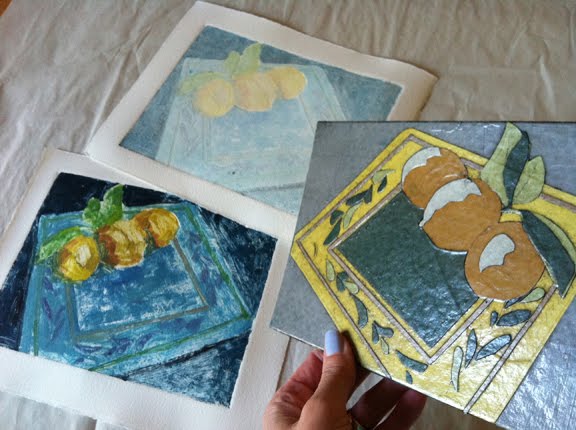
This monoprint was pulled from a construction paper collagraph plate (more on how to make one of those here). I brushed different colored printmaking ink quickly onto the collagraph plate to loosen up a bit and play with color.
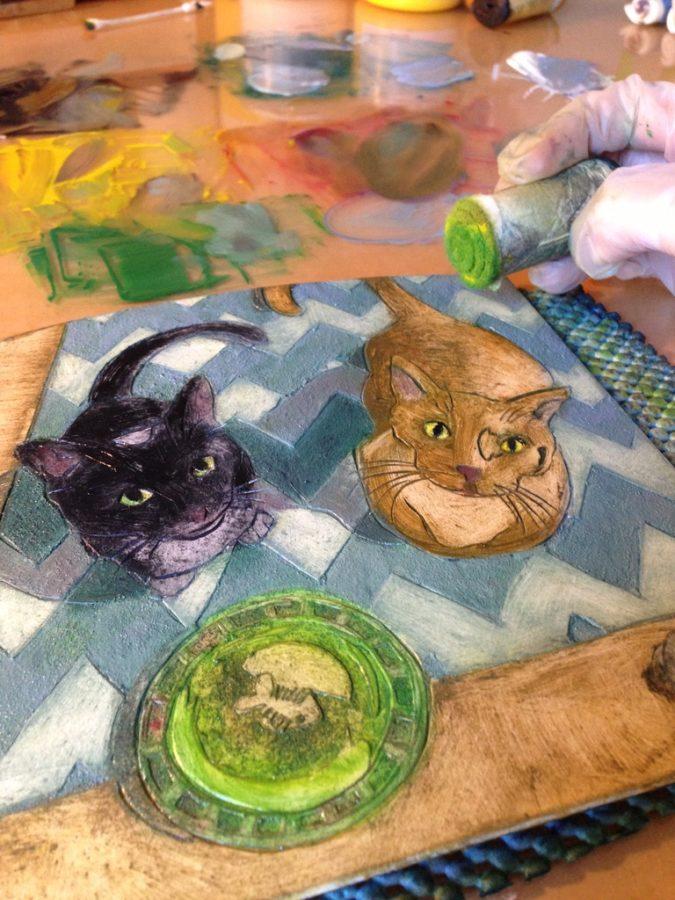
The printmaking ink was applied with brushes and felt daubers. You can see the rolled felt daubers in the photo below. Applying different color inks to a printmaking plate is called ‘a la poupee’ – a French printmaking term that means ‘with the doll’. The daubers sometimes look like little dolls. It’s a creative and painterly way to pull a full color print with just one trip through the press.


Collagraph vs Monoprint
Let’s talk about printmaking nomenclature for just a minute. It’s a hot topic, debated with ardent hand waving and speech spittle in print labs, and furious typing in the comments on social media.
A collagraph is usually made from a stiff board with collage-like materials adhered to its surface with glue, and parts of the plate might also be carved or engraved.
Monotype
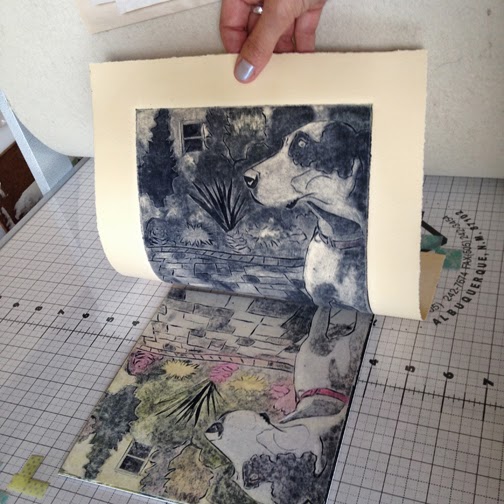
A monotype is a print made with pigment alone, from a perfectly smooth plate. There is nothing between the plate surface and the pigment. Ink is manipulated with tools or fingertips or both, and the resulting still-wet pigments are transferred from the surface of the plate to paper via pressure. You get one print, hence the root of the term MONO-type.

Monoprint
A monoPRINT is the same concept as the monotype above, except there is some form of repeatable mark in the plate; an adhered shape, or grooved line on the plate that will be marked in every print.
So the plate could be rolled with different colored inks, and the pigments could be manipulated into various compositions before each transfer – but that printable mark on the plate will show up in every print pulled from that plate.
Printmaking Verbiage
Monoprint – as a term in printmaking – is applicable in so many instances, it’s almost an overused catch phrase. The junk drawer of printmaking lingo.
If you used brushes to slather color all over a collagraph plate, a woodblock, and a zinc etching, paying no attention to the shape and linework in each matrix, and you printed each one to paper, what would you call them? They all have a repeatable mark in their matrix, but the paint colors and applications could vary from print to print, like a monoprint.
By definition, they could each be called a monoprint??? BUT, the underlying structure of the plate they were printed from (in my opinion) supersedes the printmaking method.
Maybe I’m a stickler for specificity, but if I were to exhibit the piece featured in this post, I’d label it “Monoprint from a Collagraph Plate”. Let’s spare ourselves an exploration of adding further lingo in the printmaking method realm, such as Intaglio vs Relief vs a la poupee inking methods. And is it an engraving or an etching? Another time, maybe.

Print, Dry, Hand Color Fun
So there you have it. More print layering fun with various wet and dry media, and enough print nomenclature to start a multi-thread argument in the Printmaking Group of your choice. If you’ve never seen it, I’m pinky promising that some folks smack so open palm on their view of print definitions, the comment threads resemble keyboard-fisticuffs.
But that’s not how we roll over here, because we have plates to build, and construction paper to cut, and colors to mix, and paper to soak and blot, and new designs to sketch. Let’s get busy, right?
Thanks for stopping by today, and I’ll see you in the next post -
Belinda
P.S. Here is a similar printmaking method, because the plate is made from paper (a popsicle carton), but the process (brain twister ahead) is closer to intaglio drypoint engraving.
Art Quote
An infinite question is often destroyed by finite answers. To define everything is to annihilate much that gives us laughter and joy. ~Madeleine L’Engle

The post Adding Colored Pencil to a Faint Monoprint Still Life appeared first on Belinda Del Pesco’s Art Blog Belinda Del Pesco.
Source: https://www.belindadelpesco.com/adding-colored-pencil-to-a-faint-monoprint-still-life.html/
Anyone can join.
Anyone can contribute.
Anyone can become informed about their world.
"United We Stand" Click Here To Create Your Personal Citizen Journalist Account Today, Be Sure To Invite Your Friends.
Before It’s News® is a community of individuals who report on what’s going on around them, from all around the world. Anyone can join. Anyone can contribute. Anyone can become informed about their world. "United We Stand" Click Here To Create Your Personal Citizen Journalist Account Today, Be Sure To Invite Your Friends.
LION'S MANE PRODUCT
Try Our Lion’s Mane WHOLE MIND Nootropic Blend 60 Capsules
Mushrooms are having a moment. One fabulous fungus in particular, lion’s mane, may help improve memory, depression and anxiety symptoms. They are also an excellent source of nutrients that show promise as a therapy for dementia, and other neurodegenerative diseases. If you’re living with anxiety or depression, you may be curious about all the therapy options out there — including the natural ones.Our Lion’s Mane WHOLE MIND Nootropic Blend has been formulated to utilize the potency of Lion’s mane but also include the benefits of four other Highly Beneficial Mushrooms. Synergistically, they work together to Build your health through improving cognitive function and immunity regardless of your age. Our Nootropic not only improves your Cognitive Function and Activates your Immune System, but it benefits growth of Essential Gut Flora, further enhancing your Vitality.

Our Formula includes: Lion’s Mane Mushrooms which Increase Brain Power through nerve growth, lessen anxiety, reduce depression, and improve concentration. Its an excellent adaptogen, promotes sleep and improves immunity. Shiitake Mushrooms which Fight cancer cells and infectious disease, boost the immune system, promotes brain function, and serves as a source of B vitamins. Maitake Mushrooms which regulate blood sugar levels of diabetics, reduce hypertension and boosts the immune system. Reishi Mushrooms which Fight inflammation, liver disease, fatigue, tumor growth and cancer. They Improve skin disorders and soothes digestive problems, stomach ulcers and leaky gut syndrome. Chaga Mushrooms which have anti-aging effects, boost immune function, improve stamina and athletic performance, even act as a natural aphrodisiac, fighting diabetes and improving liver function. Try Our Lion’s Mane WHOLE MIND Nootropic Blend 60 Capsules Today. Be 100% Satisfied or Receive a Full Money Back Guarantee. Order Yours Today by Following This Link.


| Visits: | 1,835,081,626 |
| Stories: | 8,721,465 |
Whistler Blowers, Insiders

