
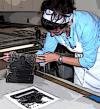
Drypoint Etching of a Girl and Her Little Dog from Clear Acrylic

This is a post from Belinda Del Pesco’s Art Blog Belinda Del Pesco.

- This article describes the process to make a Drypoint Etching from a small sheet of clear acrylic, instead of traditional metal plates.
- Drypoint Etching involves scratching a design into a plate, traditionally done on metal, but acrylic offers a simpler alternative for artists.
- Plexiglass is easier to use than metal for engravings, allowing for better linework and less physical strain on the artist.
- The article provides links to several projects, a new book, and a couple of tutorial videos demonstrating how to prepare for and print drypoint etchings, using everyday items.
- It encourages aspiring printmakers to experiment and embrace simplicity in their designs while offering resources for further learning.
Estimated reading time: 11 minutes
Drypoint Etching of a Girl and Her Little Dog from Clear Acrylic
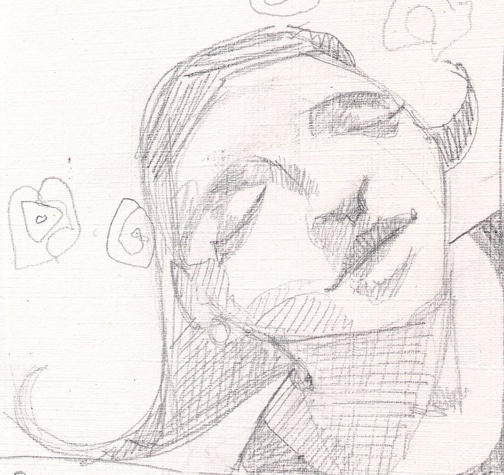

Clear Acrylic Drypoint Engraving
Here are photos and a description of the process I used to create a Drypoint Etching (also called an engraving) from a sheet of clear acrylic or plexiglass. Traditionally, these intaglio prints are made from metal plates, but we’re going to use easier to find and less expensive acrylic sheets to make an intaglio drypoint of a girl and her dog.
The drypoint etching in this post started as a sketchbook doodle during a rough chapter. I was sketching myself out of a pity party, and re-targeting my focus on things going well, and reasons to be grateful.
Sometimes, changing a bad mood is as simple as that; re-route the thought path, breathe deep, and just feel the sun. Find your Gratitude. It sounds dimple, but studies show….
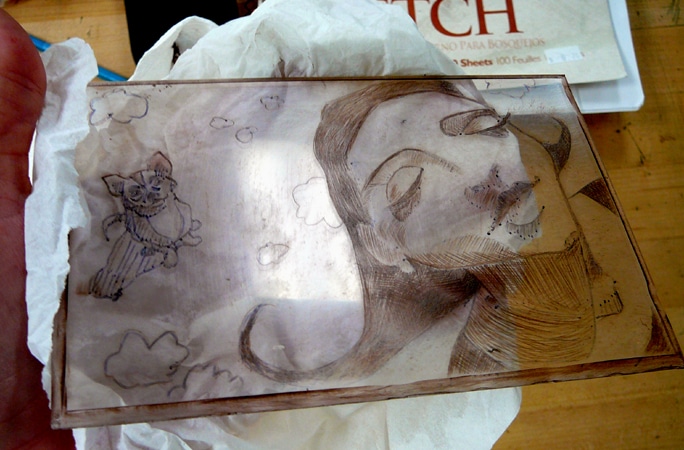
Plexiglass Clear Acrylic Plates
I was just starting to make drypoint etchings under the tutelage of a master printmaker when I created this print. It was exciting to experiment with printing an intaglio drypoint from plexiglass instead of traditional metal plates.
Acrylic and plastic matrix materials are easier to find, and less expensive than traditional copper or zinc plates.
I also found that plexiglass (or acrylic, or lexan, or perspex) are all easier to scribe linework into, compared to metal plates. (If your hands are tender, consider scribing your plates with an electric engraver.). Acrylic is also easier to bevel (very important if you’re printing on a press).
If you need instructions to bevel your acrylic or plexiglass plate, I made a video tutorial on that for you here.


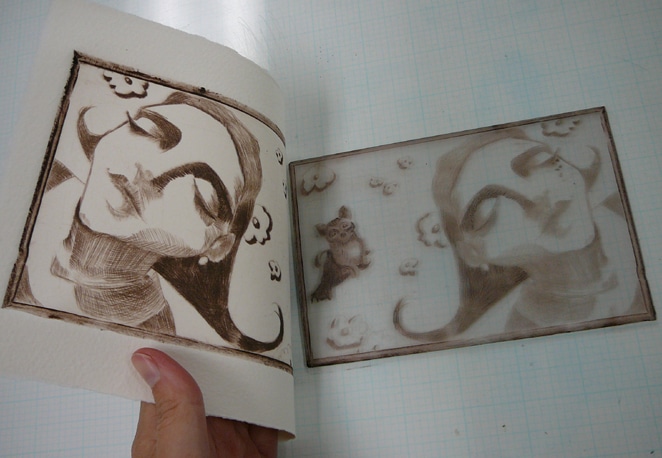
What is a Drypoint Etching?
Drypoint Etching (also known as Drypoint Engraving) is a form of printmaking that uses a hard plate and a sharp tool to scratch or incise line work into the surface of the plate.
The plate is then coated in ink, with the intension of pushing ink into all the recessed grooves etched into the surface. Then the top area of the plate is wiped off, which leaves ink embedded in the grooved lines of the drawing made with the sharp tip of the tool.
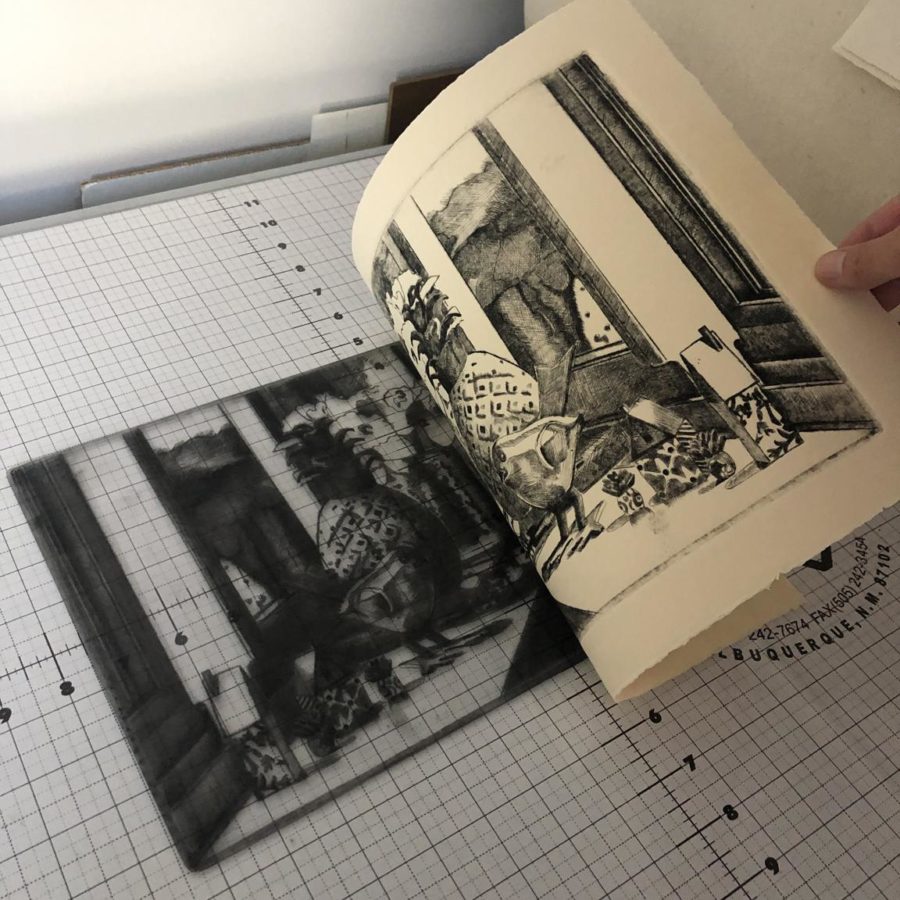
Transferring the Print
Printmaking paper is soaked and blotted, and pressed against the inked and wiped plate, usually on a printing press, to collect the ink from the drawn line work in the plate. Since the print is made from inked linework beneath the uppermost surface of the plate, it’s referred to as an intaglio print, which is derived from the Italian word “to cut in” or engrave.
NOTE: When printing from the uppermost surface, like a woodblock, a linocut or a rubber stamp, the print process is called a relief print. We use this name because the image to be printed stands in relief (elevated or raised) after the background material has been carved away.

Okay, back to intaglio…. Traditionally, drypoint engravings are done on copper plates, or even zinc. In this post, I’ve used a smooth sheet of clear acrylic.
A drypoint engraving doesn’t get dipped into an acid bath, like the process of traditional etching.
Since the process involves my simply scribing into the plate material, without using caustic liquid chemicals to create the marks on the plate, this method is called a DRYpoint.
I like to remind people that in relief printing like woodcut or linocut – I’m carving away everything *except* my drawing. When I’m working with intaglio printing, like drypoint, I’m literally drawing with my tool on top of the drawing, replacing the drawn lines with incised gouges. I’m “removing” the drawing.


Drypoint Printing
When my incised lines on the plate are looking finished, I apply printmaking ink (specific to intaglio printing) over the entire surface of the plate with either a dauber, a soft cardboard squeegee, or a brush. I’ll push the printmaking ink carefully, all the way into all the grooves left behind by the sharp tip of the twisted scribe.
Using starched cheese cloth called tarlatan, I wipe the entire plate of ink. This is where experience matters. I’m always careful to use a light touch when wiping over areas where ink is nestled below the surface, inside the gouged line work plowed by my scribe.
When my damp printmaking paper is pressed firmly against the plate by the cylinder on my etching press, the ink laying in the recessed drawn lines is lifted out by the paper, duplicating the drawing on the plate, in reverse.

What is an Edition?
After reviewing the print to make sure there’s no additional scribing necessary, the artist decides on the size of the edition. An edition is a number of identical impressions pulled from a plate. If the editions are limited in number – say an edition of ten, then it’s considered a limited edition print, and I will destroy the plate after ten prints are pulled.
In order to make an edition of ten, I ink and wipe and print the plate against new sheets of paper on the press ten times.
If the edition is open, there is no limit to the number of prints made, except for the reduced integrity of the plate over time with repeated inking, wiping and printing under pressure.
After the prints are dry, I sign, title and number each one in pencil. This normally occurs along the bottom of the art, just beneath the plate impression.
Resources to Print a Drypoint Etching without a Press
In this series of printmaking projects using stuff around the house to make art, we’ve explored drypoint etching in the posts below, in case you missed them:
- Printing a drypoint etching from a plastic Trader Joe’s biscotti container with a stomp-method (hint: your feet are the press)
- Making a Monotype without a press, from a blueberry container using acrylic paint and watercolors (hint: this one is great if you don’t have inks)
- Printing a Drypoint Etching without a press, from a plastic lettuce box, using a spoon, and then adding watercolor (hint: this one has a tutorial video)

Make a Drypoint Print
Printmaking terminology can be a brain teaser, but make rather than study. Can I suggest that you have courage, and learn as you go?
Follow the basic instructions available to you online and in books if you have them. Keep your designs epically simple and small at first. Don’t substitute recommended materials, as paper, inks and pressure all matter.
Drypoint etching is one of the more appealing “drawn line” forms of printmaking. The goal is to duplicate the drawing you made on the plate, with all of the naturally occurring soft and hard marks, wide and narrow lines, bold and lost edges.
I hope you’ll give it a whirl. C’mon now, we both know you have some gestural drawings and watercolor painted drypoint ideas floating about in your sketchbooks, right? Wink-wink, nudge-nudge….
Thanks for stopping by, and I’ll see you in the next post,
Belinda
P.S. Do you know there are over 300 art books in the Getty Museum Library than you can download and read for free? Have a look.
Art Quote
The creative is the place where no one else has ever been. You have to leave the city of your comfort and go into the wilderness of your intuition. What you’ll discover will be wonderful. What you’ll discover is yourself. ~ Alan Alda

The post Drypoint Etching of a Girl and Her Little Dog from Clear Acrylic appeared first on Belinda Del Pesco’s Art Blog Belinda Del Pesco.
Source: https://www.belindadelpesco.com/drypoint-etching-of-a-girl-and-her-little-dog-from-clear-acrylic.html/
Anyone can join.
Anyone can contribute.
Anyone can become informed about their world.
"United We Stand" Click Here To Create Your Personal Citizen Journalist Account Today, Be Sure To Invite Your Friends.
Before It’s News® is a community of individuals who report on what’s going on around them, from all around the world. Anyone can join. Anyone can contribute. Anyone can become informed about their world. "United We Stand" Click Here To Create Your Personal Citizen Journalist Account Today, Be Sure To Invite Your Friends.
LION'S MANE PRODUCT
Try Our Lion’s Mane WHOLE MIND Nootropic Blend 60 Capsules
Mushrooms are having a moment. One fabulous fungus in particular, lion’s mane, may help improve memory, depression and anxiety symptoms. They are also an excellent source of nutrients that show promise as a therapy for dementia, and other neurodegenerative diseases. If you’re living with anxiety or depression, you may be curious about all the therapy options out there — including the natural ones.Our Lion’s Mane WHOLE MIND Nootropic Blend has been formulated to utilize the potency of Lion’s mane but also include the benefits of four other Highly Beneficial Mushrooms. Synergistically, they work together to Build your health through improving cognitive function and immunity regardless of your age. Our Nootropic not only improves your Cognitive Function and Activates your Immune System, but it benefits growth of Essential Gut Flora, further enhancing your Vitality.

Our Formula includes: Lion’s Mane Mushrooms which Increase Brain Power through nerve growth, lessen anxiety, reduce depression, and improve concentration. Its an excellent adaptogen, promotes sleep and improves immunity. Shiitake Mushrooms which Fight cancer cells and infectious disease, boost the immune system, promotes brain function, and serves as a source of B vitamins. Maitake Mushrooms which regulate blood sugar levels of diabetics, reduce hypertension and boosts the immune system. Reishi Mushrooms which Fight inflammation, liver disease, fatigue, tumor growth and cancer. They Improve skin disorders and soothes digestive problems, stomach ulcers and leaky gut syndrome. Chaga Mushrooms which have anti-aging effects, boost immune function, improve stamina and athletic performance, even act as a natural aphrodisiac, fighting diabetes and improving liver function. Try Our Lion’s Mane WHOLE MIND Nootropic Blend 60 Capsules Today. Be 100% Satisfied or Receive a Full Money Back Guarantee. Order Yours Today by Following This Link.


| Visits: | 1,835,563,460 |
| Stories: | 8,724,526 |
Whistler Blowers, Insiders

