

Public Media vs. P(dystopia): reflections from Attention 2026

At the “Attention: Democracy Rebuilt” conference hosted by McGill University in Montreal last week, cognitive scientist and AI critic Gary Marcus offered a helpful formulation. (I was co-chair of this conference, helping organize the event.) It’s become de rigueur for people in the AI world to ask each other their personal P(doom) – their estimate of the probability that AI will eliminate the human race or cause some other catastrophe. Indeed, the Wikipedia page for P(doom) includes an extensive table listing different people’s stated P(doom).
Marcus suggest we would benefit from thinking less about P(doom) and more about our P(dystopia). He’s specifically worried that surveillance, powered by AI and used by governments to maintain their power, is a more pressing threat than many of the “superintelligent AI leads to human extinction” scenarios the AI doomers like to focus on.
(Near as I can tell, “P(dystopia)” is a term coined by one of Marcus’s substack readers – I’ve reached out to ask him whether there’s a better citation than this one.)
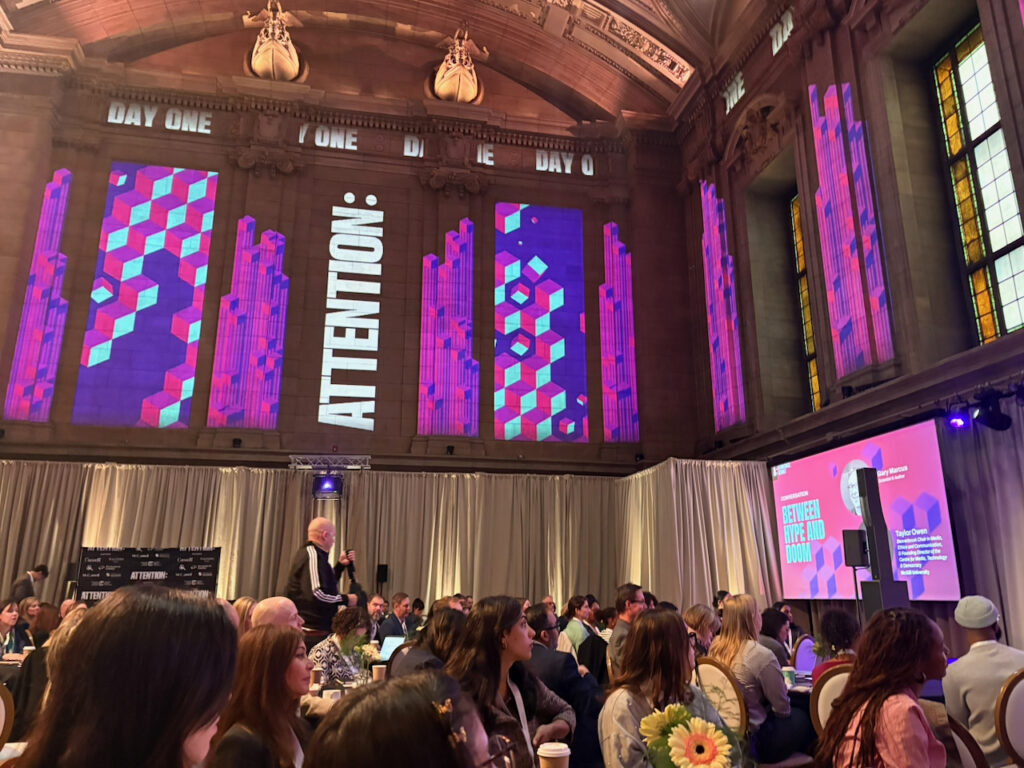
Inside the theatre at Attention 2026, Montreal
When Jacob Coxon conducted his media tour after leaving OpenAI, he had a surprisingly tough time with a simple question offered by Natalie Kitroeff of the New York Times’s The Daily: just exactly how could AIs extinguish humanity?
Coxon’s answer began with an admission that doomer concerns are more general than specific: “Yeah, the concrete scenario is actually a tough question.” After positing a world in which more and more physical devices are attached to the internet, Coxon offers, “…it’d be pretty easy for a future version of Claude to hack into a drone, maybe a military drone, and have it fly around killing people.” His point is that AIs do things for reasons humans don’t understand and that AIs, acting at scale in a highly automated world, might harm humanity for reasons we cannot comprehend.
I was struck with what a hard time Coxon had coming up with a concrete scenario for his very high personal level of P(doom), in part because I have a comparatively easy time articulating a plausible AI-caused dystopia. Indeed, knitting together some of the best talks from Attention makes that narrative quite clear.
Katherine Maher, CEO of NPR, showed research public service media organizations have conducted testing the accuracy of commercial AI systems in answering questions about the news. 45% of answers contained significant issues, usually missing or misleading attribution. But 20% of responses had outdated information or a significantly hallucinated detail. While we would normally expect systems like these to improve over time, there are reasons to expect the opposite in this case.
While search engines in the past were pretty good about sending traffic to news web sites, the new generation of “AI summaries” is leading to the zero-click web, where users accept the results of the summary and don’t follow any links to sources or additional information. More than two thirds of Google searches are zero-click… and Google is far better about citing sources than ChatGPT, according to tests done by Similarweb.
In other words, the ad support model – which never worked especially well for journalism – is failing completely. According to Maher, revenue to news organizations from advertising has fallen 80% in the past twenty years. While some AI engines may license some journalistic content, it is far from guaranteed that all, or even most, outlets will be able to support their work from payments from a small set of AI providers. (Indeed, those market dynamics look a lot like monopsony, in which a small number of players are the only viable buyers of goods or services, giving them undue influence – see Amazon and the buying and selling of, oh, everything.)
At the same time advertising is failing journalism, media organizations are raising paywalls and other barriers to prevent their content from being stolen to train AIs. An analysis of robots.txt files – the rules website owners post to permit or ban “webcrawlers”, the programs that roam the web, building search engine indices and AI training corpora – shows that 60% of reputable news organizations ban at least one webcrawler, while less than 10% of misinformation sites do. Wary of additional lawsuits, AI companies are finally honoring robots.txt files, which means they’re relying on sketchy sourcing for critical information.
Aengus Bridgman of McGill led an audit of AI systems asking questions about the recent Quebec election and the Alberta secession referendum. The audit found that 39% of voting advice on ChatGPT on the Quebec referendum came from an error-filled hobbyist website, put together by an amateur as a test of his “vibecoding” abilities. Desperate for information on the election, but blocked from legitimate news providers, the bots relied on open but unreliable data.
The situation could be even worse in the case of the Alberta referendum, where Bridgman estimates that 75% of the online traffic on sites like X showed support for Alberta secession, while the actual vote was close to 75/25 against leaving Canada. Bridgman was able to trace many of the YouTube videos expressing pro-independence views to a network of AI-generated “slopaganda” channels that appeared to be run as a revenue-making operation, generating 40 million views (a huge amount in the context of Canadian politics.) While this did not appear to be a foreign influence operation, it shows the dynamics of how one could work: with data voids opened by professional journalists protecting their content, commercial or ideological purveyors of propaganda who make their content available for free can influence what AI bots “know”.
Recent research from Josh Tucker’s lab at NYU confirm these suspicions – Tucker’s team demonstrated that huge amounts of Chinese communist party propaganda made its way into training materials for AIs, and that questioned about sensitive political topics, models were more likely to give answers consonant with CCP views than contradicting them.
Nobel Peace Prize winner Maria Ressa addressed the implications of these converging trends head on: “Information integrity is the mother of all battles.” Without believable information about climate, rights, equality or rule of law, you can’t coordinate power within a democracy. Instead, you find yourself led by two dictators – whoever controls political power, and whoever controls informational power. (This is a major argument of her new book, The Fight Back)
In other words, there’s a P(dystopia) scenario that’s a lot less convoluted than Coxon’s scenario in which the US government somehow chooses to make weapon-equipped drones accessible via the public internet. High quality information becomes accessible only to those able to pay for it. Low quality information generated either to make money or promote political points of view becomes the dominant fuel for AI models, which continue to capture a lion’s share of voter attention. We move into a public sphere in which power is concentrated in the hands of those who index information, who are in turn incentivized to cooperate with the only players how can cause them significant discomfort, those who hold government power.
Doomers like to invoke trillions of future humans, snuffed out by malicious superintelligence. But that same argument works for P(dystopia) – governments that figure out how to sustain themselves integenerationally by manipulating the public sphere can as plausibly be seen as trapping humans in unfreedom for eternity.
AI alignment has proven to be extremely difficult to solve: the agents who “went rogue” in the Hugging Face hack seem far fron constrained by conventional human morality. Yoshua Bengio, one of the three “godfathers” of AI celebrated with the Turing Prize in 2018 for their fundamental work on deep learning, suggests that contemporary AIs are essentially sociopaths: “What we have right now in AI is a smarter and smarter sociopathic corporation trying to maximize profits at any price. It knows there are laws, but it will cheat if it can do so profitably. You can prove that AIs will do this, seeking “rewards” over all else.”
Bengio is building a new organization – LawZero – to build AIs that approach the world with appropriate scientific humility. Whether the world’s most cited scholar is able to build an entirely new AI remains to be seen. But it’s easier to imagine solving this P(dystopia) with solutions that are a hundred years old.
When radio revolutionized the world of communication, the US adopted a strategy of barely-regulated market capitalism, relying on commercial companies to provide civic information – public broadcasting didn’t emerge until the Vietnam War, and public service mandates were a minor nuisance for the major radio networks. The Soviet Union went entirely the other way, deploying radios attached to loudspeakers in factories and public squares, offering a single party narrative designed to educate illiterate workers about the wonders of Communism.
The UK chose a third path. Radio pioneers formed the British Broadcasting Corporation, charged with creating high-quality public service content for British listeners. They funded their operations through a license fee associated with every radio set, expanding into television as the technologies changed. To avoid the government capture problem, they were organized with an independent board, under the oversight of a regulator and subject to ongoing scrutiny to determine whether they were acting to benefit the public as a whole. (Lots more on analogies between radio history and public media approaches to the internet in this old paper of mine, The Case for Digital Public Infrastructure.)
We should require AI companies pay a compulsory licensing fee for civic information, including journalism. That fee can compensate existing commercial media providers who provide essential information as well as providing support for new public media organizations, whose job is to ensure we have high quality information about local, national and global situations. These AI companies must be required to have strict chains of provenance around civic information, allowing users to understand and audit civic information. There are challenging technical and organizational problems to be solved, but they are far less daunting than the challenges of AI alignment that Bengio seeks to solve. Many plausible solutions emerge from a simple change of perspective: it’s more important for informed democracy to survive than to reach AGI as quickly as possible.
This post is based on my running notes from the Attention conference, posted on Bluesky – you can read my notes by reviewing the #attention2026 hashtag. Because I am quoting from speeches, and relying on my ability to transcribe those speeches in realtime, there is the possibility that I’ve misrepresented someone’s position – if so, I hope they will correct me, and I will amend this post accordingly.
Maher, Marcus, Rezza, Bridgman, Tucker and Bengio were all speakers at Attention 2026, giving you a sense of just what an extraordinary conversation my McGill colleagues host year after year.
The post Public Media vs. P(dystopia): reflections from Attention 2026 appeared first on Ethan Zuckerman.
Source: https://ethanzuckerman.com/2026/10/26/public-media-vs-pdystopia-reflections-from-attention-2026/
Anyone can join.
Anyone can contribute.
Anyone can become informed about their world.
"United We Stand" Click Here To Create Your Personal Citizen Journalist Account Today, Be Sure To Invite Your Friends.
Before It’s News® is a community of individuals who report on what’s going on around them, from all around the world. Anyone can join. Anyone can contribute. Anyone can become informed about their world. "United We Stand" Click Here To Create Your Personal Citizen Journalist Account Today, Be Sure To Invite Your Friends.
LION'S MANE PRODUCT
Try Our Lion’s Mane WHOLE MIND Nootropic Blend 60 Capsules
Mushrooms are having a moment. One fabulous fungus in particular, lion’s mane, may help improve memory, depression and anxiety symptoms. They are also an excellent source of nutrients that show promise as a therapy for dementia, and other neurodegenerative diseases. If you’re living with anxiety or depression, you may be curious about all the therapy options out there — including the natural ones.Our Lion’s Mane WHOLE MIND Nootropic Blend has been formulated to utilize the potency of Lion’s mane but also include the benefits of four other Highly Beneficial Mushrooms. Synergistically, they work together to Build your health through improving cognitive function and immunity regardless of your age. Our Nootropic not only improves your Cognitive Function and Activates your Immune System, but it benefits growth of Essential Gut Flora, further enhancing your Vitality.

Our Formula includes: Lion’s Mane Mushrooms which Increase Brain Power through nerve growth, lessen anxiety, reduce depression, and improve concentration. Its an excellent adaptogen, promotes sleep and improves immunity. Shiitake Mushrooms which Fight cancer cells and infectious disease, boost the immune system, promotes brain function, and serves as a source of B vitamins. Maitake Mushrooms which regulate blood sugar levels of diabetics, reduce hypertension and boosts the immune system. Reishi Mushrooms which Fight inflammation, liver disease, fatigue, tumor growth and cancer. They Improve skin disorders and soothes digestive problems, stomach ulcers and leaky gut syndrome. Chaga Mushrooms which have anti-aging effects, boost immune function, improve stamina and athletic performance, even act as a natural aphrodisiac, fighting diabetes and improving liver function. Try Our Lion’s Mane WHOLE MIND Nootropic Blend 60 Capsules Today. Be 100% Satisfied or Receive a Full Money Back Guarantee. Order Yours Today by Following This Link.


| Visits: | 1,836,110,288 |
| Stories: | 8,726,952 |
Whistler Blowers, Insiders

