

How to Make a Woman by Marie Darrieussecq

Two things stood out to me from reading How to Make a Woman.
The first was how successfully Marie Darrieussecq evokes a time and a place: primarily southwestern France in the 1980s, although later we move into the 90s and early 2000s in Paris, London and Los Angeles. This is one of those novels that leaves you feeling as if you’ve lived for a time as a teenager in that small village.
Interestingly, Darrieussecq doesn’t achieve that feeling through meticulous physical description—there’s actually very little description of buildings or landscapes that I can remember. Instead, she evokes the atmosphere of the place, the claustrophobic feeling of growing up in a place where everybody knows you, where every false step will be remembered and recounted, where you’re a teenager bursting with questions about sex and your body and a million other things, but you can’t ask anyone because they’ll judge you and your secret questions, and the anonymity of the Web doesn’t exist yet.
The second thing that stood out from How to Make a Woman was the characterisation. The novel revolves around two teenage girls, Rose and Solange, who were best friends as small children but gradually drift apart as the novel progresses and they take different paths into adulthood. As with the setting, I really felt as if I knew these two girls/women.
This part, I think, is due to the narrative style. The whole novel is narrated in third person, but the first section focuses tightly on Rose’s perspective, the second retells the same events from Solange’s point of view, and the short final section brings the two strands together. In the Rose section, we are deep inside Rose’s head, and the same applies in Solange’s. That kind of deep immersion doesn’t always work in novels, but in this one it does. It gives us a strong sense of the inner lives of both characters.
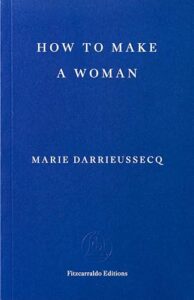
This was my first time reading Darrieussecq, so I read How to Make a Woman as a standalone novel, but I later discovered from Wikipedia that she has written several novels that are set in the same fictional village of Clèves in the Basque country of southwestern France, with the same cast of recurring characters shown at different stages of life. It sounds a bit like the work of Elizabeth Strout, where I enjoy tracing characters through different situations, so I think if you’ve read other Darrieussecq novels, you’ll probably get more out of How to Make a Woman than I did.
However, it does work as a standalone novel too. As the title suggests, Darrieussecq is exploring different ways of becoming an adult woman. Rose takes a more conventional path, studying hard and marrying her childhood sweetheart and having names picked out for her children before she’s even graduated from high school. She stays with her boyfriend Christian despite having frequent doubts about whether she really loves him, mostly because she’s scared of a life without the certainties to which she has learned to cling:
“Leave Christian, and fall into what dizzying depths?”
Damage avoidance is hardly the most romantic reason for staying with your future husband, but it’s Rose’s way of navigating life and becoming a woman. Here’s her reaction to seeing a child across the street:
“Rose would like to erect a magic shield around him. It’s such an effort going through life avoiding life, doing your best not to suffer too much, rubbing up against reality as little as possible. She understands that.”
That protective instinct reminded me of The Catcher in the Rye, a book that How to Make a Woman doesn’t resemble in any other way. It also tells us a lot about how Rose views life and explains her choices and her way of becoming a woman.
Solange, on the other hand, rubs up against reality quite a lot. She has a baby at 15, then leaves the boy with her mother so that she can escape the village and free herself from the feeling that her life is over before it’s begun. She goes to Bordeaux, then London, then Paris, then LA, staying in squats and partying in gay bars that at the time were illicit and countercultural and then, when the AIDS epidemic hit, became places of sorrow. She gets a part in a sitcom, then a movie later, and gradually builds a career and a life in America.
The two sections, Rose’s and Solange’s, give quite different views of the same events, and it’s up to us to decide which is correct, or perhaps the correct answer is both and neither. Rose seems at times to resent Solange’s freedom, even though she would never have wanted to make those choices herself. And Solange also resents Rose at times:
“Rose, her best friend Rose, is trying to be kind. But it’s too hard to accept it, that kindness. They’re so perfect, mother, daughter, with their real tea, not in bags, their ceramic teapot, their eyes full of tenderness and understanding. Solange could hit them.”
From Rose’s description, Solange seems to have an easy life of wealth and fame, but Solange’s perspective is quite different, with her life much more of a struggle and her success much more limited and precarious. There are plenty of inconsistencies like that, which it’s up to us as readers to resolve (or to leave hanging if we prefer).
In reality, of course, there are as many ways to become a woman as there are women. Darrieussecq gives us two contrasting approaches, but despite the self-help-style book title, I’m sure she’s not suggesting these are the only two. What is, perhaps, essential to becoming a woman is what lies beneath the story: not so much the safety/freedom dichotomy but the slow and sometimes painful process of pulling a life together through a combination of decisions made with limited information, responses to emotional pulls, the intervention of random chance, coincidences and happenstance, fear and uncertainty. Nobody really “makes a woman”—it’s not a conscious effort but a chaotic process that nobody, least of all the person at the centre of it, really understands until they look back on it later.
In that sense, coming of age as a girl in 1980s Clèves is not so different from coming of age as a boy in 1990s London or [insert your decade and place here]. Those are the good literary experiences, I think: when you get taken into a completely different world that nevertheless reflects something of your own experience and makes you feel less alone.
Thanks to Fitzcarraldo Editions for the review copy of How to Make a Woman by Marie Darrieussecq, which will be published tomorrow in the UK. Looks as if the North American edition will be published next month by Transit Books.
Let me know in the comments if you’ve read any other books by Marie Darrieussecq and can recommend (or recommend avoiding) any of them. I might dive further into the Clèves literary world after this.
The post How to Make a Woman by Marie Darrieussecq appeared first on Andrew Blackman.
On his blog A Writer’s Life, British novelist Andrew Blackman shares book reviews, insights into the writing process and the latest literary news, as well as listing short story contests with a total of more than $250,000 in prize money.
Source: https://andrewblackman.net/2026/08/how-to-make-a-woman-by-marie-darrieussecq/
Anyone can join.
Anyone can contribute.
Anyone can become informed about their world.
"United We Stand" Click Here To Create Your Personal Citizen Journalist Account Today, Be Sure To Invite Your Friends.
Before It’s News® is a community of individuals who report on what’s going on around them, from all around the world. Anyone can join. Anyone can contribute. Anyone can become informed about their world. "United We Stand" Click Here To Create Your Personal Citizen Journalist Account Today, Be Sure To Invite Your Friends.
LION'S MANE PRODUCT
Try Our Lion’s Mane WHOLE MIND Nootropic Blend 60 Capsules
Mushrooms are having a moment. One fabulous fungus in particular, lion’s mane, may help improve memory, depression and anxiety symptoms. They are also an excellent source of nutrients that show promise as a therapy for dementia, and other neurodegenerative diseases. If you’re living with anxiety or depression, you may be curious about all the therapy options out there — including the natural ones.Our Lion’s Mane WHOLE MIND Nootropic Blend has been formulated to utilize the potency of Lion’s mane but also include the benefits of four other Highly Beneficial Mushrooms. Synergistically, they work together to Build your health through improving cognitive function and immunity regardless of your age. Our Nootropic not only improves your Cognitive Function and Activates your Immune System, but it benefits growth of Essential Gut Flora, further enhancing your Vitality.

Our Formula includes: Lion’s Mane Mushrooms which Increase Brain Power through nerve growth, lessen anxiety, reduce depression, and improve concentration. Its an excellent adaptogen, promotes sleep and improves immunity. Shiitake Mushrooms which Fight cancer cells and infectious disease, boost the immune system, promotes brain function, and serves as a source of B vitamins. Maitake Mushrooms which regulate blood sugar levels of diabetics, reduce hypertension and boosts the immune system. Reishi Mushrooms which Fight inflammation, liver disease, fatigue, tumor growth and cancer. They Improve skin disorders and soothes digestive problems, stomach ulcers and leaky gut syndrome. Chaga Mushrooms which have anti-aging effects, boost immune function, improve stamina and athletic performance, even act as a natural aphrodisiac, fighting diabetes and improving liver function. Try Our Lion’s Mane WHOLE MIND Nootropic Blend 60 Capsules Today. Be 100% Satisfied or Receive a Full Money Back Guarantee. Order Yours Today by Following This Link.



| Visits: | 1,836,269,080 |
| Stories: | 8,727,541 |
Whistler Blowers, Insiders


I’d like to be a writer too but don’t have the time. I have to FIX
things so others can spend their time WRITING!