

Communicate a Price Increase to Customers the Right Way and Keep Them

- How you explain a price increase decides whether customers stay, leave, or never notice.
- New research on 1,454 subscribers found 58% accepted a price increase once the value was explained clearly, while only 7% canceled in frustration.
- This workflow walks through deciding how much to raise, when to send it, what to say, and how to track whether it worked.
How to communicate a price increase to customers starts with the order of information, not the number itself. Lead with what changed for them. Explain the value first, name the timing second, and put the new price last.
Small businesses that skip straight to the number lose customers. Small businesses that lead with value keep almost six in ten, according to new research.
Early in my consulting career, I billed $75 an hour for strategy work delivering five-figure savings for clients. I sat on that rate for two years, terrified that one price increase email would empty my client list. When I finally sent it, framed around a new reporting dashboard I had built for everyone, exactly one client left.
The other eleven stayed. Three of them thanked me for finally charging what the work was worth.
Why does waiting to raise your prices cost more than the increase itself?
The National Federation of Independent Business found that small business pricing decisions now reflect a careful balance between protecting margins and keeping customer relationships intact. Read between the lines. Businesses raising prices on purpose are managing their margin. Businesses freezing prices are managing their fear, and losing money on every sale while they do it.
A 1% price increase lifts net profit by roughly 12% on average. Your costs stay the same. The extra revenue drops straight to your bottom line. Skip that increase for three years running, and you’ve handed three years of profit to inflation, one invoice at a time.
If your prices haven’t moved in years, start by figuring out what you’re worth before you pick a percentage. Run the numbers on your service pricing first. Most small business owners are undercharging by more than they realize, and the increase you need is often smaller once you see your real margin.
What do your customers value about working with you?
Cleveland Research surveyed consumers in 2025 and found that most people no longer define value as the lowest price. When asked what value means, the top answers were quality, durability, and longevity. Three out of four consumers said they would rather pay more for something built to last than pay less and replace it sooner.
A 2025 study in the Asia-Pacific Journal of Consumer Research found that emotional value moves willingness to pay even more than functional value. How your product or service makes a customer feel carries more weight in their decision than the features on the page. Small business owners leave that part out of the pricing conversation more often than anything else.
Before you write a single word about your new price, ask eight to twelve of your best customers three questions. What made you choose us in the first place? What would you miss most if we disappeared tomorrow?
What do you tell other people when you recommend us? Write down their exact words.
Those words become the backbone of your price increase message, because they describe the value in language your customers already use and trust. Behind those three answers sit the emotional triggers that decide how you frame everything that follows.
How much should you raise prices and how often?
For most small businesses, the sweet spot sits between 5% and 15% per increase, spaced six to twelve months apart. A bigger jump all at once feels like a slap. A series of smaller increases feels like normal business, because it is normal business.
The best timing windows connect to value, not your calendar. Raise prices after you ship a real improvement, during contract renewals when customers already expect to revisit terms, or after your busy season if your business is seasonal. For B2B relationships, time the increase around your customer’s budget cycle so the new number fits into planning instead of arriving as a surprise.
If you’re not sure what number to land on, walk through the value-based pricing process first. The percentage matters less than whether the new price still reflects what you deliver.
How to communicate a price increase to customers without sounding defensive
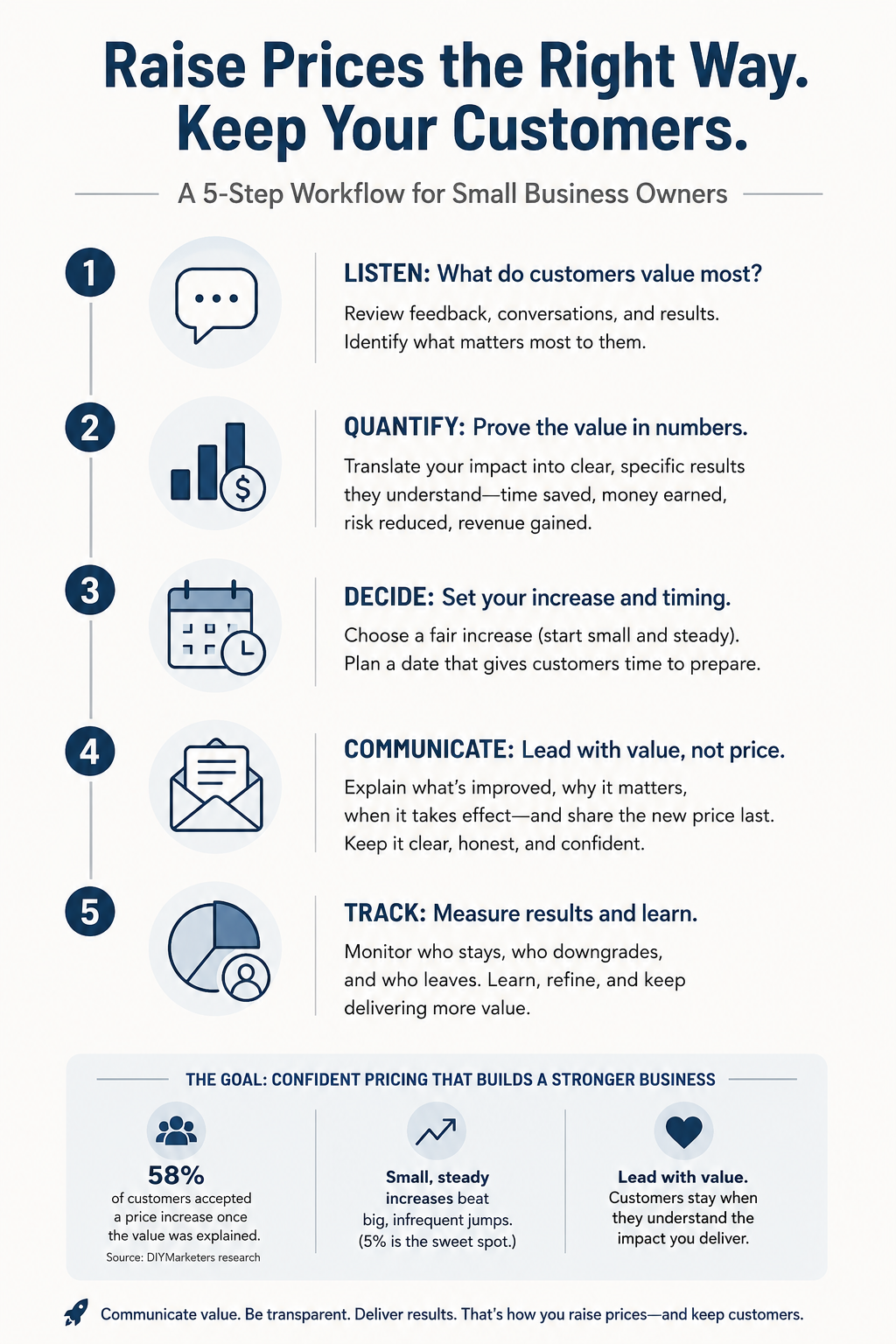
How to communicate a price increase to customers matters more than the size of the increase itself. Chargebee surveyed 1,454 subscribers in 2025 and found that 90% noticed a recent price increase, but 58% accepted it once the value was clearly explained. Only 7% canceled in frustration.
The other third downgraded, asked for a discount, or didn’t notice at all. Communication, not the number, decided most of those outcomes.
Before you fill in the brackets, write down three things: the pain your customer had before working with you, the change they wanted, and how your work bridges the two. Marketing strategist Jessica Chauhan describes this as the “Moment” approach.
Open with the exact scene where the old problem used to bite, then show what’s different now. A vague line like “we’ve improved our service” moves nobody. A specific line like “you used to wait three days for a response, now you hear back the same day” moves people because it shows proof.
Your price increase message and your positioning message should say the same thing at different times. If customers already know why they chose you, the new price confirms what they already believe instead of contradicting it.
How do you segment your message so every customer hears the right reason?
Every customer hears “price increase” differently, so segment your message instead of sending one blast. Forrester’s 2026 consumer data found that 37% of online shoppers will pay more for brands they love, while a separate Ecommerce Pulse Report found 87% of shoppers will pay more for a brand they trust, even though 55% switched brands in the past year for a better deal. Trust buys patience. It doesn’t buy infinite patience.
| If you see this customer… | It means… | Your next move |
|---|---|---|
| Heavy users who engage with you constantly | They get the most value and notice improvements first | Lead with what’s new and frame the price as access to more value |
| Long-time customers who have gone quiet | High lifetime value, but the relationship needs attention | Send a personal note acknowledging their history before the price email |
| Price-sensitive customers who joined recently | Comparing you against alternatives, low switching cost | Highlight savings they’ve already gotten or offer a short rate-lock window |
| Low engagement plus high price sensitivity | Flight risk, around 36% accept increases without a downgrade option | Offer a pause, downgrade, or smaller package before the increase hits |
For the customers in your first two rows, pairing the price increase announcement with a small loyalty reward turns a price conversation into a relationship conversation.
What should you do when a customer pushes back on the new price?
A customer pushing back on price almost always means they haven’t connected the new number to the value you deliver yet. Close that gap in one conversation, and the pushback usually disappears.
For customers who are still hesitant, a guarantee does more work than a discount. A discount tells them you’re not confident in the new price. A guarantee tells them you’re confident in the outcome. Borrow one of these guarantee templates and offer it alongside the new price instead of offering a lower number.
How do you know your price increase worked?
Track four numbers in the 30 days after your price increase goes live: acceptance rate, downgrade rate, cancellation rate, and the number of customers who reach out with questions. Research on subscription pricing found a typical spread of 58% accepting the new price, 14% downgrading to a cheaper option, 22% canceling some services, and 7% canceling in frustration. Your numbers won’t match exactly, but the spread gives you a benchmark for what normal looks like.
If your cancellation rate runs higher than 10% to 15%, look at the message before you look at the price. Go back to the three customer questions from earlier, rewrite the announcement around the answers you’re missing, and test it with the next segment before you send it to everyone. You now have a workflow for explaining a price increase in a way that protects the relationship and the revenue.
Frequently asked questions about raising your prices
For most small businesses, a 5% to 15% increase stays inside the range where buying behavior barely changes, according to research on consumer price tolerance. The safest approach is a series of smaller increases spaced six to twelve months apart rather than one large jump. A $100 service moves to $108 now, $117 in eight months, and $125 in sixteen months, landing at a 25% total increase without ever crossing the threshold where customers start dropping off. The number matters less than the explanation behind it. A 15% increase with a clear value story tends to land better than a 5% increase with no explanation at all, because customers respond to clarity and fairness more than to the size of the number on its own. Start by figuring out what your service is worth using a value-based pricing process, then choose a percentage that closes the gap gradually.
The best timing windows connect the increase to something the customer sees or feels. Send your announcement after you’ve shipped a real improvement, so the new price arrives alongside new value instead of standing alone. Contract renewals work well too, since customers already expect to revisit terms at that point. If your business is seasonal, raise prices after your busy season ends rather than before it begins, because customers compare the new price to what they paid most recently, not to what they paid a year ago. For B2B relationships, time the increase around your customer’s budget cycle so your customer plans for the new number instead of absorbing it as a surprise. The one time to avoid completely is right after a service failure, a missed deadline, or a support backlog, since raising prices while you’re still apologizing tells customers the increase is about your problems.
A price increase email works best when it follows a simple order: value first, number second, options third. Open by naming a specific improvement you’ve made, something the customer points to, not a vague claim like “we’ve enhanced our service.” State the new price and the date it takes effect, in plain numbers with no hedging. Close by offering at least one option, like locking in the current rate through the next renewal, choosing a smaller package, or pausing temporarily. Research on subscription pricing found that 58% of customers accepted an increase once the value was clearly explained this way, compared to far higher cancellation rates when companies buried the news or skipped the explanation. Keep the whole email short enough to read in under a minute. If you find yourself writing three paragraphs of justification, the value story needs work, not the email.
Your best customers are usually the ones least likely to leave over a price increase, and the data backs this up. Forrester’s 2026 research found that 37% of online shoppers will pay more for brands they love, and a separate Ecommerce Pulse Report found 87% of shoppers will pay more for a brand they trust. The customers most likely to leave are the ones who were already price-shopping before your announcement arrived, and those customers were costing you margin anyway. The bigger risk to your best customers comes from silence: a new price showing up on their invoice with no explanation, no advance notice, and no acknowledgment of the relationship. Give your loyal customers a heads-up before the price changes, tell them specifically what they’re getting for it, and most of them will stay, often without a single question.
Review your pricing at least once a year, and every six months if your costs are changing quickly. Most small businesses set a price once and never revisit it, which is exactly how a 5% gap turns into a 25% gap that requires one painful catch-up increase instead of several easy ones. Build pricing review into a recurring date, like the start of your fiscal year or the anniversary of your last increase, so it happens whether or not it feels urgent. Each review should ask three questions. Has your cost structure changed? Has the value you deliver changed? Has the market shifted around you? A yes to any of those means you likely have room to adjust. A regular pricing checkup, instead of a once-a-decade event, keeps every future increase small, explainable, and easy for customers to accept.
Additional reading
- Price Increase Strategy for Small Business, the bigger-picture strategy behind your pricing decisions
- How to Find Recession-Proof Customers, for when the economy adds pressure on top of everything else
Low budget marketing strategies for CEOs with no marketing department. Join DIYMarketers.com for free marketing tips.
Source: https://diymarketers.com/how-to-communicate-a-price-increase-to-customers/
Anyone can join.
Anyone can contribute.
Anyone can become informed about their world.
"United We Stand" Click Here To Create Your Personal Citizen Journalist Account Today, Be Sure To Invite Your Friends.
Before It’s News® is a community of individuals who report on what’s going on around them, from all around the world. Anyone can join. Anyone can contribute. Anyone can become informed about their world. "United We Stand" Click Here To Create Your Personal Citizen Journalist Account Today, Be Sure To Invite Your Friends.
LION'S MANE PRODUCT
Try Our Lion’s Mane WHOLE MIND Nootropic Blend 60 Capsules
Mushrooms are having a moment. One fabulous fungus in particular, lion’s mane, may help improve memory, depression and anxiety symptoms. They are also an excellent source of nutrients that show promise as a therapy for dementia, and other neurodegenerative diseases. If you’re living with anxiety or depression, you may be curious about all the therapy options out there — including the natural ones.Our Lion’s Mane WHOLE MIND Nootropic Blend has been formulated to utilize the potency of Lion’s mane but also include the benefits of four other Highly Beneficial Mushrooms. Synergistically, they work together to Build your health through improving cognitive function and immunity regardless of your age. Our Nootropic not only improves your Cognitive Function and Activates your Immune System, but it benefits growth of Essential Gut Flora, further enhancing your Vitality.

Our Formula includes: Lion’s Mane Mushrooms which Increase Brain Power through nerve growth, lessen anxiety, reduce depression, and improve concentration. Its an excellent adaptogen, promotes sleep and improves immunity. Shiitake Mushrooms which Fight cancer cells and infectious disease, boost the immune system, promotes brain function, and serves as a source of B vitamins. Maitake Mushrooms which regulate blood sugar levels of diabetics, reduce hypertension and boosts the immune system. Reishi Mushrooms which Fight inflammation, liver disease, fatigue, tumor growth and cancer. They Improve skin disorders and soothes digestive problems, stomach ulcers and leaky gut syndrome. Chaga Mushrooms which have anti-aging effects, boost immune function, improve stamina and athletic performance, even act as a natural aphrodisiac, fighting diabetes and improving liver function. Try Our Lion’s Mane WHOLE MIND Nootropic Blend 60 Capsules Today. Be 100% Satisfied or Receive a Full Money Back Guarantee. Order Yours Today by Following This Link.


| Visits: | 1,827,351,282 |
| Stories: | 8,682,795 |
Whistler Blowers, Insiders

