

AI Is Building Your Customers’ Holiday Shopping List. Here’s How to Get on It.

- 65% of holiday shoppers plan to use AI this Q4, and they’re using it to build a shortlist before they ever land on your website. If you’re not in that shortlist, you’re invisible.
- AI-referred shoppers converted 31% better than other traffic during the 2025 holiday season, according to Adobe Analytics. They arrive already knowing what they want. They’re comparing you to someone specific.
- This article gives you the 20% of Q4 moves that account for 80% of whether an AI names you or skips you, plus what to stop doing so you have the time and budget to execute.
It’s time to start thinking about your holiday marketing strategy for small business. Seems like this starts earlier every year. But this year, there’s a good reason. Because how customers choose you has changed in a BIG way!
AI doesn’t replace your customer’s decision. It compresses it. A shopper types “useful gift for a solopreneur under $40” into ChatGPT and gets a shortlist of three. Your competition isn’t who ranks on page one anymore. It’s whoever shows up in that answer.
I’ve been tracking this shift for the past year, and the 2026 holiday data confirms what I suspected: the fight for attention moved upstream. You can run the best December email campaign in your niche and still lose to a competitor who spent three hours writing one specific, AI-readable gift guide page back in October. That’s the trade-off nobody wants to talk about.
What AI does with your customers’ holiday shopping decisions
I’m not sure why we as entrepreneurs and small business owners think that our customers are different from us. I mean come on. And, like Google before AI,
The behavior isn’t what most small business owners picture. Shoppers aren’t asking AI to buy for them. Cordial’s 2026 research found only 6% of consumers selected “AI completing the purchase” as a use case. The big number is the shortlist: 43% use AI for gift discovery, 38% use it to compare products or brands, and 34% use it to generate gift ideas.
Think of AI as the research assistant your customer hired before they open a single tab. Product.ai’s 2026 Trust in AI Commerce Report found 86% of AI product researchers checked the recommendation against another source before buying. So the journey looks like this: ask AI → shortlist → verify → buy. Your content needs to win at the shortlist stage. Everything else is downstream of that.
Why this is the best news your small business has gotten in years
AI levels the playing field in a specific and exploitable way. PwC’s Holiday Outlook 2026 found that 68% of consumers using AI for gift ideas use it to explore gifts they wouldn’t have otherwise considered. That’s the door swinging open for you.
Big brands optimize for broad keywords and broad audiences. You can own a narrow decision. “Best gift for a new freelancer who works from home” is a question Amazon doesn’t answer well. You do, provided you write the page that answers it.
This is guerrilla marketing thinking applied to AI: pick the battle where you have an unfair advantage (specificity, niche expertise, authentic customer stories) and fight it there instead of fighting on budget or brand recognition.
The 20% of moves that make 80% of the difference
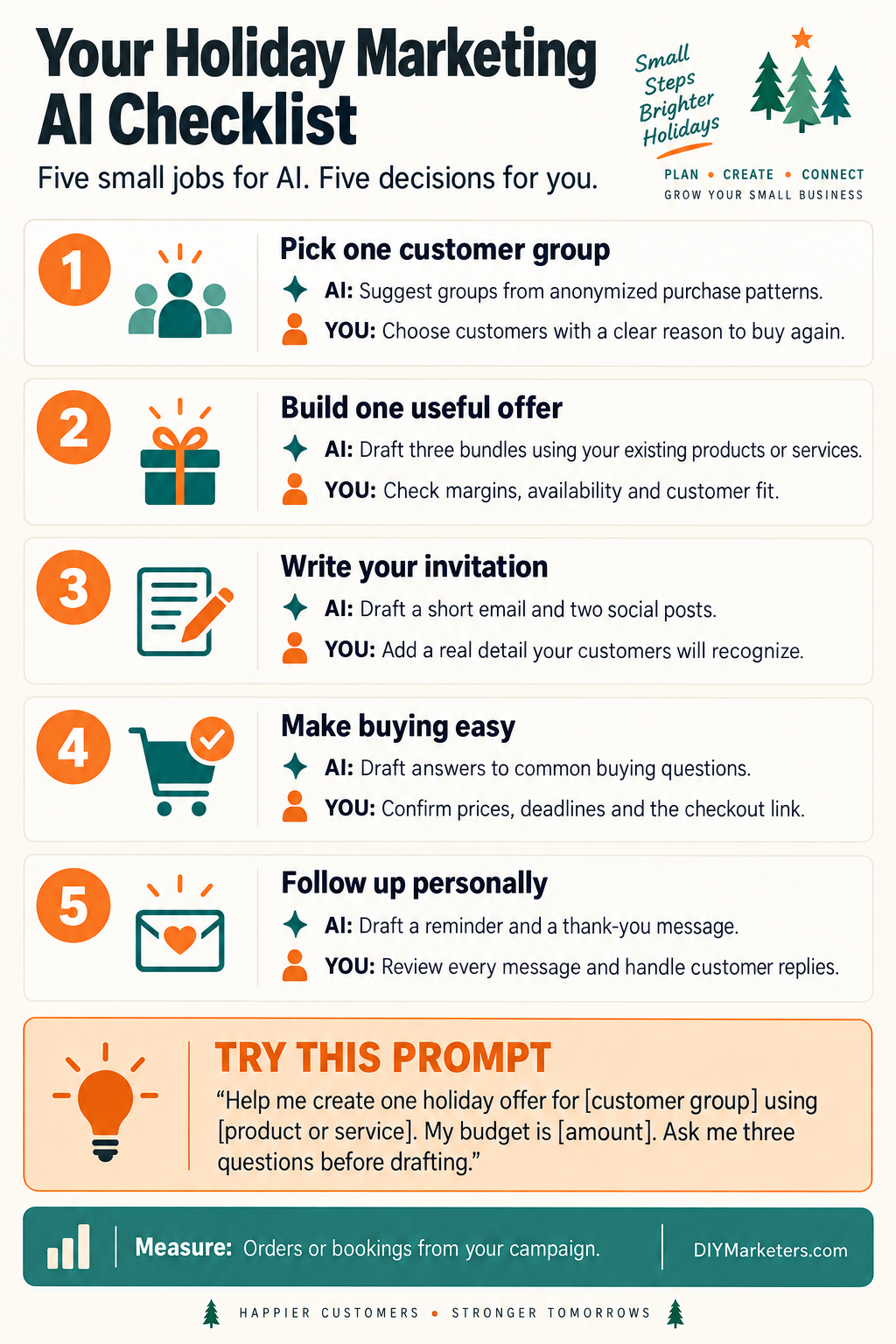
Before you build anything, stop doing one thing: writing holiday content for algorithms. A holiday marketing strategy for small business that wins in 2026 is built around the decision the shopper is trying to make, not the keyword you’re trying to rank for.
Here’s where to put your time and budget.
1. Build gift-decision pages, not gift guides
A gift guide says “10 gifts under $50.” A gift-decision page says “The best gifts for clients who can’t accept alcohol, under $75, delivered in 5 days.” AI extracts the second one because it matches a specific question. The first one competes with every other gift guide ever written.
Pick five recipient problems your product or service solves. Write one page for each. Include: who it’s for, why it fits, what it costs, any limitations, and how to get it in time. That’s your Q4 content calendar. Five pages. Done.
2. Make your facts extractable
Alchemer’s 2026 research found only 35.4% of shoppers completely or mostly trust AI recommendations. The verification step is where you win or lose the sale. If AI names you and the shopper can’t quickly confirm your price, your shipping cutoff, your return policy, or your reviews, they move to the next name on the list.
Audit every product or service page right now and add: exact price, delivery timeline, return terms, one clear photo, and at least three specific customer reviews. This isn’t SEO busywork. It’s the evidence a skeptical human needs to confirm the AI recommendation in under 60 seconds.
Check out the Small Business Holiday Marketing Checklist for a line-by-line version of this audit. It takes about 20 minutes per page.
3. Get your customers to say who you’re for
An IAB global study found 56% of consumers prefer AI recommendations that incorporate creator or customer perspectives. AI learns from those descriptions. “Best for busy moms who meal prep on Sundays” is an AI-readable context signal. “Five stars, would recommend!” is not.
Send three existing customers a two-question email this week: “Who would you recommend us to?” and “What would you tell them?” Post their answers verbatim. A customer who stays loyal and refers others is worth 4–5x the average buyer, and their words are now your best AI visibility asset.
4. Ask AI if it knows you. Fix what you find.
Open ChatGPT, Claude, or Perplexity right now. Type: “What are the best [your product or service category] for [your ideal customer] in [your city or niche]?” See what comes back. If your business doesn’t appear, that’s your assignment.
The fastest fix is usually one of three things: you don’t have enough specific, publicly available content for AI to pull; your reviews don’t use the language your customers search; or your business description on Google, Yelp, and your website all say something slightly different. Getting more Google reviews that include specific recipient language is the highest-leverage free move available before October ends.
For a deeper read on the mechanics behind this, the guide on getting your business recommended by AI covers the full framework beyond holiday season.
5. Stop doing what won’t move the needle in Q4
The 80/20 rule applies to what you stop as much as what you start. Before you add anything to your plate, cut these three time sinks from your Q4 plan:
- Generic social posts without a specific offer or page to send people to. Engagement without a destination is noise.
- Email newsletters that educate without asking for action. Q4 is not the season for thought leadership. It’s the season for “here’s who this is for and here’s how to get it.”
- Chasing new audiences. Your existing customers and their networks are your Q4 goldmine. Referrals, testimonials, and reactivation campaigns outperform cold acquisition by a wide margin when budgets are tight. The pull marketing strategies guide breaks this down in detail.
What a zero-budget Q4 AI visibility plan looks like
Here’s the entire campaign stripped to its core. No tools to buy. No agency to hire.
| Week | What to Do | Time Required | AI Visibility Impact |
|---|---|---|---|
| Week 1 | Write 2 gift-decision pages for your top recipient problems | 3–4 hours | High: creates extractable, specific content AI can match |
| Week 1 | Audit product/service pages for facts (price, shipping, returns) | 1–2 hours | High: enables verification after AI recommendation |
| Week 2 | Email 5 customers asking who you’re for and what to tell someone | 30 minutes | Medium-high: contextual review language trains AI matching |
| Week 2 | Test AI tools with your category + customer type, document gaps | 30 minutes | Medium: tells you exactly what content to create next |
| Week 3 | Write 3 more gift-decision pages; repurpose each into 2 social posts | 4–5 hours | High: breadth of specific content amplifies AI citation probability |
| Week 4 | Send one reactivation email to lapsed customers with a specific offer | 1 hour | Medium: existing customers refer and leave reviews that feed AI |
The entire plan fits inside 12–15 hours across four weeks. Most of it costs nothing except time. Low-cost marketing ideas that compound over time beat expensive campaigns that burn out after two weeks.
The trust gap in holiday marketing strategy for small business is your opening
Here’s the statistic worth printing out and taping to your monitor: Alchemer’s 2026 Retail Report found 22.2% of shoppers don’t trust AI shopping recommendations at all. That means the businesses who make verification fast and easy (consistent facts, real reviews, clear pricing, authentic customer language) win the sale even when AI does the initial legwork.
The gap between “AI mentioned you” and “customer bought from you” closes with evidence. Your holiday marketing strategy for small business in 2026 isn’t about gaming an algorithm. It’s about being the easiest answer to verify for a specific gift decision.
Do that, and you don’t need a big ad budget. A holiday marketing strategy for small business comes down to five specific pages and a handful of customers willing to say who you’re for.
Frequently asked questions about holiday marketing strategy for small business
Start the content and page-building work in September or early October, before shoppers begin their AI-assisted research in earnest. PwC’s 2026 Holiday Outlook shows 29% of consumers plan to use AI somewhere in their holiday shopping, up from 22% the prior year, and that behavior starts well before Black Friday. If you wait until November to publish gift-decision content, you’re behind the AI training curve for that season. The practical rule: spend October building and October through December promoting. Pages published in October have time to get indexed, get reviewed, and get included in AI answer pools. A page published December 10 is doing nothing for your Q4.
No. The foundation of AI visibility is free: specific, factual, publicly available content on your website. ChatGPT, Claude, Perplexity, and Google AI Overviews all pull from publicly indexed content. What you need is content that answers the questions your ideal customer is asking an AI assistant. That means gift-decision pages built around specific recipient problems, accurate product or service facts, and customer language that describes who you’re for. The platforms doing the AI answering are already reading your site. Your job is to give them something precise enough to cite. Tools and paid placements come after you’ve nailed the free fundamentals.
AI recommends businesses and products that match a specific, constrained request. The more narrowly you define who your product or service is for, the more likely AI is to surface you when someone asks that question. Generic descriptions compete with everyone. “A weekly bookkeeping service for freelancers who hate spreadsheets, starting at $150/month” competes with almost no one in an AI answer. Recipient-specific content (“best gift for a new homeowner who hates clutter”), budget-scoped content (“under $40, delivered in 3 days”), and context-specific content (“for someone who works from home”) all have higher AI citation potential than broad category claims. Start with your best customers and describe them precisely.
Test it yourself. Open ChatGPT, Perplexity, and Claude. Search for “[your product or service category] for [your ideal customer type]” and “[your city or niche] + [your category].” Also try “[gift for someone who] + [problem your product solves].” Document what comes back. If you’re not on the list, that’s your content gap. If a competitor appears instead of you, read how their page describes what they do: what language they use and what recipient problems they mention. That’s your benchmark. Repeat this test monthly through Q4 to measure progress. You don’t need a paid tool for this audit. It takes 20 minutes and gives you a direct read on your current AI visibility.
For this season: focus on the verification layer, not the discovery layer. If you’re already past mid-October, prioritize making your existing pages fast to verify: consistent pricing across every platform, clear shipping deadlines, and five to ten recent reviews that include specific language about who your product is for. That work takes two to three hours and improves conversion once AI sends someone your way. For next season, start the gift-decision pages in August. The businesses that win Q4 2027 AI recommendations are building their content right now. The holiday marketing checklist covers the fast-verification audit in detail if you need a step-by-step walkthrough.
Additional reading
- How to Get Your Business Recommended by AI (Beyond Being Cited)
- Pull Marketing Strategies for Small Business That Get Customers to Buy Before Prices Go Up
- Guerrilla Marketing for Small Business: Your Complete Low-Cost Playbook
Low budget marketing strategies for CEOs with no marketing department. Join DIYMarketers.com for free marketing tips.
Source: https://diymarketers.com/holiday-marketing-strategy-for-small-business/
Anyone can join.
Anyone can contribute.
Anyone can become informed about their world.
"United We Stand" Click Here To Create Your Personal Citizen Journalist Account Today, Be Sure To Invite Your Friends.
Before It’s News® is a community of individuals who report on what’s going on around them, from all around the world. Anyone can join. Anyone can contribute. Anyone can become informed about their world. "United We Stand" Click Here To Create Your Personal Citizen Journalist Account Today, Be Sure To Invite Your Friends.
LION'S MANE PRODUCT
Try Our Lion’s Mane WHOLE MIND Nootropic Blend 60 Capsules
Mushrooms are having a moment. One fabulous fungus in particular, lion’s mane, may help improve memory, depression and anxiety symptoms. They are also an excellent source of nutrients that show promise as a therapy for dementia, and other neurodegenerative diseases. If you’re living with anxiety or depression, you may be curious about all the therapy options out there — including the natural ones.Our Lion’s Mane WHOLE MIND Nootropic Blend has been formulated to utilize the potency of Lion’s mane but also include the benefits of four other Highly Beneficial Mushrooms. Synergistically, they work together to Build your health through improving cognitive function and immunity regardless of your age. Our Nootropic not only improves your Cognitive Function and Activates your Immune System, but it benefits growth of Essential Gut Flora, further enhancing your Vitality.

Our Formula includes: Lion’s Mane Mushrooms which Increase Brain Power through nerve growth, lessen anxiety, reduce depression, and improve concentration. Its an excellent adaptogen, promotes sleep and improves immunity. Shiitake Mushrooms which Fight cancer cells and infectious disease, boost the immune system, promotes brain function, and serves as a source of B vitamins. Maitake Mushrooms which regulate blood sugar levels of diabetics, reduce hypertension and boosts the immune system. Reishi Mushrooms which Fight inflammation, liver disease, fatigue, tumor growth and cancer. They Improve skin disorders and soothes digestive problems, stomach ulcers and leaky gut syndrome. Chaga Mushrooms which have anti-aging effects, boost immune function, improve stamina and athletic performance, even act as a natural aphrodisiac, fighting diabetes and improving liver function. Try Our Lion’s Mane WHOLE MIND Nootropic Blend 60 Capsules Today. Be 100% Satisfied or Receive a Full Money Back Guarantee. Order Yours Today by Following This Link.


| Visits: | 1,833,930,649 |
| Stories: | 8,715,202 |
Whistler Blowers, Insiders

