

How Much Time Does AI Save? Who Cares – It’s What You Do With it That Matters

- Saved hours earn nothing until you spend them on work customers feel. Adobe’s owners spend theirs on work-life balance and stress relief.
- Adobe never linked a faster post to a lead, a booking, or a sale, so the 175 hours it reports carry no proven price tag.
- By the end you will have a five-play list for your saved hours and a four-version test showing whether your AI content converts.
How much time does AI save? Adobe’s survey of 431 small business owners estimates 175 hours a year on social media posts, 152 hours on summarizing reports, and 67 hours on social ads. Owners guessed those hours. Treat 175 as a ceiling, then decide what those hours should buy.
That’s awesome and great but this is not new information. You don’t need a survey to tell you how much time an AI tool saves. What I ask myself is how can I use the time I save to generate new customers, create loyal repeat customers and make more money.
How much time does AI save small business owners in Adobe’s survey? Here’s a cool infographic – but scroll beyond that for the real deal.
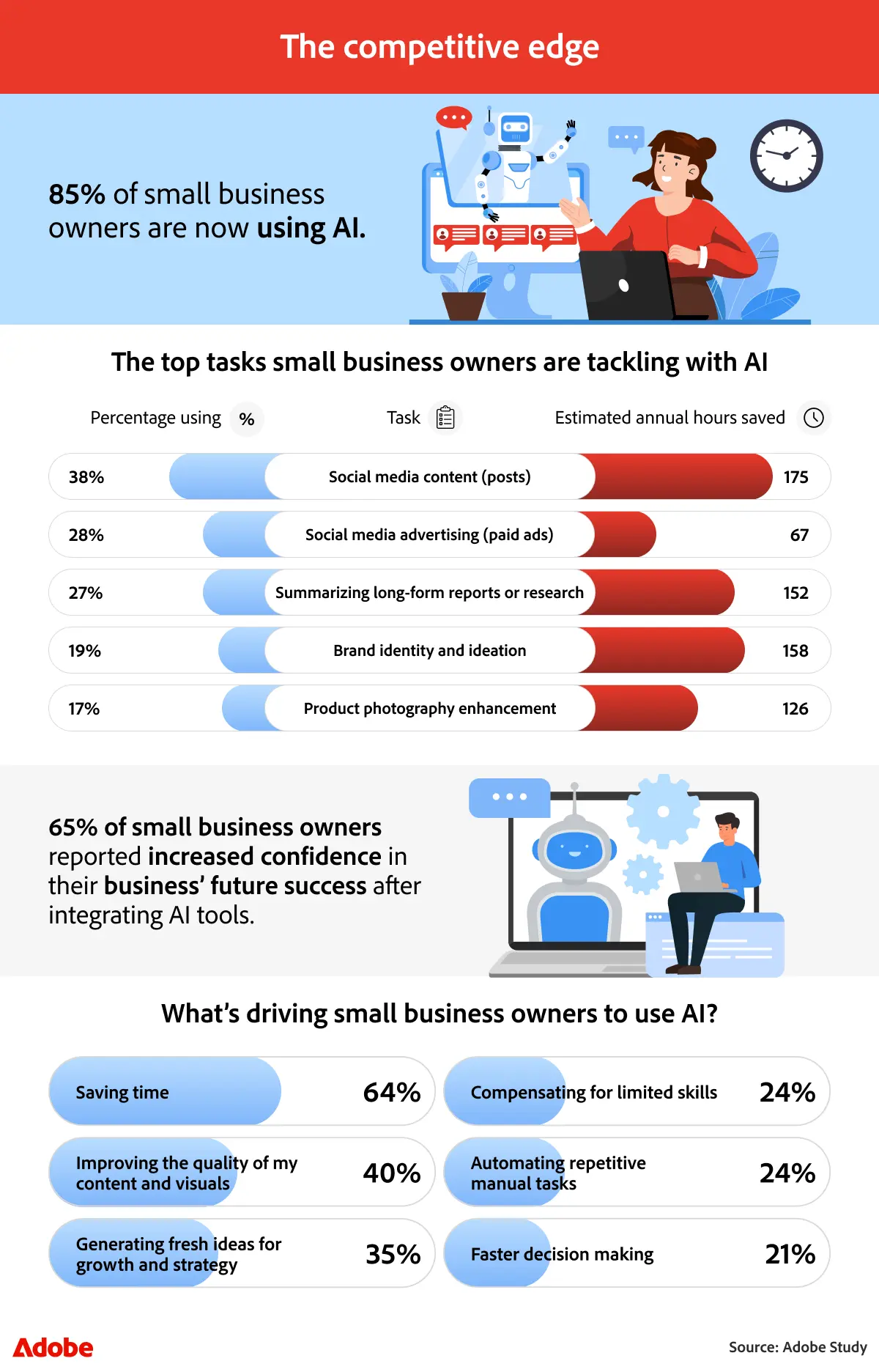
Social media content tops the task list, with 38% of respondents using AI for posts. Time savings motivate 64% of owners, the most common reason for adopting AI.
Now look at my last column. Every task lands near $33.20 an hour, because Adobe multiplied each hour estimate by one flat rate based on the average income of a small business owner. That is nothing to sneeze at. In fact, a lot of solopreneurs and small businesses barely net that much per hour worked (on the average).
But here’s the thing – saving time is awesome, saving money — also great. But what are you going to do with what you’ve saved. Because that’s what we can call “opportunity cost”. It’s time and money you were spending creating and posting, that can now be applied somewhere else.
| Task | Hours saved per year | Dollars saved per year | Dollars per hour (my math) |
|---|---|---|---|
| Social media content | 175 | $5,816 | $33.23 |
| Summarizing reports | 152 | $5,051 | $33.23 |
| Social advertising | 67 | $2,226 | $33.22 |
What do owners do with the hours AI saves?
Adobe’s owners spend saved time on themselves: 51% use the hours to improve work-life balance, and 47% use them to reduce mental stress and decision fatigue. The U.S. Chamber of Commerce Foundation’s Main Street AI Monitor shows a different pattern, with 59% use the hours to do more work or higher-quality work among workers whose AI use saves time.
And I get it. Rest is a fair use of saved time, but your bank account needs a share of it too. I call saved time inventory, because it sits on the shelf until you assign it a job.
(If marketing already drains you, read my guide on marketing burnout before you add another tool.)
But let’s get back to time saved and what to do with it. AI is awesome at generating all kinds of content fast and cheap. So use that to save time and money on marketing?
What should you do with the hours AI saves?
Focus all those saved hours on the steps between a click and a customer.
AI compresses drafting, and the bottleneck moves to customer insight, editing, testing, and follow-up. Here are five plays, in the order I would run them.
- Mine your sales conversations. Paste anonymized call notes or customer emails into AI and ask for the objections buyers raise before they stall. Write one post, one landing-page block, and one follow-up email for the top objection, then count booked calls.
- Rescue stalled leads. Export people who inquired and never bought, strip sensitive data, and ask AI to sort them by likely stall point: timing, price, missing proof, or confusion. Send each group a short follow-up and compare replies with your old generic message.
- Turn reviews into proof. Have AI group your reviews by customer situation and result, then pair one specific problem with one specific outcome. Keep quotes exact, get permission, and test these blocks against a broad “customers love us” claim.
- Fix the handoff. If people click a post and leave your page, ask AI to compare the promise in the post with your landing page headline, proof, and call to action. Repair the mismatch before you create another post.
- Repurpose a winner. Pick one message already tied to a booked call or sale and adapt its proof and offer for each platform. Skip the 30 unrelated posts.
Each play starts with your own customer evidence, which competitors cannot prompt from the public internet. Each one also ties to a number you already track, so you know within a month whether the hours paid off.
Does faster social content produce more customers?
Adobe measured three things in one survey: hours saved, engagement, and revenue. 52% of owners say AI images improved their social engagement, led by likes and reactions at 23%, profile visits at 20%, and reach at 15%.
Likes and profile visits are signals. Bookings, qualified leads, and sales are results.
The survey never shows the owners who saved time were the owners who gained engagement, or engagement produced revenue. Adobe has an ROI headline without an ROI design.
| Scoreboard | Question it answers | What Adobe gives you |
|---|---|---|
| Production | Did AI cut the resources needed to publish? | Self-estimated hours and formula dollars |
| Output | Did you ship more usable work? | No before-and-after count |
| Audience response | Did people notice or react? | Self-reported likes, visits, and reach |
| Business results | Did the campaign make money? | A revenue claim with no campaign link |
Outside research shows why the last row matters. A Columbia, Harvard, TUM, and Carnegie Mellon study of more than 300,000 ads ran sibling AI and human ads from the same advertiser, on the same day, to the same landing page. Under the strictest controls the clicks came out statistically equal.
AI creative left conversion quality intact. Taboola supplied the data, so read it as a useful study from an interested party.
A randomized experiment on more than 150 video ads found AI creative won on click-through and viewer retention and produced fewer conversions. Attention rose while buying fell.
Seven randomized experiments on an online retail platform ran from no detectable sales effect to a 16.3% lift. The biggest gain came from a pre-sale chatbot answering buyer questions. AI-written push messages and AI-written ad titles produced no statistically significant sales lift.
How do you test whether AI content brings in customers?
Most people measure AI savings by timing a task by hand one week and with AI the next. The comparison misses half the story.
AI makes each post faster, so you publish more posts, and more posts mean more reviewing, scheduling, and replying. Keep your post count the same, then run four versions of one campaign side by side.
- Version A is your current process. It sets your baseline.
- Version B is an AI draft with light edits. It shows your maximum time savings.
- Version C is an AI draft plus your customer language, your proof, and heavy editing. It tests the hybrid.
- Version D takes your best performer from A, B, or C and spins it into variants with AI. It tests whether AI scales a proven message.
Keep the audience, offer, call to action, landing page, spend, and post count as close as possible. Give each version a tagged link and track one action tied to revenue, such as a booked call, a quote request, or a sale. Log every minute: prompting, checking, editing, posting, and replying.
Skip the 90-days-before versus 90-days-after comparison. Seasonality, promotions, and algorithm changes muddy it. Alternate matched weeks instead.
- Net time saved = baseline labor minutes minus AI-assisted labor minutes
- Cost per qualified action = total campaign cost divided by qualified actions
- Contribution per labor hour = campaign contribution profit divided by total labor hours
| If You See This… | It Means… | Your Next Move |
|---|---|---|
| Fewer labor hours, same qualified actions | Efficiency win | Keep the workflow and give the saved hours a job |
| More qualified actions at similar cost | Effectiveness win | Scale the winning version |
| More likes, same qualified actions | Attention win only | Stop optimizing for likes |
| More assets plus more editing and replies | More output, same productivity | Cut volume back to your baseline |
Generic AI advice fits averages. My piece on why AI marketing advice fails small businesses shows how to check any suggestion against your own numbers, and AI marketing mistakes small business owners make catches bad advice early. Before you pay for a tool, run the nine questions in how to avoid wasting money on marketing.
What is your first move with the hours AI saves?
Pick one play from the list and run the four-version test on it for four weeks. Use a tagged link and one conversion action, so the result shows up in bookings.
The cheapest post is the one with the lowest cost per qualified customer. How much time does AI save you? Your stopwatch gives half the answer, and your booked calls give the rest.
Common questions about how much time AI saves
Adobe’s survey of 431 small business owners estimates 175 hours a year on social media content, 152 hours on summarizing reports, and 67 hours on social advertising. Adobe converted those hours to dollars at about $33.20 an hour, so the figures work as projections and carry no stopwatch data. The same survey reports saving time as the top reason owners adopt AI, cited by 64% of respondents. Your own number depends on the task, your prompting skill, and the time you spend editing drafts. Hold your post count steady, time every step by hand in one period, then time every step with AI in the next, and subtract. Start with social posts, since Adobe’s largest estimate sits there, and add report summaries if you read long documents every week. Log each result in a simple spreadsheet.
Some owners report it, though the evidence is self-reported. In Adobe’s survey, 47% of owners reported a revenue increase since adopting AI, averaging 21% among those who saw a gain. The study gives no figure for the other owners and never links the gain to AI-made social posts. Adobe’s engagement numbers, such as likes at 23%, profile visits at 20%, and reach at 15%, measure attention and carry no sales data. Outside research shows the same split: a randomized test of more than 150 video ads found AI creative won on clicks and viewer retention and produced fewer conversions. Track a booked call, quote request, or sale from a tagged link. Compare AI-assisted posts with your best human posts in matched weeks, with the same offer, audience, and spend. Pricing, offers, and follow-up drive revenue too, and AI changes none of those by itself.
Text generation tools lead at 77% of owners in Adobe’s survey, followed by image generation at 30%, data analysis at 29%, document intelligence and AI assistants at 18%, and code or website builders at 11%. Social media content ranks as the top AI task, with 38% of owners using AI to create posts. The U.S. Chamber of Commerce Foundation’s Main Street AI Monitor surveyed 1,070 small business workers through Ipsos in May 2026 and reports 64% of AI-using workers apply AI to personal productivity such as drafting, summarizing, and brainstorming. Another 26% use it for recurring tasks and 6% to automate workflows with minimal human involvement. Both studies center on writing and brainstorming. Start where owners cluster: one writing task you repeat every week, such as a newsletter, a set of social posts, or customer replies. Time it before and after you add AI.
Generic output tops the list of AI concerns in Adobe’s survey, with 42% of owners saying results feel generic or lack a human touch. Ethical concerns follow at 35%, inconsistent quality or accuracy at 31%, and data privacy at 30%. AI drafts sound generic because the tool averages across the text it has seen, so a prompt with little detail returns average copy. Fix this with inputs only you have: your customers’ exact words, your prices, your city, your numbers, and two or three paragraphs of your own past writing for the tool to match. Then edit every draft for specifics only you know. Count those editing minutes inside your time test, because rewriting a flat draft eats the savings a survey promises. Posts built from average copy sound like every competitor in your feed.
Spend it on the steps between a click and a customer. In Adobe’s survey, 51% of owners use saved time to improve work-life balance and 47% use it to reduce stress and decision fatigue. Rest matters, and revenue needs a share of the hours too. Put your share into follow-up emails for leads who never booked, a sales-call review ranking buyer objections, proof blocks built from your reviews, and a check matching each post’s promise to your landing page. Then test AI content against your best human version with the same offer, audience, and spend. Track one action tied to revenue, such as a booked call, a quote request, or a sale from a tagged link. If AI holds your conversions steady in half the time, you earned hours worth reinvesting. If likes rise and bookings stay flat, rework the content before you scale it.
Additional reading
- How to repurpose blog content for social media
- Low cost marketing ideas for small business under $50
Not Sure If This Will Work?
Book a Fix-It Session with Ivana. Within 24 hours you get a 10 to 15 minute video walk-through and a one-page summary showing which AI task earns a place in your week. $150, and nobody schedules a meeting.
Low budget marketing strategies for CEOs with no marketing department. Join DIYMarketers.com for free marketing tips.
Source: https://diymarketers.com/how-much-time-does-ai-save-small-business-owners/
Anyone can join.
Anyone can contribute.
Anyone can become informed about their world.
"United We Stand" Click Here To Create Your Personal Citizen Journalist Account Today, Be Sure To Invite Your Friends.
Before It’s News® is a community of individuals who report on what’s going on around them, from all around the world. Anyone can join. Anyone can contribute. Anyone can become informed about their world. "United We Stand" Click Here To Create Your Personal Citizen Journalist Account Today, Be Sure To Invite Your Friends.
LION'S MANE PRODUCT
Try Our Lion’s Mane WHOLE MIND Nootropic Blend 60 Capsules
Mushrooms are having a moment. One fabulous fungus in particular, lion’s mane, may help improve memory, depression and anxiety symptoms. They are also an excellent source of nutrients that show promise as a therapy for dementia, and other neurodegenerative diseases. If you’re living with anxiety or depression, you may be curious about all the therapy options out there — including the natural ones.Our Lion’s Mane WHOLE MIND Nootropic Blend has been formulated to utilize the potency of Lion’s mane but also include the benefits of four other Highly Beneficial Mushrooms. Synergistically, they work together to Build your health through improving cognitive function and immunity regardless of your age. Our Nootropic not only improves your Cognitive Function and Activates your Immune System, but it benefits growth of Essential Gut Flora, further enhancing your Vitality.

Our Formula includes: Lion’s Mane Mushrooms which Increase Brain Power through nerve growth, lessen anxiety, reduce depression, and improve concentration. Its an excellent adaptogen, promotes sleep and improves immunity. Shiitake Mushrooms which Fight cancer cells and infectious disease, boost the immune system, promotes brain function, and serves as a source of B vitamins. Maitake Mushrooms which regulate blood sugar levels of diabetics, reduce hypertension and boosts the immune system. Reishi Mushrooms which Fight inflammation, liver disease, fatigue, tumor growth and cancer. They Improve skin disorders and soothes digestive problems, stomach ulcers and leaky gut syndrome. Chaga Mushrooms which have anti-aging effects, boost immune function, improve stamina and athletic performance, even act as a natural aphrodisiac, fighting diabetes and improving liver function. Try Our Lion’s Mane WHOLE MIND Nootropic Blend 60 Capsules Today. Be 100% Satisfied or Receive a Full Money Back Guarantee. Order Yours Today by Following This Link.


| Visits: | 1,834,573,189 |
| Stories: | 8,718,816 |
Whistler Blowers, Insiders

