

How to Get Honest Customer Feedback Before You Ask for Testimonials

- Honest customer feedback starts with a safe way for friends to tell you what went wrong, before you ask them to say what went right.
- In our DIYMarketers and QuestionPro survey of 400 adults, 20% stayed quiet about a purchase problem because they knew the seller.
- You get one email for honest customer feedback, a two-tab tracker, and a simple rule for choosing your first fix. Then you know exactly when to ask for the testimonial.
Here is how to get honest customer feedback from friends. Send one question about a week after delivery: “What, if anything, was harder than you expected?” Keep it separate from any testimonial request. Save their exact words, group similar problems, and fix the one with the biggest consequence. Then ask again. Request the testimonial last.
I recently started a series with my friends at QuestionPro. We asked consumers about their experiences with small businesses and entrepreneurs. Last week I published the first one: What Your Friends Think When You Start Selling to Them.
Here’s just one surprising stat that came out of it: 20% of the 400 adults we surveyed stayed quiet about a problem with a purchase because they knew the seller.
Read this again. A friend pays you, hits a snag, and says nothing. You never find out. Then you ask for a testimonial.
Your friends are not lying when they say they liked it. They want you to win. But that same goodwill keeps real issues hidden and that’s a problem
So here is the follow-up. I want to show you how to collect honest customer feedback from the friends who tell you the least, then turn it into changes your customers will love and your business grows from.
But first, let’s take a closer look at why your friends are holding back on honest feedback.
Why do friends hold back honest customer feedback?
When you sell to friends and family, you’re essetially selling to what I call “insiders” – these are people who will do their best to support you just because you asked. And that, believe it or not, creates its own set of problems.
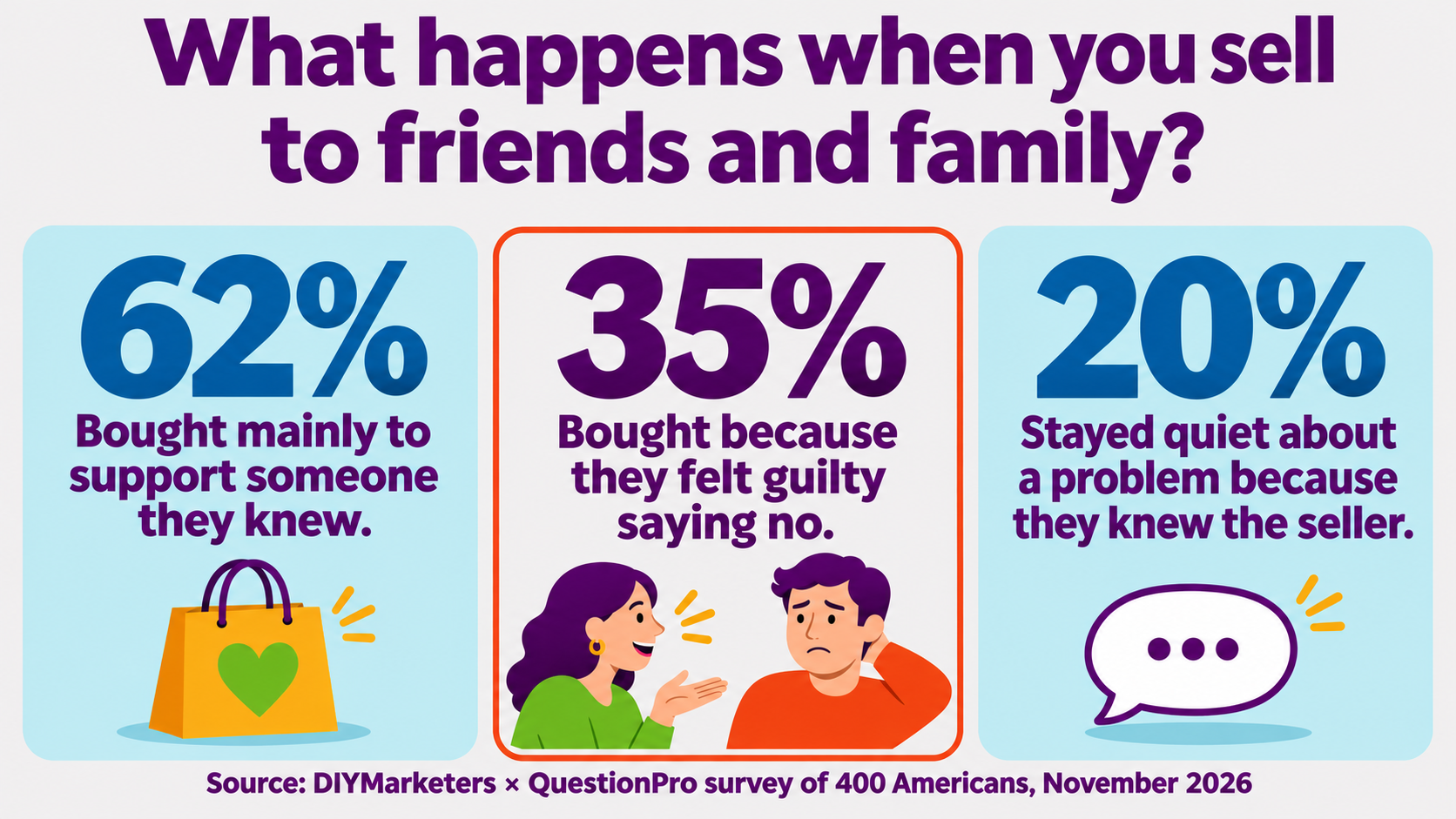
A buyer who knows the seller says less out loud. This makes honest customer feedback rare in a friendly sale. Our survey shows the pull three ways:
- 20% stayed quiet about a problem because they knew the seller.
- 62% bought mainly to support someone they knew.
- 35% bought because they felt guilty saying no.
Those groups overlap in ways the survey did not measure, so do not add them together.
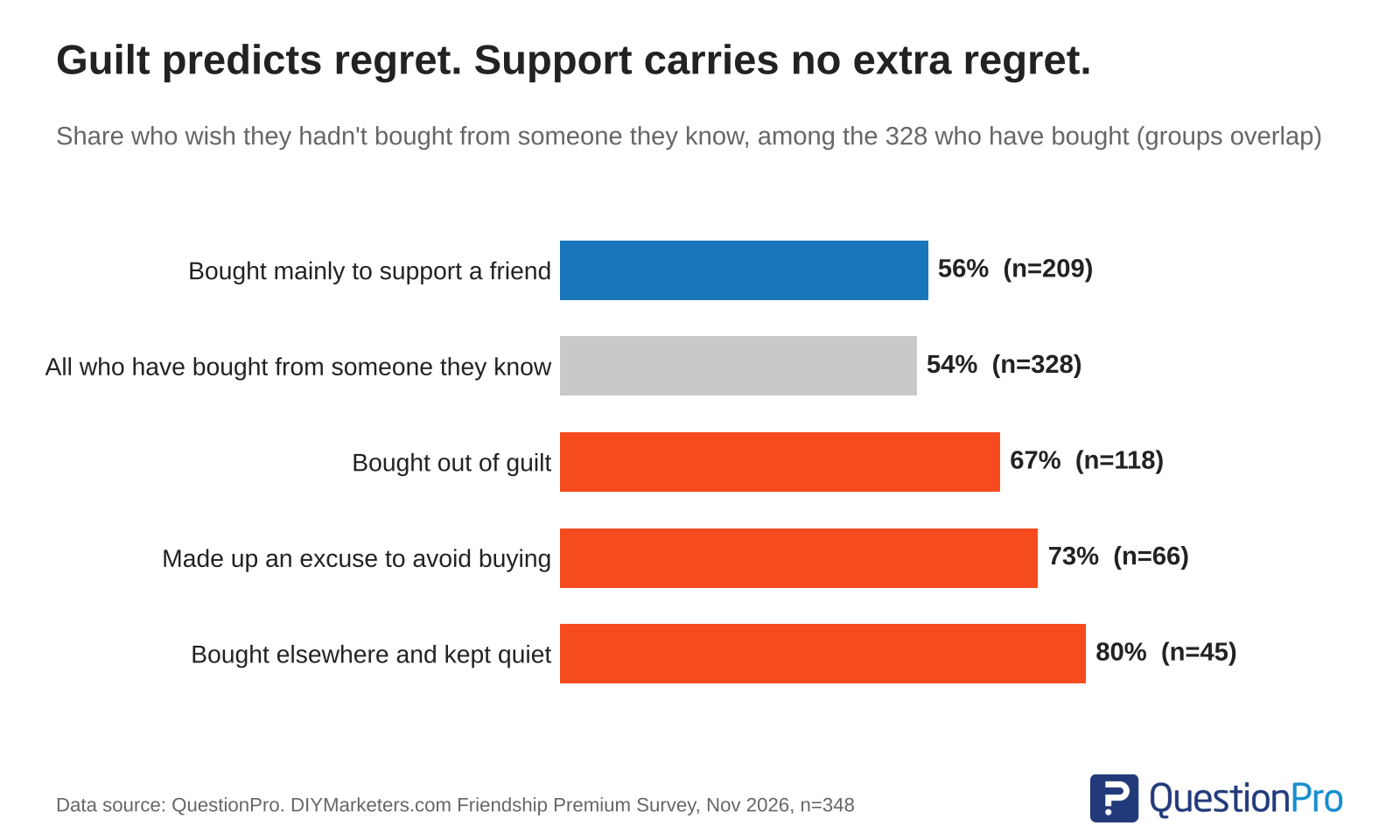
Buyers who were “guilted” into the purchase tend to have more regrets. 68% of them wish they had skipped the purchase, versus 49% of other buyers. This is an association. The survey does not show guilt caused the regret.
Researchers know this problem well. A 2026 systematic review examined 121 experiments across 79 peer-reviewed papers on reducing socially desirable answers. 55% of the experiments significantly reduced the bias. Face-saving strategies were the most effective category.
Translation: make the less flattering answer socially safe, and people give you honest customer feedback. The review did not test my question with friends buying from small businesses. Treat what follows as a smart experiment to run, not a proven formula.
Silent customers cost you more than awkward ones. Read why customers stop buying to see where quiet problems end up.
What question gets you honest customer feedback?
Ask one question to get honest customer feedback. Send it after your customer has used what they bought.
Subject: What was harder than you expected?
Hi [Name],
You have had a little time with [product/service], and I am looking for something to improve.
What, if anything, was harder than you expected?
A sentence is plenty. This is a feedback request, not a testimonial request. I will not use your reply publicly without your permission.
Thanks,
[Name]
I chose each part of this wording on purpose:
- “What” invites an answer in their own words.
- “If anything” leaves room for “nothing.”
- “Harder than you expected” points at friction and skips the request for a verdict.
“Did you like it?” invites a polite yes. Pew Research Center’s survey-writing guidance backs the general approach: clear, specific questions about one thing, because small wording changes shift answers. Pew did not test this exact question.
Timing matters too. Ask when the buyer has used the part you want honest customer feedback on, as this Shopify guide to one-email feedback suggests. A week after delivery is my starting point to test. Adjust by offer:
- Digital template: after the buyer tries it.
- Cleaning service: after the first completed visit.
- Physical product: after arrival and first use.
- Coaching package: after the first meaningful session or assignment.
Send one email per purchase.
How do you turn honest customer feedback into a fix?
Treat every piece of honest customer feedback as raw evidence. Separate what the customer said from what you think it means.
Here is an illustrative example. A customer writes: “I didn’t know what I needed to send before our call.” Break it into layers:
- Exact quote: “I didn’t know what I needed to send before our call.”
- What it shows: the customer felt unsure about preparation.
- Your working guess: the instructions sit somewhere hard to find.
- Your follow-up: “Where did you look for the preparation instructions?”
- Your fix: put a short checklist in the booking confirmation.
“The customer didn’t understand” is a guess, not a diagnosis. Find out what they tried to do, where they looked, and what happened. The GOV.UK Service Manual teaches the same sequence: record what people said or did, group observations into themes, then decide on actions.
Keep three follow-up questions ready. Use them in a personal reply, never in the first email:
- “Walk me through what happened.”
- “Where did you get stuck?”
- “What did you expect to happen next?”
| If You See This… | It Means… | Your Next Move |
|---|---|---|
| “The template was confusing.” | The buyer stalled at a specific point. | Ask where they stopped. Add a filled-in example at the stopping point. |
| “I wasn’t sure what happened next.” | A step has no clear next action. | Add a next-step message to your confirmation email. |
| “Booking took longer than I expected.” | Friction sits in availability, service choice, or the form. | Ask which step. Simplify it. |
| “I thought more was included.” | Something you wrote created an expectation. | Rewrite scope and exclusions before the purchase. |
Not every suggestion earns a feature. Decide whether the fix belongs in the product, the instructions, the booking process, or your sales promise.
How do you track honest customer feedback in a simple spreadsheet?
Build two tabs before the replies arrive. One tracks people. The other tracks problems. One customer reports three issues and still counts as one responding customer.
Tab 1: Outreach log (one row per customer)
- Customer ID (C001, C002)
- Customer type: friend or family, professional contact, other
- Offer bought and completion date
- Request date
- Reply received: yes or no
- Reply category: specific issue, vague concern, no issue, no response
- Follow-up status
Tab 2: Issue log (one row per problem)
- Issue ID and Customer ID
- Exact quote
- Journey stage: buying, booking, preparation, delivery, use, follow-up
- Theme (a short label you apply the same way every time)
- Consequence: what the problem cost or blocked
- Your interpretation, kept apart from the quote
- Next action and result
Keep “no response” and “no issue” separate. Silence tells you nothing about how the experience went.
Count customers, not messages. One customer sends four messages about the missing checklist. Two others mention it once. Three customers reported the problem. You do not have six independent reports.
Prefer a tool over a spreadsheet? I reviewed one in My Honest Looplytic Review.
How do you decide what to fix first?
Sort your honest customer feedback by consequence and repetition together. A scoring formula adds false precision, so use this decision table instead. It is my editorial aid, not a validated model.
| If You See This… | Your Next Move |
|---|---|
| A payment, access, safety, or delivery failure | Investigate now, even if one customer reported it. |
| Several customers hit the same obstacle | Make it your next improvement. |
| One vague complaint with no clear consequence | Ask a clarifying question. |
| A feature request with no reason attached | Ask what the customer tried to do. |
| A preference at odds with your core offer | Record it. Keep your offer as designed. |
| Praise with no specific example | File it as praise. Leave it out of the issue log. |
Frequency is a signal, not a verdict. Nielsen Norman Group makes the point in its video on frequency in qualitative data: the most mentioned issue is not automatically the most important, and a valuable insight sometimes shows up once.
Three people asking for a different color matter less than one person locked out of what they paid for.
My rule of thumb: when two customers independently get stuck at the same spot, investigate. When one reports a serious problem, act now. This is my advice, not a research threshold.
How do you know your feedback process works?
Track four measures of your honest customer feedback process. Define “actionable” before you read the replies: a comment naming a specific step, expectation, or outcome worth investigating. It does not need to include the solution.
- Response rate: customers who replied ÷ customers asked.
- Actionable reply rate: respondents naming at least one investigable issue ÷ all respondents.
- Customers per theme: unique customers behind each theme.
- Change status: not started, testing, checked, or unresolved.
Here is an illustrative example with made-up numbers. A consultant sends the question to 12 buyers of a starter package. Eight reply. Five name a specific issue. Three mention unclear preparation instructions, and one of those three also reports trouble rescheduling. Two others are unsure what the package includes.
The issue log holds six rows from five customers. The consultant calculates:
- Response rate: 8 of 12, about 67%.
- Actionable reply rate: 5 of 8, about 63%.
- Preparation theme: three customers. Scope theme: two. Rescheduling: one.
She investigates preparation first, adds the checklist to the confirmation email, and asks the next buyers the same question. Keep the wording consistent across rounds. Pew notes consistent wording and context matter when you measure change over time.
Two clean replies do not prove the problem is gone. Treat them as encouraging and keep checking. A falling actionable reply rate also has several explanations: the experience improved, the question weakened, or different customers replied. It measures how well you collect honest customer feedback, not satisfaction.
When do you ask friends for the testimonial?
Ask for the testimonial after you close the loop on honest customer feedback. Tell the customer what you changed and check the fix with them:
“You mentioned the setup instructions were hard to follow. I added a completed example and a three-step checklist. Does this cover the part where you got stuck?”
Make the testimonial a separate, optional request later. Do not frame praise as repayment for the fix.
Once a customer has watched you listen, their praise carries weight. Then use how to get more Google reviews, how to ask for referrals, and how to get customers to share your business to put the praise to work.
Here is your next step. Choose one offer. Send the question to your next five customers to start collecting honest customer feedback. Save their exact words, separate the problems, and pick one to investigate. Your goal is an easier experience for the next customer.
FAQ: honest customer feedback from friends How do I get honest customer feedback from friends and family?
Ask one open question after they use what they bought, and keep it separate from any testimonial request. Try “What, if anything, was harder than you expected?” Tell them a sentence is plenty, and promise not to publish their reply without permission.
When should I ask for honest customer feedback?
Send it about a week after delivery, or after the customer completes the first meaningful use. A week is a starting point to test. A cleaning service might ask after the first visit. A coaching package might ask after the first session.
What if my friends do not reply?
Record them as “no response” and keep it separate from “no issue.” Silence tells you nothing about the experience. Send a short personal follow-up message, or ask the next buyer sooner after delivery.
How many replies do I need before I change something?
One reply is enough for a payment, access, safety, or delivery problem. For smaller issues, investigate when two customers independently get stuck in the same place. This is my rule of thumb, not a research threshold.
Do I need permission to use a friend’s reply as a testimonial?
Yes. Ask in a separate, optional message after you fix the problem. Feedback shared privately stays private until the customer agrees to publish it.
Additional reading
- What Your Friends Think When You Start Selling to Them
- How to get referrals for your business
- How to build customer trust without spending a dime
Survey source: DIYMarketers and QuestionPro, fielded November 4, 2026, 400 U.S. adults, unweighted, self-reported attitudes and recalled experiences.
Low budget marketing strategies for CEOs with no marketing department. Join DIYMarketers.com for free marketing tips.
Source: https://diymarketers.com/how-to-get-honest-customer-feedback/
Anyone can join.
Anyone can contribute.
Anyone can become informed about their world.
"United We Stand" Click Here To Create Your Personal Citizen Journalist Account Today, Be Sure To Invite Your Friends.
Before It’s News® is a community of individuals who report on what’s going on around them, from all around the world. Anyone can join. Anyone can contribute. Anyone can become informed about their world. "United We Stand" Click Here To Create Your Personal Citizen Journalist Account Today, Be Sure To Invite Your Friends.
LION'S MANE PRODUCT
Try Our Lion’s Mane WHOLE MIND Nootropic Blend 60 Capsules
Mushrooms are having a moment. One fabulous fungus in particular, lion’s mane, may help improve memory, depression and anxiety symptoms. They are also an excellent source of nutrients that show promise as a therapy for dementia, and other neurodegenerative diseases. If you’re living with anxiety or depression, you may be curious about all the therapy options out there — including the natural ones.Our Lion’s Mane WHOLE MIND Nootropic Blend has been formulated to utilize the potency of Lion’s mane but also include the benefits of four other Highly Beneficial Mushrooms. Synergistically, they work together to Build your health through improving cognitive function and immunity regardless of your age. Our Nootropic not only improves your Cognitive Function and Activates your Immune System, but it benefits growth of Essential Gut Flora, further enhancing your Vitality.

Our Formula includes: Lion’s Mane Mushrooms which Increase Brain Power through nerve growth, lessen anxiety, reduce depression, and improve concentration. Its an excellent adaptogen, promotes sleep and improves immunity. Shiitake Mushrooms which Fight cancer cells and infectious disease, boost the immune system, promotes brain function, and serves as a source of B vitamins. Maitake Mushrooms which regulate blood sugar levels of diabetics, reduce hypertension and boosts the immune system. Reishi Mushrooms which Fight inflammation, liver disease, fatigue, tumor growth and cancer. They Improve skin disorders and soothes digestive problems, stomach ulcers and leaky gut syndrome. Chaga Mushrooms which have anti-aging effects, boost immune function, improve stamina and athletic performance, even act as a natural aphrodisiac, fighting diabetes and improving liver function. Try Our Lion’s Mane WHOLE MIND Nootropic Blend 60 Capsules Today. Be 100% Satisfied or Receive a Full Money Back Guarantee. Order Yours Today by Following This Link.


| Visits: | 1,837,898,192 |
| Stories: | 8,734,349 |
Whistler Blowers, Insiders

