

The 2026 Midterms: A Blue Tsunami Cometh

Midterm elections are often described as a referendum on the sitting president. History suggests that description is well deserved. From Reconstruction in 1866 to the Republican Revolution of 1994, midterm elections have repeatedly reshaped the balance of power in Washington and, at times, altered the direction of the country. Five Midterm Elections That Shaped America, highlighted in the section at the end of this post, offer a compelling look at just how consequential these elections can be.
This year may be no exception.
Blue Tsunami
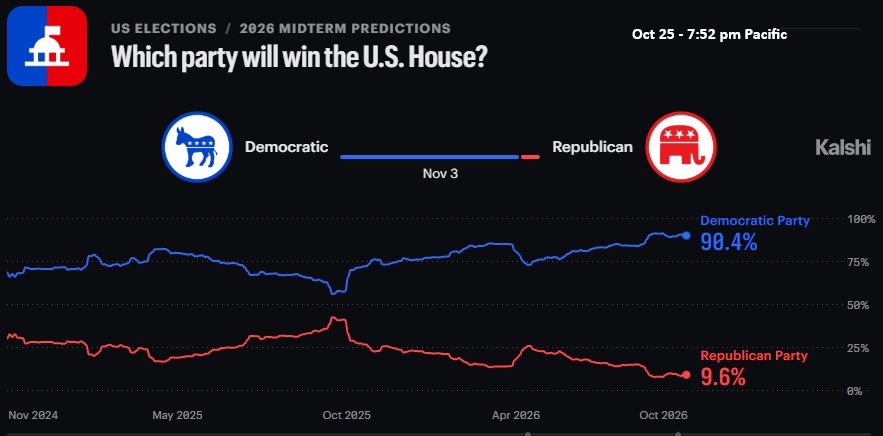
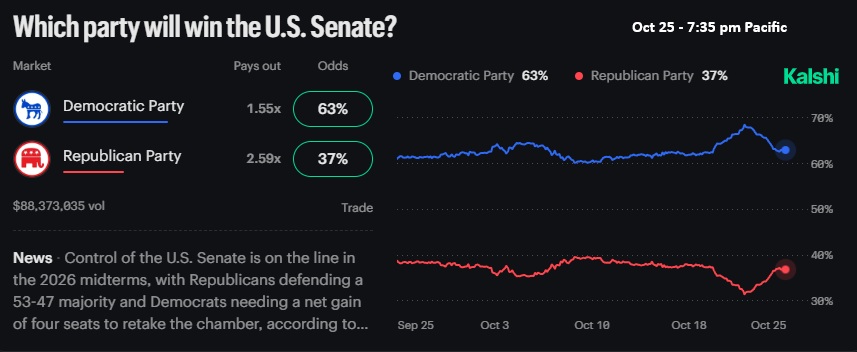
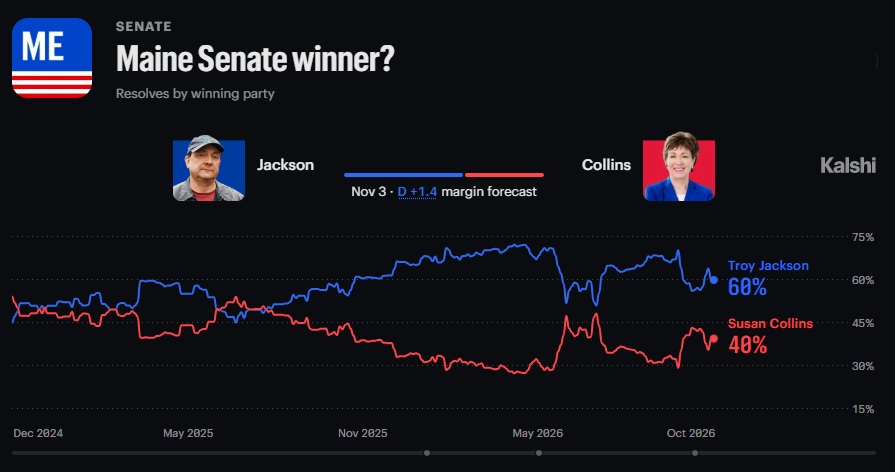
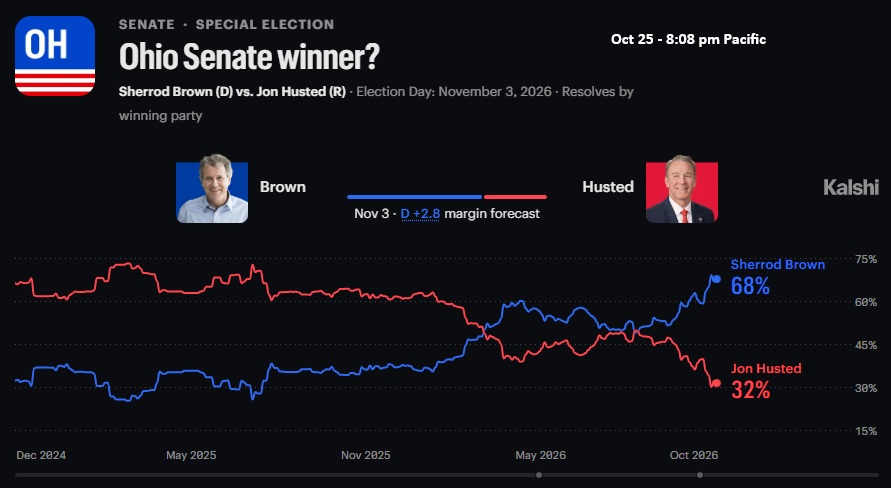
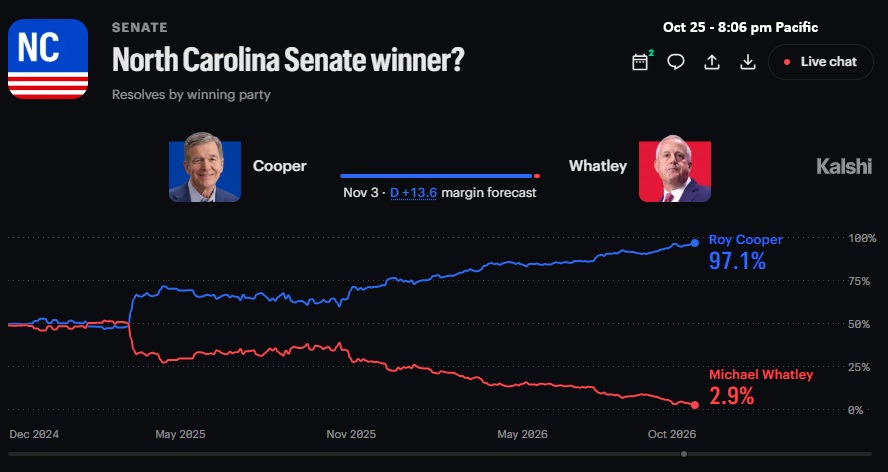
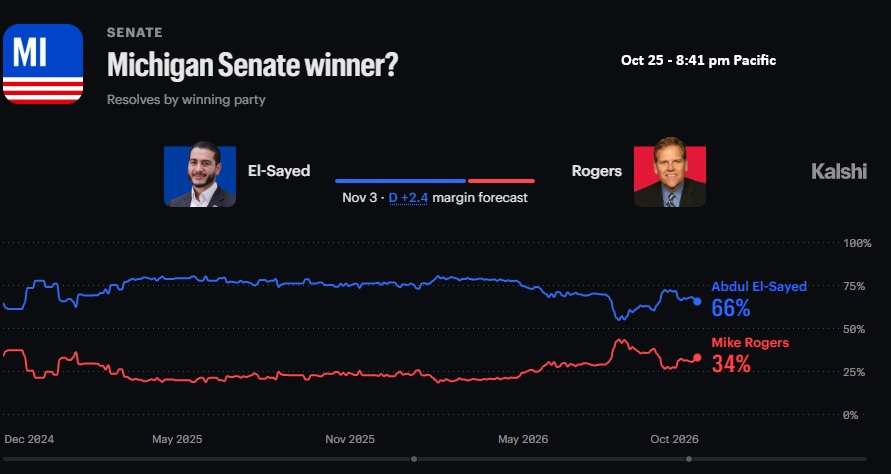
With nine days to go before the November 3 midterm elections, the outlines of a potential Blue Tsunami are coming into view. Kalshi, the prediction market, now gives Democrats a 90% probability of capturing the House of Representatives and a 63% probability of taking the Senate.
If the markets have it right, Republicans could be facing a long election night, and the Trump administration could spend the remainder of its term contending with a hostile Congress: stalled legislation, aggressive oversight, and a steady stream of subpoenas.
Why I Trust the Prediction Markets More Than the Polls
One lesson I took away from the 2024 presidential election is that it pays to put your money, literally, where your predictions are. Prediction markets such as Kalshi and Polymarket proved to be particularly useful indicators of the eventual outcome, while much of the traditional polling and political commentary continued to characterize the presidential race as essentially a toss-up.
On Election Day 2024, prediction markets were assigning Donald Trump approximately a 62% probability of winning. They ultimately moved toward his victory considerably faster than many traditional polling models and political commentators.
Why do I put more faith in these markets? There are several reasons:
- Real-time price adjustments: Traditional polls take days to conduct, weight, analyze, and publish. Prediction markets, by contrast, continuously incorporate new information. Breaking news, campaign developments, debates, and changing voter sentiment can be reflected in market prices almost immediately.
- Financial incentives for accuracy: Participants in markets such as Kalshi and Polymarket have real money at stake. Unlike political pundits, who can make predictions with little personal consequence when they get them wrong, market participants have a financial incentive to get things right. Poor judgments can cost money; accurate assessments can be rewarded.
- A different pool of participants: Prediction markets draw from a different population than traditional polling organizations. Their participants include traders, political enthusiasts, data analysts, and others who may be particularly attentive to developments that conventional surveys sometimes miss. This doesn’t necessarily make them more representative of the electorate, but it does provide another way of aggregating information.
- The ability to recognize momentum: Markets can respond quickly to changing conditions in individual states and congressional races. Rather than relying exclusively on polling averages or statistical models, they incorporate the collective judgments of participants who are constantly reassessing the odds.
Of course, prediction markets are not infallible. Their prices represent probabilities, not guarantees. They can be influenced by limited liquidity, trading volume, speculation, and unexpected developments. Still, I have found them a valuable complement to, and often a more useful indicator than traditional political polling.
A Few Reasons for Caution
There are, however, a few reasons not to declare victory for the Democrats just yet.
First, Democrats have a tendency to snatch defeat from the jaws of victory; in other words, they are not good closers. The probability of their capturing the Senate has actually declined from 69% on October 22 to 63% tonight. That is a meaningful movement in just three days, although the market still considers Democrats the favorites.
One of the party’s recurring problems is its inability to resist taking the bait on issues that play directly into Republican campaign strategies. The progressive wing, in particular, sometimes seems incapable of recognizing when an issue that energizes its own base can alienate the much larger pool of independent and swing voters needed to win elections.
2020 Election: The Blue Senate Lost
I was reminded of this during the 2020 election cycle. As American cities experienced widespread unrest following the murder of George Floyd, the “Defund the Police” movement gained traction among prominent voices on the left. Whatever the merits of the broader debate over policing and racial justice, the slogan proved politically damaging. Democrats risked allowing a relatively small but vocal faction of their party to define its message at precisely the wrong time. With businesses being burned and looted in some cities, the party’s chances of taking the Senate went up in flames as well.
It is a lesson worth remembering in 2026. Winning elections requires more than energizing the party faithful. It requires persuading voters in the political middle, many of whom are less interested in ideological battles than in economic security, public safety, and competent government.
The Democrats may have a favorable political environment, but they still have to avoid the kind of unforced errors that have undermined their victory in previous elections.
What the Prediction Markets Are Saying
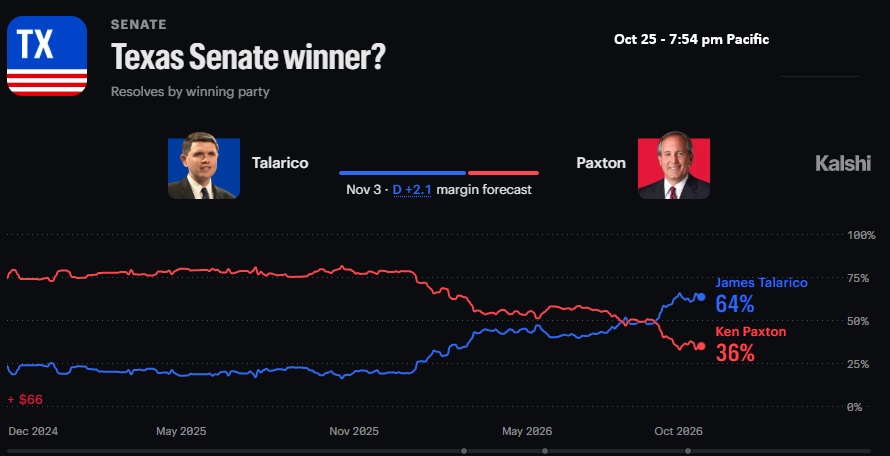
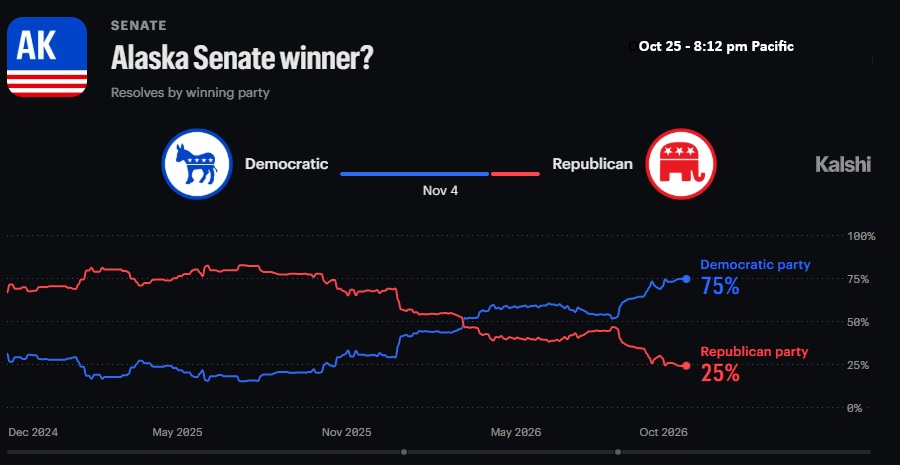
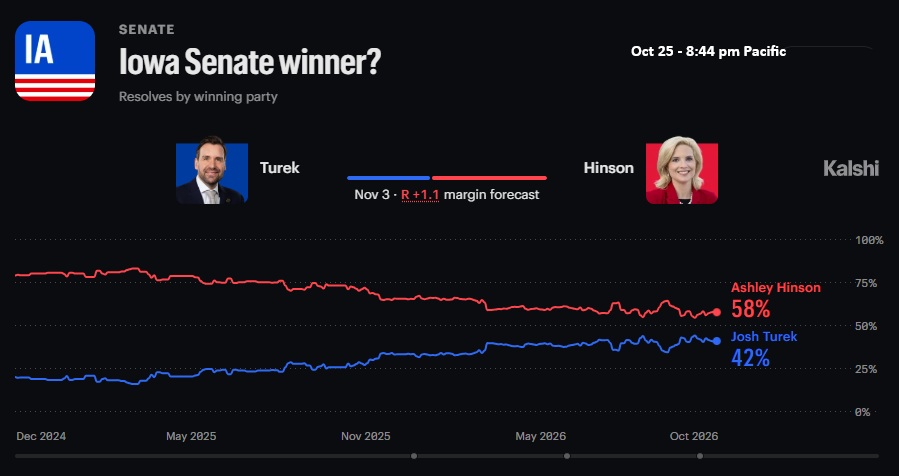
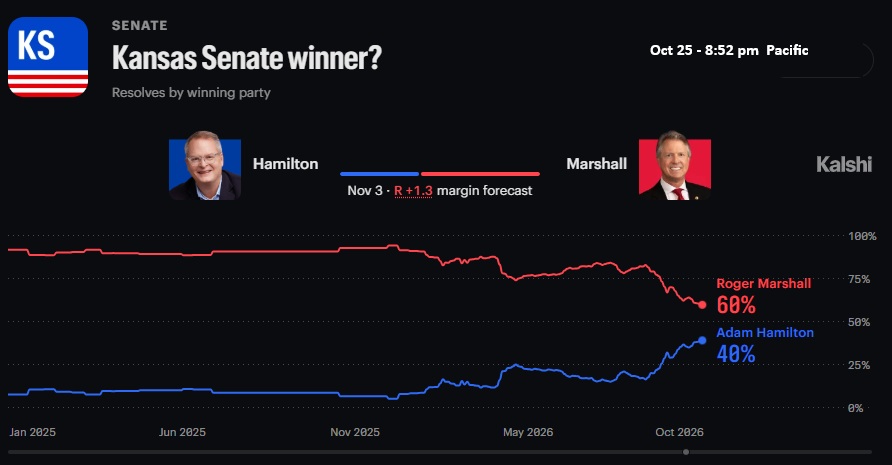
With that in mind, here are the Kalshi prediction market odds for the November 3 midterm elections, as of Sunday evening, October 25, 2026.
The numbers make for interesting reading. And if the markets are right, we could be looking at one of the more consequential midterm elections in recent history.
As always, the odds can change and we will be watching.
Five Midterm Elections That Shaped America
History offers a useful perspective on the importance of the midterm elections. In its PBS American Experience program, “Five Midterm Elections That Shaped America,” PBS examines five elections that did far more than reshuffle seats in Congress. Each reflected the political climate of its time, tested the standing of a sitting president, and, in several cases, fundamentally altered the direction of the country.
The lessons are particularly relevant as we approach the November 2026 midterms.
1. 1866 – A Referendum on Reconstruction
- The first midterm after the Civil War became a referendum on the future of civil rights for formerly enslaved Black Americans.
- President Andrew Johnson opposed the more expansive Reconstruction policies supported by congressional Republicans.
- Johnson campaigned personally for his preferred candidates, but his speaking tour backfired.
- Republicans won a landslide, gaining enough congressional seats to override presidential vetoes and advance their Reconstruction agenda.
Key takeaway: Midterms can be a direct rejection of a president’s policies and give the opposition the power to fundamentally change the country’s direction.
2. 1898 – The Wilmington Coup
- Wilmington, North Carolina, had developed a multiracial political coalition that brought Black citizens and working-class whites together.
- White supremacists used intimidation, voter suppression and outright election fraud to seize political power.
- Following the election, local officials were forced to resign at gunpoint.
- The events became the only successful coup d’état in American history.
Key takeaway: Elections are not always simply about competing political parties. The integrity of the electoral process and the protection of voting rights are fundamental to democracy.
3. 1918 – Wilson Loses Congress
- President Woodrow Wilson needed congressional support to advance his vision to end World War I and establish a lasting peace.
- His suppression of political opposition during wartime and support for segregation alienated progressives.
- Democrats suffered significant losses in the midterms.
- Wilson subsequently faced a Republican-controlled Congress, complicating his ability to secure support for his international agenda.
Key takeaway: Even during wartime, a president’s political standing matters. Losing congressional support can undermine a president’s ability to accomplish major national objectives.
4. 1982 – Reagan’s Economic Backlash
- Ronald Reagan’s popularity declined as the economy deteriorated.
- Unemployment reached its highest level since the Great Depression.
- High interest rates hurt farmers, businesses failed, and homelessness increased.
- Voters responded by removing 26 Republicans from Congress, expanding the Democratic majority in the House.
- The Reagan administration was put on the defensive until the economy recovered.
Key takeaway: Economic performance can have a powerful influence on midterm elections. Voters often hold the president’s party accountable for their economic circumstances.
5. 1994 – The Republican Revolution
- Bill Clinton’s presidency was weakened by scandal and the failure of his health care reform initiative.
- Republican Congressman Newt Gingrich organized a national strategy to make the election a referendum on Clinton.
- Republican candidates ran against the president, effectively nationalizing local congressional races.
- Republicans gained 54 seats in the House and eight in the Senate.
- They took control of Congress for the first time in 40 years.
Key takeaway: A coordinated opposition party, a weakened president, and a national political message can produce a dramatic electoral realignment.
What History Tells Us About 2026
Taken together, these five elections illustrate just how consequential midterms can be. They can serve as a referendum on a president, a verdict on the economy, a rejection of an administration’s policies, or an opportunity for an opposition party to seize control of Congress. Sometimes, the results do more than change the political balance in Washington. They change the course of the nation.
There is no guarantee that 2026 will follow the pattern of any one of these elections. Political circumstances are different, and prediction-market odds are probabilities, not promises. But the historical parallels are worth considering. A president’s party can lose congressional control surprisingly quickly, particularly when voters are dissatisfied and the opposition succeeds in making the election a national referendum.
If the current Kalshi odds prove accurate, November could deliver another major political realignment, with Democrats taking control of both the House and the Senate. That would leave President Trump facing a Congress controlled by the opposition for the remainder of his term, substantially complicating his ability to advance his agenda.
The final word belongs to the voters. And history reminds us that when Americans go to the polls in a midterm election, they are not simply choosing members of Congress. They are deciding how much power to give a president,.and, sometimes, how much to take away.
Source and credit: PBS American Experience, “Five Midterm Elections That Shaped America.”
Addendum
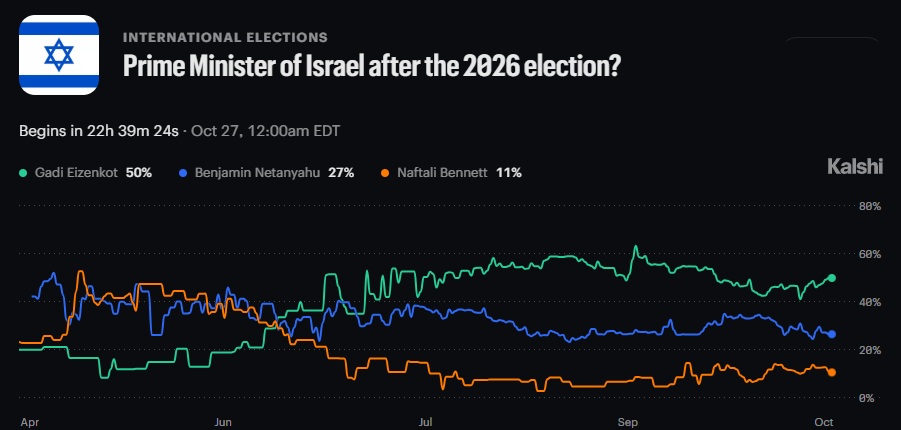
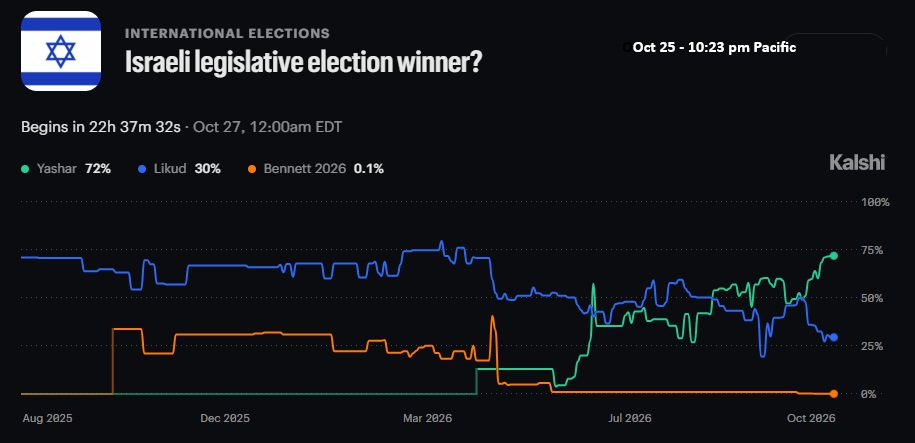
Israel holds its national election on Tuesday. Here’s what the prediction markets are forecasting.
Source: https://global-macro-monitor.com/2026/10/25/the-2026-midterms-a-blue-tsunami-cometh/
Anyone can join.
Anyone can contribute.
Anyone can become informed about their world.
"United We Stand" Click Here To Create Your Personal Citizen Journalist Account Today, Be Sure To Invite Your Friends.
Before It’s News® is a community of individuals who report on what’s going on around them, from all around the world. Anyone can join. Anyone can contribute. Anyone can become informed about their world. "United We Stand" Click Here To Create Your Personal Citizen Journalist Account Today, Be Sure To Invite Your Friends.
LION'S MANE PRODUCT
Try Our Lion’s Mane WHOLE MIND Nootropic Blend 60 Capsules
Mushrooms are having a moment. One fabulous fungus in particular, lion’s mane, may help improve memory, depression and anxiety symptoms. They are also an excellent source of nutrients that show promise as a therapy for dementia, and other neurodegenerative diseases. If you’re living with anxiety or depression, you may be curious about all the therapy options out there — including the natural ones.Our Lion’s Mane WHOLE MIND Nootropic Blend has been formulated to utilize the potency of Lion’s mane but also include the benefits of four other Highly Beneficial Mushrooms. Synergistically, they work together to Build your health through improving cognitive function and immunity regardless of your age. Our Nootropic not only improves your Cognitive Function and Activates your Immune System, but it benefits growth of Essential Gut Flora, further enhancing your Vitality.

Our Formula includes: Lion’s Mane Mushrooms which Increase Brain Power through nerve growth, lessen anxiety, reduce depression, and improve concentration. Its an excellent adaptogen, promotes sleep and improves immunity. Shiitake Mushrooms which Fight cancer cells and infectious disease, boost the immune system, promotes brain function, and serves as a source of B vitamins. Maitake Mushrooms which regulate blood sugar levels of diabetics, reduce hypertension and boosts the immune system. Reishi Mushrooms which Fight inflammation, liver disease, fatigue, tumor growth and cancer. They Improve skin disorders and soothes digestive problems, stomach ulcers and leaky gut syndrome. Chaga Mushrooms which have anti-aging effects, boost immune function, improve stamina and athletic performance, even act as a natural aphrodisiac, fighting diabetes and improving liver function. Try Our Lion’s Mane WHOLE MIND Nootropic Blend 60 Capsules Today. Be 100% Satisfied or Receive a Full Money Back Guarantee. Order Yours Today by Following This Link.


| Visits: | 1,836,018,815 |
| Stories: | 8,726,629 |
Whistler Blowers, Insiders

