

EcoFlow DELTA Pro Ultra X Review: Nearly 5 Months of Frustrating Problems

Follow us as we Twitter about energy.
I would not buy the EcoFlow DELTA Pro Ultra X again. The hardware is well built and EcoFlow’s customer service has been good, but the installation took 102 days. It went through two installers and still has no permit or inspection. Then the system refused to carry my house above 7.6 kW, on an inverter sold as 12 kW. It took a week with support to trace that to the battery cabling. During the first real storm of the season, Storm Guard, the feature that is supposed to top off the batteries before bad weather, never activated.
I bought the DELTA Pro Ultra X in July 2026 for whole-home backup at our all-electric house in rural Maryland. We have a well pump and a sump pump, so an outage means more than dark rooms. I wanted automatic switchover and enough power to run the house normally. I also wanted a path to add solar and my Briggs & Stratton generator later.
This is a long post. I have tried to be fair, including about the parts that were my own fault.
What I bought and what it cost
I am about $14,100 into this system, including the county permit fee.
| Item | Cost |
|---|---|
| DELTA Pro Ultra X (1 inverter + 2 batteries) + Smart Home Panel 3, after promo discount | about $10,127 |
| FlowMaster Generator Rectifier, bought separately | $189.74 |
| Installation by a second installer I hired directly | $3,773.44 |
| EcoFlow Turnkey Installation Service with permit ($3,400 list) | Refunded in full |
| Extra charge from the first installer ($653.94) | Refunded |
The two batteries hold about 12.3 kWh together, and EcoFlow rates the inverter at 12 kW continuous. An independent review notes you need at least two batteries to get the full 12 kW. With one battery, output is capped at 6 kW.
My first order was wrong. The site let me check out with two Smart Home Panels and no battery bundle. EcoFlow canceled it and fixed it the same day. However, the ordering flow was confusing enough that I made a $3,000 mistake without noticing.
DELTA Pro Ultra X installation: the “7-day” install took 102 days
EcoFlow launched this product under the headline “Installed in Just 7 Days.” I ordered on July 6. The hardware arrived July 9 and 10. It was installed on October 16.
To be fair, the fine print arrived by email after I paid. The 7 days are business days and apply to major metro areas. They start only after delivery and permits. I do not live in a major metro area. But the fast install was a reason I chose EcoFlow, and nothing at checkout told me to expect months.
| Date | What happened |
|---|---|
| Jul 6 | Ordered with the $3,400 Turnkey Installation Service, permit included |
| Jul 7 | A different EcoFlow team contacted me about remote video install guidance, which I had not bought |
| Jul 15 | EcoFlow’s install coordinator emailed intake questions after I was already talking to the electrician |
| Jul 16 | Video call with the assigned installer |
| Aug 18 | Still no install date |
| Aug 24 | I complained to EcoFlow. They refunded $200 as an apology. The assigned installer charged me $653.94 for extra work the same day |
| Sep 1 | Call with the installer about the generator and solar. I lost confidence |
| Sep 2 | I asked EcoFlow to cancel the turnkey package |
| Sep 13 | EcoFlow refunded the installation package |
| Oct 16 | A second installer, one I found myself, did the install |
In August I told EcoFlow the electrician had been great, and at that point the delay was my only complaint. That changed once we got into technical questions. The assigned installer could not tell me how to wire the generator rectifier or whether I needed one. They could not tell me how solar would connect. They kept saying they needed to check with EcoFlow or wanted to do a basic install and add things later. I was doing the research and explaining the product to the installer.
The coordinator apologized and offered to switch installers, and the installer returned the $653.94. I hired a different electrician directly instead.
EcoFlow’s “turnkey” service is a chain of subcontractors: EcoFlow to a coordinator to a local electrician. In my case, the people I dealt with did not know this new product well enough to answer basic questions. As a result, I paid for that in time.
The FlowMaster generator rectifier nobody mentioned
I had to buy a $199 FlowMaster Generator Rectifier to use my generator with this system, and I found that out from an AI assistant, not from EcoFlow.
EcoFlow’s product page says to “plug your generator into DELTA Pro Ultra X” for seamless backup. The rectifier appears in the next sentence and reads like an option. Retailer listings describe at least three ways to connect a generator: the rectifier, a separate charging adapter, or a direct connection to the Smart Home Panel 3. Nothing in the ordering process asked whether I had a generator. It also did not tell me which of these I needed.
I worked it out myself and ordered the rectifier on August 27, seven weeks after the main order. My assigned installer did not know either. For a system at this price, the buyer should not be the one designing it.
EcoFlow’s store makes it easy to buy the wrong thing
The rectifier was not the only trap. EcoFlow’s website and app sell add-ons next to the DELTA Pro Ultra X without telling you whether they will work with it.
My first order was one example: the site let me check out with two Smart Home Panels and no batteries. Here is another. In November, the EcoFlow app showed me a “Comfort Option” bundle. It included two DELTA Pro Ultra X systems, two extra batteries, and one 160W portable solar panel.
That panel cannot charge this system. The DELTA Pro Ultra X solar input needs 80 to 500 volts. The 160W panel puts out about 21 volts open-circuit and about 18 volts under load. You would need roughly five of them wired in series before the inverter would even accept their power. One panel on its own does nothing for this system.
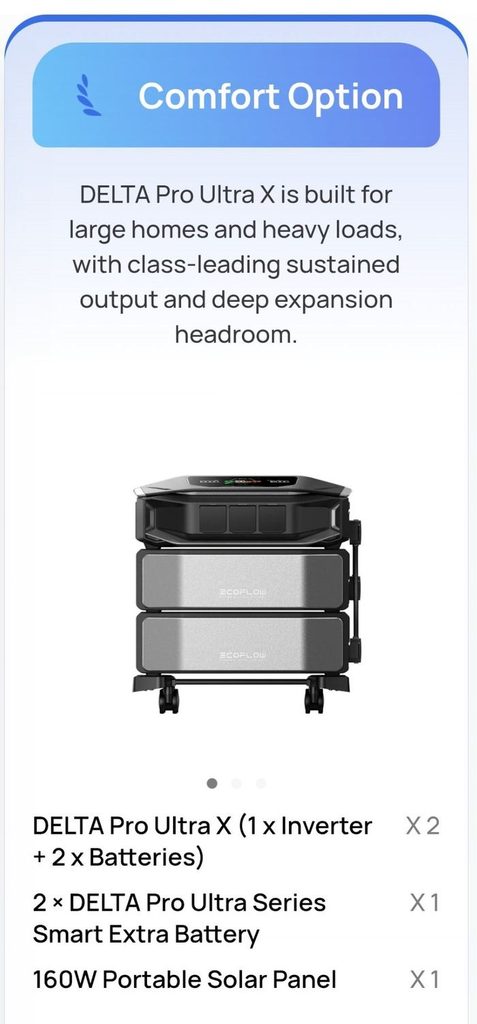
The numbers are all in the spec sheets if you know where to look. But buyers expect a company’s own store to check compatibility for them, especially its own bundles.
Six weeks after install: no permit, no inspection, no heat detector
As of November 26 the system is running without a completed permit or a county inspection.
This part is on the second installer, not EcoFlow. The install went well and took about 11 hours. The county’s records showed a permit from the first electrician but none from the second installer. I had paid the second installer for one, so they are now pulling it after the fact.
The open item is fire detection. My understanding of the county requirement is that an indoor battery system needs a heat detector above it. The detector must trigger every alarm in the house. I bought detectors in September and was told to return them because the installer would bring one. None was installed. My home’s existing alarms are not interconnected, so I designed a wireless-bridge workaround myself and sent it to the installer on October 19. I am still waiting on that install.
If you buy any indoor battery system, ask your installer about the permit and fire detection before work starts, and get the answer in writing.
Error 2031 and “load power too high”: a cabling problem nobody caught
On October 25, the house drew 7.61 kW, and the battery was at 94%. The app showed “Energy storage box overload (2031). Reduce connected load devices.” The Smart Home Panel then reported “The load power is too high to switch to battery power.” The same alert kept coming back through mid-November whenever the load climbed past about 7 kW.
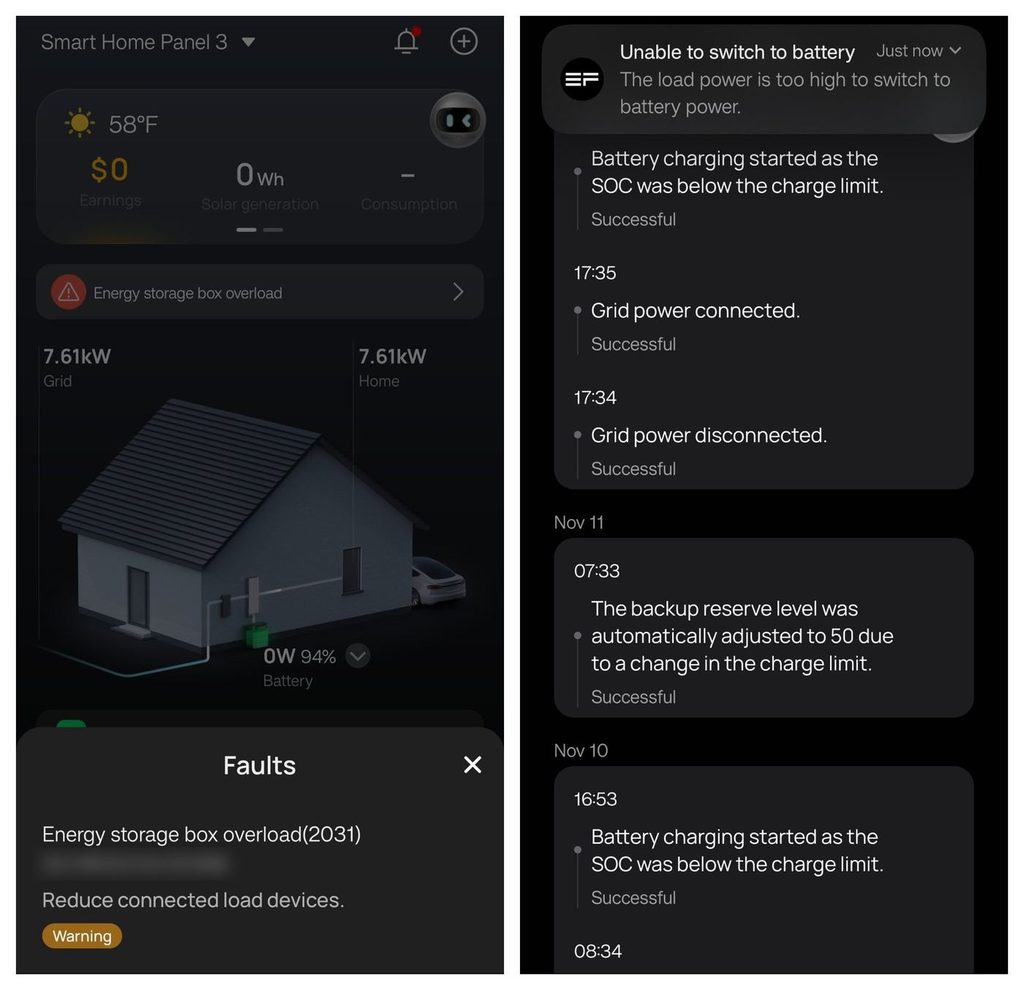
7.6 kW is above my average load, but it is well under the 12 kW this inverter is sold on. If the grid had failed at those moments, the house would not have transferred to battery. Until it was fixed, running on battery meant switching off the water heater and both HVAC units by hand.
I opened a ticket on November 14, and EcoFlow’s technical support worked it over the following week. They asked for the specs of my water heater and both heat pumps and which panel circuits they were on. On November 18, their engineers reviewed my system data remotely. They concluded that both batteries were feeding the inverter through a single battery port, which caps output at 7,200 W.
I pushed back at first, because I believed the batteries were on separate ports. On November 20 they sent back my own photo marked up beside a reference photo, and they were right. The second battery was chained through the first. The inverter’s second battery port was sitting empty under its cover. The cable that linked the batteries was too short to reach that port, so I recabled with a longer battery cable. Each battery now has its own inverter port, and the overload is gone.
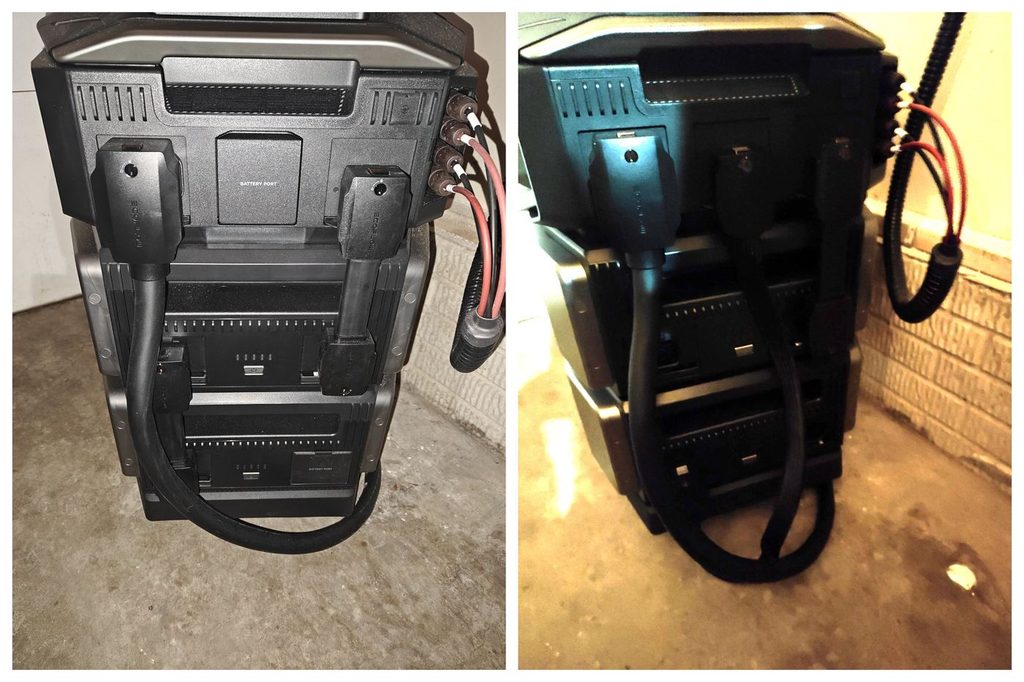
The system was cabled this way at installation, and neither the installer nor I caught it. It is an easy mistake to make because the batteries also have ports for chaining to each other. But nothing in the app or the error message pointed to the cabling. A system that knows it is running at half its rated output should say why.
One honest caveat: some of the sizing is on me. This house uses roughly 2,300 kWh a month, about 75 kWh a day. Two batteries hold 12.3 kWh, which is a few hours at our average draw. Nobody at EcoFlow asked about my usage before I bought, and the site did not prompt me to check it. I should have done that math more carefully myself.
To get where I wanted to be, I would need a second inverter, at least two more batteries, and solar. I priced an 8 kW ground-mount array at $28,425. Its payback would be near 20 years, so that is not happening.
Storm Guard not working: silent through the first real storm
On Thanksgiving morning, November 26, the system rode through a power outage, but Storm Guard never activated before or after it.
Storm Guard is supposed to watch the weather and ignore your charge limit when a storm is coming. It should then fill the batteries to 100%. It is enabled in my app. At 5:38 AM, the National Weather Service issued a Hazardous Weather Outlook for Carroll County. A Wind Advisory remained in effect until 7 PM, with gusts of 55 to 65 mph and possible scattered tree damage.
My power went out at about 7:09 AM. The good news: the system switched to battery on its own and carried the house. The app estimated more than a day of runtime at our light morning load. The bad news: it started the outage at 81%, because Storm Guard had not topped it off. When the grid came back, the advisory was still in effect, and the wind was still blowing. Storm Guard still did not trigger. I raised the charge limit to 100% by hand.
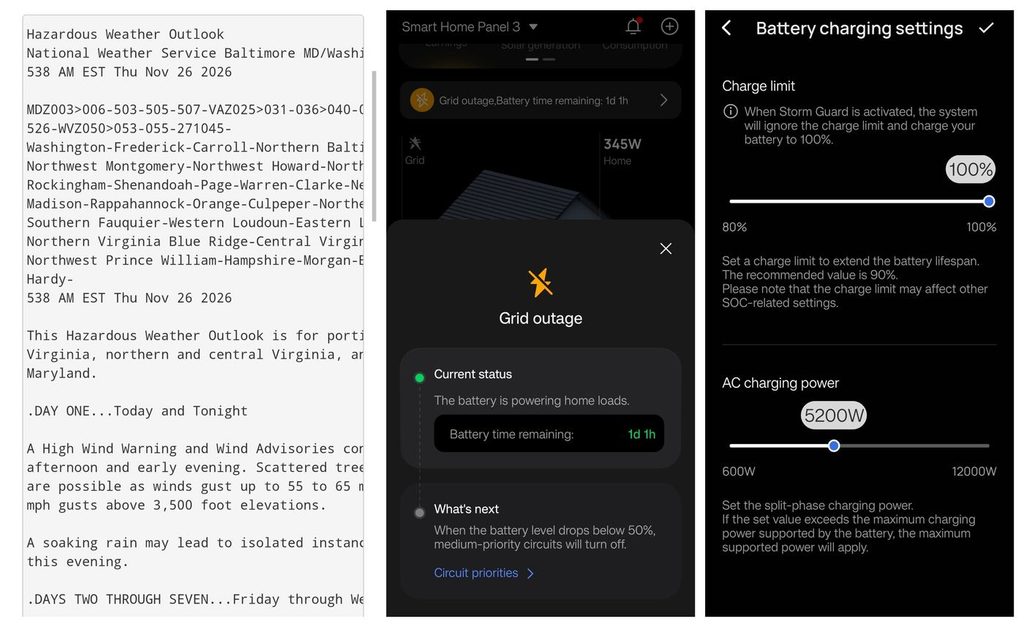
I have asked EcoFlow why it did not activate, which weather alerts it watches, and how much warning it needs. It may respond only to certain alert types. Alternatively, 90 minutes of notice may have been too short. If so, that is a limit the app does not explain. I will add their answer here.
What EcoFlow got right
EcoFlow’s customer service has been fantastic, and I want that on the record.
- They fixed my botched first order the same day.
- They refunded $812.17 in Maryland sales tax once I showed the exemption applied.
- When I complained about the install delay, they answered within hours and offered $200 as an apology.
- When I asked to cancel the turnkey install, they refunded the whole package, and their coordinator got the first installer to return my $653.94.
- When the overload kept happening, their technical team found the cabling problem from my system data and walked me through the fix with marked-up photos.
Every person I dealt with was polite and followed through. The problem is not the support staff. It is what they are being asked to clean up: marketing that promises speed and simplicity, a website that makes it hard to know what you need, and an install network that was not ready for this product, in my experience.
If you are considering one (don’t consider one…)
- Do your own load math first. Pull 12 months of utility bills and compare your daily kWh and peak kW to the battery capacity and inverter rating.
- Ignore the 7-day install claim unless you live in a listed metro area and already have a permit.
- Pick your own installer. Ask whether they have installed this exact model, with a generator and with solar.
- After install, check the battery cabling yourself. Each battery should connect directly to its own battery port on the inverter, not chain through the other battery.
- If you own a generator, ask EcoFlow in writing which accessory you need before you order.
- Check solar panel voltage before you buy, even in EcoFlow’s own bundles. The DELTA Pro Ultra X needs at least 80 volts from each solar string.
- Get the permit and fire-detection plan in writing before install day.
- Budget for more than the bundle. The inverter and two batteries are a starting point for a large all-electric home, not a whole-home solution.
- Do not count on Storm Guard alone. In storm season, keep the charge limit at 100% yourself.
Verdict
I would not buy the DELTA Pro Ultra X again. Almost five months and about $14,100 in, the system finally carries my house the way it should. It also got us through a Thanksgiving outage. But installation took 102 days. A week of support emails helped find a cabling mistake, and the system is still not permitted. Storm Guard sat out the first real storm of the season. EcoFlow’s support team has earned my respect. The product experience around them has not.
I paid for this system with my own money. EcoFlow refunded the installation package, sales tax and $200 as described above, and has given me nothing else.
DELTA Pro Ultra X FAQ How long does EcoFlow DELTA Pro Ultra X installation take?
Mine took 102 days from order to install. The “installed in 7 days” claim counts business days and applies to major metro areas. The timeline starts only after delivery and permits.
Why does my DELTA Pro Ultra X say the load power is too high to switch to battery?
In my case, both batteries connected to the inverter through one battery port, which caps output around 7,200 W. Each battery needs its own inverter battery port to reach the 12 kW rating.
Do I need the FlowMaster Generator Rectifier?
It depends on your generator and how it is connected, and EcoFlow lists it as optional. I needed one for my Briggs & Stratton, and nothing at checkout told me. Good luck finding out if you need one…
Can I charge the DELTA Pro Ultra X with an EcoFlow 160W portable solar panel?
Not with one panel. The DELTA Pro Ultra X solar input needs 80 to 500 volts. A single 160W panel produces about 21 volts.
Does EcoFlow Storm Guard work?
It did not activate during a National Weather Service wind advisory at my house on November 26, 2026. A power outage also occurred. I have asked EcoFlow why.
Would you buy the DELTA Pro Ultra X again?
No. Absolutely not. I would look at the Anker Solix system.
Sources
- EcoFlow launch announcement: “Installed in Just 7 Days”, 12 kW continuous, bundle pricing
- ESS News coverage of the US launch
- The Solar Lab review: two batteries required for 12 kW, 6 kW with one
- EcoFlow US product page: generator and rectifier wording
- EcoFlow US product page: DELTA Pro Ultra X solar input 80 to 500 V
- EcoFlow 160W portable solar panel specs: 21.4 V open circuit, 18.2 V Vmp
- My own order confirmations, invoices, support emails and app screenshots, July to November 2026
The post EcoFlow DELTA Pro Ultra X Review: Nearly 5 Months of Frustrating Problems first appeared on Alternative Energy Blog.
EnergyRefuge.com features the latest alternative energy news and information resources to raise awareness for the general public and environmentalists alike. Visit our alternative energy blog to stay up on the latest green news and be sure to download our free energy ebook.
Source: https://www.energyrefuge.com/blog/ecoflow-delta-pro-ultra-x-review/
Anyone can join.
Anyone can contribute.
Anyone can become informed about their world.
"United We Stand" Click Here To Create Your Personal Citizen Journalist Account Today, Be Sure To Invite Your Friends.
Before It’s News® is a community of individuals who report on what’s going on around them, from all around the world. Anyone can join. Anyone can contribute. Anyone can become informed about their world. "United We Stand" Click Here To Create Your Personal Citizen Journalist Account Today, Be Sure To Invite Your Friends.
LION'S MANE PRODUCT
Try Our Lion’s Mane WHOLE MIND Nootropic Blend 60 Capsules
Mushrooms are having a moment. One fabulous fungus in particular, lion’s mane, may help improve memory, depression and anxiety symptoms. They are also an excellent source of nutrients that show promise as a therapy for dementia, and other neurodegenerative diseases. If you’re living with anxiety or depression, you may be curious about all the therapy options out there — including the natural ones.Our Lion’s Mane WHOLE MIND Nootropic Blend has been formulated to utilize the potency of Lion’s mane but also include the benefits of four other Highly Beneficial Mushrooms. Synergistically, they work together to Build your health through improving cognitive function and immunity regardless of your age. Our Nootropic not only improves your Cognitive Function and Activates your Immune System, but it benefits growth of Essential Gut Flora, further enhancing your Vitality.

Our Formula includes: Lion’s Mane Mushrooms which Increase Brain Power through nerve growth, lessen anxiety, reduce depression, and improve concentration. Its an excellent adaptogen, promotes sleep and improves immunity. Shiitake Mushrooms which Fight cancer cells and infectious disease, boost the immune system, promotes brain function, and serves as a source of B vitamins. Maitake Mushrooms which regulate blood sugar levels of diabetics, reduce hypertension and boosts the immune system. Reishi Mushrooms which Fight inflammation, liver disease, fatigue, tumor growth and cancer. They Improve skin disorders and soothes digestive problems, stomach ulcers and leaky gut syndrome. Chaga Mushrooms which have anti-aging effects, boost immune function, improve stamina and athletic performance, even act as a natural aphrodisiac, fighting diabetes and improving liver function. Try Our Lion’s Mane WHOLE MIND Nootropic Blend 60 Capsules Today. Be 100% Satisfied or Receive a Full Money Back Guarantee. Order Yours Today by Following This Link.


| Visits: | 1,840,104,130 |
| Stories: | 8,745,574 |
Whistler Blowers, Insiders

