

Canada Smokes the U.S.

This post Canada Smokes the U.S. appeared first on Daily Reckoning.
“O… cough… Canada! … cough, cough… Our home and native land! … cough, cough…”
Well, at least they do land acknowledgements up there, just before they let it all burn.
Holy smokes, if you’ll forgive the choice of words… What’s going on with Canada? Last week they were choking us down here.
According to Canada’s CBC News, “President Donald Trump personally told Prime Minister Mark Carney to stop poisoning American air and take action to put out wildfires burning across the country.”
This past Sunday, Trump raised the issue of wildfire management with Carney when the two leaders appeared together to watch the World Cup Final between Argentina and Spain in East Rutherford, New Jersey. According to Trump, speaking at a post-game press event, “I told him, I mean, ‘You got to stop these fires from coming in and, you know, poisoning our air. Our air has been poisoned.’”
Meanwhile, when Trump took office in early 2025, among his first acts was to place tariffs on a wide array of Canadian products, from aluminum and auto parts to steel and softwood lumber.
Canadian politicians whined and bellyached, and then restricted U.S. goods and services flowing north. Now, it’s difficult to find Tennessee whiskey in Canada, and – even worse! – many Canadians are supposedly boycotting Disneyworld.
As if boycotting whiskey and Disneyworld weren’t enough, Canada has bequeathed the U.S. with a serious cross-border air-quality problem. Let’s dig in…
When the Sky Turns to Brass
Last week, something went wrong with our American air, and it has everything to do with the atmospheric fact that much of it blows down from Canada. Recently, much of the U.S. baked beneath a putrid mass of dull, brass-colored haze.
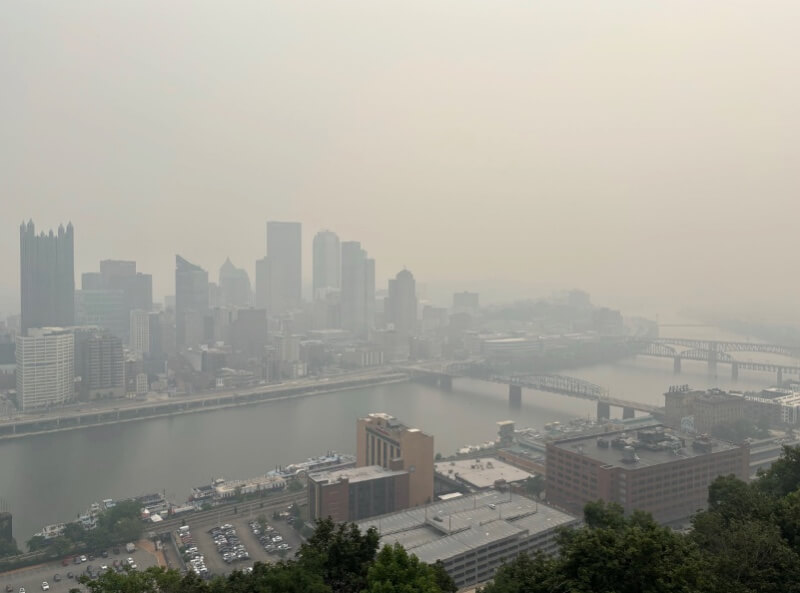
Downtown Pittsburgh this past Friday. Credit WPXI.com.
This photo shows downtown Pittsburgh a few days ago, as seen from atop “Coal Hill,” aka Mt. Washington. In 1884, Mark Twain described a similar perspective of the city in its early industrial days, noting, “We sauntered about the mount and looked down on the lake of fire and flame. It looked like a miniature hell with the lid off.”
Thank you, Mark Twain, but Pittsburgh’s current air situation is not a locally produced industrial hellscape. Usually, the region’s air is clean. And that yucky haze is no mystery of chemistry, nor a failure of law or regulation.
In fact, the photo shows Canadian wood smoke from that nation’s burning boreal forest. It also raises hard questions about forest policy, fire suppression priorities, fuel loads, budgets, and whether Ottawa and the provinces are managing the problem at the scale required.
Last week, thanks to Canada, air-quality alerts affected more than 20 U.S. states, from the Great Plains to the Atlantic Seaboard. Large cities like Minneapolis, Detroit, Cleveland, Chicago, Pittsburgh, Philadelphia, New York, and others watched the sky turn orange and yellow.
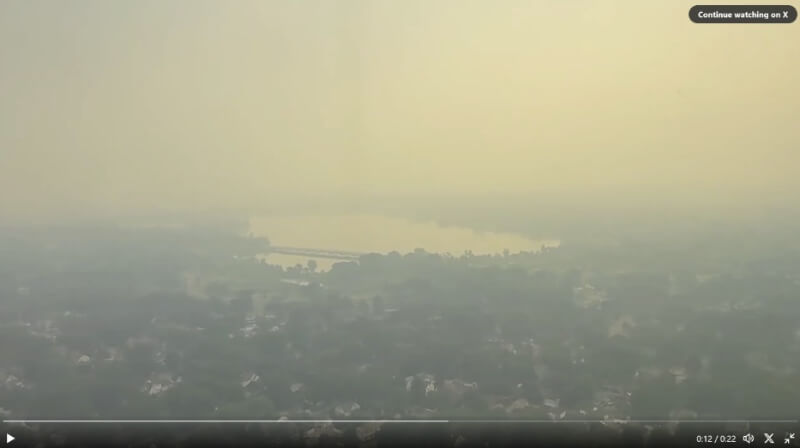
Minneapolis, as seen from aircraft landing at MSP airport. Credit @1labare.
At one point last week, the air in Detroit, Minneapolis, and Chicago ranked among the dirtiest of major cities on Earth – worse than many famously polluted urban centers overseas.
Readings from monitoring services such as AirNow showed that parts of the U.S. Great Lakes region and other downwind areas reached “hazardous” air-quality levels, the top warning category.
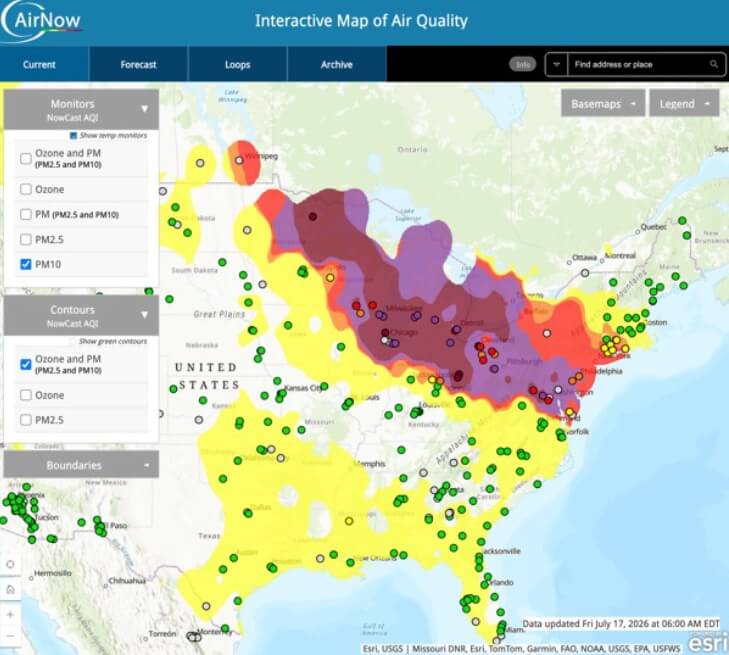
U.S. air quality map from Friday, 17 July 2026. Credit ESRI.
This is not just some annoying summertime haze; it’s an international public-health event.
Not the Old Rust Belt Smoke
Back in 1948 in Western Pennsylvania (before my time), we had the “Donora Killer Smog,” and the tale is still told with chilling effect. Meanwhile, I grew up in the 1960s “Steel City” Pittsburgh of old, when coke ovens and mills lined the riverbanks. You want air pollution? I can tell you a few things about air pollution.
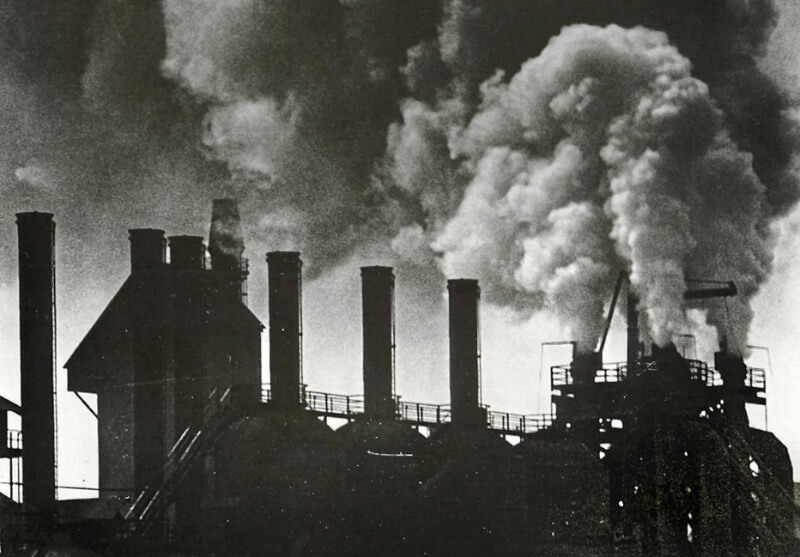
Pittsburgh riverbank blast furnaces, 1960s. Credit Pittsburgh Post-Gazette.
But this new aerosol phenomenon is not from long-gone smokestack industries of America’s Rust Belt. No, the source is hundreds of miles away, in a vast country with abundant natural resources and a government that regularly lecturesothers about climate virtue while many of its forests smolder and burn, and air patterns blow the residue south.
Canada has money for national health care, mass immigration, social spending, Ukraine aid, and seemingly endless committees, strategies, frameworks, and consultations. Canada also has money for climate mandates, clean-power targets, vehicle-emission rules, carbon pricing, and global sermonizing. Indeed, Canada recently announced $125 million to Brazil for environmental support.
But when the bottom-line deliverable is a long-term, consistent national-scale program of forest thinning, access roads, fire breaks, prescribed burns, pumper trucks, fire crews, water-bomber aircraft, and law enforcement when arson is involved, the results are still written in soot across the American sky.
As of mid-July, Canadian wildfire tallies showed roughly 850 to 950 active fires, depending on the day, with many classified as “out of control” or being monitored rather than immediately suppressed. And it’s no simple careless-camper problem; collectively, fires involve lightning, human activity, dry conditions, fuel loads, and policy choices. The result is an atmospheric issue that spans half of North America.
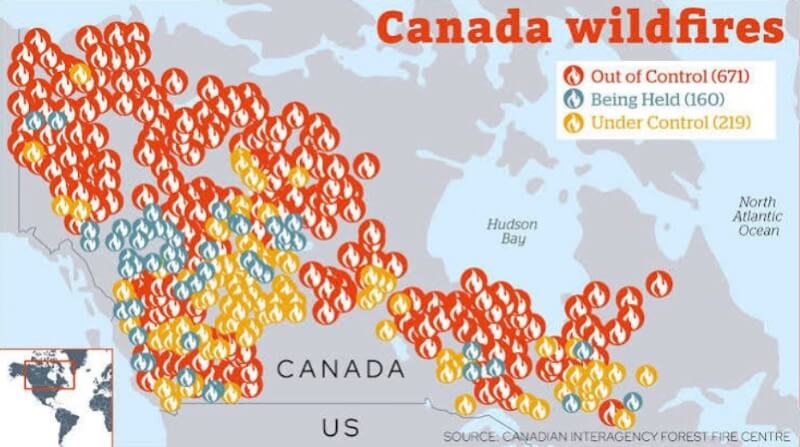
Canada burns, mid-July 2026. Credit Canadian Interagency Forest Fire Centre.
There’s a technical term for what drifted across the border last week: “PM2.5,” aka fine particulate matter small enough to lodge deep in the lungs and pass into the bloodstream.
Wildfire smoke can also carry carbon monoxide and volatile organic compounds, including benzene, formaldehyde, toluene, and xylenes. You don’t need a Ph.D. in atmospheric chemistry to understand the problem. If you can smell the forest from your front porch, Canada’s aerosol exports have reached out to touch you.
America Paid Dearly to Clean Its Air
Another galling aspect to this situation is that, since the 1970s, Americans spent a king’s ransom cleaning up our own air. Think of the Clean Air Act, catalytic converters, power-plant scrubbers, reformulated gasoline and diesel fuel, and tens of thousands of factories that either retooled at great expense or closed (and moved overseas) because owners could not afford new investments in modern tech.
America’s economy and culture took major hits: massive job losses; cities and entire regions thrown into economic chaos; endless court battles and permitting fights.
America spent hundreds of billions of dollars to comply with endless rules and bureaucratic edicts. And yes, in the end, much of that expense worked. Today, we have much cleaner air.
Now, living in Pittsburgh is no longer the pulmonary-health equivalent of a two-pack-a-day cigarette habit. And then along comes this summer smoke blast from up north, and U.S. cities suffer from Canada’s land-management problem.
Remote Does Not Mean Harmless
To be fair, Canada’s boreal forest is vast – something like 1.3 billion acres, much of it remote, unpopulated, and difficult to access under the best circumstances. One Canadian university professor calculated that Canada has 9,000 times more trees than people.
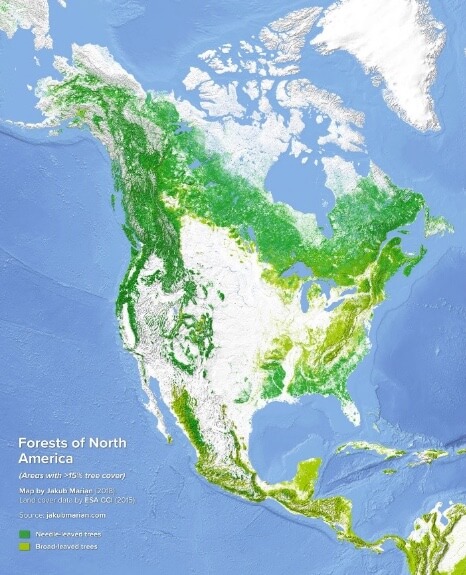
North American forest lands. Credit Jakub Marian.
Absolutely, Canada has many trees and fire is natural. Plus, lightning starts wildfires in Canada, just as in the U.S. And not all remote wilderness fires can be extinguished; no argument.
According to Natural Resources Canada, that country’s fire management includes a range of responses, from complete extinguishment to little or no intervention at all. Generally, remote and lower-priority fires may be allowed to burn when people, towns, infrastructure, and commercial assets are not directly threatened.
From the U.S. standpoint, though, “remote” in Canada does not mean “harmless” down here. Smoke does not respect jurisdiction, let alone stop at customs stations. A fire judged lower priority in northern Ontario can become a hazardous-air day in Ohio or Pennsylvania. And a decision to monitor rather than suppress may make sense under Canadian priorities, but the bill still arrives in American lungs.
Misplaced Fire Priorities
Of course, Canada runs an array of fire programs: fire intelligence systems, predictive services, firefighter training, equipment funds, and WildFireSat, a dedicated satellite mission planned for daily fire monitoring. Okay, great…
But at some point, guys with backhoes and bulldozers must get out in the field to dig fire lines, thin out fuel piles, and put water on smoldering ash. The core issue is priorities.
One problem is that Canada’s fire-response machinery often resembles a provincial guild system. The country has an agency called the Interagency Forest Fire Centre that coordinates resource sharing. But on the ground, provinces still guard credentials, contracts, and turf. Each province has its own training rules and bureaucratic gatekeepers, and the overall effect is to exclude outsiders even when large fires rage and continental air quality is on the line.
In other words, firefighters from one Canadian province may face credentialing or contracting barriers before working in another jurisdiction. Critics say the result can be crews and equipment sitting idle in, say, Alberta while smoke from Ontario or Quebec drifts across the Great Lakes and into American cities.
Meanwhile, some U.S. firefighting companies say they face hurdles getting hired or deployed in Canada. At the same time, Canadian aircraft and crews have long flown south to help fight U.S. fires and are compensated under cross-border arrangements. Nice work if you can get it, but the larger point is coordination.
Per the map above, Canada’s boreal forest covers a staggering expanse, and no serious person imagines every acre can be defended. But Canada can do more than shrug at the physics of air movement and smoke transport. It can build more firefighting capacity, harden vulnerable corridors, expand prescribed fire and fuel treatment to reduce catastrophic burn risk, and improve law enforcement where arson is a factor. Plus, Canada can coordinate earlier with U.S. states that now suffer the consequences of cross-border smoke.
Above all, Canada’s government can stop pretending that fire smoke is just another bout of bad weather. Because really… weather doesn’t burn; it just delivers the plume.
Stated another way, of course fire is “natural.” But government policy also affects forest management. For example, what is the fuel load? What’s the approach to local, regional, and national fire response? Who funds – or underfunds – crews, clears access, and decides which fires get fought and which fires get watched until it rains next fall or snow arrives in winter?
Last week, P.M. Carney gave a talk and glibly emphasized climate change as a central driver to forest fires. Okay, climate and weather matter; but proper forest management, prescribed burns, fuel reduction, fire preparedness, and cross-border smoke also deserve serious discussion, not just another promise to assess damage after the season.
I’ve been traveling up into Canada for a long time, since the mid-1980s. And in recent years I’ve heard plenty of so-called “land acknowledgments” to First Nations; they’re de rigueur anymore. Yet for all the lip service to First Nations, the country does a miserable job of actual stewardship. The solemn words are lovely, but they don’t substitute for clearing brush, thinning fuel, building fire breaks, maintaining access roads, moving crews, enforcing laws, and putting aircraft and pumps out where the smoke begins. That’s the serious work.
The Political Bill Comes Due
And now come the politics. For example, Sen. Bernie Moreno (R-OH) will soon introduce the CANADA FIRE Act, a sanctions bill aimed at Canadian officials deemed responsible for the recurring smoke emergency. Reported versions would revoke visas, block assets, restrict certain government contracts, and study a victim-compensation fund financed by tariffs.
And as noted at the beginning, President Trump has weighed in, which is about as clear a “smoke signal” as you can get. Canada’s aerosol exports are not just an unfortunate act of God. They are becoming a hazardous cross-border nuisance, tied to personal names, agencies, budgets, and government policy choices.
Again this year – as has been the case before – Canadian smoke has undercut decades of U.S. national policy and hard-bought local air-quality gains. Looking ahead, fire diplomacy will be on the agenda next to trade, tariffs, water, pipelines, defense, and border security.
The lesson is simple. America cleaned up its smokestacks. Canada must clean up its forests, and not by banning fire from nature but by managing fuel, money, access, resources, and response to match the continental-scale public-health problem this has become.
None of this means Canada can control every lightning strike or extinguish every remote blaze. It means that when smoke repeatedly crosses an international border and disrupts public health, work, schools, travel, and daily life, the issue stops being merely local forest policy and becomes a continental problem.
Until then, when the summer sky turns brassy brown over half of the Lower 48, don’t ask what went wrong with American air. Ask why Canada keeps blowing smoke at us.
That’s all for now. Thank you for subscribing and reading.
The post Canada Smokes the U.S. appeared first on Daily Reckoning.
This story originally appeared in the Daily Reckoning
Source: https://dailyreckoning.com/canada-smokes-the-u-s/
Anyone can join.
Anyone can contribute.
Anyone can become informed about their world.
"United We Stand" Click Here To Create Your Personal Citizen Journalist Account Today, Be Sure To Invite Your Friends.
Before It’s News® is a community of individuals who report on what’s going on around them, from all around the world. Anyone can join. Anyone can contribute. Anyone can become informed about their world. "United We Stand" Click Here To Create Your Personal Citizen Journalist Account Today, Be Sure To Invite Your Friends.
LION'S MANE PRODUCT
Try Our Lion’s Mane WHOLE MIND Nootropic Blend 60 Capsules
Mushrooms are having a moment. One fabulous fungus in particular, lion’s mane, may help improve memory, depression and anxiety symptoms. They are also an excellent source of nutrients that show promise as a therapy for dementia, and other neurodegenerative diseases. If you’re living with anxiety or depression, you may be curious about all the therapy options out there — including the natural ones.Our Lion’s Mane WHOLE MIND Nootropic Blend has been formulated to utilize the potency of Lion’s mane but also include the benefits of four other Highly Beneficial Mushrooms. Synergistically, they work together to Build your health through improving cognitive function and immunity regardless of your age. Our Nootropic not only improves your Cognitive Function and Activates your Immune System, but it benefits growth of Essential Gut Flora, further enhancing your Vitality.

Our Formula includes: Lion’s Mane Mushrooms which Increase Brain Power through nerve growth, lessen anxiety, reduce depression, and improve concentration. Its an excellent adaptogen, promotes sleep and improves immunity. Shiitake Mushrooms which Fight cancer cells and infectious disease, boost the immune system, promotes brain function, and serves as a source of B vitamins. Maitake Mushrooms which regulate blood sugar levels of diabetics, reduce hypertension and boosts the immune system. Reishi Mushrooms which Fight inflammation, liver disease, fatigue, tumor growth and cancer. They Improve skin disorders and soothes digestive problems, stomach ulcers and leaky gut syndrome. Chaga Mushrooms which have anti-aging effects, boost immune function, improve stamina and athletic performance, even act as a natural aphrodisiac, fighting diabetes and improving liver function. Try Our Lion’s Mane WHOLE MIND Nootropic Blend 60 Capsules Today. Be 100% Satisfied or Receive a Full Money Back Guarantee. Order Yours Today by Following This Link.


| Visits: | 1,828,999,472 |
| Stories: | 8,688,012 |
Whistler Blowers, Insiders

