

Fire to Fortune: A Year of Living Volcanically

This post Fire to Fortune: A Year of Living Volcanically appeared first on Daily Reckoning.
There I was, high on the slopes of Mount Etna, more than 9,000 feet above the Mediterranean tide, with the hills and plains of Sicily spread out far below. And the volcano was venting.
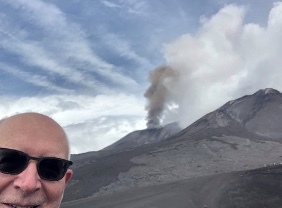
Your editor (minus obligatory hard hat) on Mt. Etna, Sicily. BWK photo.
Above the tree line, there’s no soil; just lava, ash, shattered rock, and a few spots of lichen here and there. Wind, rain, frost, and gravity are all hard at work, but at this moment in geologic time they are losing the race. Mount Etna rises faster than weather and erosion can break the mountain apart and carry it away.
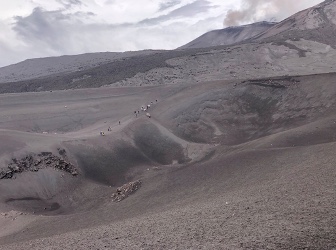
Distant hikers cross a barren volcanic landscape on Mt. Etna. BWK photo.
Near the summit, Etna’s terrain is stripped to elemental colors: charcoal, rust, flashes of sulfur yellow, and vast swaths of fresh, pale-gray ash. Indeed, each step grinds through cinders and loose pebbles. While jagged debris and volcanic bombs litter the slopes; at one time, they were molten blobs and superheated blocks hurled far from the vents and then frozen in flight.
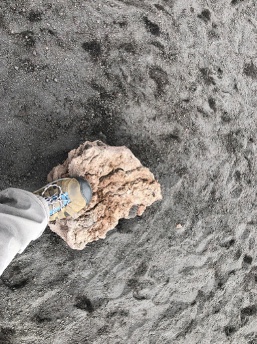
Sixty pounds of basalt, tossed from the mouth of Mt. Etna. BWK photo.
Sorry to say, but we have no mineral deposits here; well, none of any particular value. There’s no gold, silver, copper, etc. Just basalt and volcanic ash for, say, construction; and it’s a long haul down a steep slope to take it anywhere. Still, if you know how to observe things, the geology lessons are priceless in terms of how to find mineral deposits.
The Forge of Hephaestus
Ancient Phoenicians had a word, “attuna.” It translates as chimney, likely the root of Etna’s name. And it’s a fitting description of the smoking landmark they saw from afar, long ago.
Later, Greek explorers and settlers framed the massive mountain as the seat of Hephaestus, god of the forge. Certainly, it makes sense because Etna supplies perfect imagery: furnace-like heat rising from below, tremors that remind one of hammer blows, smoke and sparks at the vents, and black slag draped across the flanks.
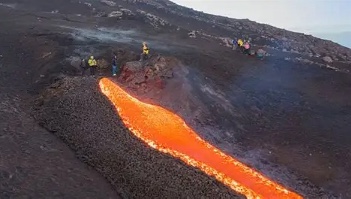
Recent lava flow from Mt. Etna. Credit Geological Survey of Italy/Italian Institute for Environmental Protection and Research
Even today, and for all the accumulated knowledge of geological science, walking amidst the ash beds of Etna, Hephaestus feels less like myth than an actual field observation. Which leads to a particular physical truth; namely, that Etna’s summit is the topmost, smoky outlet of a complex system that channels energy and mass from deep in the Earth, upwards toward the surface.
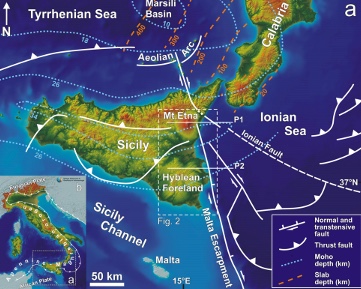
Tectonic map of Sicily/Mt. Etna and Ionian Sea. Credit NATO.
Measured from sea level, Etna towers over Sicily at 3,403 meters (11,165 feet). But trace its structural foundations eastward, along a massive fault system and down toward the floor of the neighboring Ionian basin and Calypso Deep, at 5,267 meters (17,100 feet) below sea level. Do some math and the true scale of this tectonic edifice becomes larger still.
Another way to explain the geological story is that, from near the summit and then down-down-down to far beneath my boots, Etna is a series of stacked lava flows, feeder dikes, intrusions, faults, and magma pathways. It’s the buried machinery of Hephaestus’s forge that channels heat and mass from the depths. And in fact, what looks like a single mountain is really the exposed crest of a three-dimensional, northwest-southeast trending, energy-mass transport system rooted far down in the planet’s mantle.
A Geology Lesson Between Tectonic Plates
One of my jobs at Paradigm Press is to look at mining company plays and figure out their advertised mineral systems and ore deposits. Then, if it’s the real deal, I assess exploration and development potential to turn interesting science into cash-flowing operations. Over the years, I’ve traveled the world, from Alaska to South Africa, from Chile to Kyrgyzstan, to look at mineral and mining ideas. And I’ve found some great ones, along with more than a few that never panned out.
With mineral deposits as in life more broadly, you must look before you can find. Nothing is ever handed to you. And when you look, it helps greatly to understand what you see. Which is why I routinely take opportunities to visit just plain “geology” jurisdictions; to maintain basic field competencies and relearn – or learn anew – some aspect of science that can help me find the Next Big Thing.
And the opportunity to see an active Mount Etna up close is what took me recently to Sicily, a geology classroom set above the collision zone between the African and Eurasian Plates. Plus, it’s worth mentioning, about a year ago I was in Iceland where the North American and Eurasian Plates diverge. Also, this past summer I was in the Canary Islands, part of Spain but offshore of Morocco, atop a fascinating volcanic feature of the African Plate.
Tourism aside, the geologic lessons of these volcanic features involve plate convergence or divergence, subduction, slab-edge processes, regional extension, crustal faults, thermodynamics and mantle flow interactions.
Together, they show how tectonic forces channel energy, create pathways, move mass from deep within the planet, and set up chemical conditions that form mineral deposits. And understanding this aspect of earth dynamics – if not just plain old volcanism – is how geologists learn to find the good stuff; namely, the valuable minerals (although some say that “it’s all good”).
Along the way, I saw much of a type of rock called basalt, which to a geologist is a start but definitely not a diagnosis. That is, to understand what builds a volcano, and where and how mineralization may occur, it’s necessary to reconstruct the geologic history, the “deep time” aspects, the tectonic engine, magma sources, and structures that guide mass through the crust.
Follow the Energy, Then Follow the Mass
Mount Etna is currently active. It attracts tourists, which is good for Sicily’s economy; but on occasion, its eruptive ash clouds close entire sectors of Mediterranean airspace to flight traffic, lest jet engines ingest the volcanic emissions and, basically, seize up mid-flight.
And to be sure, for obvious reasons of public safety, access to the actual explosive vents is restricted by Italian authorities.
Meanwhile, and beyond providing a stunning spectacle for tourism, Mount Etna – and any volcano, when you get around to it – is the surface expression of deep-earth energy and mass in motion. And mineral deposits are not isolated anomalies; they are products of a dynamic set of systems that move heat, rock, fluids, and dissolved elements from one place to another.
The earth’s inner heat drives melting. Buoyant magma rises through fractures and crystallizes in intrusions. Gases and hot fluids separate from the melt and react with the surrounding rock. As temperature, pressure, chemistry, and permeability shift, metals may remain in an intrusion or accumulate in veins, breccias, replacement zones, and alteration halos.
Again, I’ve seen this all over, from the gigantic platinum deposits of Rustenburg, South Africa to volcanic-massive sulfide (VMS) deposits in the Andes, or up in the “golden triangle” of British Columbia. I recall visiting a county-sized lead-zinc-silver deposit at the base of the Tien Shan mountains of Kyrgyzstan, and then there’s the gold-silver arc of southern Idaho, created by North America sliding over a mantle hotspot which now sits directly beneath Yellowstone Park, in Wyoming.
Finding new ore deposits is why the study of active, youthful volcanoes matters to exploration efforts, even exploration in much older terrain. Sure, the volcanic thing may have occurred long ago; but that’s the idea! Chemistry and physics played out and created ore deposits, and subsequent deformation and erosion removed the upper reaches of an ancient system, while deformation or metamorphism may have scattered the evidence.
Yet parts of the old geological plumbing can survive; namely, feeder dikes, intrusive centers, fault corridors, hydrothermal alteration, and mineralized structures. And it happens everywhere, on every continent; too many places to name.
Then come the practical questions: What supplied the heat? What carried the magma and fluids? Which structures focused their flow? Where did physical or chemical conditions change enough to deposit and preserve minerals?
To me, at least, basalt-oriented volcanic systems and islands make those relationships easier to read. The rift zones, calderas, lava fields, dike systems, geothermal areas, collapses, and age-progressive landscapes expose different parts of the same planetary machinery. It’s quite a textbook if you read it.
The Point of the Journey
I could take my “basalt bucket list” to thoroughly nerdy levels, but I’ll spare you. The essential point is this: finding the right kinds of mineral and ore deposits begins with understanding the nearly infinite geological experiments our planet has run.
Mount Etna, Iceland, the Canary Islands… Read together, these landscapes turn black rock into a record of plate motion, energy flow, mantle melting, magma movement, fluid circulation, and chemical concentration. That record is more than an academic illustration of how the Earth works; it is a guide to where mineral wealth can form.
These volcanic systems teach geologists to reconstruct ancient movements of energy and mass. That, and to recognize where those forces concentrated mineral wealth, where time and tectonics concealed it, and where evidence to find it may still remain.
And that’s the point of the journey to Mount Etna. When you learn to read the rocks, they can lead you to the next great discovery.
That’s all for now. Thank you for subscribing and reading.
The post Fire to Fortune: A Year of Living Volcanically appeared first on Daily Reckoning.
This story originally appeared in the Daily Reckoning
Source: https://dailyreckoning.com/fire-to-fortune-a-year-of-living-volcanically/
Anyone can join.
Anyone can contribute.
Anyone can become informed about their world.
"United We Stand" Click Here To Create Your Personal Citizen Journalist Account Today, Be Sure To Invite Your Friends.
Before It’s News® is a community of individuals who report on what’s going on around them, from all around the world. Anyone can join. Anyone can contribute. Anyone can become informed about their world. "United We Stand" Click Here To Create Your Personal Citizen Journalist Account Today, Be Sure To Invite Your Friends.
LION'S MANE PRODUCT
Try Our Lion’s Mane WHOLE MIND Nootropic Blend 60 Capsules
Mushrooms are having a moment. One fabulous fungus in particular, lion’s mane, may help improve memory, depression and anxiety symptoms. They are also an excellent source of nutrients that show promise as a therapy for dementia, and other neurodegenerative diseases. If you’re living with anxiety or depression, you may be curious about all the therapy options out there — including the natural ones.Our Lion’s Mane WHOLE MIND Nootropic Blend has been formulated to utilize the potency of Lion’s mane but also include the benefits of four other Highly Beneficial Mushrooms. Synergistically, they work together to Build your health through improving cognitive function and immunity regardless of your age. Our Nootropic not only improves your Cognitive Function and Activates your Immune System, but it benefits growth of Essential Gut Flora, further enhancing your Vitality.

Our Formula includes: Lion’s Mane Mushrooms which Increase Brain Power through nerve growth, lessen anxiety, reduce depression, and improve concentration. Its an excellent adaptogen, promotes sleep and improves immunity. Shiitake Mushrooms which Fight cancer cells and infectious disease, boost the immune system, promotes brain function, and serves as a source of B vitamins. Maitake Mushrooms which regulate blood sugar levels of diabetics, reduce hypertension and boosts the immune system. Reishi Mushrooms which Fight inflammation, liver disease, fatigue, tumor growth and cancer. They Improve skin disorders and soothes digestive problems, stomach ulcers and leaky gut syndrome. Chaga Mushrooms which have anti-aging effects, boost immune function, improve stamina and athletic performance, even act as a natural aphrodisiac, fighting diabetes and improving liver function. Try Our Lion’s Mane WHOLE MIND Nootropic Blend 60 Capsules Today. Be 100% Satisfied or Receive a Full Money Back Guarantee. Order Yours Today by Following This Link.


| Visits: | 1,835,731,730 |
| Stories: | 8,725,648 |
Whistler Blowers, Insiders

