

From Waste Plastics To Power Plascred Circular Innovations (plas – Cse)

This plastics-to-condensate technology is still 16 months away from revenue…BUT…they have some HUGE partners already. Global trading giant Trafigura has already signed on to take the first 2000 boepd they can make. That first plant is estimated to cost just CAD$25 million.
Canadian National Railway has already supplied the location and building for the technology’s first plant–and their ex-VP of logistics is on the board. They have attracted $20 million+ in non-dilutive capital.
And CEO Troy Lupul has built and sold private tech companies before.
This is a home-grown Canadian clean energy story that appears to tick every box — taking plastic waste and making clean energy out of it–without anyone subsidizing operating costs.
I am long a bit, but not much. I’ve lost a lot of capital over the decades waiting for these technology plays to get commercial. And like I say, first revenue is (very) late 2027.
A lot of detail here, maybe too much for this tiny micro-cap. But I think we covered all the bases here.
QUICK FACTS
Trading Symbols: PLAS
Share Price Today: $0.25
Shares Outstanding: 202 million
Market Capitalization: $50 million
Cash: ~$5 million*
Debt: –
Enterprise Value: $45 million
*Estimated based on money raised from share financing, money from grants and costs incurred
TURNING PLASTIC INTO DOLLARS
Here is the skinny on PlasCred Circular Innovations (PLAS – NEO). It is a Calgary-based company with a process for recycling mixed plastics. The process works – they have proven it at small scale.
Now they have to prove it at a big one.
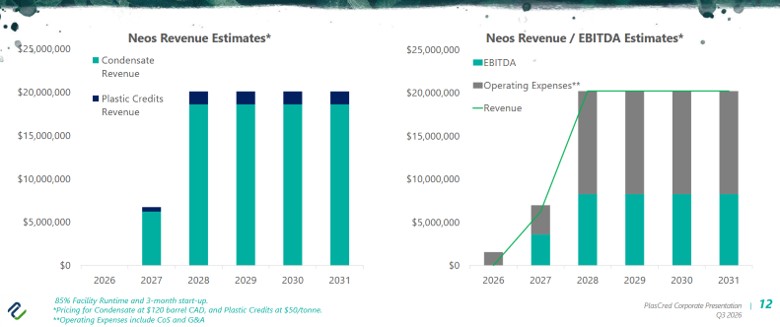
The production scale plant, called Neos, could be a company maker. PlasCred is forecasting $20 million a year in revenue and $8 million in EBITDA once operational.
Source: PlasCred Investor Presentation
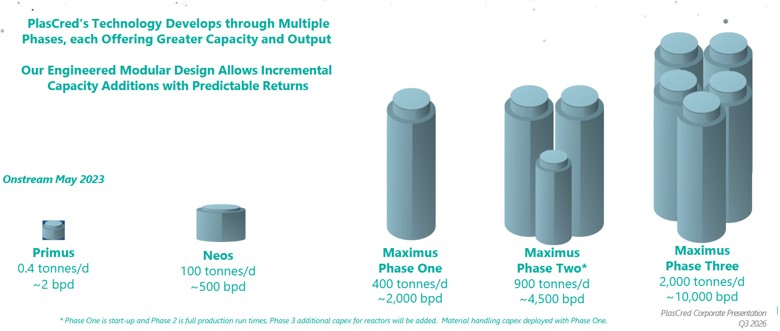
But the bigger point isn’t Neos. It’s that once the process is proven at production scale, adding capacity becomes a copy-and-paste job. An even larger facility, called Maximus, is already on the drawing board, with 3 phases building to 33x the size of Neos.
Source: PlasCred Investor Presentation
On paper it lines up to a great growth story.
The problem is that recycling plastic is a brutal business with a graveyard full of failures.
That’s why I’m writing this one up differently.
I’ll start the usual way – what PlasCred is trying to do and how the process works.
Then I am going to spend the rest of the report on other companies that have tried and something similar and couldn’t make it work. That is most of the ink and it’s the part I would normally skip over.
You can skip it too. But I’d read it. Just as us investors hope PlasCred has learned from the failures before them, I think we can learn a lot about their odds by looking at where other came apart.
Even if they pull it off, PlasCred will be a “long lead-time” story. They have raised money and are going to have to raise more. They have to build a plant. They have to survive commissioning and get it to capacity. It will all take time
If you decide to own the stock, you own it for the long haul.
Which may in fact be worth the wait. If the process works at scale, PlasCred wins.
I think they’ve got a real shot. They’ve checked almost every box short of the one that matters most – building the thing and running it. But if they were that far, the stock wouldn’t have a $50 million market cap. It would be much, much higher.
What they do have is impressive:
· Dedicated feedstock
· Dedicated offtake
· A site lined up in a easy-to-access location
· Economics that work on paper
· A demonstration plant that works in practice
On top of that, they’re first to benefit from a recent shift in how Canadian provincial governments treat plastic recycling. I’ll spend a lot of time on that too, because it matters a lot.
This is a longer report than usual. Given what Plascred is trying to do, I think its worth it. My guess is you’ll come out of it thinking what I think: nowhere near a sure thing, but better odds than most microcap build stories you’ll come across.
RECYCLING PLASTIC THROUGH PYROLYSIS
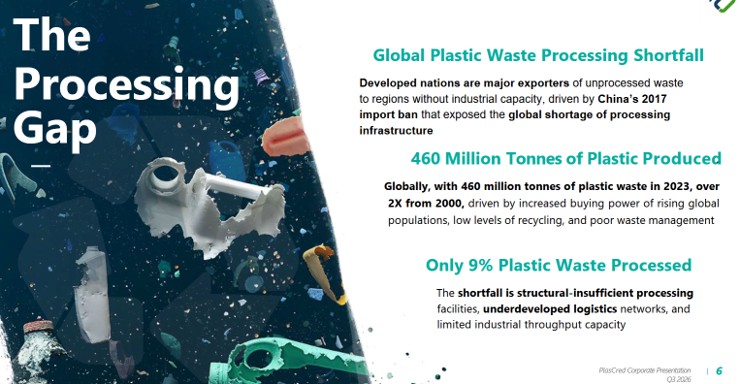
I’m not going to spend much time on why plastic recycling is a big market. We all know the story. There is an enormous amount of plastic, most of it ends up in landfill, and the reason why is because recycling it is hard and doesn’t pay.
If PlasCred can change that dynamic, it is a huge opportunity.
Source: Plasred Investor Presentation
PlasCred’s process is pyrolysis. Feed in mixed plastic, get out a condensate-like liquid that can be sold back into the petrochemical chain to make new plastic.
Pyrolysis works by heating a material like plastic without oxygen. That’s the whole trick. Oxygen is what lets things burn. If you take it away you can push the plastic to temperatures where it stars coming apart.
Three things have to be controlled:
· Temperature: Held at strict targets, which is what keeps the feedstock from burning
· Oxygen: Removed or kept low to prevent fires or unwanted chemical reactions.
· Heating Rate: Regulated, because how fast you heat the material determines how it breaks apart
Get those three things right and you get “controlled thermal degradation”.
Plastics are polymers, which are long chains of hydrocarbons. Pyrolysis snaps the bonds of the chains and turns the plastic into smaller hydrocarbon chains.
What comes out the other end sorts into three streams by weight:
· Heavy hydrocarbons — char
· Medium hydrocarbons — condensate
· Light hydrocarbons — synthetic gas
The condensate is the one that matters. That’s the product.
THE PROOF-OF-CONCEPT
PlasCred has been running a pilot plant called Primus in the industrial district of Calgary since November 2023. Primus is proof-of-concept.
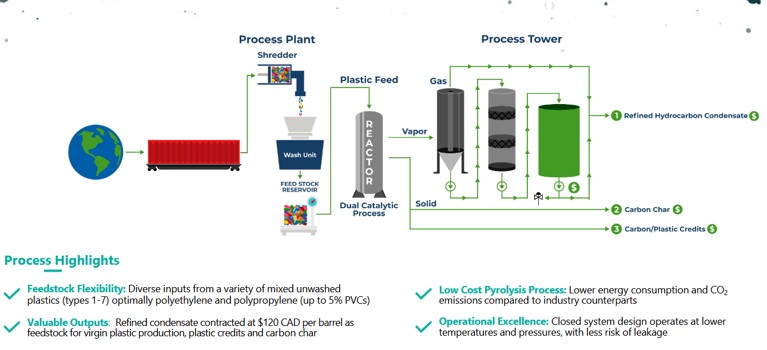
It validates the process, shown below, that PlasCred now needs to scale.
Source: PlasCred Investor Presentation
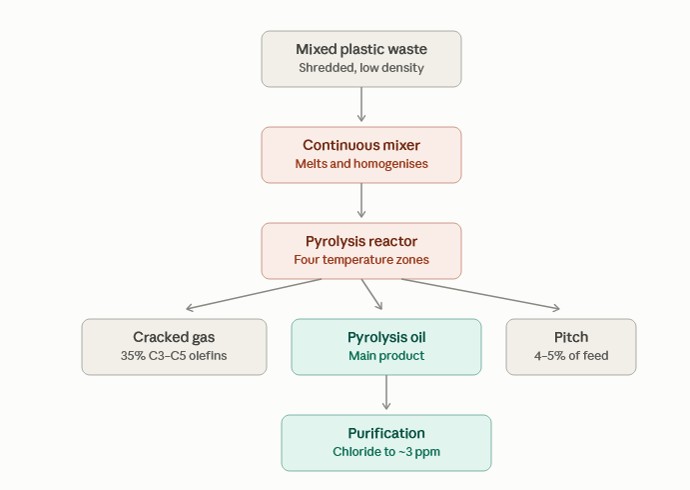
In pre-processing, the plastic gets shredded, washed and melted.
The melting step is worth pausing on. It is not always done, but it accomplishes a few things. First, it turns the plastic into a relatively homogeneous mixture. Second, it gets strips chlorine from the stream.
Chlorine is a headache for mixed plastic recycling. PVC plastics are made with chlorine molecules and PVC turns up in any mixed stream. If you don’t get out the chlorine, it can cause corrosion in pipelines or refineries upstream. Buyers know this and have strict guidance on how much chlorine they’ll accept.
The reactor is where pyrolysis takes place. The process uses heat (somewhere between 300 deg C and 600 deg C according to a patent filing from PlasCred) to separate the hydrocarbons. Worth noting is that PlasCred seems to have figured out how to run the reactor at lower temperatures than the comps I have seen.
Catalysts—the separated hydrocarbons are run over by catalysts. This may take place within the reactor or as a separate step after the reactor. The patent application contemplates both.
There are two kinds at work. Guard bed catalysts clean up contaminants, and in particular mop up whatever chlorine survived the melting step. Cracking catalysts do the heavy lifting, breaking the bigger molecules down into smaller ones.
Separation. Out the back comes three streams. The solid char isn’t worth much. The syngas can be burned or flared.
The value is in the liquid condensate. The yields here look good.
PlasCred has produced high-quality, zero sulphur, green condensate that meets industry specifications. In their patent filing, PlasCred expected yields between 70% and 88%.
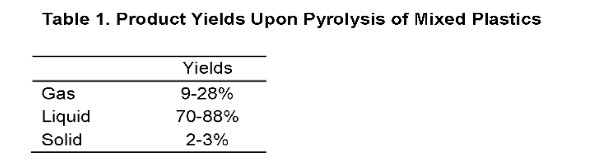
Source: PlasCred Patent
They have since said that in their Primus demonstration plant they have achieved over 80% yield.
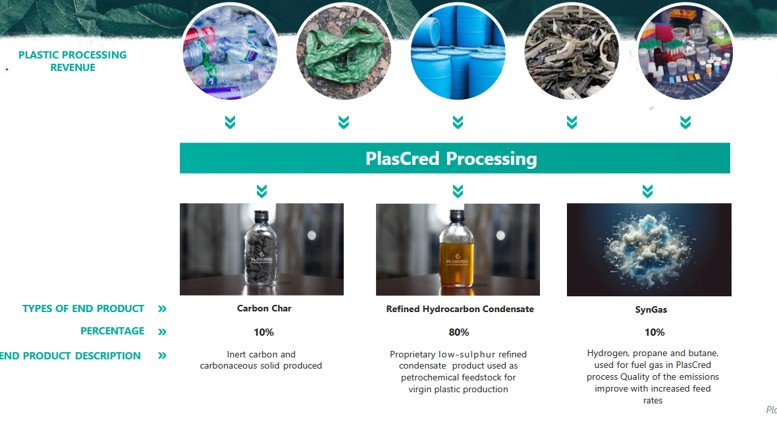
Source: PlasCred Investor Presentation
That is as economic as you are going to get. As long as it scales, the process will work.
SCALING TO PRODUCTION SIZE
The big leap here is scale.
Primus handles 400 kg per day. Neos is 250x larger than that. The question is whether this team can pull it off?
PlasCred is run by Troy Lupul. Lupul is an operator, not a promoter, a clear positive. He’s a NAIT grad (Northern Alberta Institute of Technology) who founded two companies before this one and sold both.
The first was FilterBoxx, which built modular, skiddable water treatment units and rented them out. It was bought by Ovivo, a global water and wastewater treatment equipment supplier.
The second was ClearBakk Energy Services, an industrial fluid management company focused on water use in oil and gas production. More engineering and less product, but still, the through-line is clear enough. Lupul has built and sold modular industrial equipment businesses before, which is essentially what PlasCred is trying to become.
The chemical processing side is thinner. PlasCred had a chemical process engineer on staff, Dr. Wayne Monnery, but his specialty wasn’t pyrolysis, he has since left and I’m not sure he was even full-time with the company.
Both Monnery and Lupul are listed on PlasCred’s patent application. A third contributor, Karl Angermeyer, works for the firm Grey Owl Engineering.
Grey Owl is the part of this that gives me the most confidence.
They have been on the project since the beginning. The are responsible for Primus and they will have a large hand building Neos. Realistically, a bet on the stock is as much a bet on Grey Owl as anyone.
Grey Owl is a proven engineering firm with a real track record. They have designed and built gas plants, deep cut facilities, blending facilities and refinery fluid catalytic cracking (FCC) flare knockout systems.
All of these are at least adjacent to what PlasCred is trying to build.
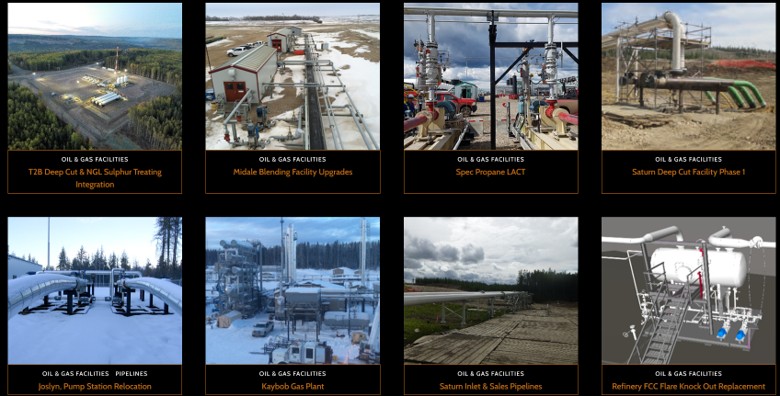
Source: Grey Owl Engineering
Grey Owl has a number of pictures of the Primus plant on their website.
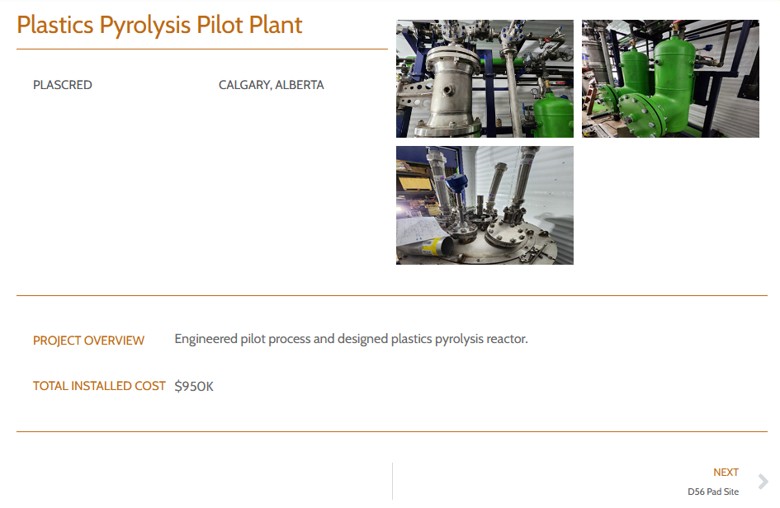
Source: Grey Owl Engineering
Here’s the nugget that is most interesting. Grey Owl lists the cost of the Primus plant at $950,000 right there on their site.
The Neos plant is 250x bigger than the Primus plant, and CEO Troy Lupul has said the larger plant will cost $25 million.
To their credit, PlasCred didn’t just pull the number out of the air. That estimate comes from Grey Owl.

Source: PlasCred Investor Presentation
A Class IV estimate means that Grey Owl has done enough work to know the major equipment and rough sizing, and they’ve priced it using scaling factors and past experience rather than actual vendor quotes and detailed drawings.
Class IV estimates are usually within -30% to +50% accuracy—somewhere between roughly $18 million and $37 million.
Even so, the numbers suggest some significant economies of scale. It is something to follow-up on with management.
I did follow up, and management had answers. The $25 million figure already carries a 30% contingency, so the real working estimate is closer to $18 million. That goes some way to explaining the economies of scale.
PlasCred is on the hook for any cost overruns, but Lupul says they have circled back with their major vendors to re-confirm pricing and are hunting for used equipment where they can to keep costs down.
He expects some inflation creep but thinks they can keep it in check. Worst case, if they add a couple of extra items to the process, it might push toward $30 million — but that would be capital-dependent. Hey, they’re a junior tech—they always need more capital.
Management was also candid about how they will bring the plant up. Neos will start on clean feedstock to prove the process out, then work in contaminated feedstock three to four months later. The plant is designed to run 21 hours out of every 24. They budget three cycles to clean the carbon char out of the system but keep the process running through the clean-out, which gets them to an 85% uptime assumption.
Importantly, their financial model is built on 425 barrels per day, not the 500 barrel-per-day nameplate. Lupul expects issues at the start and admits hitting the number will be challenging, but figures they will have it worked out over a couple of months.
His framing on why they will succeed where others didn’t: most of the failures in this industry are “garbage guys trying to figure out how to run a petrochemical plant. We are doing the opposite.”
THE ALBERTA EPR PROGRAM –
CHANGING THE GAME FOR ECONOMICS
EPR stands for Extended Producer Responsibility. The idea is simple: instead of leaving recycling to municipalities and taxpayers, the responsibility gets pushed back onto the companies that put the packaging into the market in the first place.
The program came first to British Columbia, then to Ontario and, beginning in October 2026, it will be mandatory in Alberta.
Under EPR, any company supplying goods, packaging or paper into the province has to fund and manage the end-of-life recycling of that material. Plastic, paper, metal and glass are all covered.
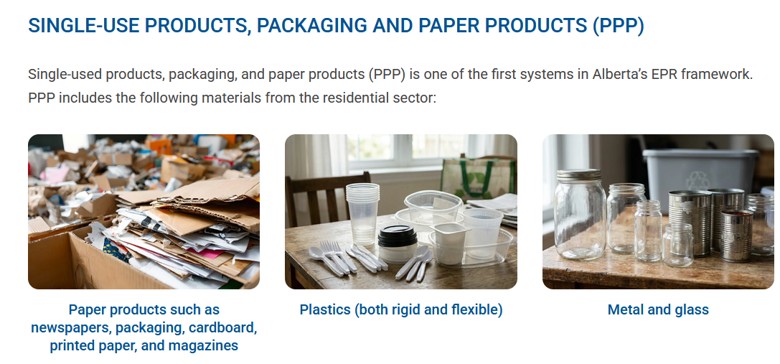
Source: Albertarecycling.ca
For a company like PlasCred, this changes everything. It effectively puts a price on recycled plastic. Producers have to pay whether they like it or not.
To handle the obligation producers like Coca-Cola, Procter & Gamble, Nestle and Costco, have set up producer responsible organizations (PROs) to manage their waste volumes.
Worth understanding that these are material-equivalent volumes. Coca-Cola doesn’t have to recycle its own bottles specifically. It just has to make sure that, by volume, an equivalent amount of plastic gets recycled somewhere.
PlasCred has locked up feedstock from one of these PROs, Circular Materials.
Circular Materials gets paid by producers to collect and repurpose the material. In Alberta, in 2026 this amounts to $0.83 per kg on a consolidate basis for all recycled materials.
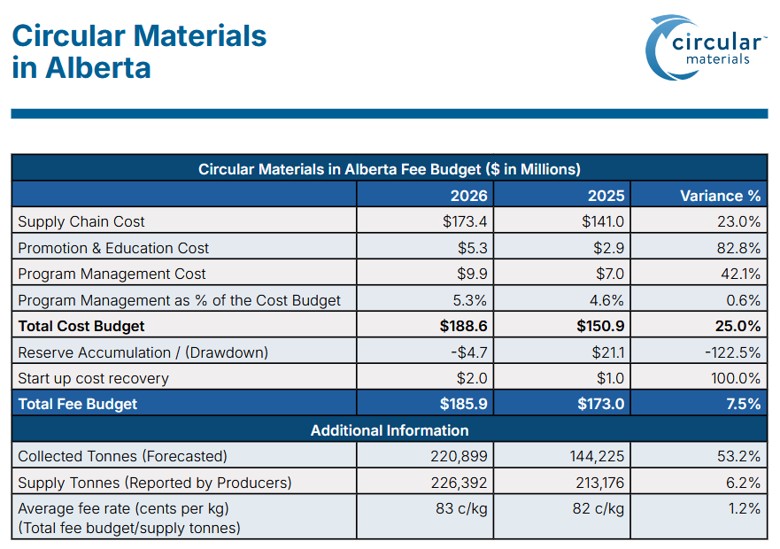
Source: Circular Materials
Plastic products are on the high-end of that average, ranging from 63 cents to 364 cents per kg.
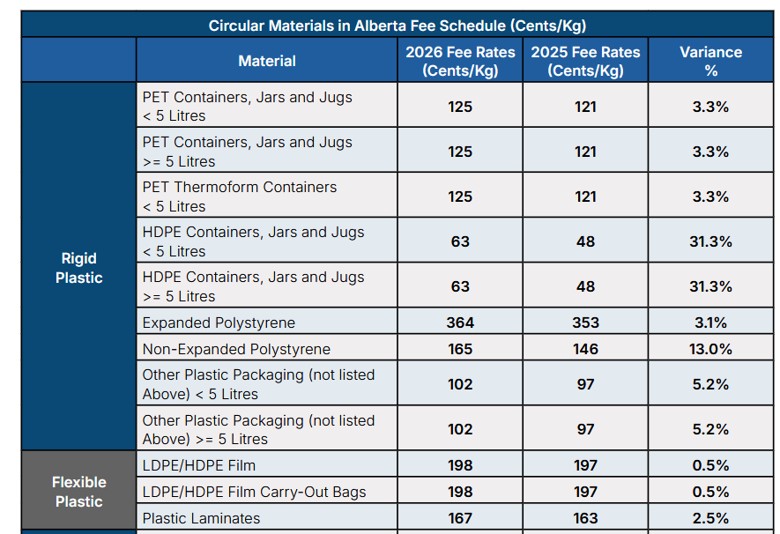
Source: Circular Materials
Here’s how this filters down to PlasCred. Circular Materials is paid to make the plastic go away. PlasCred makes it go away. According to at least one source, Circular Materials is actually willing to pay them to do so.
The terms of the agreement aren’t published, so I’m going off of an admittedly spotty source. There is a Substack post on PlasCred (here) referencing Lupul saying that PlasCred will be paid to take the plastic and that this could entirely cover their operating expenses.
Unfortunately, that video isn’t up anymore. But it is a reasonable assumption given the numbers involved.
Consider that PlasCred is contracting for “flexible plastics”. Referring to the Circular Materials pay schedule, they receive 198 cents/kg for LDPE/HDPE film and 167 cents for laminates. That’s $1,980 and $1,670 per tonne.
Now look at PlasCred’s costs.
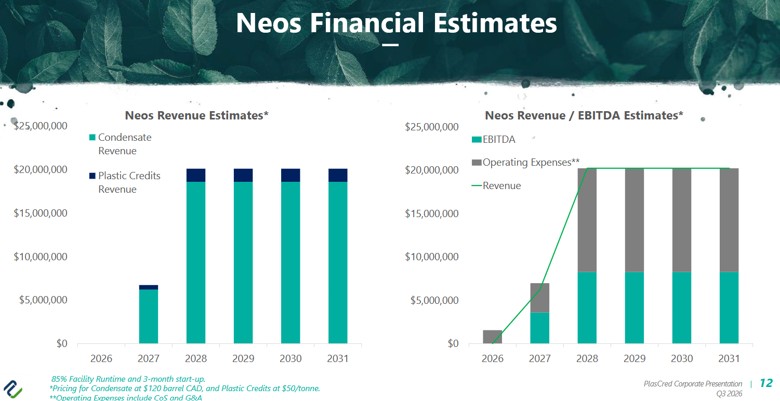
Source: PlasCred Investor Presentation
PlasCred’s expected operating costs work out to about $12 million per year. That translates to $328 per tonne of plastic feedstock per year.
Compare that to the pay schedule from Circular Materials. They would be paying a relatively small 15-20% of their collections budget to PlasCred to take the recycled plastic off their hands.
As will become very clear as we walk through a few examples of failed pyrolysis projects, the importance of getting paid to take the plastic can’t be overstated.
When I put this to management directly, they filled in some of the blanks — though not all. They can’t disclose the Circular Materials terms; Circular is sensitive about revealing pricing so as not to offend the producers footing the bill. What they would say is that Circular covers roughly 17% of Neos feedstock at the start, that the fee is a sliding scale based on contamination, and that they have modelled the cleanest feedstock at the lowest tipping fee.
Circular could supply the entire plant — they started small to test the process — and management says they could “easily” get paid on all of their feedstock if they chose to take fully contaminated material. They expect the fee structure to go up, not down, as Producer Responsibility programs mature.
The more important piece is what this does to the cost structure. Management laid out three cases. If PlasCred pays for feedstock ($82/tonne) and pays to ship it to the plant ($80/tonne), operating costs run about $67 per barrel — and that is the base case behind the $7-8 million EBITDA figure. If they get feedstock for free, which Lupul says is easy to find, opex drops to about $34 per barrel. And when they get paid to take it, as with Circular Materials, it drops to roughly $0.67 per barrel. All against a $120 per barrel offtake, and all in Canadian dollars.
That last point is the one to sit with. The base case — the one that underpins the headline economics — assumes PlasCred pays full freight for its feedstock. Getting paid to take it isn’t baked into the numbers; it is upside. It could even swing to a negative feedstock cost if they take on more contamination. So the getting-paid story I built up above, which I had been sourcing from that spotty Substack, is real — but it sits on top of a model that already works without it.
One more thing worth noting, this time on the revenue side: management budgets essentially nothing from plastic credits. The deck carries only about $1.5 million of credit revenue inside the roughly $22 million top line, priced at $50 a tonne, which is well below where credits trade today. They are working on Verra certification but don’t want to count on it. As Lupul puts it, credits are a bonus — the EBITDA is driven by actual cost estimates and the offtake. The real story is flipping a cost centre into a revenue centre.
Shortly after signing with Circular Materials in early June, PlasCred entered a conditional long-term property lease with CN to construct an advanced recycling facility in Fort Saskatchewan.
This is right on the rail line, which should make receiving feedstock and shipping condensate straightforward.
The lease is 15-years. The property is 7.34-acre and has a 35,000-square-foot industrial building, more than large enough to house Neos, and a 200-car rail siding. PlasCred already has an agreement with CN Rail for delivering plastic feedstock to the site.
OFFTAKE FROM THE PLANT
So far, we’ve got a working pilot, feedstock they get paid to take, a well-placed site, and credible engineering. That leaves one last checkbox: someone to buy the product.
Here PlasCred has landed a serious counterparty.
PlasCred has an agreement with Trafigura, a large commodity trading house, to purchase the condensate output from Neos.
It is a five-year fixed-price offtake. The price is C$120 per barrel. Trafigura will be responsible for transportation off-site.
According to the Substack I referenced earlier, Trafigura was on-site at Primus for a week performing due diligence. The author described a thorough due diligence of the process.
That’s about as close to independent validation as a pre-production microcap gets. It isn’t proof the process works at scale — Trafigura was looking at a 400 kg/day pilot, same as everyone else. But a trading house with real money at stake sent people to look at the plant and came away willing to commit to a five-year price. Not bad.
WHAT HASN’T WORKED IN THE PAST
That covers the pieces that PlasCred has put into place. Now for what could go wrong.
This is where we look at the other guys. We can see what went wrong and gauge whether PlasCred can avoid these pitfalls.
Avoiding pitfalls is what this story comes down to.
I found several projects worth looking at. All but one has failed, and the survivor is still under construction and behind schedule. Let’s start with the biggest wreck.
PAST FAILURES – BRIGHTMARK
Brightmark’s Ashley plant was a $260 million pyrolysis facility in Indiana designed to take 100,000 tonnes of mixed waste plastic per year – about 3x that of Neos.
3x the size and 10x the cost.
The design was to turn that 100,000 tons into 18 million gallons of diesel and naphtha blend plus 6 million gallons of wax. That’s a yield of about 50-55% liquids, lower than the ~80% that PlasCred is doing.
The plant was pyrolysis with a small fractionator bolt-on.
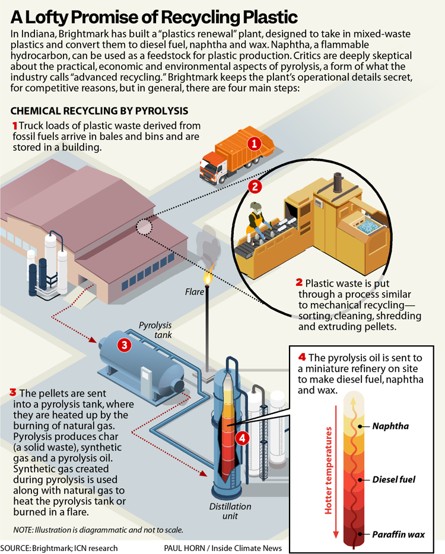
The fractionator bolt on is worth remembering. It shows up more than once. A fractionator is essentially a small refinery. Most plastic recycling plants I looked at had something like that, and not because they wanted to. Companies did this to produce end products like diesel and naphtha that they could sell into the market.
This is something PlasCred does not have to do.
Here is how Ashley worked. Waste came in as bales from municipalities and industries. The waste was cleaned, chopped and pressed into pellets. Unlike PlasCred, there wasn’t a melting step.
The process used natural gas to generate heat. The process needed temperatures of 800-1,500 degF. This is much, MUCH higher than PlasCred. Ashley used straight thermal cracking. There weren’t any catalysts (PlasCred uses two types).
PlasCred appears to have “cracked the code” by comparison. Without catalysts, all the work is done by heat. PlasCred has found catalysts that unlock the process, allowing their plant to operate at a lower temperature than most of these failed predecessors.
Doing so just makes things easier. Lower heat means less coking, less fouling, cheaper parts and less chance of failure.
Once the hydrocarbons were “cracked”, a distillation unit is used to separate the light ends (syngas) from the mid-ends (naphtha and diesel) and heavy (paraffin wax). This is like PlasCred.
The syngas was burnt and flared. The char went to landfill as non-hazardous waste. The pyrolysis oil went to a small on-site refinery where it was separated into low-sulphur diesel, naphtha, and wax for industrial use or candles.
Brightmark claimed that their process could handle 3% PVC by weight in the mixed plastic feed. I imagine they couldn’t handle chlorine content of any larger amount.
Now, because Brightmark went bankrupt, we don’t have to speculate about what went wrong. We can read the filings.
Problem #1 was that Ashley never really ran at capacity. It averaged only 5% of capacity over the life of operation.
The equipment didn’t work as expected. Filings say that “various aspects did not operate as intended and have required substantial re-engineering and re-design”.
The bankruptcy filings also say that Brightmark needed $800,000 per week in capital just to complete projects needed to keep the plant running.
A second problem was selling the output. The filings say that it wasn’t feasible to produce “fuel products”. I don’t believe that the fractionation step in the facility was ever actually operated. They ended up selling a condensate-type liquid like PlasCred is selling, but without a dedicated offtake customer.
Again, the EPR is the gamechanger. PlasCred has an offtake customer because this plastic needs to go through full-cycle recovery to satisfy the EPR requirements. Without that, they would be competing on the market like Brightmark tried and failed.
Add it up and Ashley had two fatal problems. Either one would have been serious. Together, the Ashley plant was doomed to fail.
PAST FAILURES – NEW HOPE
The Trinity Oaks facility in Tyler Texas was operated by New Hope Energy. It started in 2018 and was designed to take in 50,000 tonnes of feedstock per year – the same order of magnitude as Neos.
The process they used will look familiar. Feedstock went through a melting step, similar to what PlasCred uses. All the resins combined under controlled temperature and pressure before entering pyrolysis. Then the reactor, then a separate purification step to knock down chlorine. No catalysts that I can find.
That’s the pattern across all of these projects. Nothing PlasCred is doing is unusual. The chemistry isn’t exotic and the process isn’t novel. The key is execution, plain and simple.
Trinity Oaks died from four inflicted wounds.
First was bespoke equipment. New Hope had a subsidiary, New Hope Fabrication, described as the exclusive manufacturer of the proprietary equipment needed to build the pyrolysis facilities. That sounds expensive, and it means you carry full cost and full risk of every design change.
Second was an unfortunate incident with management. The founder of New Hope, Johnny Combs, died in 2021, shortly after the project got off the ground. After his death the company was operated by his son and wife, though articles clearly explain that this was Johnny’s operation.
A third issue appears to have been the process itself. Trinity Oaks used a batch process. It required cleaning out solid char from the reactor and then reloading the pyrolysis furnace. This created a low-efficiency duty cycle with lots of stops and starts.
Fourth was a problem with fires. There were four fires in three years from 2020-2023. There were also accounts from the Tyler municipality that hazardous waste wasn’t being stored correctly.
A final issue with Trinity Oaks was getting enough plastic feedstock.
Plastic should be plentiful, but that isn’t always the case. The reason is two-fold. Plastics that can be used in these facilities are often limited in type. Second, because plastic isn’t easily recycled it is often not actually kept and sorted, so its not necessarily available for purchase on demand.
This is the thread running through every failure. Brightmark couldn’t sell its output. New Hope couldn’t source its input.
Both were operating in a world where nobody was required to make plastic recycling happen and nobody was paying for it, a problem largely solved by the EPR.
PAST FAILURES – AGILYX REGENYX
Agilyx’s Regenyx plant in Oregon is the cleanest illustration of that supply problem.
Regenyx took a single type of plastic, polystyrene from coffee cups, egg cartons, and meat trays, and broke it down into its building blocks.
It was a 10 ton per day plant, about 1/20th the size of Neos. A second larger plant was proposed but never got off the ground.
The small plant was a demonstration facility. It operated for 5 years, which suggests that it did so at least somewhat successfully. A second plant in Japan used technology from Agilyx and appears to be operating today.
The larger project appeared to die on supply, not chemistry.
US polystyrene recycling is only about 0.9%. Clean post-consumer polystyrene is scarce. It seems that Agilyx just couldn’t guarantee the supply they needed for a 50 or 100 ton per day facility.
Again, it is why the EPR program is so important. The program ensures that PlasCred gets feedstock because the producers of the plastic need to provide the feedstock to satisfy their own obligations. Agilyx needed a supply chain, and no one had the reason to build it. Now they do.
PAST FAILURES – SKIVE
The most instructive comparison of the lot is Quantafuel’s Skive plant in Denmark — a plant that mostly worked and closed anyway.
Skive was opened in September 2020. It was designed to process 20,000 tonnes of plastic waste per year, a little less than Neos. It would produce 16,000 tonnes of pyrolysis oil, naphtha, and low-carbon diesel, a yield similar to PlasCred.
Quantafuel ran catalytic pyrolysis, much like PlasCred does. They used pre-sorted feedstock but did not appear to have gone through any pre-processing melting stage. Skive had the bolt-on fractionator that facilitated separation of diesel and naphtha.
Two takeaways from Skive are worth mentioning.
The first is that getting to nameplate can take time. By 2023, more than two years after startup, Skive processed 548 tonnes per month — around 33% of nameplate capacity.
But that didn’t mean the project was dead, just delayed. In 2024 the problems were ironed out. Yield wasn’t an issue over the last few years of operation at Skive. The plant hit yields of 70%-75%, above expectations.
Second, the technology worked. In the press release where Viridor, which bought Quantafuel in 2024, announced the shutdown of Skive they emphatically said, “the technology worked” and was not the reason they were shutting it down.
So what did kill Skive?
It was the market for their products and the cost of feed stock.
Recycled naphtha polymer was always more expensive than virgin polymer, but this increased over time. China product undercut that price. Eventually the product lost out to Chinese petrochemical oversupply.
Skive also had to pay for their feedstock through tipping fees. Whereas PlasCred gets paid to take it.
Low prices and the higher input cost meant Skive couldn’t make it work.
Again, what is interesting about Skive is that the two problems the plant ran into are essentially solved by the feedstock and offtake agreements that PlasCred has already signed.
LYONDELL BASELL’S MoReTec OPERATION
This will be the last project I talk about and the only one that hasn’t been a failure.
MoReTec is LyondellBasell’s proprietary catalytic pyrolysis technology. They started building their first facility, MoReTec-1, in 2025. It is designed at 50,000 tonnes per year — about 137 tonnes/day, so roughly 1.4x Neos.
MoReTec uses pre-sorted and processed plastic waste. LyondellBasell built a joint venture specifically to prepare the feed. Compare this to PlasCred, where the feed comes (mostly) pre-sorted from Circular Materials.
There is no melting stage with MoReTec-1. Like Neos, MoReTec-1 uses catalysts, but the catalysts are fed into the reactor, not applied downstream as I believe it is with PlasCred. Apart from these slight differences, these plants are running the same basic process, as are all of these plants.
One notable difference is that the MoReTec-1 reactor unit is heated with electricity. This is important because in Germany carbon considerations are paramount and they can operate the plant on renewable power.
While not directly relevant to PlasCred, the renewable power source gives the project less than 50% the carbon footprint of fossil-based feedstocks. Which hints at where the industry might be headed.
LyondellBasell claims that both the liquid and gas outputs can be used as feedstock for new plastics. I’m not entirely sure how the gas hydrocarbons are used as plastic feedstock. LyondellBasell describes the yield at 80%, which seems to be a common anchor for yield and sanity checks PlasCred’s own claims.
Probably the biggest difference between MoReTec-1 and PlasCred’s Neos is the capital required.
While LyondellBasell hasn’t published a build-cost for the project, they raised $400 million of green bonds and received another $40 million grant from the EU for construction.
This is significantly more than PlasCred requires for Neos, even though MoReTec-1 is only about 40% larger in size.
To be clear: I don’t know why this is.
Some of it is explainable. LyondellBasell built a feedstock preparation joint venture while PlasCred buys prepared feed.
LyondellBasell is building greenfield in Germany to German labour and permitting costs while PlasCred is building brownfield in Alberta on a site with a building already there.
LyondellBasell is designing a flagship technology showcase it intends to replicate worldwide, with all the redundancy, documentation and gold-plating that implies. PlasCred is a microcap with Grey Owl building the smallest thing that works.
All that may account for some of the difference. But the ten-fold gap is hard to reconcile.
WHAT HAVE WE LEARNED?
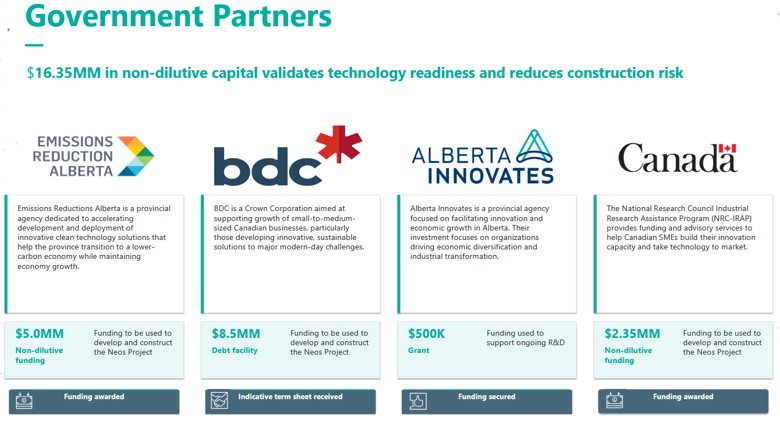
PlasCred has raised money via both share offerings and through government partners.
They have $16.35 million of non-dilutive capital from government grants and loans. This money is all earmarked to fund the Neos project.
Source: PlasCred Investor Presentation
In April and May PlasCred did a two-tranche equity raise. Together they issued 39 million shares and another 39 million warrants. They raised $6.6 million in total.
That leaves PlasCred still a bit short of the $25 million they need to fund Neos.
When I pressed on the gap, management put it at only about $5 million. They have roughly $8.5 million of warrant proceeds that come in if the stock trades at $0.40 for ten straight trading days — those include the 40 million warrants at $0.22 from the last unit financing. And they are in discussions on royalty structures to cover the balance, which would be non-dilutive to shareholders. They are moving forward on the assumption they close the gap as they go, and say they will announce a formal final investment decision once they do. Worth keeping in mind that the warrant money depends on a $0.40 share price — about 60% above where the stock sits today — and that the FID is gated on closing that gap.
Even with the dilution, PlasCred sits at a $50 million market cap today. It feels a bit steep given where the business is at. But it is also a sign of the times. Micro-caps just aren’t as cheap as they were a few years ago.
The chance of success seems a lot higher than the failures I have discussed. After considering the five pyrolysis case studies, I can see that PlasCred has a number of advantages over them.
First, they are producing an intermediate product, basically a condensate AND they have a customer for it.
Every one of the failed examples we looked at had to do a post-processing step, refining the oil component into products like diesel and naphtha.
That is extra cost. It also means you are competing on price against competing products. And these other plants were selling it into the market.
Plascred is producing one product, one fixed price, no fractionation, no premium chain. Everything realizes CAD $120/bbl whether the molecules end up as diluent, plastic feedstock, or anything else.
The second advantage, and this is maybe the biggest one, is that Plascred is getting paid to take the plastic feedstock. I can’t overstate the importance of the EPR. It flips the largest variable cost to the revenue line.
The third advantage is that PlasCred has been running their Primus facility for 2+ years—a strong validation of the process.
And the plant is not inventing anything new. Plascred’s patent describes assembly of published technology and chemistry, not a new and unproven approach.
To be sure, there is still a lot that could go wrong. They will be building a new brand facility. They are scaling what they have significantly. And clearly, pyrolysis is not an easy process to get running at capacity.
It is hard to imagine all the unknown-unknowns. But PlasCred is off to a good start.
Source: https://oilandgas-investments.com/2026/latest-reports/from-waste-plastics-to-power-plascred-circular-innovations-plas-cse/
Anyone can join.
Anyone can contribute.
Anyone can become informed about their world.
"United We Stand" Click Here To Create Your Personal Citizen Journalist Account Today, Be Sure To Invite Your Friends.
Before It’s News® is a community of individuals who report on what’s going on around them, from all around the world. Anyone can join. Anyone can contribute. Anyone can become informed about their world. "United We Stand" Click Here To Create Your Personal Citizen Journalist Account Today, Be Sure To Invite Your Friends.
LION'S MANE PRODUCT
Try Our Lion’s Mane WHOLE MIND Nootropic Blend 60 Capsules
Mushrooms are having a moment. One fabulous fungus in particular, lion’s mane, may help improve memory, depression and anxiety symptoms. They are also an excellent source of nutrients that show promise as a therapy for dementia, and other neurodegenerative diseases. If you’re living with anxiety or depression, you may be curious about all the therapy options out there — including the natural ones.Our Lion’s Mane WHOLE MIND Nootropic Blend has been formulated to utilize the potency of Lion’s mane but also include the benefits of four other Highly Beneficial Mushrooms. Synergistically, they work together to Build your health through improving cognitive function and immunity regardless of your age. Our Nootropic not only improves your Cognitive Function and Activates your Immune System, but it benefits growth of Essential Gut Flora, further enhancing your Vitality.

Our Formula includes: Lion’s Mane Mushrooms which Increase Brain Power through nerve growth, lessen anxiety, reduce depression, and improve concentration. Its an excellent adaptogen, promotes sleep and improves immunity. Shiitake Mushrooms which Fight cancer cells and infectious disease, boost the immune system, promotes brain function, and serves as a source of B vitamins. Maitake Mushrooms which regulate blood sugar levels of diabetics, reduce hypertension and boosts the immune system. Reishi Mushrooms which Fight inflammation, liver disease, fatigue, tumor growth and cancer. They Improve skin disorders and soothes digestive problems, stomach ulcers and leaky gut syndrome. Chaga Mushrooms which have anti-aging effects, boost immune function, improve stamina and athletic performance, even act as a natural aphrodisiac, fighting diabetes and improving liver function. Try Our Lion’s Mane WHOLE MIND Nootropic Blend 60 Capsules Today. Be 100% Satisfied or Receive a Full Money Back Guarantee. Order Yours Today by Following This Link.


| Visits: | 1,834,704,447 |
| Stories: | 8,719,489 |
Whistler Blowers, Insiders

