

Trump’s ‘Ballroom’ and a Legal Bunker-Buster

This post Trump’s ‘Ballroom’ and a Legal Bunker-Buster appeared first on Daily Reckoning.
Last week the Supreme Court issued an arcane, procedural order that looks narrow but holds the potential to explode in the future like a buried bomb beneath the national roadbed.
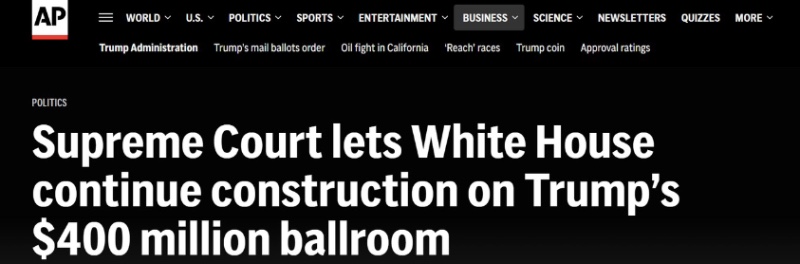
Typical headline on “Ballroom” issue. Credit Associated Press.
I’m talking about President Trump’s so-called “Ballroom,” or more accurately the ballroom-and-buried-bunker complex that the Orange Man is building adjacent to the White House.
Or as the Associated Press (AP) framed the matter:
WASHINGTON (AP) — A divided Supreme Court on Monday (August 31; BWK) allowed the White House to continue construction on a $400 million ballroom project as lawsuits play out, a win for President Donald Trump as he flexes unprecedented executive power and remakes the capital in his image.
Most imagery of the new structure shows a spacious building with prominent pillars, glass, and the usual gilded glitz of a Trump-brand hotel.
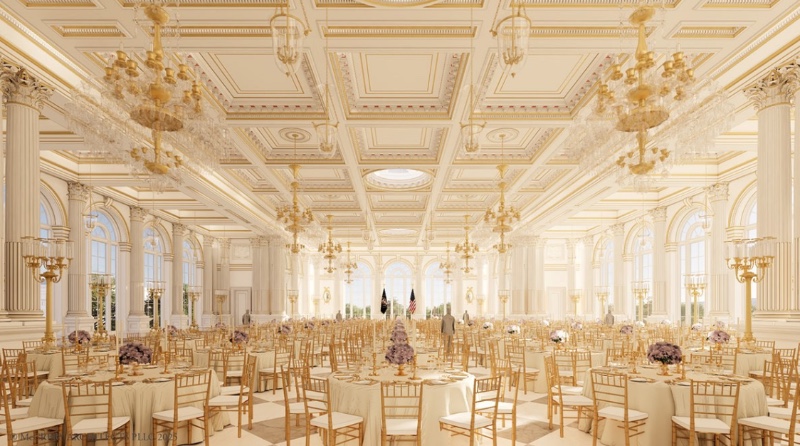
Proposed interior of new Ballroom. Credit White House.
But wait, there’s more! Because, per court filings, apparently the above-ground edifice will cap a deeply buried military complex of nuclear-hardened spaces, communications capacity, medical facilities, and more of the super-secret stuff that supports what people in Washington call “continuity-of-government.”
Marble above. Bunker below. Versailles sur Cheyenne Mountain, one might say.
Does Standing on the Sidewalk Convey “Standing”?
No doubt, you’ve heard the story. Last year Trump ordered that the 1940s-era East Wing be demolished. He then presented drawings for a “Ballroom.” And of course, the usual suspects squealed like stuck hogs.
Naturally – cuz it’s Trump! – a so-called “historic preservation” group sued and argued that the Chief Executive could not reconstruct the White House grounds absent bureaucratic review, if not congressional authority. Then, naturally, a D.C. district judge and two D.C appellate judges took the claim seriously and ordered work halted as the concrete was setting.
Trump’s lawyers appealed and, in a 5–4 decision, the Supreme Court allowed construction to continue while litigation proceeds. The unsigned majority order stated that the court was not deciding whether Trump’s reconstruction project is lawful. Indeed, the outcome rests entirely upon whether the plaintiff has what’s called “standing” to bring suit in the first place.
Standing sounds like a term from the legal weeds but is, in essence, the key to the door of the courthouse. That is, if I’m standing on the sidewalk and your tree falls on my head, arguably I have standing to sue you because I was injured. But if I’m standing on the sidewalk and I don’t like the paint color on your house, I’m not really “injured” enough to have standing to sue, right?
Basically, if you show standing, you can sue; if you lack standing, you can’t file. And in this case, per the Supreme Court, absent standing by the preservation group, Trump and his construction crews can continue to erect steel and stone.
Which returns us to that vote, 5–4. Four justices, including Chief Justice Roberts (full disclosure: a classmate of mine at Harvard), apparently believe that the plaintiff has enough stake – aka standing – in the White House project to keep the case alive. Plus, Roberts and the court’s three liberal justices opined that the construction was “likely unlawful.”
But five justices thought otherwise. Which means that only one vote separates “likely unlawful” construction from the ancient legal concept of “pour more concrete.”
Is this crazy, or what? We’re not talking about patching potholes in Pittsburgh. This is the White House, easily among the most recognizable buildings in the world. And the lawsuit is about presidential power to build and rebuild without bureaucratic and legislative signoff.
Five justices said the plaintiff cannot sue the president. But four justices said that a guy walking his dog outside the fenceline can seek judicial remedies and slam the brakes on further construction.
At which point, this whole thing is NOT about marble, fancy pillars and gold gilt, let alone the bomb shelter. It’s about the rules of political combat in our Republic. That is, who may sue whom? Over what? And when is a claimed “injury” sufficient to open the big bronze doors of the courthouse?
Meanwhile, in terms of Supreme Court jurisprudence, when does the so-called “highest court in the land” determine that a dispute is too radioactive? And then bury the Geiger counter beneath the doctrine of standing?
The Trapdoor of Standing
If this issue seems familiar, recall December 2020 when the State of Texas filed what’s called an “original jurisdiction” action in the Supreme Court against Pennsylvania, Georgia, Michigan and Wisconsin over election procedures from that year. Sixteen other states joined the case.
Under the Constitution’s original jurisdiction language, the Supreme Court is the forum for disputes between states. And Texas’s filing was no jailhouse missive scrawled on some yellow legal pad. In fact, Texas had a long list of claims, and soon the docket was packed with related, supplemental filings, including many well-crafted “amici” briefs from serious players. And of course, the defendant states filed answers.
Whatever one might think of the Texas allegations, at an institutional level the question was national and Constitutional, regarding a presidential election and original jurisdiction.
But the Supreme Court dismissed Texas and the other states – one third of the states of the Union – with two sentences. Namely, that Texas lacked standing because it had not shown a “judicially cognizable interest” in how other states conduct elections. And all other motions were moot.
To their credit, in 2020 Justices Alito and Thomas argued that the Supreme Court lacked discretion to refuse an original jurisdiction case. But still, the Court summarily ended the matter based on one magic word: standing, aka the trapdoor of the courthouse. By dismissing the case, the Supreme Court avoided addressing Texas’s arguments, while coming off as merely controlling the keys to the front door.
So, here we have two cases about standing. One dismissed an original jurisdiction action, a legal pathway clearly written into the Constitution; the other was a close call – one vote! – about a case filed by some guy who walked his dog in front of the White House and claimed “aesthetic” injury.
Which is it? Is there no more original jurisdiction? Or does a guy in the street almost – by four votes out of nine – have standing to stop a White House military bunker with a Ballroom on top? Or are both cases simply occasions when the Supreme Court avoided inconvenient matters?
At root, the idea of standing prevents courts from becoming debating clubs. And it’s probably prudent to avoid ugly politics. Yet at some point we don’t have neutral law anymore, either.
The Price of Legal Fog
The Ballroom litigation is not just an argument about Donald Trump, the East Wing or the emotions of 2020. Because federal courts are part of the operating system of the Republic.
If standing is too tight, genuine injuries go unheard. If standing is too loose, anyone with an attitude can jam the gears. Either way, confusion is costly: projects and progress halts; political actors preen and posture; lawfare body shops seek plaintiffs; and capital fails to move because legal uncertainty is a tax, but no one knows the exact rate.
This is how a modern empire declines and falls; not through one grand Constitutional crash, but via thousands of acts of ambiguity. Do you have standing or not? After a while no one knows where the lines are, so everybody sues if only to preserve leverage.
The irony is that the Supreme Court claims to stay out of politics. Yet clearly, the Constitution assigns certain disputes by design. Meanwhile, federal governance is a priori political. And obviously, the presidency is political and every justice on the Court reached the bench through a political process. So, when the Court sanctimoniously pretends to be apolitical, it doesn’t purify a quarrel; it just relocates the knife fight to a darker alley.
And no, the Court can’t decide every national p!ssing fight. It’s not a council of elders. But when it defaults to “lack of standing” to avoid hard questions, it owes the country some bright lines. Otherwise, standing is not a constitutional doctrine. It’s more like a judicial mood gauge.
From Permits to Political Risk
Carry this idea beyond the courthouse. Pipelines and mining roads cross federal lands. Ports and rivers must be dredged. Defense sites and shipyards may need to expand. And in countless other ways, many ambiguities arise that are not distinctly addressed in law and regulation, such that someone somewhere claims injury. And the question of who can sue becomes almost as important as who is right.
When legal thresholds are obscure, project sponsors lack certainty. Permitting is provisional, final agency action is in “quotation marks,” litigation looms, and capital formation slows because investors can’t model whether a permit ends the process or merely determines who files the appeal. Infrastructure and economic development transition from asset creation to hostage negotiation. In their own bizarre way, court dockets become part of the overall capital portfolio.
The fog of legal uncertainty favors the side that willingly litigates. It rewards delays and allows public officials to recast policy disputes as jurisdictional puzzles. It turns every development project into a law-school exam.
In this sense, the 2020 “lack of standing” dismissal against Texas still stings. Set aside the personalities and election outcomes. If Texas and 16 other states believed that sister states altered voting rules to distort the legitimacy of our federal compact, where else can this kind of dispute go? We’ve already tried Fort Sumter.
Perhaps Texas deserved to lose on the merits; but we’ll never know because the 2020 dismissal was based on catch-all “lack of standing” procedure. So, instead of clarifying law, the Supreme Court bred further suspicion.
Likewise, if Congress must authorize Trump’s Big Beautiful Ballroom, then say so. If executive control of the White House grounds prevails, say that. But draw some boundaries because restraint without explanation is not wisdom. Evading hard calls comes with costs.
The Holy Roman Warning
Perhaps our nine justices simply don’t want to arbitrate a fractured Republic. Or in a manner of speaking, nobody wants to referee the Holy Roman Empire, and this point is more than a joke.
The Holy Roman Empire was a loose mosaic of kingdoms, duchies, bishoprics, counties and imperial cities. Its emperor was elected. Authority was layered, with many overlaps. The emperor possessed majesty but limited powers. Local rulers guarded sovereignty like family silver. And this concoction of a political entity endured for centuries, which is no small achievement. But it also produced jurisdictional complexity, from the days of Charlemagne to governance under Napoleon.
The lesson is not that federal systems are doomed. Indeed, ambiguity can help preserve order by allowing every faction to tell itself a tolerable story. But confusion compounds, and over time every quarrel becomes a legal fight that drags out and locks up the gears of society.
With a dismissal based on “lack of standing,” the Supreme Court justices may think they’ve avoided ugly politics. But actually, they create an imperial, jurisdictional maze within which every elector, governor, politician, agency and lawfare mill reads a different map. Last week, the Court saved itself a bitter decision on the merits; but now hands the country a future of procedural wars.
Law, or Oracles?
Done right, the doctrine of standing disciplines litigation. It prevents generalized grievances from becoming federal cases and prevents judges from issuing advisory opinions. Courts remain a forum for real disputes brought by parties with real stakes.
But unpredictable “standing” doctrine – whether dismissing Texas or a 5-4 decision about Trump’s Ballroom – does the reverse. Now, we’ll see more lawsuits because nobody knows the boundaries. The Court has politicized procedure because its denials look selective. Meanwhile, the Court invites forum shopping, bizarre claims and emergency applications.
When the courthouse is open only according to the heat map of a dispute, the Court reveals its institutional discomfort with the power of the Constitution. And sorry, but America can’t run on judicial avoidance.
Indeed, over 250 years – okay, since 1789 – the Republic has survived bad rulings, even foolish ones. But what it cannot survive is an elite legal culture that turns access to court into some sort of petition to the oracles. You ask whether you may sue; the oracle studies goat entrails, sniffs the political winds and replies: “Yes, but only maybe; and not exactly now, but possibly next time.”
That’s not law; it’s judicial ambiguity. It weaponizes procedure and leaves citizens and states wondering whether the Constitution has become another museum piece: admired and revered, protected by thick glass at the National Archives, and increasingly irrelevant.
With the Ballroom decision, the justices may think they acted in restraint. But I suspect that history will frame it as a warning sign of deep, structural problems that precede the so-called “decline and fall,” if not disaster.
And on that note, I rest my case.
That’s all for now… Thank you for subscribing and reading.
The post Trump’s ‘Ballroom’ and a Legal Bunker-Buster appeared first on Daily Reckoning.
This story originally appeared in the Daily Reckoning
Source: https://dailyreckoning.com/trumps-ballroom-and-a-legal-bunker-buster/
Anyone can join.
Anyone can contribute.
Anyone can become informed about their world.
"United We Stand" Click Here To Create Your Personal Citizen Journalist Account Today, Be Sure To Invite Your Friends.
Before It’s News® is a community of individuals who report on what’s going on around them, from all around the world. Anyone can join. Anyone can contribute. Anyone can become informed about their world. "United We Stand" Click Here To Create Your Personal Citizen Journalist Account Today, Be Sure To Invite Your Friends.
LION'S MANE PRODUCT
Try Our Lion’s Mane WHOLE MIND Nootropic Blend 60 Capsules
Mushrooms are having a moment. One fabulous fungus in particular, lion’s mane, may help improve memory, depression and anxiety symptoms. They are also an excellent source of nutrients that show promise as a therapy for dementia, and other neurodegenerative diseases. If you’re living with anxiety or depression, you may be curious about all the therapy options out there — including the natural ones.Our Lion’s Mane WHOLE MIND Nootropic Blend has been formulated to utilize the potency of Lion’s mane but also include the benefits of four other Highly Beneficial Mushrooms. Synergistically, they work together to Build your health through improving cognitive function and immunity regardless of your age. Our Nootropic not only improves your Cognitive Function and Activates your Immune System, but it benefits growth of Essential Gut Flora, further enhancing your Vitality.

Our Formula includes: Lion’s Mane Mushrooms which Increase Brain Power through nerve growth, lessen anxiety, reduce depression, and improve concentration. Its an excellent adaptogen, promotes sleep and improves immunity. Shiitake Mushrooms which Fight cancer cells and infectious disease, boost the immune system, promotes brain function, and serves as a source of B vitamins. Maitake Mushrooms which regulate blood sugar levels of diabetics, reduce hypertension and boosts the immune system. Reishi Mushrooms which Fight inflammation, liver disease, fatigue, tumor growth and cancer. They Improve skin disorders and soothes digestive problems, stomach ulcers and leaky gut syndrome. Chaga Mushrooms which have anti-aging effects, boost immune function, improve stamina and athletic performance, even act as a natural aphrodisiac, fighting diabetes and improving liver function. Try Our Lion’s Mane WHOLE MIND Nootropic Blend 60 Capsules Today. Be 100% Satisfied or Receive a Full Money Back Guarantee. Order Yours Today by Following This Link.


| Visits: | 1,833,808,941 |
| Stories: | 8,714,641 |
Whistler Blowers, Insiders

