

Missing use, or missing middle?

Genebank data seems to be in the air. Just in the past few days, I pontificated about descriptors, Mike Jackson has reminisced about the early days of rice molecular markers and CGIAR announced a big new initiative.
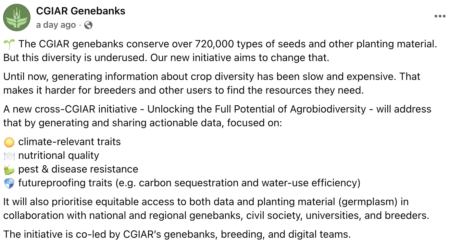
More data is always good to have, I’m sure. But, but, but… Genebanks are underused and more data will solve the problem? We’ve been saying something much like this for a long time now. Leave aside for the moment the question of whether CGIAR genebanks really are “underused.” Underused by whom, according to what metric, compared to what? But let’s just assume for the sake of argument that they are, indeed, underused. What if… Hear me out: what if that problem cannot be solved just by making genebank databases bigger, deeper and easier to search?
Ok, that will need some unpacking. But remember as you read this that I’m not saying that genebanks working with others to generate and share more data on nutritional quality or disease resistance is a bad thing. Just that it’s not enough. Never has been. Probably never will be.
Genebank access has often meant, in effect, “Here are millions of accessions spread across dozens of genebanks and their databases, have at it.” Successive generations of genebank scientists have of course been aware that this is not ideal and have chipped away at the problem in different ways. By my count, this has included: (1) characterizing and evaluating accessions more extensively and systematically; (2) organizing collections into core, reference, trait-specific and other targeted subsets; (3) undertaking multi-environment screening, pre-breeding and genetic enhancement to make material more immediately useful; (4) digitizing and standardizing collection information and aggregating databases; (5) creating better mechanisms for access and exchange, including the Plant Treaty’s Multilateral Systems and, later, persistent identifiers (DOIs); (6) sequencing and genotyping collections; (7) linking genetic, phenotypic, environmental and geographic information to predict which accessions are likely to be useful; (8) engaging breeders, farmers and other users more directly in defining needs and evaluating material; and, most recently, (9) using AI and machine learning to automate the discovery and prioritization of potentially useful diversity.
I’m sure I’m forgetting a bunch of things that have been tried over the years, but you get the picture. Each of these “solutions” addressed a real constraint, no doubt, but the underlying weakness seems to have remained, hence the continuing perceived “underuse.”
And what is that underlying weakness? I think maybe it is that nobody has been consistently responsible for the entire journey from an agricultural problem to an adopted diversity-based solution. It’s not that people could not find and access the diversity; it was that finding it was only the beginning of a difficult and uncertain process that nobody fully owned.
I think what is needed, therefore, is not just more and better data, but recognition that an institutional function is missing.
What we’re missing is a middle layer of expertise and brokerage whose starting point is the agricultural problem, rather than a particular collection, crop mandate or institutional responsibility. Kind of like an insurance broker, but for diverse farming landscapes rather than for safe and healthy households: someone who understands the intricacies of the system, and guides the client through it.
The broker would work with farmers, breeders, researchers, businesses or public programmes to define a problem, translate it into a genetic-resources question, search across the available diversity, and assemble a solution package. They would identify the people and places capable of testing the material, arrange the necessary germplasm exchanges and permissions, coordinate evaluation in relevant environments, engage users, arrange further selection or pre-breeding where necessary, and connect successful material to pathways towards adoption. They would not perform these activities. Their distinctive responsibility would be to make sure that somebody does them, in the right sequence, and that the process remains focused on solving the original problem.
You could say that this should be done genebanks. Fair, and some days I think that myself. In a given country, the national genebank could and should probably play the crop diversity broker. At regional level, networks. But there may be good reasons for keeping the role institutionally neutral, especially at the global level. A genebank should be able to contribute its material and expertise without also having to decide whether its own collection, another genebank, a breeding programme, a community seed bank, on-farm diversity or something else entirely is the best answer. The broker’s job would be to search across the global system rather than represent one part of it, and to bring together whatever combination of germplasm, breeding, testing, knowledge and other resources is needed. Fragments of this function already exist in CGIAR, including in this latest effort involving the genebank, breeding and digital teams, but they are generally embedded in particular crops, programmes or institutional mandates and often depend on people who happen to make the relevant connections.
What’s lacking is the function itself: deliberately resourced, institutionally recognized, able to work across collections and organizational boundaries, and accountable for the space between discovery and use. That is different from asking genebanks to become breeding programmes, extension services or agricultural innovation agencies. Indeed, trying to make them own the entire process could weaken rather than strengthen them by stretching their mandates and creating conflicts of interest. Their contribution is indispensable because they are custodians of great genetic diversity, but that does not mean they should own every activity that follows from its conservation.
The missing brokerage function should instead sit across the existing pieces, connecting them without becoming captive to any one of them. Its job would be to turn a problem into a coordinated search for a solution, and to stay with that search until the genetic resources have either produced something useful or been shown not to be the answer.
In this brave new world, the future of genebanks would depend less on making collections ever more data-rich and discoverable than on ensuring that someone is responsible for making them useful and valuable. The system around genebanks needs to acquire the elusive capacity to turn what genebanks conserve into solutions: allowing them to shift from saying “Here is the crop diversity we have” to “Tell us the problem, and we will help you find and develop a solution based on crop diversity.”
And perhaps there is already a place to start. The Plant Treaty and the Crop Trust occupy complementary positions in the global system: one provides the international framework for access to and exchange of plant genetic resources, the other works across the world’s genebanks and has a particular interest in ensuring that the diversity they conserve is used. Both are responsible for critical information infrastructure. A partnership between the two could potentially provide the institutional home for the missing brokerage function. Not another database, project or programme, but a deliberately problem-driven service that works across collections, institutions and crops, connecting agricultural problems with the genetic diversity, expertise and capabilities needed to address them.
Just an idea. By all means let’s keep adding to the data pile. But we can’t keep saying that the next data layer or search interface or fancy bit of maths or kit will be the one that finally breaks us through to a Nirvana where genebanks are no longer “underused.” If we are really serious about moving from preserving the world’s crop diversity to exercising the options it contains, perhaps we need to tweak the institutions rather than the databases.
Got a better idea? Let me know in the comments.
Source: https://agro.biodiver.se/2026/09/the-missing-middle/
Anyone can join.
Anyone can contribute.
Anyone can become informed about their world.
"United We Stand" Click Here To Create Your Personal Citizen Journalist Account Today, Be Sure To Invite Your Friends.
Before It’s News® is a community of individuals who report on what’s going on around them, from all around the world. Anyone can join. Anyone can contribute. Anyone can become informed about their world. "United We Stand" Click Here To Create Your Personal Citizen Journalist Account Today, Be Sure To Invite Your Friends.
LION'S MANE PRODUCT
Try Our Lion’s Mane WHOLE MIND Nootropic Blend 60 Capsules
Mushrooms are having a moment. One fabulous fungus in particular, lion’s mane, may help improve memory, depression and anxiety symptoms. They are also an excellent source of nutrients that show promise as a therapy for dementia, and other neurodegenerative diseases. If you’re living with anxiety or depression, you may be curious about all the therapy options out there — including the natural ones.Our Lion’s Mane WHOLE MIND Nootropic Blend has been formulated to utilize the potency of Lion’s mane but also include the benefits of four other Highly Beneficial Mushrooms. Synergistically, they work together to Build your health through improving cognitive function and immunity regardless of your age. Our Nootropic not only improves your Cognitive Function and Activates your Immune System, but it benefits growth of Essential Gut Flora, further enhancing your Vitality.

Our Formula includes: Lion’s Mane Mushrooms which Increase Brain Power through nerve growth, lessen anxiety, reduce depression, and improve concentration. Its an excellent adaptogen, promotes sleep and improves immunity. Shiitake Mushrooms which Fight cancer cells and infectious disease, boost the immune system, promotes brain function, and serves as a source of B vitamins. Maitake Mushrooms which regulate blood sugar levels of diabetics, reduce hypertension and boosts the immune system. Reishi Mushrooms which Fight inflammation, liver disease, fatigue, tumor growth and cancer. They Improve skin disorders and soothes digestive problems, stomach ulcers and leaky gut syndrome. Chaga Mushrooms which have anti-aging effects, boost immune function, improve stamina and athletic performance, even act as a natural aphrodisiac, fighting diabetes and improving liver function. Try Our Lion’s Mane WHOLE MIND Nootropic Blend 60 Capsules Today. Be 100% Satisfied or Receive a Full Money Back Guarantee. Order Yours Today by Following This Link.


| Visits: | 1,833,971,818 |
| Stories: | 8,715,562 |
Whistler Blowers, Insiders

