

Trump’s Department of Transportation unevenly advances deregulation as transparency declines

The White House Office of Management and Budget’s Office of Information and Regulatory Affairs (OIRA) published on July 3 the Unified Agenda of Regulatory and Deregulatory Actions along with the annual Regulatory Plan, which is composed of agency statements on regulatory priorities. The Unified Agenda is intended as a biannual snapshot of the federal administrative state and tracks the thousands of regulatory actions across hundreds of agencies. While imperfect in many ways, it does provide some valuable insight into forthcoming federal agency actions. For each edition of the Unified Agenda, Reason Foundation surveys the rulemaking activities at the U.S. Department of Transportation.
This edition indicates that the professed deregulatory mission of the second Trump administration continues to be implemented at the Department of Transportation. But this general commitment to deregulation is not uniform, with several rulemaking projects being proposed that would increase regulation. The regulatory proposals generally involve other Trump administration policy priorities, suggesting that the Trump administration’s commitment to deregulation has its limits. In addition, the Trump administration’s public documentation of its regulatory reform efforts has become noticeably less frequent, raising serious concerns about regulatory transparency.
While it doesn’t explicitly spell out its publication schedule, OIRA suggests by the publication name and contents that this will be the only edition published in 2026 after having missed publication of the Fall 2025 Unified Agenda, which also should have included the 2025 Regulatory Plan. The Regulatory Flexibility Act requires the publication of agency regulatory flexibility agendas in April and October of each year (5 U.S.C. § 602(a)). The publication of this edition of the Unified Agenda with an annual Regulatory Plan that accompanies the Fall editions of the Unified Agenda suggest that OIRA has forgone the Spring 2026 edition of the Unified Agenda. Consistent with that, OIRA has labeled it the “2026” edition without a seasonal identifier.
In its 2026 Regulatory Plan statement of regulatory priorities, the U.S. Department of Transportation states that it ”oversaw the Federal Government’s largest deregulatory program” during the first Trump administration and “intends to build upon this success in the second Trump [a]dministration.”
According to OIRA’s accounting of agency actions under the Executive Order (EO) 14192 requirement that agencies issue 10 deregulatory actions for each new regulatory action, the U.S. Department of Transportation initiated 78 deregulatory actions and zero regulatory actions in FY 2025 for a cost savings of $23 million. In terms of deregulatory actions, the U.S. Department of Transportation ranked third (after the Departments of Treasury and Veterans Affairs) and accounted for 12.1% of reported deregulatory actions across the federal government. In terms of cost savings, the U.S. Department of Transportation ranked 13th and accounted for just one-hundredth of one percent of federal-wide regulatory cost savings.
I previously examined the transportation rulemakings contained in Spring 2025, Fall 2024, Spring 2024, Fall 2023, Spring 2023, Fall 2022, Spring 2022, Fall 2021, Spring 2021, and Spring 2020 editions of the Unified Agenda for Reason Foundation. From a historical perspective, Figure 1 below shows that the 2026 volume of regulatory activity at the U.S. Department of Transportation has reverted to closer to the historical average after an unprecedented Spring 2025 edition that exceeded the previous record number of newly published rulemaking projects set in Spring 1996 by nearly 50%.
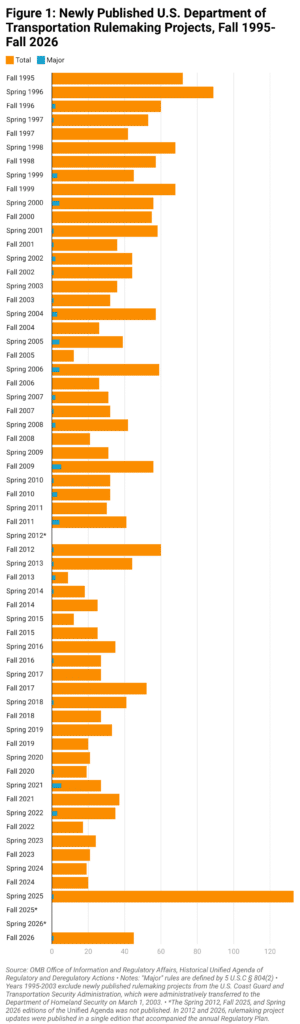
The 2026 Unified Agenda lists 315 active rulemaking projects at the U.S. Department of Transportation. Of those 315, 45 are new rulemaking projects first published in the 2026 edition. These new rulemaking projects are listed in Table 1 at the bottom of this article.
The Unified Agenda contains rules determined to be “significant regulatory actions,” or “economically significant” rules, which had been defined by EO 12866 (1993) as regulations that would have an annual impact on the economy of $100 million or more, or otherwise “adversely affect in a material way the economy, a sector of the economy, productivity, competition, jobs, the environment, public health or safety, or State, local, or tribal governments or communities.” Rules deemed economically significant are subject to greater scrutiny, most notably a requirement that agencies conduct a benefit-cost analysis of the proposed regulation.
When the Biden administration issued EO 14094 (2023), the annual cost threshold for a rule to be considered a “significant regulatory action” doubled to $200 million plus an inflation adjustment every three years. A discussion of the rationale and implications of this change can be found in my review of the Fall 2023 edition of the Unified Agenda.
One important implication is that EO 14094 made historical comparisons of the stock and flow of “economically significant rules” more challenging. Fortunately, as part of the Congressional Review Act, Congress itself requires a separate “major” rule designation that retains the traditional $100 million threshold (5 U.S.C. § 804(2)(A)), allowing for continued like-for-like historical accounting.
Figure 1 maintains the $100 million cost threshold by counting “major” rules instead of “economically significant” rules. While Trump revoked EO 14094 (2023) as part of EO 14148 (2025) and thereby restored the traditional $100 million cost threshold for “economically significant” rules, we have opted to count “major” rules rather than economically significant rules to ensure continuity and historical comparability.
There are currently 12 “major” rules under development at the Department of Transportation. Of the 45 new rulemaking projects that first appeared in the 2026 edition of the Unified Agenda, only one has been designated a “major” rule. However, 23 have a “major” status listed as “undetermined,” meaning they could be later designated as “major” rules as they move through the rulemaking process and economic costs are estimated.
Transportation deregulation in the first half of the second Trump administration
Given that Trump signed an executive order titled “Unleashing Prosperity Through Deregulation,” it should perhaps not be surprising that the U.S. Department of Transportation has categorized many of its newly announced rulemaking actions as “deregulatory.” That order, EO 14192, established a regulatory budget, which necessitates the categorization of rules as “regulatory” or “deregulatory.” OIRA issued a memo in March 2025 providing guidance on this process.
According to the 2026 Unified Agenda, of the Department of Transportation’s 45 newly announced rulemaking projects, 30 are categorized as “deregulatory,” seven are categorized as “regulatory,” with the remainder being categorized as “fully or partially exempt,” “not subject to, not significant,” or “other.” This works out to a deregulatory-to-regulatory action ratio of 4.29:1, less than half the targeted 10:1 ratio in EO 14192. However, adding the U.S. Department of Transportation’s completed regulatory activities from FY 2025 yields a deregulatory-to-regulatory ratio of 15:1, which suggests the current pipeline of regulatory activities is still on track to comply with EO 14192.
Setting aside the raw counts of regulatory actions, the specific actions that are categorized as regulatory or deregulatory reveal Trump administration transportation priorities. The seven actions announced in the 2026 Unified Agenda that are categorized as regulatory are two aviation equipment mandates from the Federal Aviation Administration (FAA) on shielding aircraft altimeters from 5G radio wave interference (2120-AM21) and increasing airliner cockpit voice recording times from two hours to 25 hours (2120-AM19), one that would apply Buy America domestic content requirements to electric vehicle chargers procured under the Federal Highway Administration’s (FHWA) National Electric Vehicle Infrastructure program (2125-AG29), and four increasing requirements on the trucking workforce from the Federal Motor Carrier Safety Administration (FMCSA) (2126-AC99, 2126-AD00, 2126-AD03, 2126-AC98).
All but one of these actions is justified as addressing a purported safety market failure. The arguments for the FAA altimeter shielding and 25-hour flight recorder requirements, which reflect a safety policy consensus, are better grounded than the FMCSA’s crackdown on noncitizen truck drivers, which appear to be motivated by the Trump administration’s broader policy agenda against immigration and has already spawned litigation. The other action, FHWA’s Buy America requirements for federally funded electric vehicle charging stations, increases burdens on vehicle technology disfavored by the administration while being consistent with the economic protectionism that has animated the past three presidential administrations.
In contrast, Department of Transportation rulemakings around technologies and practices favored by the Trump administration tend to be categorized as deregulatory. This is most obvious in the National Highway Traffic Safety Administration’s continued work to advance automated vehicle technologies. The 2026 edition of the Unified Agenda contains seven newly published rulemakings designed to clear a regulatory path for vehicle automation technologies and enable commercial deployment, all categorized as deregulatory, which are listed below:
- Automated Driving Systems (ADS) Performance Assessment (2127-AM99);
- Amending Bumper Standard 49 CFR part 581 (2127-AN02);
- Modernization of FMVSS No. 110 to Accommodate ADS-equipped Vehicles (2127-AM96);
- Modernization of FMVSS No. 135 to Accommodate ADS-Equipped Vehicles (2127-AN00);
- Modernization of FMVSS No. 126, Electronic Stability Control Systems for Light Vehicles, to Accommodate ADS-Equipped Vehicles (2127-AN03);
- Modernization of FMVSS No. 201 and FMVSS No. 208 to Accommodate ADS-Equipped Vehicle (2127-AN04);
- Modernization of FMVSS No. 111, Rear Visibility, to Accommodate ADS-Equipped Vehicles (2127-AN05).
The use of regulation by any presidential administration to advance its policy priorities is to be expected. Elections have consequences, after all. While its professed commitment to deregulation is being applied unevenly, the Trump Department of Transportation’s attention is welcome. However, if political leadership wishes to see durable deregulatory reforms, action must come from Congress to limit Executive Branch opportunities to engage in discretionary regulation in the first place.
Short of major economic policy reforms, Congress should at the very least demand regulatory transparency. The inconsistent publication of the Unified Agenda by the second Trump administration is concerning in this regard. The failure to meet the Regulatory Flexibility Act’s biannual publication requirements is not unprecedented—the Obama administration published just a single edition of the Unified Agenda in 2012—but it is highly atypical. As it stands, the second Trump administration is on track to miss publication of at least two Unified Agenda editions, which would be unprecedented.
Congress should seek an explanation from the administration for this decline in regulatory transparency as well as a commitment to resume regular regulatory agenda publication consistent with the Regulatory Flexibility Act. To further advance regulatory transparency, the U.S. Department of Transportation should resume publication of the Monthly Significant Rulemaking Report, which offered more frequent updates on the development economically significant rules. This report ceased regular publication during the onset of the COVID-19 pandemic at the end of the first Trump administration, was published only twice during the Biden administration, and was then terminated by the second Trump administration, also without explanation.
Table 1: U.S. Department of Transportation Rulemaking Projects First Published in the 2026 Unified Agenda
| Agency | Stage of Rulemaking | Title | RIN |
|---|---|---|---|
| OST | Proposed Rule Stage | Revisions to Subtitle B of Title 2 on Federal Financial Assistance | 2105-AF44 |
| OST | Final Rule Stage | Eliminating T-8 Report of All Cargo Operations | 2105-AF41 |
| OST | Final Rule Stage | Technical Corrections to DOT Operating Administration Titles | 2105-AF42 |
| OST | Final Rule Stage | Updates to Aviation Economic Procedural Regulations | 2105-AF43 |
| OST | Final Rule Stage | Rescinding Portions of Department of Transportation’s Title VI Regulations to Conform More Closely With the Statutory Text and to Implement Executive Order 14281 | 2105-AF45 |
| FAA | Proposed Rule Stage | Modernizing to Electronic Payments | 2120-AM16 |
| FAA | Proposed Rule Stage | Flexibility Enhancements of Weather Reporting Systems | 2120-AM17 |
| FAA | Proposed Rule Stage | Improving Emergency Medical Kit Efficacy and Flexibility in Commercial Airline Operations | 2120-AM18 |
| FAA | Proposed Rule Stage | Removal of the Federal Aviation Administration Aviation Safety Inspector Observation of Pilot-in-Command Requirement | 2120-AM20 |
| FAA | Proposed Rule Stage | Requirements for Certain Aircraft to be Equipped with Interference Tolerant NextGen Radio Altimeter Systems | 2120-AM21 |
| FAA | Proposed Rule Stage | Space Launch and Reentry Licensing and Permitting User Fees | 2120-AM22 |
| FAA | Proposed Rule Stage | Removal of FAA Third-Class Medical Certificate Requirement for Military Pilot Trainees | 2120-AM23 |
| FAA | Proposed Rule Stage | Flight Operations: Pilot requirements; Use of oxygen | 2120-AM24 |
| FAA | Proposed Rule Stage | Modernizing Medical Standards For Certain Low-Risk Non-Insulin Dependent Diabetes Cases | 2120-AM25 |
| FAA | Proposed Rule Stage | Streamlined Launch and Reentry License Requirements Improvement | 2120-AM26 |
| FAA | Final Rule Stage | 25 Hour Cockpit Voice Recorder (CVR) Requirements for Existing Aircraft | 2120-AM19 |
| FHWA | Proposed Rule Stage | National Electric Vehicle Infrastructure Standards and Requirements – Buy America Standard for Electric Vehicle Chargers | 2125-AG29 |
| FHWA | Proposed Rule Stage | Revisions to Federal Highway Administration (FHWA), Federal Transit Administration (FTA), and Federal Railroad Administration (FRA) regulations implementing the National Environmental Policy Act | 2125-AG30 |
| FMCSA | Proposed Rule Stage | English Language Proficiency, Out of Service Criteria | 2126-AC99 |
| FMCSA | Proposed Rule Stage | Entry Level Driver Training (ELDT) Program for Strengthening Certification Requirements of Training Providers | 2126-AD00 |
| FMCSA | Proposed Rule Stage | Passenger Carrier Regulations in 49 CFR Part 374 | 2126-AD01 |
| FMCSA | Proposed Rule Stage | Standards for Broker and Freight Forwarder Qualifications/Knowledge | 2126-AD02 |
| FMCSA | Proposed Rule Stage | Commercial Driver’s License (CDL) Standards | 2126-AD03 |
| FMCSA | Final Rule Stage | Restoring Integrity to the Issuance of Non-Domiciled Commercial Drivers Licenses (NDCDL) | 2126-AC98 |
| FMCSA | Final Rule Stage | Technical Amendments | 2126-AD04 |
| NHTSA | Prerule Stage | Automated Driving Systems (ADS) Performance Assessment | 2127-AM99 |
| NHTSA | Prerule Stage | Seat Belt Assurance System Compliance Option for Federal Motor Vehicle Safety Standard (FMVSS) No. 208, “Occupant Crash Protection” | 2127-AN01 |
| NHTSA | Prerule Stage | Amending Bumper Standard 49 CFR part 581 | 2127-AN02 |
| NHTSA | Proposed Rule Stage | Modernization of FMVSS No. 110 to Accommodate ADS-equipped Vehicles | 2127-AM96 |
| NHTSA | Proposed Rule Stage | Modernize FMVSS No. 208, “Occupant Crash Protection” | 2127-AM97 |
| NHTSA | Proposed Rule Stage | Modernize FMVSS No. 122a, “Motorcycle Brake Systems” | 2127-AM98 |
| NHTSA | Proposed Rule Stage | Modernization of Federal Motor Vehicle Safety Standard (FMVSS) No. 135 to Accommodate ADS-Equipped Vehicles | 2127-AN00 |
| NHTSA | Proposed Rule Stage | Modernization of FMVSS No. 126, Electronic Stability Control Systems for Light Vehicles, to Accommodate ADS-Equipped Vehicles. | 2127-AN03 |
| NHTSA | Proposed Rule Stage | Modernization of FMVSS No. 201 and FMVSS No. 208 to Accommodate ADS-Equipped Vehicles. | 2127-AN04 |
| NHTSA | Proposed Rule Stage | Modernization of FMVSS No. 111, Rear Visibility, to Accommodate ADS-Equipped Vehicles. | 2127-AN05 |
| FRA | Proposed Rule Stage | Litigation Protections for System Safety Program and Risk Reduction Program Information | 2130-AD62 |
| FRA | Proposed Rule Stage | Amendments to Streamline and Modernize Regulations Pertaining to New Safety Technology | 2130-AD63 |
| FRA | Proposed Rule Stage | Revisions to Federal Highway Administration (FHWA), Federal Transit Administration (FTA), and Federal Railroad Administration (FRA) Regulations Implementing the National Environmental Policy Act (NEPA | 2130-AD64 |
| FTA | Proposed Rule Stage | Major Capital Investment Projects | 2132-AB62 |
| FTA | Proposed Rule Stage | Charter Service | 2132-AB63 |
| FTA | Proposed Rule Stage | Revisions to Federal Highway Administration (FHWA), Federal Transit Administration (FTA), and Federal Railroad Administration (FRA) Regulations Implementing the National Environmental Policy Act | 2132-AB64 |
| SLSDC | Final Rule Stage | Seaway Rules and Regulations: Periodic Updates, Various Categories | 2135-AA59 |
| SLSDC | Final Rule Stage | Tariff of Tolls | 2135-AA60 |
| PHMSA | Proposed Rule Stage | Hazardous Materials: Providing Regulatory Relief for Last Mile Delivery of Retail Products | 2137-AG20 |
| PHMSA | Proposed Rule Stage | Hazardous Materials: Advancing Safety of Highway, Rail, and Vessel Transportation | 2137-AG21 |
Source: Office of Information and Regulatory Affairs, Unified Agenda of Regulatory and Deregulatory Actions, 2026
Note: RIN = Regulation Identifier Number, a unique alphanumeric code assigned by the Regulatory Information Service Center to each rulemaking project listed in the Unified Agenda. An explanation of Stage of Rulemaking terms can be found on page 13 of the Introduction to the Unified Agenda from the Regulatory Information Service Center.
The post Trump’s Department of Transportation unevenly advances deregulation as transparency declines appeared first on Reason Foundation.
Source: https://reason.org/commentary/trumps-department-of-transportation-unevenly-advances-deregulation-as-transparency-declines/
Anyone can join.
Anyone can contribute.
Anyone can become informed about their world.
"United We Stand" Click Here To Create Your Personal Citizen Journalist Account Today, Be Sure To Invite Your Friends.
Before It’s News® is a community of individuals who report on what’s going on around them, from all around the world. Anyone can join. Anyone can contribute. Anyone can become informed about their world. "United We Stand" Click Here To Create Your Personal Citizen Journalist Account Today, Be Sure To Invite Your Friends.
LION'S MANE PRODUCT
Try Our Lion’s Mane WHOLE MIND Nootropic Blend 60 Capsules
Mushrooms are having a moment. One fabulous fungus in particular, lion’s mane, may help improve memory, depression and anxiety symptoms. They are also an excellent source of nutrients that show promise as a therapy for dementia, and other neurodegenerative diseases. If you’re living with anxiety or depression, you may be curious about all the therapy options out there — including the natural ones.Our Lion’s Mane WHOLE MIND Nootropic Blend has been formulated to utilize the potency of Lion’s mane but also include the benefits of four other Highly Beneficial Mushrooms. Synergistically, they work together to Build your health through improving cognitive function and immunity regardless of your age. Our Nootropic not only improves your Cognitive Function and Activates your Immune System, but it benefits growth of Essential Gut Flora, further enhancing your Vitality.

Our Formula includes: Lion’s Mane Mushrooms which Increase Brain Power through nerve growth, lessen anxiety, reduce depression, and improve concentration. Its an excellent adaptogen, promotes sleep and improves immunity. Shiitake Mushrooms which Fight cancer cells and infectious disease, boost the immune system, promotes brain function, and serves as a source of B vitamins. Maitake Mushrooms which regulate blood sugar levels of diabetics, reduce hypertension and boosts the immune system. Reishi Mushrooms which Fight inflammation, liver disease, fatigue, tumor growth and cancer. They Improve skin disorders and soothes digestive problems, stomach ulcers and leaky gut syndrome. Chaga Mushrooms which have anti-aging effects, boost immune function, improve stamina and athletic performance, even act as a natural aphrodisiac, fighting diabetes and improving liver function. Try Our Lion’s Mane WHOLE MIND Nootropic Blend 60 Capsules Today. Be 100% Satisfied or Receive a Full Money Back Guarantee. Order Yours Today by Following This Link.


| Visits: | 1,829,718,436 |
| Stories: | 8,690,859 |
Whistler Blowers, Insiders

