

Borrowing to Avoid Social Security Reform Could Add $46 Trillion to the Debt by 2056

Romina Boccia and Ivane Nachkebia
Social Security is often described as a problem in 2032, when its insolvency will trigger automatic benefit cuts under current law. But the program has already been adding to federal debt for more than a decade. Since 2010, Social Security’s dedicated tax revenues have fallen short of benefit payments, and the federal government has financed the difference through additional borrowing. If Congress responds to trust fund exhaustion by borrowing to maintain scheduled benefits rather than reforming the program, the cost will grow dramatically.
Over the next 30 years, Social Security could add roughly $46 trillion to federal debt.
Social Security’s Contribution to Federal Deficits and Debt
Social Security is a pay-as-you-go program, which means that payroll taxes collected from today’s workers and income taxes on current benefits finance the benefits of today’s retirees. The resulting funding stream is the program’s cash flow, with the difference between tax revenues and benefit payments being the cash-flow balance.
Between 1983 and 2009, the program ran cash-flow surpluses, meaning its tax revenues exceeded benefit expenditures. These surpluses weren’t saved but were spent by the government on other, non–Social Security purposes. In exchange, the trust fund was credited with special-issue Treasury securities. These securities, referred to as trust fund “reserves,” represent intragovernmental IOUs, claims on the Treasury backed by prior cash-flow surpluses.
The trust fund’s securities have legal and accounting value for determining scheduled benefits under current law, but they do not represent net resources for the federal government as a whole. Redeeming them requires the Treasury to raise taxes, reduce other spending, or borrow from the public.
Since 2010, the Social Security system has run continuous cash-flow deficits, requiring the redemption of these intragovernmental IOUs to pay promised benefits. Because the federal government has been running budget deficits over this period, the Treasury has borrowed from the public to finance IOU redemptions and cover Social Security’s cash-flow gaps.
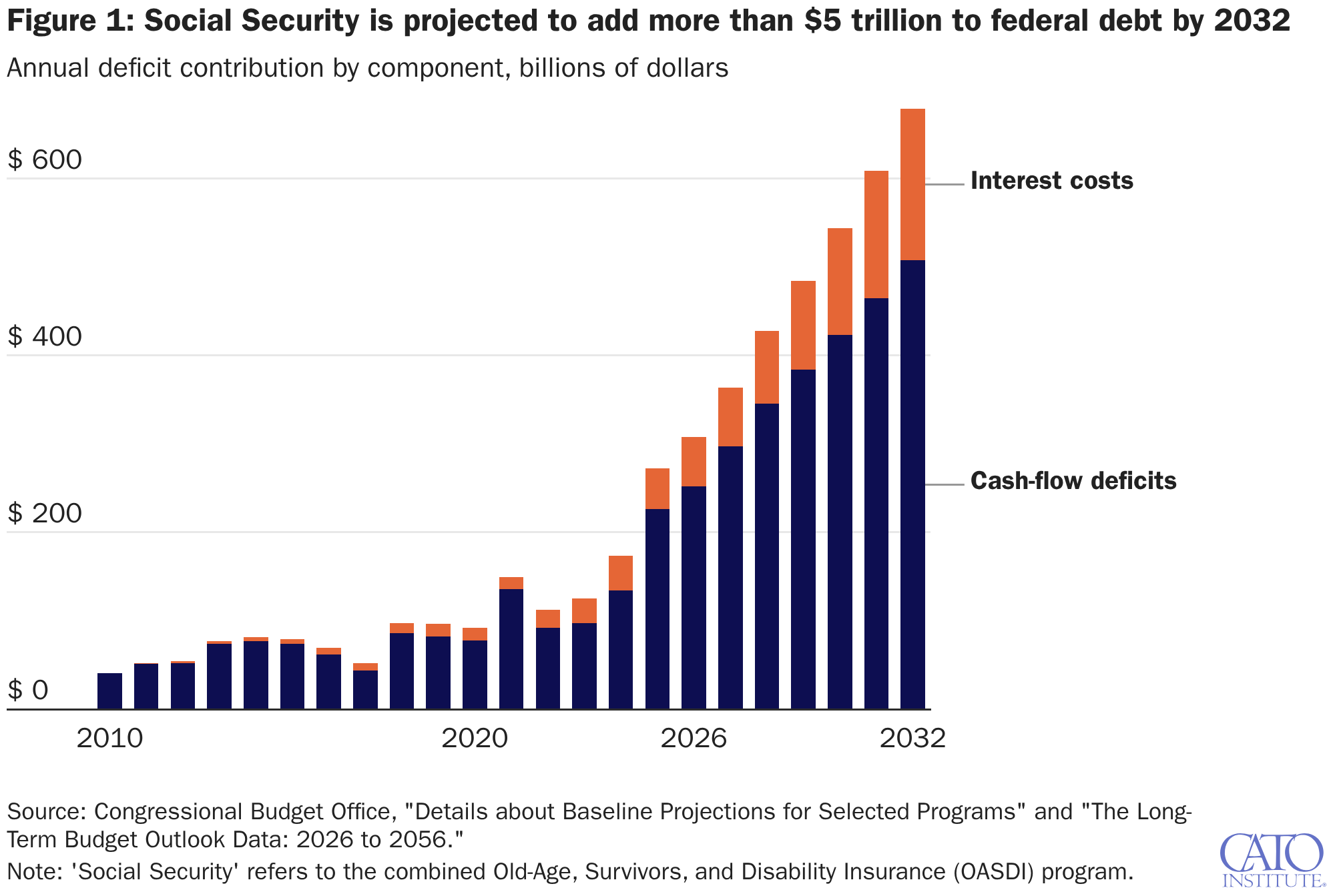
As a result, between 2010 and 2025, Social Security’s cash-flow deficits added about $1.4 trillion to federal debt. Importantly, a cash-flow deficit in a given year that’s financed by borrowing from the public also generates interest costs in subsequent years. To fully capture Social Security’s debt contribution, we’ve estimated those interest costs as well. (Download our methodology document, which illustrates how to calculate the interest costs associated with borrowing for the Old-Age and Survivors Insurance [OASI] program. Although the estimates presented here cover the combined Old-Age, Survivors, and Disability Insurance [OASDI] program—for consistency with the 30-year projections used elsewhere in this piece, projections the CBO has updated only for the combined program—the methodology itself is unchanged.) When including associated interest costs, Social Security’s 2010–2025 debt contribution rises to $1.6 trillion, with an additional $3.4 trillion projected by 2032 (Figure 1).
The Cost of Borrowing Beyond 2032
Once the trust fund is exhausted (estimated to happen in the fourth quarter of 2032), current law no longer permits the program to pay scheduled benefits without sufficient incoming revenue.
At that point, Congress will face three options: allow automatic benefit cuts to take effect, adopt structural reforms that put Social Security on a fiscally sustainable path, or amend the law and maintain scheduled benefits through borrowing. Borrowing would avoid an immediate benefit reduction but would not eliminate Social Security’s financing gap. It would merely transfer that gap to the federal government’s already strained balance sheet.
Under a borrowing scenario, Social Security’s cash-flow shortfalls between 2026 and 2056 would total approximately $25.4 trillion. Financing those shortfalls would generate an additional $17.1 trillion in interest costs over the same period. On top of that, Social Security–related borrowing between 2010 and 2025 would continue generating interest costs after 2026, adding another $3.9 trillion by 2056. Altogether, the program would add roughly $46 trillion to federal debt between 2026 and 2056. That represents about 34 percent of projected federal debt growth over the period.
Figure 2 separates Social Security’s debt contribution into its underlying cash-flow shortfalls and the interest costs generated by financing them. This distinction matters: Borrowing does not merely postpone the financing problem. Rather, it causes the shortfall to compound as interest accumulates on both current and prior borrowing.
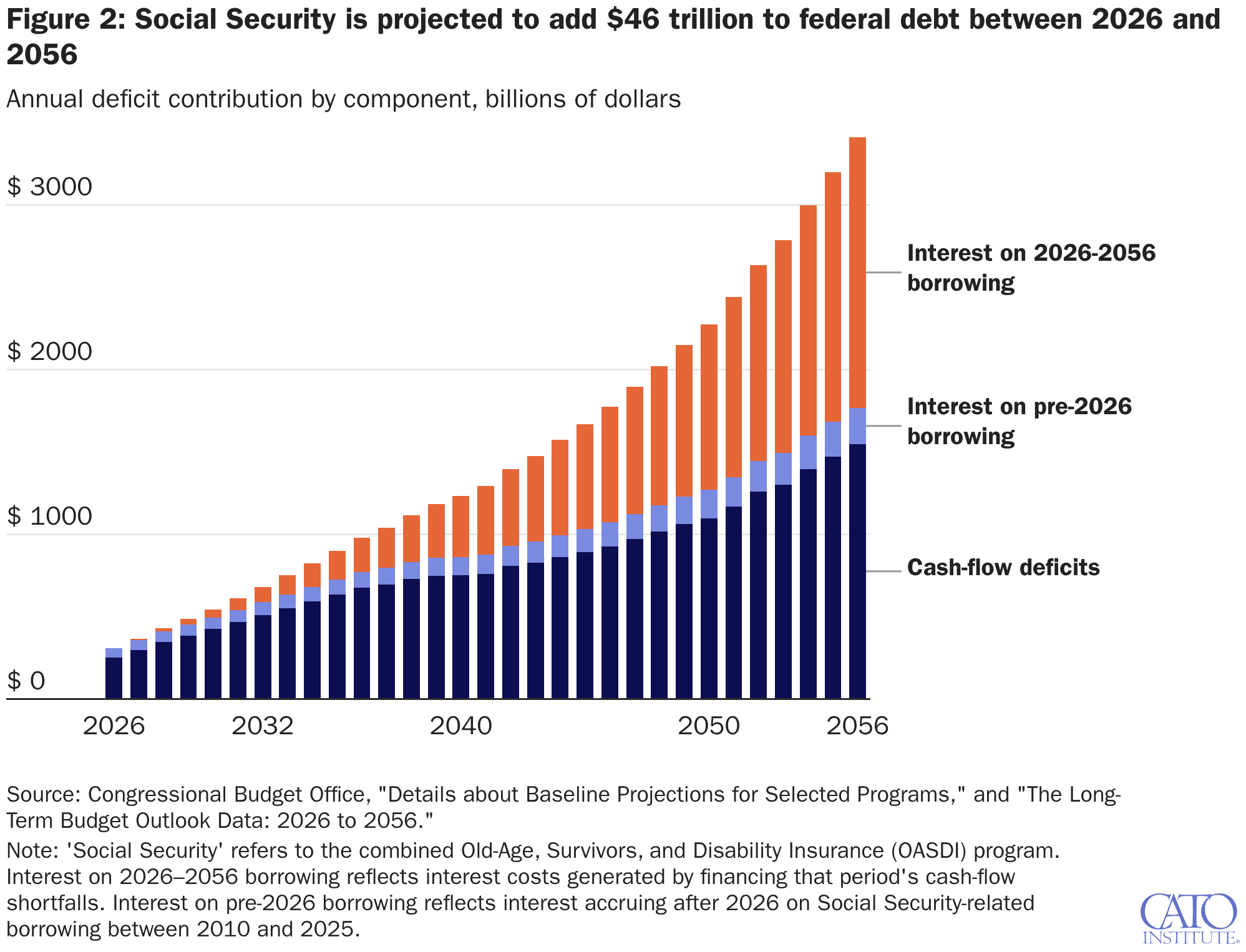
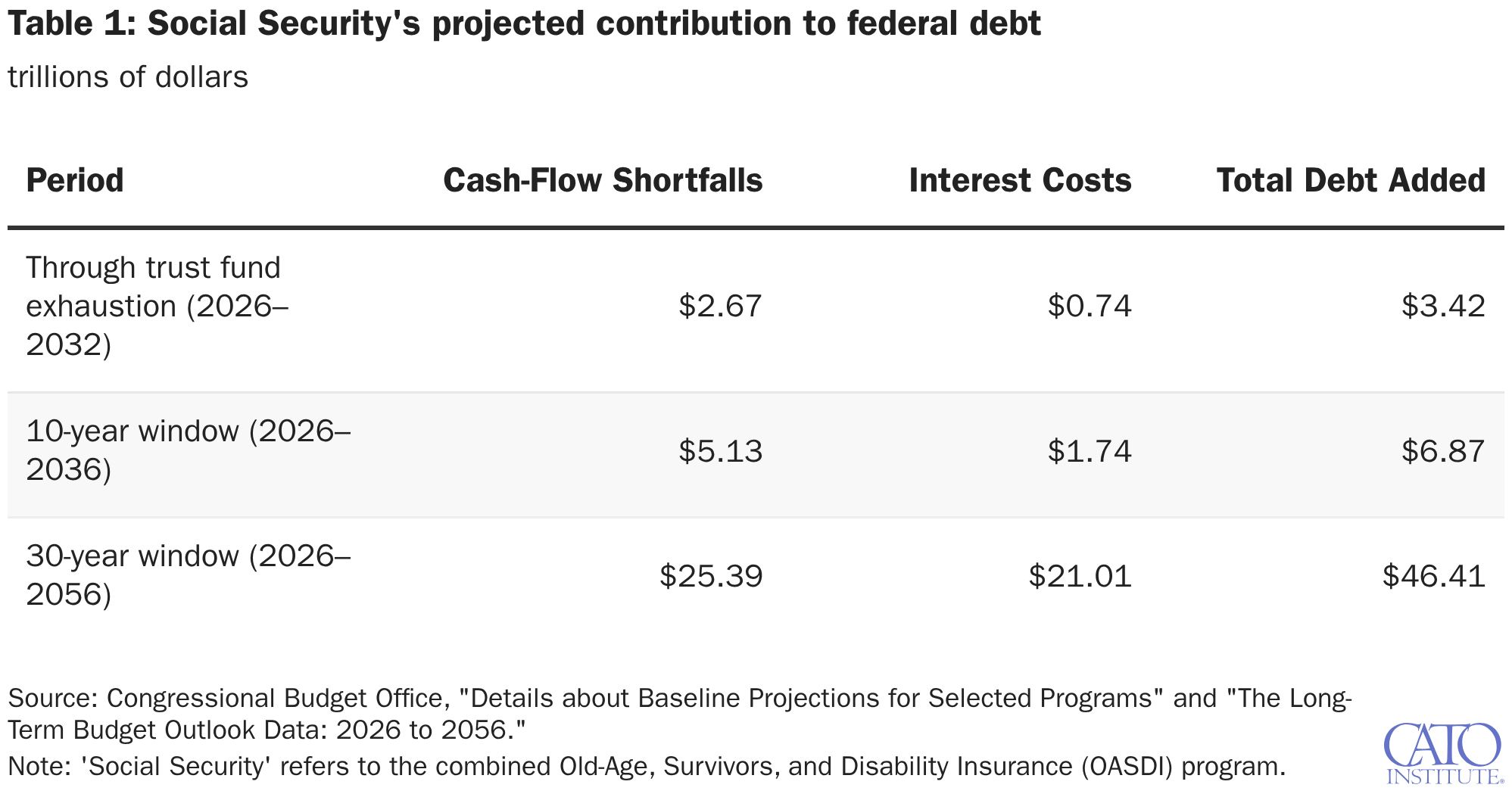
Table 1 summarizes Social Security’s projected debt contribution through trust fund exhaustion, and over 10- and 30-year projection windows.
Borrowing to maintain scheduled benefits would impose costs beyond the additional debt itself. The Congressional Budget Office found that gross domestic product (GDP) would be about 1 percent higher in 2036 than in its baseline projection if benefits were automatically reduced after trust fund exhaustion instead of being financed through additional borrowing. Lower government debt would reduce interest rates and support private investment, while lower benefits would lead some individuals to work or save more.
Borrowing on this scale could also increase the risk of a broader fiscal crisis if bond markets demanded higher yields, further accelerating the dangerous debt trajectory. In a negative feedback spiral, higher debt could also worsen Social Security’s finances by reducing investment, wages, and the payroll tax base—effects that are not incorporated into the trustees’ projections.
Congress Must Reform Social Security—Not Borrow Around It
Using general revenues to maintain scheduled benefits would not solve Social Security’s financing problem. It would shift the program’s shortfall onto the federal budget, increase interest costs, and expose workers and taxpayers to the economic risks of higher debt. Borrowing may postpone benefit reductions, but it won’t make Social Security sustainable.
Congress should act—before trust fund exhaustion—while it still has time to phase in structural reforms and give workers and retirees time to adjust. Waiting would leave fewer options, require more abrupt changes, and increase political pressure to finance the gap with additional borrowing.
The central obstacle is not a lack of policy options but Congress’s inability to assemble and enact a workable reform package. A commission of independent experts modeled on the Base Realignment and Closure (BRAC) process could help overcome political gridlock.
A BRAC-style commission would differ from past failed fiscal commissions in two important ways. One, it would consist of independent experts rather than elected representatives, insulating its recommendations from political pressures. And two, its recommendations would benefit from default adoption: Congress could reject the package, retaining final say, but not amend it. Importantly, a recent Cato Institute poll found that 71 percent of Americans support giving an independent commission such authority.
Social Security is not merely a future insolvency problem. It is already contributing to federal deficits and debt. Congress should act this year to reform the program—not borrow around it in 2032.
Source: https://www.cato.org/blog/borrowing-avoid-social-security-reform-could-add-46-trillion-debt-2056
Anyone can join.
Anyone can contribute.
Anyone can become informed about their world.
"United We Stand" Click Here To Create Your Personal Citizen Journalist Account Today, Be Sure To Invite Your Friends.
Before It’s News® is a community of individuals who report on what’s going on around them, from all around the world. Anyone can join. Anyone can contribute. Anyone can become informed about their world. "United We Stand" Click Here To Create Your Personal Citizen Journalist Account Today, Be Sure To Invite Your Friends.
LION'S MANE PRODUCT
Try Our Lion’s Mane WHOLE MIND Nootropic Blend 60 Capsules
Mushrooms are having a moment. One fabulous fungus in particular, lion’s mane, may help improve memory, depression and anxiety symptoms. They are also an excellent source of nutrients that show promise as a therapy for dementia, and other neurodegenerative diseases. If you’re living with anxiety or depression, you may be curious about all the therapy options out there — including the natural ones.Our Lion’s Mane WHOLE MIND Nootropic Blend has been formulated to utilize the potency of Lion’s mane but also include the benefits of four other Highly Beneficial Mushrooms. Synergistically, they work together to Build your health through improving cognitive function and immunity regardless of your age. Our Nootropic not only improves your Cognitive Function and Activates your Immune System, but it benefits growth of Essential Gut Flora, further enhancing your Vitality.

Our Formula includes: Lion’s Mane Mushrooms which Increase Brain Power through nerve growth, lessen anxiety, reduce depression, and improve concentration. Its an excellent adaptogen, promotes sleep and improves immunity. Shiitake Mushrooms which Fight cancer cells and infectious disease, boost the immune system, promotes brain function, and serves as a source of B vitamins. Maitake Mushrooms which regulate blood sugar levels of diabetics, reduce hypertension and boosts the immune system. Reishi Mushrooms which Fight inflammation, liver disease, fatigue, tumor growth and cancer. They Improve skin disorders and soothes digestive problems, stomach ulcers and leaky gut syndrome. Chaga Mushrooms which have anti-aging effects, boost immune function, improve stamina and athletic performance, even act as a natural aphrodisiac, fighting diabetes and improving liver function. Try Our Lion’s Mane WHOLE MIND Nootropic Blend 60 Capsules Today. Be 100% Satisfied or Receive a Full Money Back Guarantee. Order Yours Today by Following This Link.


| Visits: | 1,832,690,232 |
| Stories: | 8,708,778 |
Whistler Blowers, Insiders

