
Data Centers Are Not the Problem. Bad Policy Is.

America’s newest villain is a windowless, humming, usually beige building that’s now being targeted by moratoria across the country, including at the federal level, and galvanizing many a 2026 political campaign. Data centers are, much like Hansel, so hot right now—and not in a good way.
,
In one sense, public backlash to data centers in the United States shouldn’t be surprising: Their construction and deployment have skyrocketed across the country, creating—not to get all goopy on you—a highly visible target for American angst about AI, Big Tech, U.S. politics, the turbulent economy, male-pattern baldness, and surely more. A recent New York Times op-ed captures the mood on the left well: These giant bricks guzzle water, gobble electricity, buzz loudly 24/7, and enrich Silicon Valley billionaires at regular folks’ expense. Opposition, however, isn’t just on the left: You’ll find similar takes from MAGA types on Facebook and NextDoor, and—as I just saw myself when driving outside Raleigh last week—big “NO DATA CENTER” signs along many a rural roadside.
Yet most of the common objections to data centers collapse under scrutiny. The buildings certainly aren’t faultless and raise some real challenges, but they also generate substantial benefits that the backlash conveniently ignores. To the extent data centers really do create problems, moreover, the source is mainly government policy, especially subsidies and energy bottlenecks. And that means better policy can mitigate the real problems surrounding America’s data center buildout—no bans or dire economic consequences needed.
,
,
What even is a data center?
While we throw around the term “data center” a lot, there are actually many different types—not just big and small but ones that vary by ownership and technology. For a good primer, I recommend this recent Forbes piece on all the basics—and why the issue suddenly resonates. (NetChoice’s explainer series has even more.) As discussed there, data centers have been around for decades, and there are thousands already operating in the United States. They’re basically any “purpose-built building that runs large numbers of computers reliably, securely and around the clock,” and there’s probably one or more humming near your house right now. (It’s okay! Don’t freak out!)
What’s changed in recent years is the scale and speed of data center deployment in the United States. The newest and biggest data centers—so-called “hyperscale” ones that can cover millions of square feet—are powering both AI and one of the largest waves of capital investment in American history:
,

,
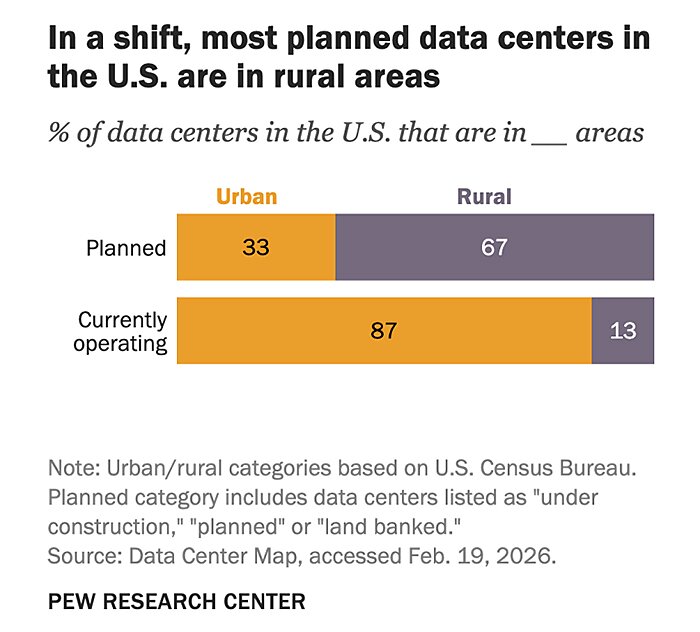
As we’ve unfortunately learned in the U.S. housing market (sigh), such large, rapid development was bound to engender pushback. In the case of data centers, however, it’s amplified by the fact that these humongous facilities are being increasingly located in quiet, rural areas that probably weren’t expecting the kind of noise and disruption that accompanies the construction and operation of any massive project—regardless of what’s going on inside it:
,
,
Throw in the usual incentives for grifters and politicians (redundant!) to make hay out of Americans’ insecurities about these big buildings and AI more broadly, and you have a recipe for mass hysteria—and, if the latest national polling and social media are to be believed, that’s just what we’ve got.
(I kid you not, one guy recently posted on NextDoor a list of all the data centers already operational here in North Carolina’s Triangle region—including tiny ones at nearby universities!—and called on his neighbors and local officials to rise up against them. Sigh.)
The water and electricity panic.
Most of the hysteria, however, is nonsense—random anecdotes and shoddy pseudoscience that drown out rational analysis and leverage humans’ natural insecurities and innumeracy.
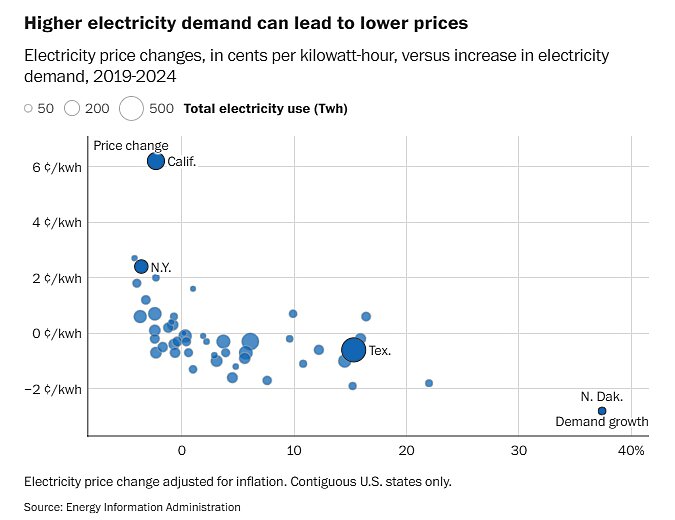
Let’s start with electricity, which is arguably the most difficult data center issue—at least in the future. Several regional and national studies have found little merit to the common claim that data centers have already caused large, localized increases in Americans’ electricity bills. In fact, a brand new, peer-reviewed study found that data centers actually caused average U.S. retail electricity rates to “fall modestly” between 2015 and 2024, because the centers’ high, steady power demand helped spread a grid’s fixed costs over more usage. This finding is counterintuitive but consistent with research from 2025 that high-demand areas—including ones like North Dakota and Virginia that saw an explosion of data centers—“saw lower prices overall,” while prices rose in places like California where demand had declined:
,
,
“More power customers,” the Washington Post explains, “means more ways to divvy up … fixed costs”—thus reducing rates for everyone.
As Roger Pielke Jr. discusses over at Dispatch Energy, this doesn’t mean that the same electricity trends will apply in the future. Hyperscaler growth is truly massive, and demand for power is projected to outpace supply. This mismatch is already showing up in certain communities’ electricity bills, albeit modestly, and it’ll likely show up in other places where policy prevents the supply side from responding. But, as Pielke notes, this mismatch is a fixable policy problem—not an immutable “data center” one. More on the policy in a sec.
The case is much weaker for water. As the Washington Post editors noted last year, arguably the most viral water claim—that a single Google data center in Chile consumed more than 1,000 times the water supply of a town there—was later acknowledged by its author to be “off by a magnitude of 1,000.” They added that all U.S. data centers combined use less than 0.5 percent of the United States’ freshwater, and that “Google’s thirstiest facility, in Iowa, uses approximately what some golf courses do.”
The golf course comparison is apt, because it hints at a common trick data center opponents use to gin up local angst: offer scary-sounding numbers with no real-world comparator. The American Enterprise Institute’s Jim Pethokoukis recently did such a comparison, revealing data center water usage to be a relative non-issue:
,
U.S. data centers consumed about 17.5 billion gallons of water in 2023, according to Lawrence Berkeley National Laboratory. That sounds like a lot until you compare it with total public water supply: it’s about 0.3 percent. Beef production, cotton farming, and golf courses each quietly consume far more with little public outcry. No one frowns at someone who grabs a burger in the clubhouse after playing a round of 18 on a beautifully manicured green course in Palm Springs.
,
AI researcher Andy Masley has done yeoman’s work explaining why a lot of “data center water usage” stats in various studies include non-potable water, indirect usage from nearby power plants, and water actually recirculated instead of consumed (thus causing little change to local supplies). Doing this can inflate water usage stats—and thus public outcry—dramatically, even though the data center itself isn’t consuming much water at all and nearby locals aren’t affected.
Looking ahead and at real data center consumption, Masley estimates that the water all American data centers will directly consume onsite in 2030 will be the equivalent of just 8 percent of U.S. golf industry usage and just 1 percent of the water used for American corn production. It’s also dwarfed by industrial usage for things like steel plants. Even including indirect consumption doesn’t move the needle much: The 100 billion gallons used in 2023 amount to a drop in the bucket (pun!) compared to what we use each year for golf courses (550 billion gallons) and lawns (3 trillion gallons). Surely, there could be some discrete issues for water usage in certain heavily constrained areas, but I’m fairly confident there’d be minimal local outrage in these places if it were a golf course or cornfield causing the “problem.”
Masley has also debunked several viral stories about rural data centers destroying local drinking water supplies, in each finding that the issue was wildly misreported (or an outright scam). In general, he finds that data centers aren’t major sources of water pollution in host communities, mainly because most of their usage (e.g., for cooling) is in closed systems. (And, again, their actual usage is dwarfed by other, totally acceptable things like farming.)
Masley has since run the same exercise on land use and waste heat, reaching similarly benign conclusions. Air pollution too. The Taxpayers Protection Alliance, meanwhile, has debunked recent online claims that data centers generate intolerable ambient noise.
In each case, it’s not that data centers do nothing. It’s that their impacts are unremarkable or minuscule compared to those of all sorts of other economic and leisure activities we tolerate and embrace every day—much of it providing far fewer economic benefits than what data centers do (no offense to golf!). And these data center effects can—just like the others—be addressed via normal regulatory channels, not a blanket ban.
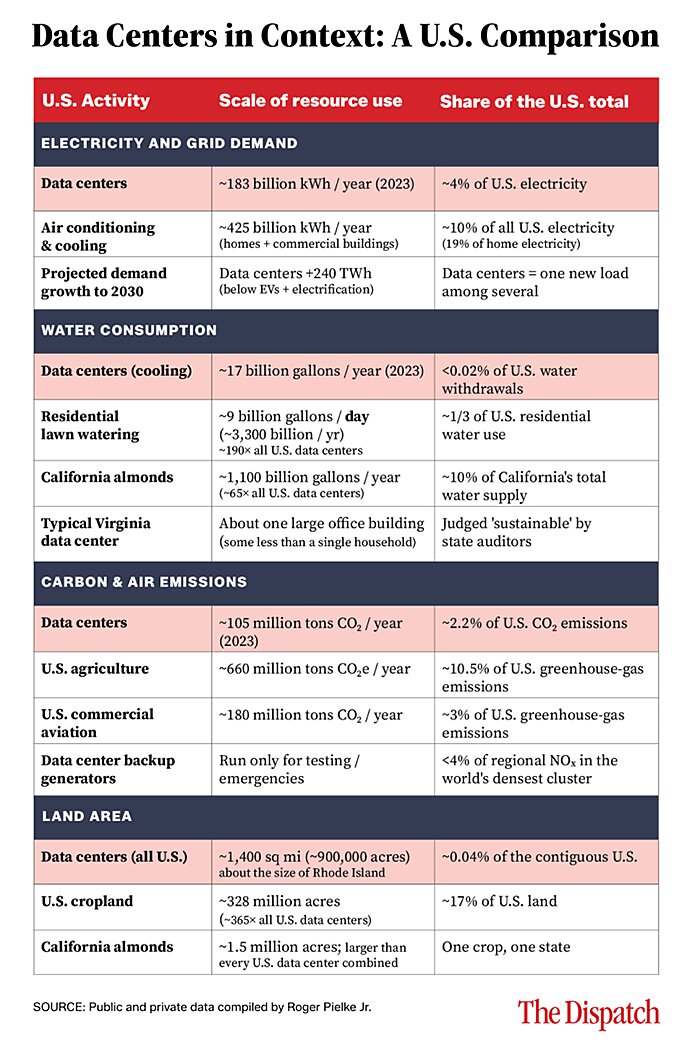
Here’s a good summary chart from Pielke offering useful comparisons that dismantle a lot of the online data center hysteria:
,
,
Then there are the benefits.
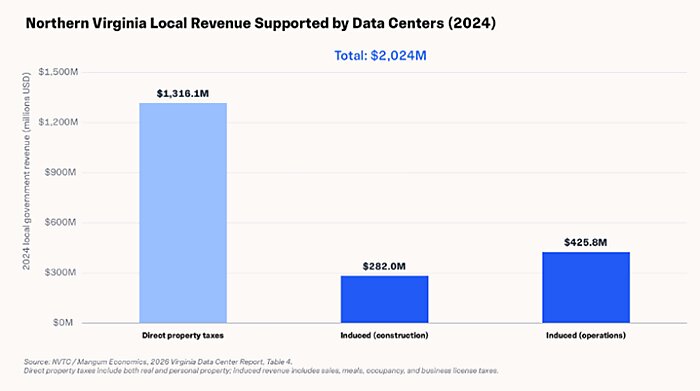
The other big problem with most data center opposition is that it routinely ignores the benefits they bring to local communities and the nation as a whole. The easiest place to start is with tax revenue, and Northern Virginia is the clearest test case. According to a recent report from the Chamber of Progress, the region in 2024 enjoyed more than $2 billion additional tax dollars because of its booming data center market, mainly thanks to property taxes:
,
,
Virginia localities have spent this money on schools, housing, and other government services. The Chamber report further found that, without data center tax revenue, Loudoun County’s residential property tax rate would’ve needed to almost double, adding roughly $5,800 to a typical homeowner’s annual tax bill. Instead, residents got a property tax cut.
The report then looks at the private sector economic activity supported by both the construction and operation of data centers in Northern Virginia:
,
In 2025, data centers in the region directly supported approximately 15,210 operational jobs and 29,075 construction jobs, with $4.1 billion in employee pay and benefits and $18.7 billion in direct economic output. When indirect and induced effects are included, total economic activity associated with data centers reached 87,560 jobs, $7 billion in pay and benefits, and $31.8 billion in economic output regionally. … Data centers in Northern Virginia directly employ more workers than the region’s child day care services, airlines, private K–12 schools, retail clothing stores, and landscaping services.
,
These economic benefits aren’t unique to Northern Virginia. A Georgia Tech analysis of facility-level openings nationwide found that the average county saw employment, wages, and business formation rise significantly after a data center opened. Gains in urban areas, which already have deep labor markets and established business networks, were more substantial than in rural ones, but the latter gained, too, from lower unemployment and higher tax revenues.
Both the Wall Street Journal and Bloomberg, meanwhile, have documented a genuine data center construction-jobs “gold rush” in many parts of the country, with welders, plumbers, and electricians now making more than $100,000 a year, along with getting signing bonuses and other perks (free steaks!). This construction boom has fueled demand for local workforce housing and other services, as well as nationwide demand for electrical, cooling, and power equipment manufactured in the United States and abroad. Overall, Pielke notes, “The AI-infrastructure buildout contributed about 0.8 percent of U.S. GDP by early 2026.” That’s a lot.
Americans willing to sell their land to data centers, meanwhile, are also getting rich.
Zoom out further and the economic case gets even stronger. As Gene Marks notes in USA Today, “Today’s data centers are yesterday’s railroads. They are the infrastructure behind everything that powers our economy. Railroads moved freight. Data centers move information and make modern commerce possible.” AI is a big (and transformative) part of the deal here, but—as the Cato Institute’s Jennifer Huddleston and Christopher Gardner explain—it’s not the only thing fueling demand:
,
Data centers are needed to meet increasing demands beyond just AI, including the volume of connected devices and data Americans use regularly. Our capacity needs have expanded with AI, but demand had been growing even before AI’s exponential leaps. Data centers are critical to AI and the progress it enables across a variety of areas. AI products power not only the direct-to-consumer chatbots many have come to rely on to improve access to information but also an array of products that can improve health, enhance cybersecurity, or support responses to natural disasters. All of this is to say AI’s benefits are far from merely ephemeral.
,
Block data centers, and this important commerce stalls in the United States. And it picks up overseas instead, taking the jobs, tax base, and geopolitical influence with it.
The source of the real problems. And how to fix them.
None of this means data centers are perfect, and it’d be intellectually lazy to claim the pushback is entirely manufactured (though some of it surely is). Where real problems exist, however, the cause is almost always a policy choice rather than an immutable feature of data centers or AI. And that means the issues can be fixed with policy, too.
The most obvious place to start is by nixing all the subsidies that certain states and localities toss at data center projects—and their billionaire owners. Virginia’s data center sales and use tax exemption, for example, cost more than $1 billion in 2024 and is projected to cost almost double that in 2025, with benefits accruing to Google, Amazon, and other bajillion-dollar companies. Indiana’s subsidies are almost as big. Given demand for AI and every other internet-based service in the United States, these data centers will be built without all the subsidies. So, much like sports stadiums and corporate relocation incentives, the handouts are less about real economic development and more about companies playing states and localities against each other to get the sweetest deal for themselves—at taxpayers’ expense. Kill ’em all. The industry doesn’t need the help, and every subsidy dollar is one that not only diminishes data centers’ tax revenue benefits but also fuels a legitimate grievance by the pro-moratorium crowd—maybe their only legitimate grievance.
The next obvious solution is to liberalize the supply side of the electricity market, where the only serious economic risk likely exists. As Pielke notes, various studies confirm that local power prices wouldn’t rise if supply could meet new demand, yet—
,
The constraint is our national inability to build—hampered by permitting queues and interconnection backlogs that mean that new transmission takes six to 10 years to build—while new demand emerges much faster. A moratorium seeks to freeze demand to match a sclerotic supply side. A better response speeds the creation of supply to meet demand. That means permitting reform, faster interconnection, advanced transmission, and water system investment, including new supply. Blocking construction treats the symptom rather than the disease.
,
Other things, such as tariffs on transformers, electrical steel, solar panels, and other essential equipment, add to these burdens. Fix them, and some of the demand-side pressure from data centers will be released.
For the rest, Cato’s Travis Fisher and Huddleston have an even better idea: Let data center developers contract directly with private generators or build their own power, through “consumer-regulated electricity” (CRE) reforms:
,
[CREs] allow for privately financed, off-grid electric utilities to serve new customers under voluntary contracts. These utilities would be physically “islanded” from the regulated grid and would not be subject to economic regulation at the state or federal level. Because they would not interconnect with incumbent systems, CRE utilities would impose no costs, reliability risks, or stranded-asset exposure on existing customers.
,
Letting these giant, cash-rich companies pay their own way makes abundant (pun!) sense, yet utility regulations and related factors make that impossible in most places. And that, not data center demand, is the problem. Fortunately, as Fisher writes, there are some positive developments in this regard: A few states have already begun experimenting with CRE, and the White House’s voluntary Ratepayer Protection Pledge, signed by most hyperscalers, gestures at similar principles. But much more needs to be done—and fast.
Other data center issues, such as noise, pollution, and land use, have a simpler solution: localities enforcing the relevant laws they already have on the books and making local decisions about whether to permit data centers in their communities. NIMBYism drives a lot of the opposition to data center projects, and I think almost all of it is wrong. The bright side, however, is that it’s an exercise of local control, not a statewide or federal moratorium that blocks an entire industry. In the former case, a data center can move to more welcoming U.S. areas that will enjoy the direct benefits—and occasional headaches—that rapid development offers, while negotiating site-specific terms and mitigation directly with developers, the way Loudoun County did. America’s great Laboratories of Democracy can do their thing.
As Huddleston notes, on the other hand, turning a local land-use dispute into a federal ban would throw out the baby with the bathwater, generating economic harms that go far beyond a few NIMBY-captured communities.
Summing it all up.
Most of what people hate about data centers is either factually incorrect or aimed at the wrong target. Beyond what we’ve discussed, for example, there are real—and in some cases genuinely alarming—concerns about AI safety, security, and disruption, and I’m increasingly worried about incumbent AI giants capturing U.S. regulators and creating new legal moats to block competition. But the right response to those and other real issues with AI is to address them directly, not to throttle the physical infrastructure that makes the technology—and so much more—possible. The latter approach makes no sense, and it comes with huge local, national, and likely global costs.
The remaining data center concerns that are real, meanwhile, trace back to identifiable and fixable policy failures: unnecessary subsidies, sluggish permitting, antiquated power rules, and more. Fix those, and the problems dissipate. Nationalize the issue, and things only get worse.
In a lot of ways—good and bad—the current data center debate reminds me of the one America had over fracking almost two decades ago. That, too, was a genuinely disruptive industrial buildout, with real, localized costs—costs that were wildly blown out of proportion, if not faked entirely, and which drove calls to ban the activity nationwide. Fortunately, the United States avoided a federal fracking ban, leaving it mostly to states and localities to decide the activity’s fate. Some of those places banned fracking anyway, handing the jobs, tax revenue, and more to their neighbors. That decision was in retrospect misguided, but it had a big upside: Because the bans were localized, they didn’t eliminate a remarkable, transformational technology with massive economic and—as we’re seeing right now—geopolitical upsides.
Hopefully data centers can suffer the same, second-best fate, because the prohibitionist alternative could have implications that make the fracking revolution look like a bake sale.
Markets FTW
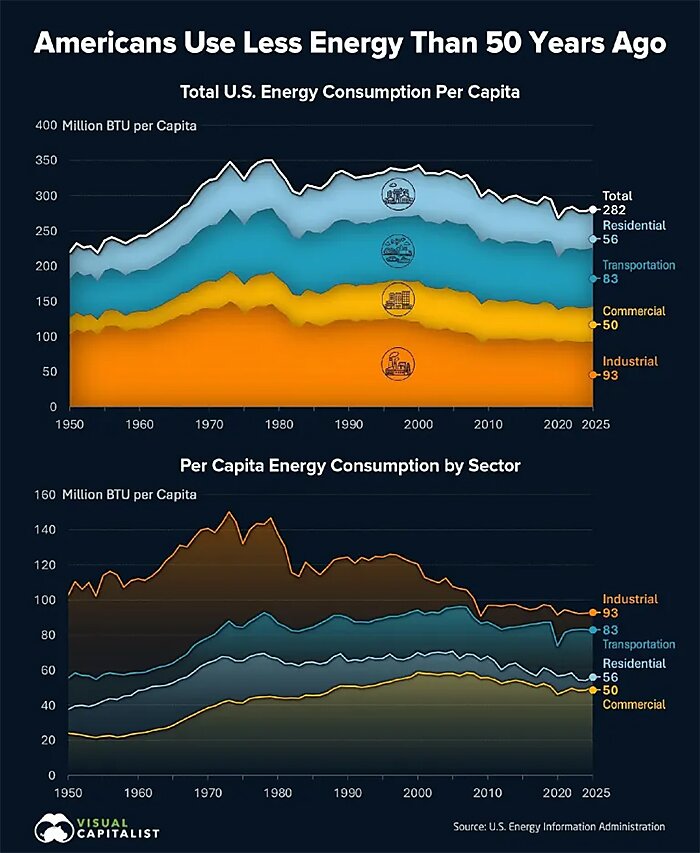
Maybe, just maybe, we don’t accurately remember the “good ol’ days”:
,
I am 73. When I was growing up, we had one television and received four channels for free. We had one telephone in the house. For years, we had one car, even though my father was a successful attorney. He took the train to work, and the day he bought my mother her own car was a major family event.
Our big annual vacation was driving to Florida and staying in a modest motel. Children played sports, but families didn’t spend thousands of dollars on year-round travel teams, private coaching, specialized equipment, hotels and airfare.
Today, many households pay for several cars, multiple cellphones, cable, streaming services, internet, frequent restaurant meals and regular air travel. None of these expenses seems excessive by themselves, but together they greatly increase the cost of what we now call a normal middle-class life.
,
Chart of the Week
,
,
,
,
,
Source: https://www.cato.org/commentary/data-centers-are-not-problem-bad-policy
Anyone can join.
Anyone can contribute.
Anyone can become informed about their world.
"United We Stand" Click Here To Create Your Personal Citizen Journalist Account Today, Be Sure To Invite Your Friends.
Before It’s News® is a community of individuals who report on what’s going on around them, from all around the world. Anyone can join. Anyone can contribute. Anyone can become informed about their world. "United We Stand" Click Here To Create Your Personal Citizen Journalist Account Today, Be Sure To Invite Your Friends.
LION'S MANE PRODUCT
Try Our Lion’s Mane WHOLE MIND Nootropic Blend 60 Capsules
Mushrooms are having a moment. One fabulous fungus in particular, lion’s mane, may help improve memory, depression and anxiety symptoms. They are also an excellent source of nutrients that show promise as a therapy for dementia, and other neurodegenerative diseases. If you’re living with anxiety or depression, you may be curious about all the therapy options out there — including the natural ones.Our Lion’s Mane WHOLE MIND Nootropic Blend has been formulated to utilize the potency of Lion’s mane but also include the benefits of four other Highly Beneficial Mushrooms. Synergistically, they work together to Build your health through improving cognitive function and immunity regardless of your age. Our Nootropic not only improves your Cognitive Function and Activates your Immune System, but it benefits growth of Essential Gut Flora, further enhancing your Vitality.

Our Formula includes: Lion’s Mane Mushrooms which Increase Brain Power through nerve growth, lessen anxiety, reduce depression, and improve concentration. Its an excellent adaptogen, promotes sleep and improves immunity. Shiitake Mushrooms which Fight cancer cells and infectious disease, boost the immune system, promotes brain function, and serves as a source of B vitamins. Maitake Mushrooms which regulate blood sugar levels of diabetics, reduce hypertension and boosts the immune system. Reishi Mushrooms which Fight inflammation, liver disease, fatigue, tumor growth and cancer. They Improve skin disorders and soothes digestive problems, stomach ulcers and leaky gut syndrome. Chaga Mushrooms which have anti-aging effects, boost immune function, improve stamina and athletic performance, even act as a natural aphrodisiac, fighting diabetes and improving liver function. Try Our Lion’s Mane WHOLE MIND Nootropic Blend 60 Capsules Today. Be 100% Satisfied or Receive a Full Money Back Guarantee. Order Yours Today by Following This Link.


| Visits: | 1,830,489,569 |
| Stories: | 8,695,849 |
Whistler Blowers, Insiders