

Taxing the Rich Can’t Close the Federal Deficit

It’s not just the Democratic Socialists who believe in “taxing the hell out of millionaires.” The belief that Washington can finance itself by taxing a relatively small group of wealthy Americans has become increasingly mainstream and bipartisan.
Senators Elizabeth Warren (D‑MA) and Bernie Moreno (R‑OH) propose removing the Social Security payroll tax cap, subjecting earnings above $184,500 to the 12.4 percent combined employer-employee payroll tax. Senators Chris Van Hollen (D‑MD) and Cory Booker (D‑NJ) each propose exempting more wages from income taxes at the bottom while raising taxes on higher earners. President Trump has pursued a similar strategy of expanding tax exemptions, while President Joe Biden and Vice President Kamala Harris both pledged not to raise taxes on anyone earning less than $400,000.
Each approach shifts more of the tax burden toward the top. One problem with this approach is that there are not enough high-income Americans to finance the current federal budget deficit, let alone fund additional spending or tax cuts.
One simple way to illustrate the mathematical impossibility of raising taxes only on rich people is to ask an intentionally extreme question: How much income is actually left to tax at the top? Not as much as popular proposals usually assume.
Using IRS data, the post below shows an upper bound for income-tax increases on high earners. In 2023, if the government had confiscated every dollar earned over half a million dollars, it still would have run a budget deficit.
What’s left to tax?
Using IRS data from the 2023 tax year (the most recent available), we can illustrate the difficulty of raising a lot more revenue from a narrow segment of the population.
In 2023, taxpayers filed 161 million individual income tax returns, reporting $15.3 trillion in adjusted gross income (AGI). AGI includes wages, capital gains, personal business income, and other forms of income, minus adjustments for things like student loan interest and retirement contributions.
The IRS reports this information by different income groups, separating taxpayers into buckets with AGIs above and below $200,000, $500,000, $1 million, and $10 million, among others. Table 1 shows the total AGI and income taxes paid, including federal taxes and an estimate of state-level taxes, by each group.
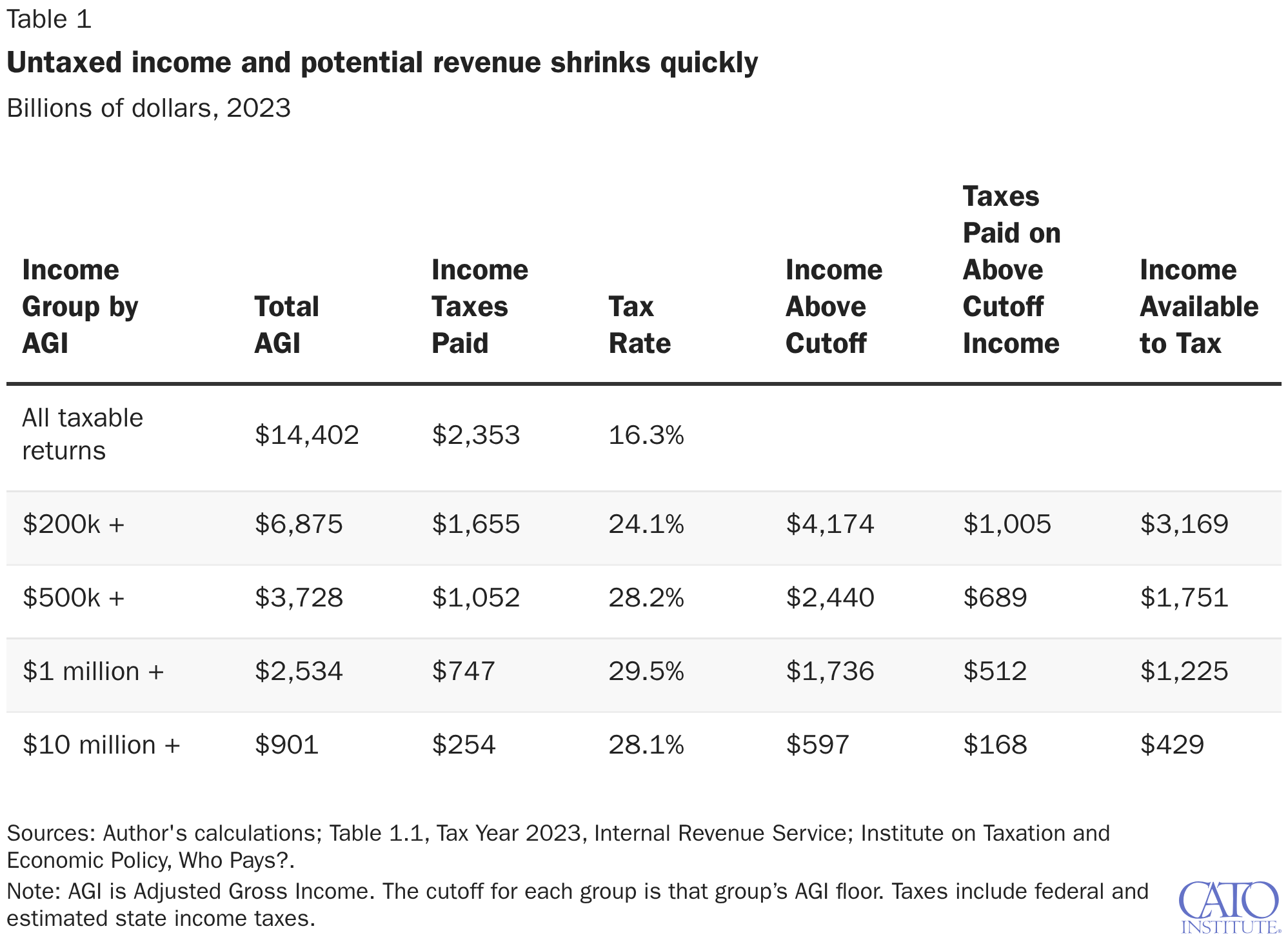
In 2023, taxpayers earning over $1 million reported $2.5 trillion in total AGI and paid $747 billion in federal and state income taxes. To estimate state income taxes, we apply average rates by income group from the Institute on Taxation and Economic Policy. The 799,094 tax returns in the $1 million+ group accounted for 0.5 percent of all returns and paid an average federal and state income tax rate of 29.5 percent.
In theory, Congress could devise a way to reach every dollar of untaxed millionaire income. But most proposals to raise taxes on high earners instead start by increasing marginal tax rates. Under a graduated income tax, a higher rate imposed above $1 million applies only to income exceeding that threshold, which exempts the taxpayer’s first $1 million from additional taxes.
The IRS data show that for the $1‑million-and-above group, there is $1.7 trillion in AGI above the threshold. Applying the group’s average tax rate implies they have already paid roughly $512 billion in taxes on their above-threshold income. That leaves $1.2 trillion after taxes.
If Congress confiscated every one of the remaining $1.2 trillion after-tax dollars earned above $1 million, the resulting revenue would have fallen nearly $600 billion short of covering the cost of the 2023 $1.8 trillion calendar-year deficit. Dropping the taxable income threshold to $500,000 would also have fallen just short of covering the same year’s deficit. And these estimates make the wildly unrealistic assumption that a 100 percent marginal tax rate would have no behavioral or other economic effects.
Figure 1 extends the improbable assumption over 10 years, assuming that high-income Americans would continue to earn income when facing 100 percent income tax rates. It adjusts the 2023 data by projected income and household growth to show untaxed income over the next 10 years. Confiscating all income earned over $1 million would cover only about 80 percent of the Congressional Budget Office’s (CBO) projected $24.4 trillion federal deficit over the same period.
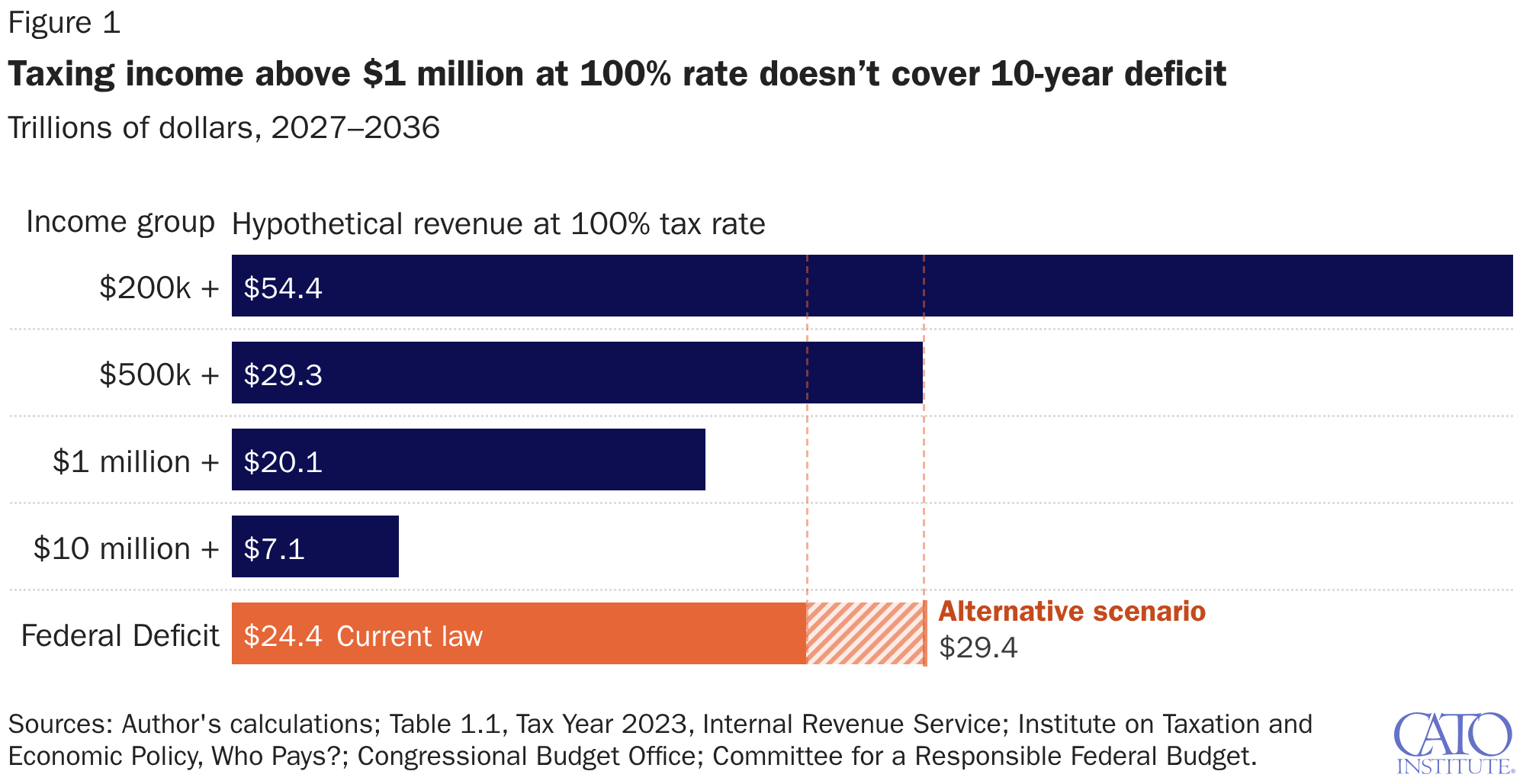
The Committee for a Responsible Federal Budget produces a more realistic projection of future deficits that assumes Congress extends many expiring tax and spending programs (which the CBO is required to assume are not renewed). At the more likely deficit figure of $29.4 trillion, even lowering the income threshold to $500,000 does not cover the next decade’s budget shortfall.
Lowering the taxable income threshold further to $200,000 expands the pool of untaxed income, but it does not make confiscatory tax rates economically plausible.
Common sense and economic incentives make clear that Congress cannot raise marginal income tax rates anywhere close to 100 percent and expect taxpayers to continue earning and reporting the same income. A recent report by economists at the Joint Committee on Taxation estimates that combined state and federal income tax rates are already near their revenue-maximizing level. Raising top income tax rates further would result in revenue gains of about 0.1 percent of GDP, equivalent to at most $400 billion over the next decade.
Conclusion
Taxing incomes at 100 percent marginal rates is not a realistic policy proposal. Taxes significantly higher than what we have today would radically change how much people work, invest, and realize as income, as well as how much income they report to the government. The point of this exercise is to show that “just tax the rich” proposals fail, even under arithmetic that is the most favorable possible.
Source: https://www.cato.org/blog/taxing-rich-cant-close-federal-deficit
Anyone can join.
Anyone can contribute.
Anyone can become informed about their world.
"United We Stand" Click Here To Create Your Personal Citizen Journalist Account Today, Be Sure To Invite Your Friends.
Before It’s News® is a community of individuals who report on what’s going on around them, from all around the world. Anyone can join. Anyone can contribute. Anyone can become informed about their world. "United We Stand" Click Here To Create Your Personal Citizen Journalist Account Today, Be Sure To Invite Your Friends.
LION'S MANE PRODUCT
Try Our Lion’s Mane WHOLE MIND Nootropic Blend 60 Capsules
Mushrooms are having a moment. One fabulous fungus in particular, lion’s mane, may help improve memory, depression and anxiety symptoms. They are also an excellent source of nutrients that show promise as a therapy for dementia, and other neurodegenerative diseases. If you’re living with anxiety or depression, you may be curious about all the therapy options out there — including the natural ones.Our Lion’s Mane WHOLE MIND Nootropic Blend has been formulated to utilize the potency of Lion’s mane but also include the benefits of four other Highly Beneficial Mushrooms. Synergistically, they work together to Build your health through improving cognitive function and immunity regardless of your age. Our Nootropic not only improves your Cognitive Function and Activates your Immune System, but it benefits growth of Essential Gut Flora, further enhancing your Vitality.

Our Formula includes: Lion’s Mane Mushrooms which Increase Brain Power through nerve growth, lessen anxiety, reduce depression, and improve concentration. Its an excellent adaptogen, promotes sleep and improves immunity. Shiitake Mushrooms which Fight cancer cells and infectious disease, boost the immune system, promotes brain function, and serves as a source of B vitamins. Maitake Mushrooms which regulate blood sugar levels of diabetics, reduce hypertension and boosts the immune system. Reishi Mushrooms which Fight inflammation, liver disease, fatigue, tumor growth and cancer. They Improve skin disorders and soothes digestive problems, stomach ulcers and leaky gut syndrome. Chaga Mushrooms which have anti-aging effects, boost immune function, improve stamina and athletic performance, even act as a natural aphrodisiac, fighting diabetes and improving liver function. Try Our Lion’s Mane WHOLE MIND Nootropic Blend 60 Capsules Today. Be 100% Satisfied or Receive a Full Money Back Guarantee. Order Yours Today by Following This Link.


| Visits: | 1,831,868,459 |
| Stories: | 8,704,504 |
Whistler Blowers, Insiders

