

Trump’s Vaunted ‘Trade Deals’ Are Much Less than Meet the Eye

As the evidence mounts that President Donald Trump’s tariffs have been a legal, economic, and fiscal miss, their defenders have retreated to foreign policy. Sure, the argument goes, the tariffs raised prices without meaningfully changing the trade balance or reviving American manufacturing. But they nevertheless pushed dozens of foreign governments to open their markets, to invest trillions of dollars here, and to fall in behind Washington on China and other geopolitical priorities.
,
Three events from the last few weeks have shown some of the flaws with this story:
- On August 22, U.S.-Canada negotiations—prompted by new Trump tariff threats—collapsed hours before an already-extended deadline, causing not only the U.S. tariffs to enter into force but also Canadian retaliation, U.S. retaliation for that, and the clear risk of a spiraling trade conflict that threatens almost $1 trillion in annual commerce and one of the United States’ closest military alliances.
- Days earlier, something even weirder had happened. Citing his “very good relationship” with North Korea’s murderous Kim Jong Un, Trump ordered the Pentagon to scale back joint exercises with South Korea—a move reportedly motivated by U.S. officials’ frustration with Seoul slow-walking the $350 billion investment pledge it made as part of a tariff-fueled trade deal with Washington.
- And just this past Tuesday, the United Kingdom announced that, thanks to Canadian approval in July, it became a full member of the Comprehensive and Progressive Agreement for Trans-Pacific Partnership (CPTPP)—a sprawling trade deal that broadly liberalizes trade among 11 other economies (and that Trump abandoned in 2017).
Start with the Vaporware Deals.
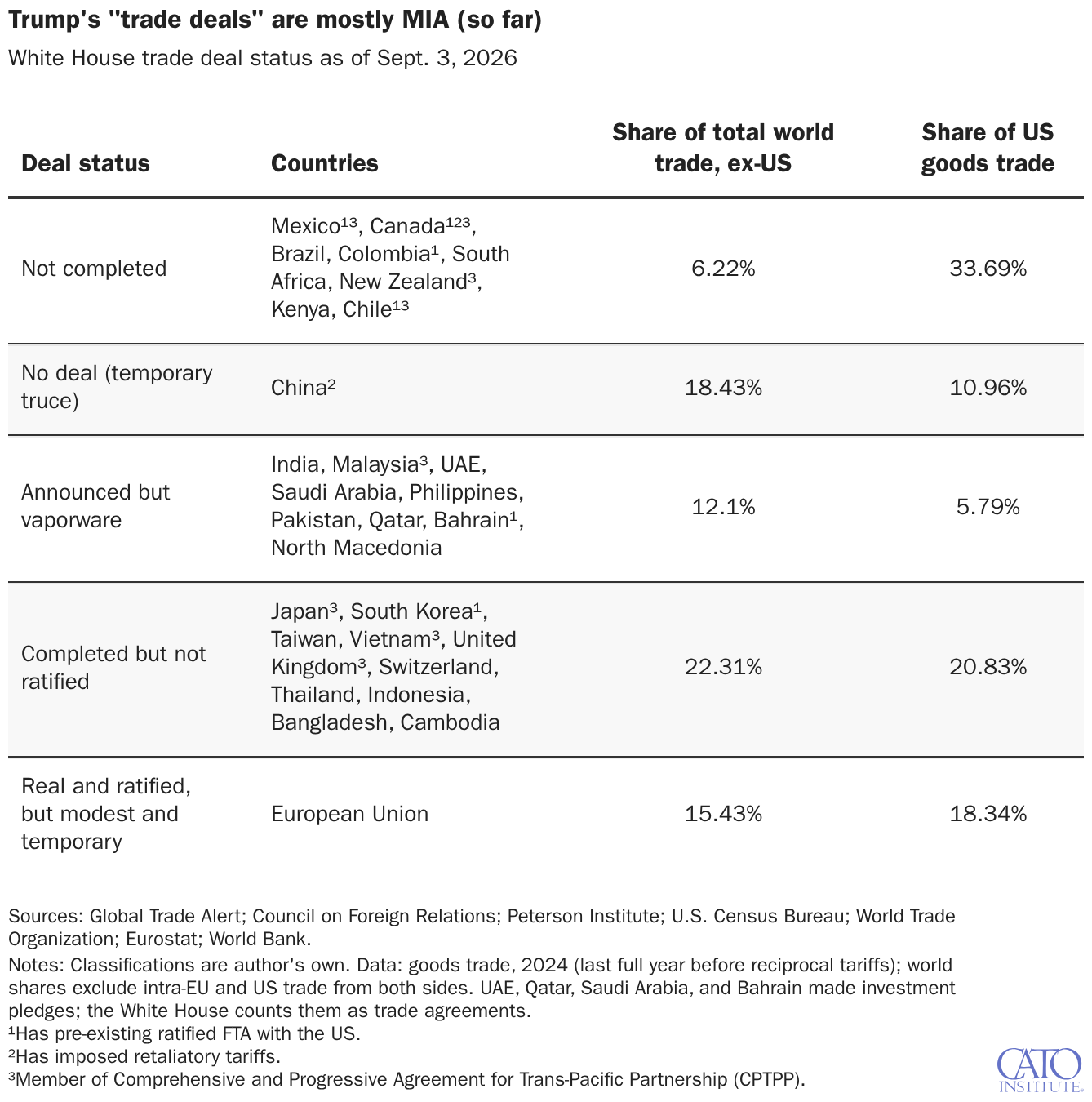
Arguably the centerpiece for Trump’s tariff regime was the 20-plus “trade deals” his team announced last year to great fanfare. Yet many of them have turned out to be little more than press releases, if that.
Several promised deals were never finished. The U.S.-India agreement, which U.S. Trade Representative (USTR) Jamieson Greer’s team called “99 percent” done last June, remains on hold. Brazil got tariffs instead of a deal after its negotiations collapsed. South Africa’s talks are stalled. Kenya is starting over (again). Free-trading New Zealand never got anything at all; Chile didn’t either. And, obviously, there’s Canada.
Other deals were announced as finished but never actually materialized. Malaysia’s trade minister declared his country’s October 2025 agreement null and void after the Supreme Court’s ruling against Trump’s “emergency” tariffs in February. Indonesia signed its deal a day before the ruling, but Jakarta now says it never entered into force. The framework deals of Vietnam, Taiwan, and Argentina are similarly unratified. The U.S. announced deals with the Philippines and Pakistan, but those governments never confirmed the same terms. Bangladesh signed its deal three days before a major national election, and the new government says it’s now under review. Thailand’s still negotiating the implementation of its October 2025 framework deal, and North Macedonia … who knows, man.
Also into this category fall my personal favorites, the U.S. “trade deals” with Saudi Arabia, the UAE, and Qatar. Those have no treaty text or signed framework (let alone formal approval by the governments’ respective advisory councils) and are instead simply White House fact sheets touting non-binding investment pledges worth a ridiculous $4 trillion—almost double the nations’ collective GDP in 2026 and far greater than anything they’ve ever invested here before. Here, history seems to be repeating: In 2017 the Saudis announced U.S. investments worth $350 billion ($110 billion of it “immediate”), yet measured Saudi direct investment rose by just $5 billion through 2024.
The Real Deals Are Modest—and Temporary.
Four deals have progressed beyond the press release stage, but weaknesses abound here, too.
The U.K. The U.S.-U.K. “economic prosperity deal” was signed on May 8, 2025, but remains incomplete. In July, the House of Commons Business and Trade Committee reported that the EPD, the follow-on (and now paused) “technology prosperity deal,” and a December 2025 pharmaceutical deal are all legally non-binding because they weren’t enacted into law, though a few elements—on expanded beef and ethanol quotas and pharmaceutical pricing—were implemented via secondary legislation. (In exchange, the U.S. gave the U.K. a lower 10 percent baseline tariff rate and preferential treatment for British aerospace, agriculture, pharmaceuticals, and automotive goods.) On nontariff barriers (including regulatory standards) and digital trade, the committee’s report shows no progress, while services were never in the deal. Notably, the U.K.’s discriminatory digital services tax is still in place, leading Trump to threaten new tariffs over it and similar European DSTs back in April.
Japan. The U.S. implemented its July 2025 framework with Japan by executive order, while Japan never ratified anything. In fact, Japan told WTO members earlier this month that it has made no tariff concessions, and that the agreement is not legally binding. Instead, the deal—including $550 billion in promised Japanese spending and investments—is an “administrative understanding” that Japan can terminate at any time. The Japanese government promised to buy more American rice but told the WTO that procurement would still be by open tender, with no preference given to any country and no additional quota allocation to the United States. Its promised defense purchases were already planned as part of its defense buildup program.
As we already discussed last February, some new Japanese investments in the U.S. will occur under the tariff deal, with returns eventually tilted in the United States’ favor. However, deals have materialized slowly; Japanese officials say only 1 to 2 percent of the $550 billion will be actual direct investment; and the flagship $40 billion nuclear project with Westinghouse has stalled out.
South Korea. After its National Assembly declined to ratify the full U.S.-South Korea deal, Korea passed a special enabling law in March to unlock the $350 billion in new investment Seoul had promised. As Trump’s North Korea shenanigans indicate, the investments are proceeding slowly: Of the $350 billion, $150 billion is earmarked for shipbuilding but has yet to be spent, and the other $200 billion has never been announced. Earlier this month, Korean news reported that surprise U.S. demands for semiconductor-related investments have thrown Seoul’s first investment “into uncertainty.”
The Korean market was already mostly open to U.S. exports and investment, thanks to the U.S.-Korea FTA—a ratified, comprehensive deal that’s been in force since 2012 (and that Trump’s tariffs egregiously violate). Promised additional movement on intellectual property, digital trade, and nontariff barriers—above and beyond KORUS—has also been slow to materialize. And Washington’s new anger over alleged discrimination against U.S. e‑commerce retailer Coupang shows what the deal’s digital language is worth.
The European Union. The EU deal is probably the strongest case the administration has, but that’s not really saying much. As we’ve already discussed, the EU’s big investment promises are empty because the European Commission has no power to effectuate any of them. Nevertheless, the Europeans in June officially implemented the trade parts of the deal, and the regulation entered into force on July 1. Thus, unlike every other Trump trade deal, this one is binding and now in force for all 27 EU member states.
The details, however, are underwhelming. The EU deal’s biggest deliverable was duty-free access for U.S. industrial goods, but EU tariffs on these items were already super low (a trade-weighted average of just 1.5 percent). As U.S trade negotiators know all too well, the EU’s protected, subsidized, and regulated agriculture market is where the real trade policy action is, but the Europeans’ concessions here are narrow: basically just modestly bigger tariff quotas on “non-sensitive” products like pork, nuts, processed foods, seafood, and a couple dairy products. Left out are not only many “sensitive” farm products, but also European regulations—on beef hormones, GMOs, pork enhancers, poultry treatments, etc.—that have long blocked U.S. farm products from penetrating the EU market in significant quantities. Also omitted are new European regulatory barriers, such as the onerous deforestation regulation that the American Farm Bureau warns could affect almost half of all U.S. agricultural exports to the EU. (Negotiators are supposedly working on it.)
Just as importantly, the EU deal’s implementing legislation contains several elements that will discourage long-term contracts and investments involving U.S. companies. In particular, the regulation sunsets the entire deal on December 31, 2029, suspends it at the end of this year if U.S. steel and aluminum tariffs don’t improve (they still haven’t), and includes a new “safeguard” mechanism that would halt certain U.S. preferences if surging American imports “threaten” EU companies. The whole regime took effect on July 1, and it might stop in December.
The China ‘Deal’ Is Really Just a Temporary Truce (with Tariffs on Both Sides).
As we’ve discussed, the China “deal” is really just a one-year truce that expires in November. There’s no signed agreement or even Chinese confirmation of most of what Washington announced. At the Beijing summit in May, China promised even more agricultural and aircraft purchases, and both sides trumpeted a “Board of Trade” to liberalize a small amount of trade in “non-sensitive” goods. But the board still hasn’t launched; the Boeings were always gonna be bought; and even if the agricultural commitments pan out, the best case for U.S. exports is that they get back to levels enjoyed in 2024, before the trade wars ever started. (Yes, this includes soybeans.) Meanwhile, exporters in Latin America—especially Brazil and Argentina—are slowly taking American farmers’ market share.
The Overall Pattern: Press Releases, Small-Ball, and Running Out the Clock.
With all these these “deals,” a clear pattern emerges: In response to Trump’s tariffs and in exchange for modestly lower ones, foreign governments have offered big, flashy numbers but small, concrete concessions, while maintaining almost all of their “sensitive” sacred cows and looking to run out the clock on everything else. Over time, the commitments have gotten thinner, not thicker, and little of it is set to endure when Trump leaves office in 2029. Meanwhile, continued tariffs and U.S. trade bellicosity have likely undermined what was supposedly the tariffs’ core foreign-policy objective—isolating China.
,
,
The pattern is also familiar: The tariff-backed “Phase One” deal with China during Trump’s first term also generated splashy headlines but had minimal follow-through (on both sides) and meager trade effects before it ultimately collapsed in 2021. And as I documented years ago, U.S. efforts in the 1980s and ’90s to use tariffs to open foreign markets ultimately failed far more often than they succeeded, while generating all sorts of unintended harms along the way. In each case, the same lesson emerges: Vague, one-sided U.S. trade deals made at virtual gunpoint tend to fail over time because sovereign foreign governments have little incentive to comply in good faith.
Always Consider Real-World Alternatives.
The results above are meager, but they’re also not nothing. Yet the deals’ modest achievements shouldn’t be compared to a Liberation Day status quo but instead to what the U.S. used to do—and, as my colleague James Bacchus explains in a new Cato paper, what everyone else is still doing today.
The United States has 14 free trade agreements covering 20 countries. Unlike Trump’s deals, these eliminate almost all tariffs—typically more than 98 percent—on both sides. Data from WTO therefore show, for example, that 99.85 percent of U.S.-Canada trade was duty-free in 2024 (i.e., before Trump started tariffing stuff), thanks to NAFTA and then Trump’s own USMCA. Just as importantly, these deals liberalize services and digital trade and establish clear and detailed rules for intellectual property, customs enforcement, government procurement, investment, and more—along with binding dispute settlement procedures for when disagreements arise. And the agreements are hardwired into law by the U.S. and counterparties, meaning they’re far more durable than Trump’s deals.
,
,
Being political arrangements, these deals certainly aren’t perfect. They contain politically sensitive carve-outs for things like Canadian dairy, Korean rice, or U.S. “trade remedies” (bah), and new issues can arise, especially in novel legal areas like digital trade. Nevertheless, the combination of real trade liberalization; clear, predictable and consistent rules; and big economic benefits for both parties has been undoubtedly effective: Trade agreement parties tend to comply voluntarily with a deal’s terms because—unlike with today’s gunboat deals—they want it to persist, and covered trade and investment increases substantially after an FTA takes effect. By 2023, in fact, almost half of all U.S. goods exports went to FTA partner countries that had committed to giving these goods duty-free treatment.
The kicker here, of course, is that Trump has violated all U.S. past FTAs and in 2017 walked away from the CPTPP, which is as deep and comprehensive as the other agreements (if not more so) and includes the U.K., Japan, Vietnam, and several other countries now doing “deals” with Washington. In these cases, Americans are now paying billions in new U.S. tariffs for worse terms than what Trump abandoned almost a decade ago. Such a lopsided comparison between “tariff deals” and real FTAs helps to explain why so many other governments are still doing the latter:
,

,
Meanwhile, There Are the Costs.
And that gets to some of the tariff deals’ costs. As Bacchus documents in his paper, instead of directly retaliating against U.S. goods and services, most governments have done something more subtle and durable: They went around us with trade agreements of their own—real ones. Some notable examples of deals and negotiations over the last 18+ months include:
- The EU has signed and/or implemented comprehensive FTAs with India, Mercosur, Australia, and Indonesia, while also deepening its agreement with Mexico and advancing FTA negotiations with Malaysia, the UAE, and the Philippines.
- Mercosur—the Southern Common Market—also opened talks with Japan and restarted negotiations with Canada.
- Canada completed deals with Ecuador and Indonesia, launched FTA negotiations with Turkey, Thailand, India, and the Philippines, and relaunched them with Mercosur.
- Along with its EU deal, India completed FTAs with the U.K., Oman, and New Zealand.
- Fifty-four African Union members are implementing a continental free trade area.
- After adding the U.K., the CPTPP group will soon include Costa Rica, while Taiwan, Ukraine, Indonesia, the Philippines, and the UAE are in the queue (as is China, but this is more posturing than anything).
- China upgraded its agreements with the ASEAN bloc and Switzerland (a major expansion of scope and coverage) and continued talks with Kenya and Ecuador.
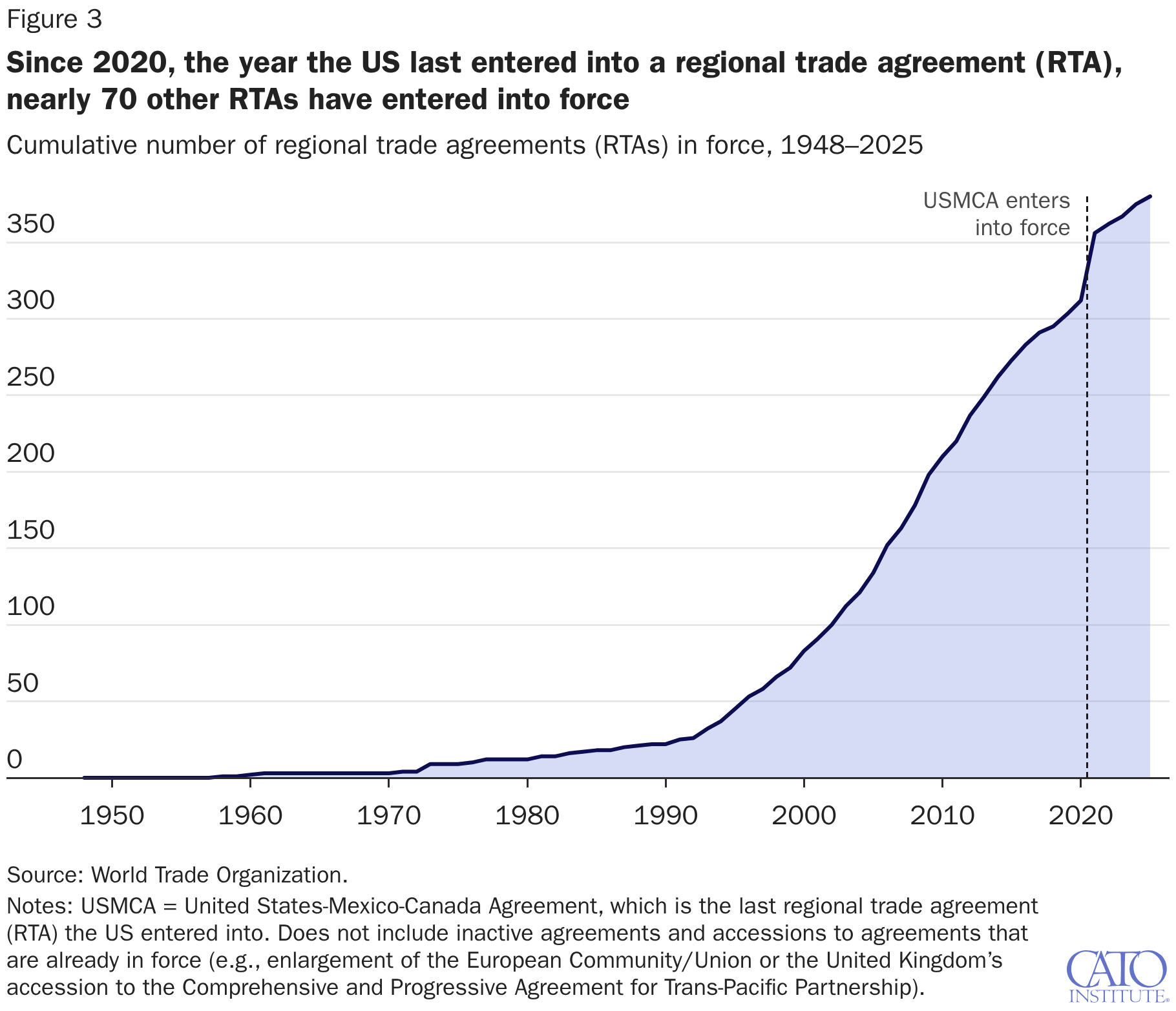
These agreements and others like them are deeper, broader, and more legally durable than the U.S. deals—and, importantly, they supplement the hundreds of non‑U.S. FTAs already in force, including the China-backed Regional and Comprehensive Economic Partnership, which will eventually liberalize about 90 percent of all trade among its 15 member countries (including Japan and Korea).
,
,
These moves not only allow governments to hedge away from depending on the U.S. market but also allow for “hidden” retaliation against U.S. goods and services: Instead of raising tariffs on American stuff and drawing Trump’s ire, governments can still put U.S. exporters at a long-term competitive disadvantage in their markets by cementing lower barriers to non‑U.S. goods.
Other forms of retaliation have also occurred. China and Canada went the typical route and applied tariffs on U.S. exports—the former to a significant degree. Brazil is now considering the same. As I discussed last year, moreover, foreigners also retaliated by boycotting American goods and services. A new study quantifies some of that damage, finding that foreign tourism—especially but not only among Canadians—declined substantially in response to “Liberation Day” tariffs, reducing U.S. services exports and costing American companies more than $1 billion per month in lost revenue.
Trump’s trade deals also, of course, require historically high U.S. tariffs backed by a flimsy legal rationale in permanent flux—hundreds of billions of dollars in chaotic new taxes that are mostly borne by U.S. companies, will likely depress investment, output, and, ironically, exports in seen and unseen ways, and have even fueled a “sell America” movement of foreigners slowly divesting from U.S. dollars and debt. Before all this started, U.S. tariffs averaged around 2 to 3 percent and were relatively transparent and simple. Since then, they’ve roughly quadrupled in magnitude and become mind-bendingly complicated. Throw in never-ending modifications and court litigation, and it’s an environment almost tailor-made to discourage companies—foreign and domestic—from making long-term bets on the U.S. market.
And for what? As I wrote last time, tariffs have likely been a drag on U.S. manufacturing output and capacity over the last 18 months, with the sector’s recent upswing focused on less-protected industries and driven by nontariff factors like the AI buildout. Prior to the trade wars, the U.S. had long been the top global recipient of foreign direct investment (FDI)—much of it going into manufacturing—and had seen real goods exports grow at about 3 percent a year from 2000 to 2019.
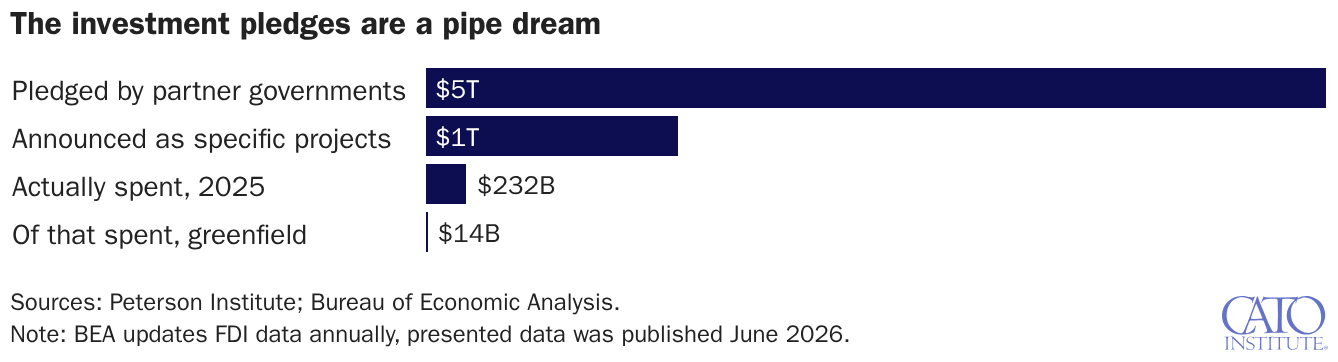
So far, there’s little sign of Trump’s deals improving on these figures. Last year, the United States remained the largest destination (and the largest source) of foreign direct investment, but the American share of global inflows continued to fall, from about 22 percent in 2022 to roughly 17 percent in 2025. (And the 2025 decline happened in a year when global FDI rose 6 percent, so we lost share in a rising market.) Foreigners’ direct spending on new or expanded U.S. facilities last year was $13.8 billion—a perfectly respectable clip but below 2023 in nominal terms. Promised future FDI of $66.1 billion was an improvement over 2024, but much of it is scheduled to land in 2028 or later. It’s also well below the $104.1 billion reported in 2022, not to mention the trillions the White House keeps reporting.
,
,
In short, the “tariff investment boom” still hasn’t materialized/shown up in the hard numbers, and—as shown above—there are strong reasons to believe it never will.
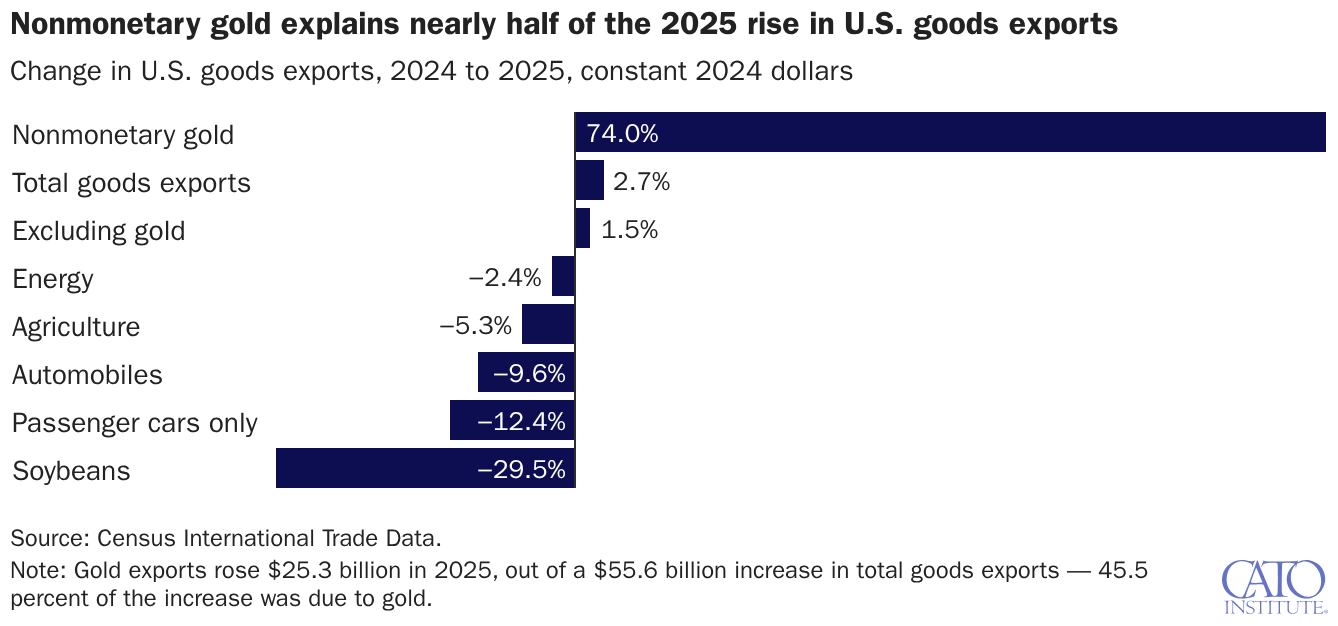
American exports, meanwhile, rose 2.7 percent in real terms last year, a little below the historical average and much of it owed to nonmonetary gold, which moved for reasons only tangentially related to U.S. trade policy. Beyond tourism, U.S. exports exposed to direct retaliation or high tariff-related costs—especially agriculture and autos—fell hard in real terms, with the farm situation so rough that it necessitated yet another multibillion-dollar government bailout.
,
,
Economists have long said that “a tax on imports is a tax on exports,” thanks to retaliation, higher input costs, currency adjustment, and resources shifting from export-oriented to import-competing industries. So far, the rule still applies.
Finally, there are the costs we can’t put in a chart. Studies have shown that past Trump tariff salvos have eroded U.S. “soft power” in measurable ways, and it seems to be happening again—much to China’s benefit. In July, Pew found that China was viewed more favorably than the United States in most of the 36 countries surveyed, with big swings coming in allied nations like Canada, Australia, France, and Germany. Middle-income countries, meanwhile, saw China as a more “reliable partner” than the U.S. and more likely to “contribute[ ] to peace and stability around the world.” A few months earlier, Gallup found China’s median global approval passing America’s across more than 130 countries and by a historic margin. Foreign policy isn’t a global popularity contest, but public opinions can affect foreign officials’ willingness to sign on to U.S.-led initiatives. And—as we just saw this week at the G20 finance ministers meeting in Asheville, North Carolina—few, if any, countries are eager to join U.S. efforts to choke off Iran or ring-fence China, partly because of tariff policy. (And let’s not even start on the Greenland tariff debacle.)
To the extent that projecting American power abroad depends on a strong and growing U.S. economy or on softer forms of persuasion, Trump’s tariffs have been a clear headwind.
Summing It All Up.
On the foreign policy front, Trump’s tariff experiment has produced a handful of tangible wins on market access abroad and foreign investment at home. What really matters, however, is how those narrow victories compare to what’s been promised and what real-world alternatives have achieved—and how much they cost. By these metrics, the tariff-first approach to U.S. foreign policy has been a demonstrable failure. We got big, empty promises and small, ephemeral deliverables that are dwarfed by what comprehensive, ratified trade agreements have achieved, and the process imposed substantial economic costs while pushing many countries—including many close geopolitical allies—to diversify away from the United States in real and long-lasting ways. Meanwhile, the nation’s biggest geopolitical challenges remain untouched.
In the end, the president’s tariff-centric approach—and the “world minus one” system it spawned—will make America less influential in trade and foreign policy and less secure overall, while emboldening China along the way. Oh, and we’ll be poorer, too.
If this is the best case that tariff advocates can make, I’d hate to see what the others look like.
Source: https://www.cato.org/commentary/trumps-vaunted-trade-deals-are-much-less-meet-eye
Anyone can join.
Anyone can contribute.
Anyone can become informed about their world.
"United We Stand" Click Here To Create Your Personal Citizen Journalist Account Today, Be Sure To Invite Your Friends.
Before It’s News® is a community of individuals who report on what’s going on around them, from all around the world. Anyone can join. Anyone can contribute. Anyone can become informed about their world. "United We Stand" Click Here To Create Your Personal Citizen Journalist Account Today, Be Sure To Invite Your Friends.
LION'S MANE PRODUCT
Try Our Lion’s Mane WHOLE MIND Nootropic Blend 60 Capsules
Mushrooms are having a moment. One fabulous fungus in particular, lion’s mane, may help improve memory, depression and anxiety symptoms. They are also an excellent source of nutrients that show promise as a therapy for dementia, and other neurodegenerative diseases. If you’re living with anxiety or depression, you may be curious about all the therapy options out there — including the natural ones.Our Lion’s Mane WHOLE MIND Nootropic Blend has been formulated to utilize the potency of Lion’s mane but also include the benefits of four other Highly Beneficial Mushrooms. Synergistically, they work together to Build your health through improving cognitive function and immunity regardless of your age. Our Nootropic not only improves your Cognitive Function and Activates your Immune System, but it benefits growth of Essential Gut Flora, further enhancing your Vitality.

Our Formula includes: Lion’s Mane Mushrooms which Increase Brain Power through nerve growth, lessen anxiety, reduce depression, and improve concentration. Its an excellent adaptogen, promotes sleep and improves immunity. Shiitake Mushrooms which Fight cancer cells and infectious disease, boost the immune system, promotes brain function, and serves as a source of B vitamins. Maitake Mushrooms which regulate blood sugar levels of diabetics, reduce hypertension and boosts the immune system. Reishi Mushrooms which Fight inflammation, liver disease, fatigue, tumor growth and cancer. They Improve skin disorders and soothes digestive problems, stomach ulcers and leaky gut syndrome. Chaga Mushrooms which have anti-aging effects, boost immune function, improve stamina and athletic performance, even act as a natural aphrodisiac, fighting diabetes and improving liver function. Try Our Lion’s Mane WHOLE MIND Nootropic Blend 60 Capsules Today. Be 100% Satisfied or Receive a Full Money Back Guarantee. Order Yours Today by Following This Link.


| Visits: | 1,834,028,646 |
| Stories: | 8,715,829 |
Whistler Blowers, Insiders

