

The Jones Act is suppressing demand for American shipping

In March, the Trump administration waived Section 27 of the Merchant Marine Act of 1920 (better known as the Jones Act) for certain cargo to combat surging energy prices during the war with Iran. The law, which requires ships transporting cargo between U.S. ports to be U.S-built, -flagged, -owned, and -crewed, has insulated the American waterborne transportation and shipbuilding industries from often cheaper, more specialized international competition.
Though justified on national security grounds, the Jones Act has been waived in crises dating back to Pearl Harbor and most recently, due to the Trump administration’s current war with Iran. The current waiver, set to expire in November, shows how heavily the Jones Act suppresses demand.
The Jones Act was passed after World War I to protect the U.S. shipbuilding and shipping industries and ensure sealift capacity in wartime. The idea was that requiring all goods to ship between U.S. ports on U.S.-built, -flagged, -operated, and -owned ships would keep the domestic shipbuilding industry strong and retain a large number of merchant mariners.
But the fleet has suffered since the Jones Act was signed into law. Ships have grown larger and carry more deadweight tonnage (a measure of cargo capacity), but the Jones Act-eligible fleet has shrunk from 434 oceangoing ships in 1950 to 92 as of April 2026, the date of the Maritime Administration’s (MARAD) latest Privately-Owned Merchant Fleet Report.
Total fleet deadweight tonnage is still lower than in 1950, as shown in Figure 1 below.
Figure 1: U.S. Domestic Trade Fleet – Deadweight Tonnage vs. U.S. GDP, 1951-2026
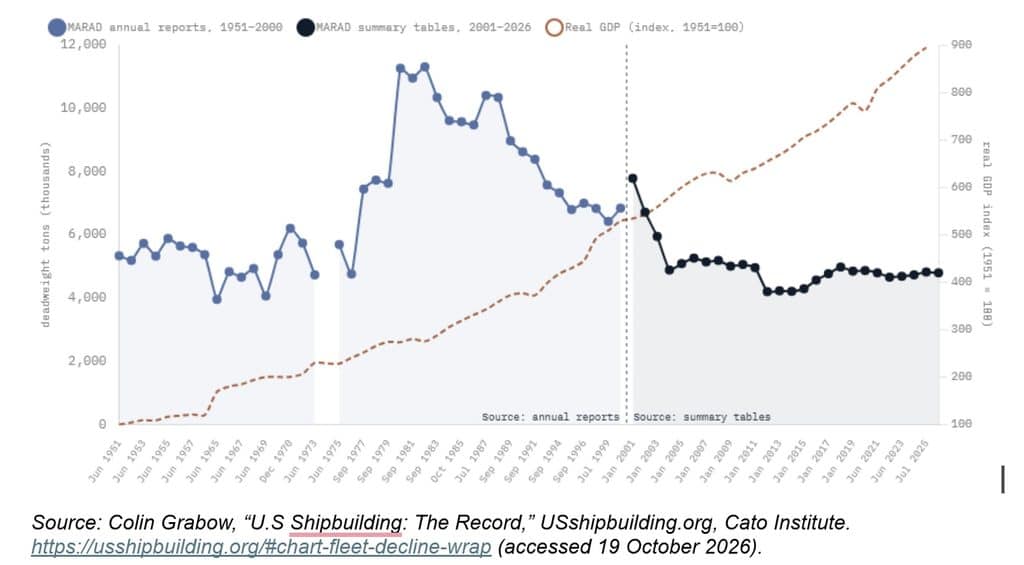
The law’s national security goal is undermined by the need to waive it during both natural disasters and military conflicts. In 2022, I wrote about the waiver that let a foreign vessel carry diesel fuel to Puerto Rico to help with recovery efforts. And this year, at the Department of Defense’s request, the Jones Act was waived again. The repeated need for these waivers shows that the Jones Act has some clear limitations. Instead of relying on national security concerns to allow foreign ships to carry goods between U.S. ports, Congress should create a process that allows waivers when no suitable American vessel is available.
That current waiver operates under a national defense statute (46 U.S.C. § 501(a)), allowing foreign-flagged ships to carry specific cargoes (energy products and fertilizer) between U.S. ports. The waiver was initially set for 60 days and has been extended twice for 90 days each. Operators must request approval before each trip. MARAD then conducts a vessel availability survey to see if a qualified U.S. vessel is available. If a qualified U.S. vessel isn’t available, the Department of Homeland Security can authorize a foreign vessel to carry the cargo. The Department of Defense has the final say on whether it grants a waiver and can issue one even when a U.S. vessel is available. Operators still file reports on every trip with MARAD, which publishes them.
The Cato Institute, a libertarian think tank, works extensively on Jones Act reform and has published a webpage tracking the current waiver and its impact on shipping. As of Oct. 19, Cato reports a total of 306 voyages using 235 unique vessels, 74 traversing the Panama Canal, shipping 81 million barrels of energy products. The findings show that the Jones Act has suppressed domestic demand.
For example, Puerto Rico received 10.5 million barrels of energy products in the first 208 days of the waiver, 279% above the annual baseline. Figure 2 below shows a more granular breakdown.
Figure 2: History of Shipments to Puerto Rico 2004-2026
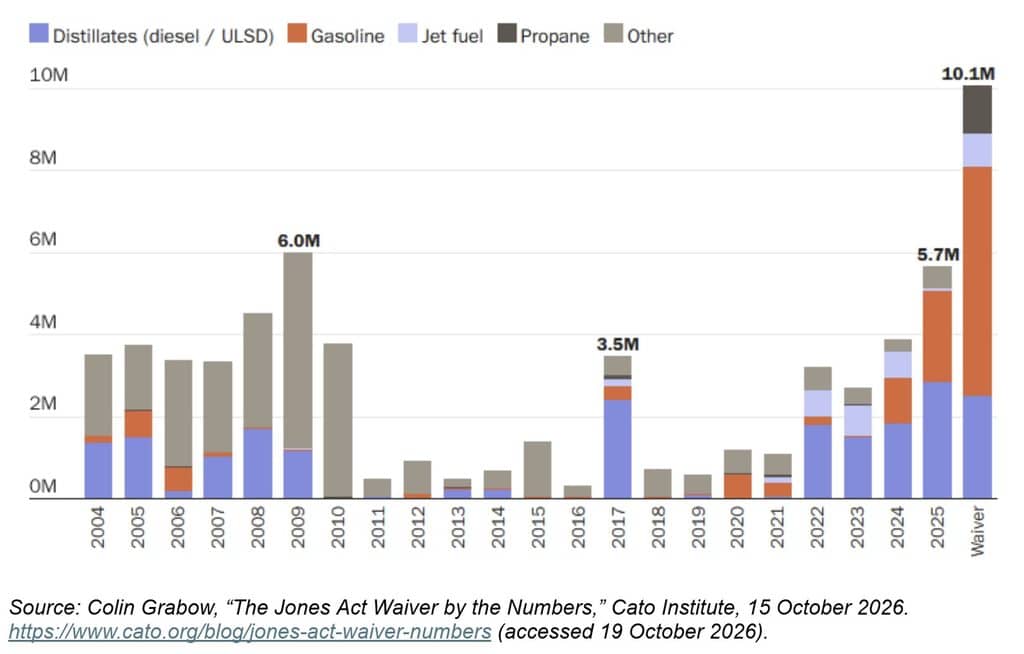
In less than seven months, U.S. petroleum exports to Puerto Rico have broken the previous all-time annual record. The page’s authors note that approximately 227% more propane was transported to Puerto Rico from the U.S. mainland in the first 202 days of the waiver than the combined total transported between 2004 and 2025. The United States is the world’s largest propane exporter, but before the waiver, Puerto Rico had to import propane from Chile, Nigeria, Equatorial Guinea, and other distant sources because of the Jones Act.
Cato’s tracking shows the Jones Act fleet itself has remained fully employed during the waiver, contrary to the industry’s claims. New routes are opening because demand that was priced out now has an affordable option, and in some cases because a suitable vessel now exists. The Jones Act fleet lacks specialized vessels for many voyages—for example, the fleet has only one liquefied natural gas carrier, zero dry bulk carriers, and zero liquefied petroleum gas carriers—so waivers like this allow trips that otherwise have no U.S. option to be carried out.
Currently, the only legal paths for major waivers run through the defense secretary or president, and both require a national defense finding.
Secretary of Defense Pete Hegseth treated the fuel and fertilizer shortage as a military matter, which made the current waiver possible. Congress ought to add a separate track for waiver approval based on economic need, allowing shippers, states, and territories to request a waiver when no U.S. vessel can carry the cargo. MARAD would publish the requests, give U.S. operators a set number of days to offer the service, and then decide whether a U.S. vessel takes the cargo or a foreign vessel receives a license for the voyage.
Canada and Mexico already have similar systems. Canada issues coasting trade licenses when no Canadian vessels are available for a voyage, and requests are filed through the Canada Border Services Agency.
Mexico’s Ley de Navegación y Comercio Marítimos, Art. 42 states that foreign vessels chartered by Mexican shipowners can provide service between two Mexican ports as long as no Mexican vessel can do it on equal terms.
The current Jones Act waiver expires Nov. 15, and the Trump administration can extend it again. Outright repeal is politically unlikely, but the waiver has shown where unmet demand exists, and an economic-need track would let Congress serve that demand without repealing the law. An economic-need process would give shippers, states, and territories a rule to follow and a way to use foreign ships to meet domestic demand that the Jones Act has suppressed since it was signed into law.
Congress shouldn’t wait until the next supply shortage to act and should pass a bill codifying an economic-need waiver track, especially for noncontiguous states and territories like Hawaii and Puerto Rico, to give them access to foreign vessels when no U.S. vessel is available.
The post The Jones Act is suppressing demand for American shipping appeared first on Reason Foundation.
Source: https://reason.org/commentary/the-jones-act-is-suppressing-demand-for-american-shipping/
Anyone can join.
Anyone can contribute.
Anyone can become informed about their world.
"United We Stand" Click Here To Create Your Personal Citizen Journalist Account Today, Be Sure To Invite Your Friends.
Before It’s News® is a community of individuals who report on what’s going on around them, from all around the world. Anyone can join. Anyone can contribute. Anyone can become informed about their world. "United We Stand" Click Here To Create Your Personal Citizen Journalist Account Today, Be Sure To Invite Your Friends.
LION'S MANE PRODUCT
Try Our Lion’s Mane WHOLE MIND Nootropic Blend 60 Capsules
Mushrooms are having a moment. One fabulous fungus in particular, lion’s mane, may help improve memory, depression and anxiety symptoms. They are also an excellent source of nutrients that show promise as a therapy for dementia, and other neurodegenerative diseases. If you’re living with anxiety or depression, you may be curious about all the therapy options out there — including the natural ones.Our Lion’s Mane WHOLE MIND Nootropic Blend has been formulated to utilize the potency of Lion’s mane but also include the benefits of four other Highly Beneficial Mushrooms. Synergistically, they work together to Build your health through improving cognitive function and immunity regardless of your age. Our Nootropic not only improves your Cognitive Function and Activates your Immune System, but it benefits growth of Essential Gut Flora, further enhancing your Vitality.

Our Formula includes: Lion’s Mane Mushrooms which Increase Brain Power through nerve growth, lessen anxiety, reduce depression, and improve concentration. Its an excellent adaptogen, promotes sleep and improves immunity. Shiitake Mushrooms which Fight cancer cells and infectious disease, boost the immune system, promotes brain function, and serves as a source of B vitamins. Maitake Mushrooms which regulate blood sugar levels of diabetics, reduce hypertension and boosts the immune system. Reishi Mushrooms which Fight inflammation, liver disease, fatigue, tumor growth and cancer. They Improve skin disorders and soothes digestive problems, stomach ulcers and leaky gut syndrome. Chaga Mushrooms which have anti-aging effects, boost immune function, improve stamina and athletic performance, even act as a natural aphrodisiac, fighting diabetes and improving liver function. Try Our Lion’s Mane WHOLE MIND Nootropic Blend 60 Capsules Today. Be 100% Satisfied or Receive a Full Money Back Guarantee. Order Yours Today by Following This Link.


| Visits: | 1,836,079,534 |
| Stories: | 8,726,747 |
Whistler Blowers, Insiders

