

Will Anyone Stop America’s Creeping Socialism?

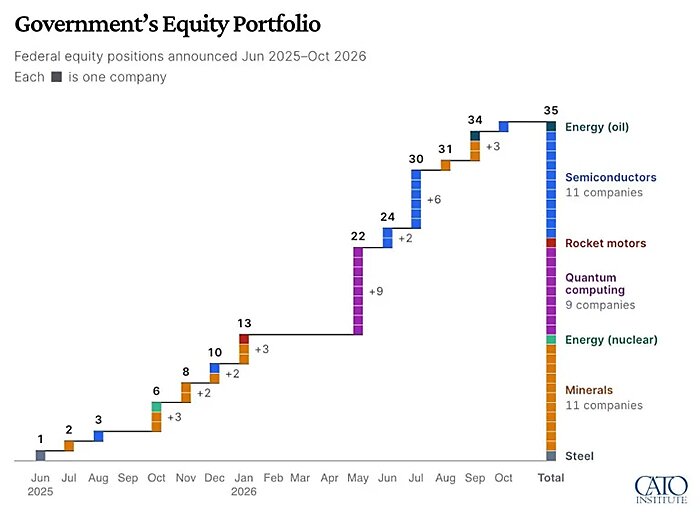
When I first checked in last year on the Trump administration’s unprecedented ownership stakes in private U.S. companies, I warned that the 10 equity deals—and “the year America went (kinda) socialist”—gave us plenty to worry about. Ten months later, Uncle Sam’s equity portfolio has now grown to cover 35 deals across the steel, critical minerals, semiconductors, quantum computing, nuclear power, rocket motor, and crude oil industries, using a variety of laws and agencies to acquire the stakes. Even more deals are likely on the way—including ones, such as the new Andruil submarine arrangement announced last week, that give Washington a stake in certain projects instead of entire companies.
,
Given the radical and opaque nature of the Trump administration’s moves—recall that Washington hadn’t taken a non-crisis stake in a healthy company in decades—Cato this week launched our Restoring Free Enterprise project to document, analyze, and counter the trend. As I wrote in the project’s introductory essay and in an August piece for the Washington Post, the government’s ownership stakes raise serious problems that have already begun to materialize: capital misallocation, politicized business decisions, preferential treatment, state coercion, corruption, and more.
Yet the biggest problem of all might be the simplest: Nobody—not even the Trump administration’s own lawyers—can point to a single U.S. law that expressly authorizes the executive branch to do any of this. That omission is glaring, and it matters for the stakes themselves, for how they might get unwound, and for whether anything stops the next president, of either party, from doing more of the same.
,
,
What the law actually says.
It’s been 16 months since the government took its first stake (last June’s U.S. Steel “golden share”), yet the Trump administration still hasn’t offered a clear and detailed legal justification for that deal or any other equity-based transaction. When Sens. Jack Reed and Roger Wicker asked about the legality of the Defense Department’s equity deals at a Senate Armed Services hearing in March, the Pentagon’s top industrial-base official said government lawyers would soon submit something to Congress on the issue. You’ll be shocked to learn that we’re still waiting for the memo. Other agencies have been similarly circumspect, offering little more than a press release with a statutory citation and no elaboration. Sometimes, we don’t even get that.
,
,
The Trump administration’s silence is notable—and troubling. Without a clear and official paper trail for all these equity deals, the public is left to guess as to how these expansive new powers—influencing or even controlling private companies!—are permissible under the law. The table below, constructed from press releases, SEC filings, and third-party reporting, is one such guess (and it’s admittedly incomplete). As the final column shows, none of the laws implicated by these deals expressly authorizes the federal agency at issue to take an ownership stake in a private, U.S.-based company:
,

,
In court, a Justice Department lawyer and Commerce Secretary Howard Lutnick recently argued that the CHIPS Act expressly authorizes the government’s Intel stake, but this is clearly false. Instead, these laws say the government can offer grants, loans, and other subsidies to target companies, and some of them contain broad language—e.g., “mitigation agreements” for transactions reviewed by the Committee on Foreign Investment in the United States (CFIUS) or “payments” and “other transactions” under the CHIPS Act—into which one could argue that equity arrangements fall. Yet none of these laws is new—the Defense Production Act that created CFIUS dates back decades; the Advanced Technology Vehicles Manufacturing (ATVM) loan program program started in 2008; the Industrial Base Fund began in 2011; CHIPS was enacted in 2021; and the Office of Strategic Capital in 2022—and no president has ever used them to acquire direct ownership interests like the ones Trump keeps taking. (A single ATVM loan to Tesla in 2010 gave the government the right to eventually exercise warrants to buy Tesla stock between 2018 and 2023, but the warrants were terminated when Tesla repaid the loan in 2013.)
In other words, numerous presidents of both parties did not read these laws as a broad license to indefinitely hold stock in numerous private companies. Only Trump did.
As Georgetown’s Peter Harrell explained last year, the administration’s best legal argument here is simply that the language of these laws is vague and does not expressly forbid taking a golden share, equity stake, or other slice of the corporate pie, and a target firm could always just walk away if it didn’t like the government’s terms. Yet this argument fails for several reasons.
For starters, this is Washington we’re talking about, and there’s already evidence in several cases that these companies couldn’t just walk away from the equity deals (i.e., demands) they were presented. As I noted in the Post, in fact, the Intel deal and others appear to have been coerced by the Trump administration or “conditioned on the granting of a permit, subsidy or other government privilege.” When the federal government wants a slice of a company whose business depends on something Uncle Sam has, saying no isn’t really an option. And it’s foolish (at best) to pretend otherwise.
There’s also clear evidence that Congress knows how to say “equity” when it wants equity, just like it knows how to say—and does say—“grants” or “loans” in these very same laws. In CHIPS, for example, Sens. Bernie Sanders and Elizabeth Warren proposed an amendment forcing subsidy recipients to hand over equity, but it never passed. This year, Republican-led committees in the House and Senate have advanced legislation to authorize the Pentagon to make government equity investments with certain limitations, but those aren’t yet law, either. On the other hand, the Troubled Asset Relief Program expressly required the Treasury Department to obtain warrants (or senior debt) from the institutions it bought assets from, and the CARES Act barred Treasury from lending to eligible large businesses without receiving warrants or equity. (Both laws were also enacted during crises, of course.)
In a forthcoming essay for the Restoring Free Enterprise project, Cato legal expert Molly Nixon examines this statutory language in detail, finding that none of the laws behind today’s equity stakes contain anything like it. That matters—or, at least, it should.
The Trump administration also knows about equity authority—until it doesn’t. When Trump’s Venezuela oil deal was announced, for example, a spokesman for the Pentagon’s Office of Strategic Capital initially said that the office doesn’t take equity stakes in private companies. A few days later, another U.S. official claimed, without evidence, that Congress had given OSC exactly that power. Semafor, meanwhile, reports that Congress previously had declined Pentagon requests for equity authority, and over at Lawfare, Benjamin Press elaborates on the administration’s selective memory in this case (emphasis mine):
,
At the outset of the second Trump administration, the executive branch evidently believed that the department lacked clear authority to take equity stakes, and the Office of Management and Budget requested language in the National Defense Authorization Act (NDAA) for Fiscal Year 2026 that would have granted the Defense Department the authority to do so. Nevertheless, no such language was added to the NDAA—or any other law. In other words, the only thing that could have changed between the beginning of the Trump administration, when the White House evidently believed that the Defense Department lacked clear authority, and mid-2025, when the department began making its investments, is its interpretation of existing authorities.
,
The administration’s new “interpretation,” meanwhile, appears to be distressingly thin. As Semafor reported last month, a June 2025 memo from the Office of Management and Budget claimed that a $400 million investment in MP Minerals was legal simply because it was “necessary to avoid an imminent threat to human life and government property.” The opinion also cited the Defense Production Act, a 2017 defense authorization, Article II of the Constitution, and—I kid you not—the “venerable tradition of presidential obligations in advance of appropriation” stretching back to 1792. (None of these things, of course, actually authorize equity stakes.) Former Pentagon officials briefed by Semafor said they were “skeptical” of OMB’s legal reasoning. “[I’m] surprised that the current team has discovered the authority to do this under the Defense Production Act,” one former OSC official told the outlet, adding that “laws can be elastic, but elasticity snaps at some point.” Sigh.
These justifications, by the way, are the best of the bunch. Some, such as the Commerce Department’s “participation interest” deal with Westinghouse or the government’s cut of Nvidia and AMD chip sales to China, don’t even bother with a statute. (Nvidia is now getting sued in Delaware on the grounds that the government is “constitutionally barred from imposing duties or taxes on exports.”) Trump’s Venezuela oil deal is even sketchier.
Finally, there are the obvious and troubling implications of an executive branch declaring sweeping and unprecedented new powers simply because Congress didn’t expressly bar such actions. As I explained in a new podcast accompanying the Restoring Free Enterprise project rollout, that’s an argument for unlimited executive power, not just for equity stakes, and it directly contradicts our constitutional system of government and enumerated powers. Even folks who are decidedly not from my libertarian side of the law, such as Georgetown’s Harrell and Biden-era Assistant Secretary of Defense Laura Taylor-Kale, are uncomfortable with where this is all heading.
So, how do we stop it?
That leads us to what might be the worst part of it all: Without any clear legal framework for doing this stuff, there’s no clear way to undo it or to stop more transactions in the future. As already noted, the pace of these deals has accelerated in 2026, and Trump has literally said that his standard for taking government equity stakes is simply “when people need something.” Trump and his team will surely announce more deals this year and next (another one popped up while I was typing this). And whoever wins in 2028, Republican or Democrat, will inherit both the portfolio and the unbridled power to expand it. The economic and political consequences—private capital increasingly flowing to the connected, a government with a direct financial interest in a growing set of firms, crony losers flocking to D.C, for an equity bailout, a president who increasingly uses stock deals to reward and punish American companies, and plenty more—could be enormous.
Congress could pass a law to force divestment and dismantle these (implied) powers, but that’s easier said than done. Some Democrats are uncomfortable with the equity deals, but many others—and not just Bernie Sanders and his fellow travelers—simply want more transparency and structure around them. Meanwhile, the party campaigning against “socialism” this fall is ironically the one advancing bills to authorize equity investments rather than terminate them. There are welcome exceptions—Sen. Jon Husted introduced a bill requiring covered stakes to be liquidated, and Sens. Thom Tillis and Mike Rounds have criticized the deals—but they probably won’t be the rule as long as Trump’s in office. Thus, securing a veto-proof majority for broad divestment legislation will likely be a serious challenge for the foreseeable future.
That leaves the courts, but the path here is also difficult and murky. Most companies with government equity stakes have little incentive to challenge a deal that inflates their stock prices, and the same goes for their shareholders. Any such challenge, moreover, would risk upsetting an all-powerful federal government and its, ahem, temperamental president. The same risk applies to federal contractors who might challenge government contracts awarded to state-backed firms on conflict-of-interest grounds.
These incentives likely explain why there’s been just one shareholder lawsuit to the equity deals so far. There, plaintiffs have challenged the Intel deal as a breach of its directors’ fiduciary duties (because they gave the government shares in exchange for nothing). Many legal experts think it’ll be a tough case to win, and, even if it is eventually successful, there are dozens of other deals that would also need to be challenged.
Finally, Congress could sue the Trump administration, similar to how the House of Representatives challenged—successfully in part, and unsuccessfully in others—President Obama’s implementation of the Affordable Care Act. That case required only a House majority, which Democrats will likely have next year. But here, too, there are major uncertainties surrounding whether Democrats will actually want to trim these new powers and whether a federal court would rule in their favor, given courts’ deference and these laws’ ambiguities.
In short, the same government that took these unprecedented equity stakes without clear statutory permission has no clear path for getting out. To restore both free enterprise and the rule of law, however, it’s imperative that we chart one.
Markets FTW (whether you like it or not)
Despite legally and morally dubious Trump administration airstrikes, the Wall Street Journal reports that “[r]ecord supplies of cocaine still arrive in the U.S., Europe and as far away as Australia every day, cheaper and purer than they’ve been in decades.” The Journal goes on to document how, in response to crackdowns by U.S., European, and other government officials, drug traffickers didn’t stop trafficking—they just found new and creative ways to satisfy unchanged global demand for the drug. (Example: “Smugglers have learned to embed the drug in charcoal, leather hides, cement and fruit pulp, and then take it out after pickup at a destination port.”)
Shocking, I know. I’m sure more taxpayer money and innocent victims will solve this problem any second now.
Chart of the Week
,
,
,

,
,
Source: https://www.cato.org/commentary/will-anyone-stop-americas-creeping-socialism
Anyone can join.
Anyone can contribute.
Anyone can become informed about their world.
"United We Stand" Click Here To Create Your Personal Citizen Journalist Account Today, Be Sure To Invite Your Friends.
Before It’s News® is a community of individuals who report on what’s going on around them, from all around the world. Anyone can join. Anyone can contribute. Anyone can become informed about their world. "United We Stand" Click Here To Create Your Personal Citizen Journalist Account Today, Be Sure To Invite Your Friends.
LION'S MANE PRODUCT
Try Our Lion’s Mane WHOLE MIND Nootropic Blend 60 Capsules
Mushrooms are having a moment. One fabulous fungus in particular, lion’s mane, may help improve memory, depression and anxiety symptoms. They are also an excellent source of nutrients that show promise as a therapy for dementia, and other neurodegenerative diseases. If you’re living with anxiety or depression, you may be curious about all the therapy options out there — including the natural ones.Our Lion’s Mane WHOLE MIND Nootropic Blend has been formulated to utilize the potency of Lion’s mane but also include the benefits of four other Highly Beneficial Mushrooms. Synergistically, they work together to Build your health through improving cognitive function and immunity regardless of your age. Our Nootropic not only improves your Cognitive Function and Activates your Immune System, but it benefits growth of Essential Gut Flora, further enhancing your Vitality.

Our Formula includes: Lion’s Mane Mushrooms which Increase Brain Power through nerve growth, lessen anxiety, reduce depression, and improve concentration. Its an excellent adaptogen, promotes sleep and improves immunity. Shiitake Mushrooms which Fight cancer cells and infectious disease, boost the immune system, promotes brain function, and serves as a source of B vitamins. Maitake Mushrooms which regulate blood sugar levels of diabetics, reduce hypertension and boosts the immune system. Reishi Mushrooms which Fight inflammation, liver disease, fatigue, tumor growth and cancer. They Improve skin disorders and soothes digestive problems, stomach ulcers and leaky gut syndrome. Chaga Mushrooms which have anti-aging effects, boost immune function, improve stamina and athletic performance, even act as a natural aphrodisiac, fighting diabetes and improving liver function. Try Our Lion’s Mane WHOLE MIND Nootropic Blend 60 Capsules Today. Be 100% Satisfied or Receive a Full Money Back Guarantee. Order Yours Today by Following This Link.


| Visits: | 1,835,225,372 |
| Stories: | 8,722,128 |
Whistler Blowers, Insiders

