

To Curb China’s Maritime Ambition, the U.S. and Allies Must Forge Trusted Maritime Port Networks

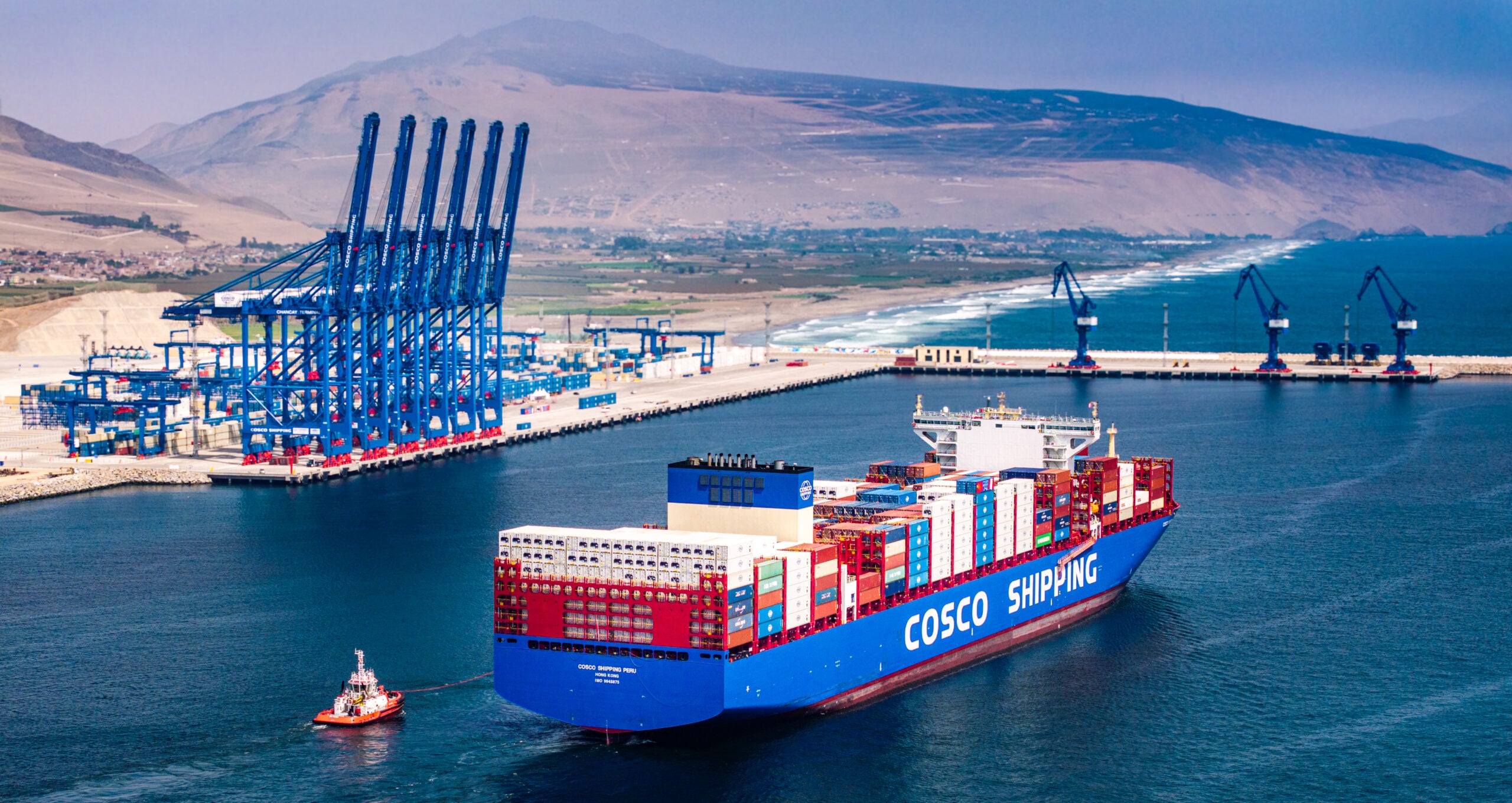
The Chancay Port in Peru: A key node revealing China’s expansive maritime ambition within the trans-Pacific logistics network. (Photo Credit: CGTN)
Over the last twenty years, China has moved with calculated speed to assemble a sophisticated and highly integrated network of global ports. According to the Council on Foreign Relations tracker on Chinese overseas ports, Chinese firms and state‑linked entities have invested in or acquired operational stakes in 129 overseas port projects worldwide. China’s maritime footprint now extends across every continent except Antarctica, reinforced by dozens of bilateral shipping agreements and substantial state‑backed financing arrangements. With nearly 95 percent of China’s international trade dependent upon maritime routes, Beijing has powerful incentives to secure privileged access to overseas logistical infrastructure.
The strategic implications of this expansion derive not simply from the scale of investment, but from the inherently dual‑use character of contemporary port infrastructure. Deepwater terminals, repair facilities, fuel depots, and smart logistics platforms can facilitate not only commercial activity but also military sustainment and strategic access. Chinese influence, therefore, may not necessarily manifest itself through overt naval basing arrangements. More often, it materializes through quiet leverage over the connective tissue of global commerce — data systems, transshipment networks, financing structures, and logistical chokepoints.
This reality has provoked a gradual strategic recalibration among the United States and its allies. Recent trends in global infrastructure competition suggest that Western governments are increasingly seeking to support alternative port development projects adjacent to Chinese‑dominated logistics corridors, spanning from the Mediterranean to Latin America and the Caribbean. Yet, despite this growing awareness, a pronounced asymmetry in strategic mobilization remains.
Peru’s Chancay Port exemplifies this imbalance with particular clarity, serving as a primary engine for Chinese economic encirclement in the Western Hemisphere. Located just north of Lima, this ultra-modern deep-water facility—backed by a $1.3 billion initial investment from COSCO Shipping—has fundamentally altered Pacific logistics. By cutting shipping times to Shanghai by a third to just 23 days, the port has already catalyzed a 47.1% year-on-year surge in trade between Peru and Shanghai since late 2024. This direct maritime corridor allows Beijing to ‘snap up’ critical volumes of copper and zinc essential for the green energy transition, while simultaneously flooding regional markets with cheaper Chinese automobiles and electronics. More significantly, Chancay is emblematic of a broader ‘pincer’ strategy involving over a dozen Chinese-controlled hubs across Latin America. It illustrates Beijing’s capacity to synchronize state financing, industrial policy, and maritime interests into a coherent strategy to consolidate control over critical supply chains. Consequently, Chancay has evolved beyond a mere Pacific gateway; it now functions as a strategic bridgehead that translates infrastructure investment into permanent political leverage, effectively challenging U.S. commercial and logistical primacy in its own ‘near abroad.’
By contrast, the United States has frequently struggled to synchronize public and private capital around comparable strategic infrastructure initiatives abroad. This deficiency is especially consequential in the Caribbean Basin, where logistics hubs sit in close proximity to critical American maritime approaches. Jamaica’s Kingston Port, for instance, processed over three million TEUs in 2025—accounting for 60% of all cargo transit in the Caribbean region—with the overwhelming majority consisting of transshipment cargo tied to regional and global trade flows. However, America’s lagging investment in the port has created a predatory opportunity for China to fill the vacuum. Last year, the China Harbour Engineering Company (CHEC) secured a bid to undertake a massive expansion of Kingston Harbor. This initiative, featuring a new 800-meter deep-water berth and an automated storage yard, is projected to increase annual throughput to 3.2 million TEUs. Such heightened involvement by Chinese state-linked firms significantly bolsters Beijing’s strategic position, utilizing Kingston as a central hub to catalyze the development of the Jamaica Free Trade Zone—a critical node in the China-Latin America Maritime Silk Road.
If Washington intends to preserve a stable maritime order across both the Atlantic and Pacific theaters, it cannot rely exclusively upon conventional deterrence. It must also compete in the slower, less visible, yet ultimately decisive arena of maritime infrastructure development.
From Home to Abroad: How Allied Innovation Can Counter China’s Maritime Ambition
To overcome the apparent asymmetry in global maritime investment, the United States must collaborate with its allies to counter China’s port ambitions, starting within domestic borders before expanding strategically abroad. Strategic gateways such as Long Beach, California, and Houston, Texas, demand a fundamental shift toward structural modernization that integrates automation, digital logistics, and resilient infrastructure. As critical nodes for Pacific trade and global energy exports, these hubs must be fortified—not only to enhance commercial efficiency but to secure national interests against geopolitical coercion and supply-chain weaponization.
Crucially, this transition is achieved through a deep alignment between U.S. national security requirements and the industrial expertise of key allies. This synergy focuses on transforming these vital maritime assets into energy-independent hubs, offering a new model for national resilience. While Japan’s leading corporate partners have already demonstrated the viability of hydrogen-powered logistics, the integration of contributed technologies from South Korea—particularly in high-density energy management and automated propulsion—could further stabilize the power architecture across both Pacific and Gulf Coast facilities. By weaving these allied innovations into the domestic fabric, the United States can displace vulnerable foreign hardware with a self-sustaining, American-led energy grid capable of maintaining critical operations during global disruptions.
Furthermore, to eliminate reliance on compromised foreign technology, the alliance must cultivate a fully autonomous and secure port ecosystem. This involves the deployment of trusted infrastructure, including contributed automated ship-to-shore (STS) cranes, autonomous transport systems, and secure operating software that meet the highest U.S. security standards. Rather than simple procurement, this model represents an integrated operational partnership where allied expertise is embedded into U.S.-certified infrastructure. By replacing vulnerable operational environments with these trusted, allied-contributed solutions, the partnership ensures that the strategic port networks of both California and Texas effectively neutralize any attempts by adversarial powers to dominate global maritime data and logistics.
Domestic revitalization, however, serves merely as the foundation for a broader strategic project. The next phase must involve the systematic construction of trusted maritime infrastructure networks overseas, particularly in regions central to critical-mineral supply chains. Chile’s San Antonio port exemplifies this strategic logic. As global demand for lithium and copper accelerates, Pacific ports connecting South America to the Indo-Pacific will become vital nodes within allied industrial supply chains. Rather than permitting these networks to evolve exclusively around Chinese-centered financing and logistics, the United States and its allies—including South Korea, Japan, and Australia—must pursue long-term co-investment frameworks that offer partner nations a technologically superior and strategically secure alternative.
Beijing recognized long ago that maritime influence is exercised not through naval tonnage alone, but through the terminals, energy corridors, and logistics software that command the flow of trade. If the United States and its allies intend to preserve a resilient and balanced maritime order, they must move beyond reactive competition. In the coming decades, the balance of power will depend less upon who commands the seas directly than upon who constructs—and secures—the infrastructure through which global commerce ultimately flows.
Source: https://foreignpolicyblogs.com/2026/06/29/to-curb-chinas-maritime-ambition-the-u-s-and-allies-must-forge-trusted-maritime-port-networks/
Anyone can join.
Anyone can contribute.
Anyone can become informed about their world.
"United We Stand" Click Here To Create Your Personal Citizen Journalist Account Today, Be Sure To Invite Your Friends.
Before It’s News® is a community of individuals who report on what’s going on around them, from all around the world. Anyone can join. Anyone can contribute. Anyone can become informed about their world. "United We Stand" Click Here To Create Your Personal Citizen Journalist Account Today, Be Sure To Invite Your Friends.
LION'S MANE PRODUCT
Try Our Lion’s Mane WHOLE MIND Nootropic Blend 60 Capsules
Mushrooms are having a moment. One fabulous fungus in particular, lion’s mane, may help improve memory, depression and anxiety symptoms. They are also an excellent source of nutrients that show promise as a therapy for dementia, and other neurodegenerative diseases. If you’re living with anxiety or depression, you may be curious about all the therapy options out there — including the natural ones.Our Lion’s Mane WHOLE MIND Nootropic Blend has been formulated to utilize the potency of Lion’s mane but also include the benefits of four other Highly Beneficial Mushrooms. Synergistically, they work together to Build your health through improving cognitive function and immunity regardless of your age. Our Nootropic not only improves your Cognitive Function and Activates your Immune System, but it benefits growth of Essential Gut Flora, further enhancing your Vitality.

Our Formula includes: Lion’s Mane Mushrooms which Increase Brain Power through nerve growth, lessen anxiety, reduce depression, and improve concentration. Its an excellent adaptogen, promotes sleep and improves immunity. Shiitake Mushrooms which Fight cancer cells and infectious disease, boost the immune system, promotes brain function, and serves as a source of B vitamins. Maitake Mushrooms which regulate blood sugar levels of diabetics, reduce hypertension and boosts the immune system. Reishi Mushrooms which Fight inflammation, liver disease, fatigue, tumor growth and cancer. They Improve skin disorders and soothes digestive problems, stomach ulcers and leaky gut syndrome. Chaga Mushrooms which have anti-aging effects, boost immune function, improve stamina and athletic performance, even act as a natural aphrodisiac, fighting diabetes and improving liver function. Try Our Lion’s Mane WHOLE MIND Nootropic Blend 60 Capsules Today. Be 100% Satisfied or Receive a Full Money Back Guarantee. Order Yours Today by Following This Link.


| Visits: | 1,834,745,816 |
| Stories: | 8,719,843 |
Whistler Blowers, Insiders

