

The nonprofits that ate the California Dream

California was America, fearless and productive. It gave us memories of test pilots over the Mojave Desert, Wozniak and Jobs in a garage, Gregg Toland and Orson Welles cutting a hole in the floor of a sound stage on the RKO lot to get a lower camera angle for Citizen Kane. It’s where the dreamers went to make things. It starting dying about forty years ago, but it took us a while to notice.
California in 2026 is the home to a formidable collection of supposedly non-governmental organizations—NGOs—that proclaim their commitment to social justice and economic equity. They’re helping. That’s their industry.
The California Endowment, with “more than $4 billion in assets,” pursues “the mandate to ensure health and justice for all.”
The James Irvine Foundation, with a $3.6 billion endowment, seeks “fair and just outcomes for all Californians.”
The Weingart Foundation, with about $900 million in assets, “partners with communities across Southern California to advance racial, social, and economic justice for all.”
The California Wellness Foundation works on things such as “civic engagement and power-building to elevate community voices and priorities,” and has about a billion dollars in assets to help them elevate those voices. That’s presumably a lot of voice-elevating.
And so on. The California Association of Non-Profits last published a detailed report on the size of the state’s nonprofit sector in 2019, concluding that “one in every 14 California jobs is at a nonprofit.” For a current estimate, the national advocacy organization Independent Sector reports that the state has 144,728 non-profit organizations, 123,321 of which are public charities. Together, those organizations employ an estimated 1,112,268 people.
Also, California leads the country in poverty. A recent report from CalMatters notes that “California’s rate, 17.7%, means that nearly 7 million of its residents are impoverished, 5 percentage points higher than the national rate and tied with Louisiana.”
A massive fairness industry, partnering with communities to advance social and economic justice for all, isn’t advancing social and economic justice for much of anyone, while they get in the way of the productive and useful part of the state. Advocacy, even expensive advocacy, doesn’t appear to produce the thing the advocates call “justice.”
So, what does it produce? A report from the California Policy Center (a rare conservative nonprofit in the state) offers a suggestion: “Over the last 50 years, a well-resourced network of donors, foundations, advocacy groups, and unions have developed a strategy to build a funding infrastructure capable of shaping policy, public opinion, and electoral outcomes.”
All of that works together as one integrated unit, and all of it imposes extraordinary costs on the culture, economy, and politics of the state.
An NGO-controlled state legislature
The NGOcracy governs California. Legislators tend to come from the world of activism and nonprofits, not from business. They make laws that reflect the experience of making things or building things.
Consider the story of a single California NGO and the person who ran it.
You can read about the origins of the non-profit corporation now called SBX Youth and Family Services on their website, starting with the founding of a student group at Rialto High School in 1995. Then came the big milestone of high school graduation for “the founding members…including our first President Corey Jackson,” which happened in 2000. Jackson did political work for years, leading the group that would become SBX while drawing a paycheck as a field representative for a series of legislators.
Then came the lawsuit: In 2018, the Inland Empire non-profit that was then still called Sigma Beta Xi and the ACLU sued Riverside County over the operation of a program run by probation officers for at-risk youth, the Youth Accountability Team (YAT). The ACLU and its plaintiff argued that “YAT treats children who have not been convicted of crimes like hardened criminals with surprise searches, unannounced home visitations, strict restrictions on who participants can speak to, curfews, and interrogations into intimate details of their lives. It’s a program far more likely to be applied to youths of color.”
The county settled the lawsuit. Among the conditions: a promise to provide millions of dollars in direct county funding “for community-based organizations to provide services to youth.” Sigma Beta Xi and its president were finally funded, steadily and reliably. An NGO was consistently connected to a source of taxpayer dollars, and Jackson could lead it as full-time work.
You can see the result in Sigma Beta Xi’s Form 990, the financial disclosure reports that a nonprofits file with the IRS. In 2022, the group reported $2,398,366 in “contributions and grants,” reporting its activities in all-caps: “MENTORING APPROXIMATELY 400 STUDENTS ON 15 VARIOUS SCHOOL CAMPUSES LOCATED IN THE INLAND EMPIRE METROPOLITAN AREA OF SOUTHERN CALIFORNIA.”
Take a moment to divide $2.4 million by 400 for yourself. Sigma Beta Xi also reported that it had paid a salary of $97,390 to its CEO and president, Corey Jackson.
Near the end of that year, Jackson left the nonprofit for his new job as a California state legislator.
This story is typical California. When the legislature encounters NGOs, it meets itself. Legislators tend to come from the world of activism and nonprofits, not from business. They don’t end up making laws because they used to make things or build something. Instead, their professional background is “fighting for access to” or “ensuring that everyone gets a chance to.” The legislature is a little island of NGO culture, comfortable with the language and presumptions of professional badgering and hectoring.
The state senator Maria Elena Durazo has just been elected to the Los Angeles County Board of Supervisors. Here’s the opening of the “Meet Maria” page on her campaign website:
A farm worker organizer. A student activist.
A sweat shop organizer and union reformer. A national immigration leader.
A Democratic National Committeewoman. LA County’s Labor Federation President.
A State Senator.
Arrested over 13 times for leading non-violent Civil Rights and Worker Rights protests.
This is who makes the laws and shapes the state budget in California. Government and the thing ironically called “non-governmental organizations” eloped while no one was looking. NGOs are GOs, living in good part on government grants while they shape the debate that guides state government. Legislators and NGO executives are partners and peers. They march in step.
The former Assembly Speaker Anthony Rendon came to the legislature through a series of NGOs, including a stint as “executive director of Plaza de la Raza Child Development Services, Inc., which provides comprehensive child development and social and medical services to over 2,300 children and families throughout Los Angeles County.”
The reptilian Silicon Valley Assemblyman Marc Berman, a lawyer, worked for a while at private law firms, but then he found his true calling: “While serving on the Palo Alto City Council, Marc worked for the Silicon Valley Education Foundation, a non-profit focused on increasing access to high quality STEM education and closing the achievement gap in Bay Area public schools.”
Senator John Laird “served as executive director of the Santa Cruz AIDS Project.”
Assemblywoman Mia Bonta, the wife of California Attorney General Rob Bonta: “Prior to being elected to the State Assembly, Mia served as the CEO of Oakland Promise, a cradle-to-college and career preparation initiative across Oakland public schools.”
Assemblywoman Stephanie Nguyen “served as the Executive Director of Asian Resources, Inc. (ARI) to ensure that all communities, especially the low-income, immigrant, refugee, limited English-speaking, formerly incarcerated and undocumented, have access to support and services to help them get one step closer to self-sufficiency.”
And on, and on, and on. The NGOcracy governs California. NGOs are the farm team for elected office, and the players on the big league team play the game they learned as they came up through the minors.
The California Dream
In 2024, a Republican state senator made the theme of flight explicit, speaking during a legislative hearing in Sacramento to tell families to run. “If you love your children,” said Senator Scott Wilk, “you need to flee California. You need to flee.”
The idea of America runs through the Slater Mills to Henry Ford’s River Rouge plant, and on to the SpaceX Starbase. Americans have perceived themselves as makers, builders, restless people who moved and created. The 1893 Chicago World’s Columbian Exposition was a party the country threw for itself in front of the world, with 200,000 electric lights (in the first electrified World’s Fair), a towering steel-framed Ferris Wheel, and giant exhibition buildings to show off American industry: Look at what we can do. Just go look at the photographs of the fair’s Electricity Building, and try not to burst into nervous laughter at the audacity of the thing.
California was that America. It built prosperity as a maker state, a place of explosive growth and major industry. It buzzed. Not actually, but close enough. The birth of movies and television were the birth of Hollywood. The birth of computers was the birth of Silicon Valley. The Cold War was the birth of an aerospace industry that relied on industrial innovation even as it paid the bills with the government funding. Lockheed Martin’s Skunk Works sits in the Mojave Desert because that’s where that stuff happened. There are still outdoor spaces in the desert north of Los Angeles where you can find public monuments to wild men in white polyester shirts and black clip-on ties, the cowboy-engineers who tried to fly whatever the aerospace companies tried to build.
Affluent and ambitious, California became a cultural center because there was money to pay for the cultural stuff. Pasadena is a center of Arts & Crafts architecture because Pasadena was a center of East Coast industrial wealth that went looking for nice weather; the famous Greene and Greene-designed Gamble House was built with soap money. Richard Neutra left Austria to build Modernist homes in places like Palm Springs. Bakersfield was an important center for mid-century modern architecture, because there was oil money there. Important architects wanted to build, so they went to the place where people were doing that.
Restless and always building, California drew Americans from other states. A population of a little less than seven million people in 1940 grew to twenty million by 1970, drawn by aerospace jobs and postwar prosperity. Now it’s close to forty million.
That population has also begun, for the first time, to shrink. Remarkable news headline from March of this year: “Los Angeles County sees largest population decline in the U.S., census data shows.” A county of ten million people has become a county of 9.7 million people; 54,000 left in a single year, from the middle of 2024 to the middle of 2025.
Los Angeles isn’t alone. A January report from the Public Policy Institute of California describes a relentless tide of outmigration from the whole state. “From 2010 through 2024 (the year of the latest data) almost 10 million people moved from California to other states,” the report concludes, “while just over 7 million people moved to California from other parts of the country, according to the American Community Survey. In fact, according to Department of Finance estimates, the state has lost residents to other states every year since 2001.”
Here’s a clue about who’s leaving and who’s coming: In ten years, statewide public school enrollment has declined by a half a million children.
In 2024, a Republican state senator made the theme of flight explicit, speaking during a legislative hearing in Sacramento to tell families to run. “If you love your children,” said Senator Scott Wilk, “you need to flee California. You need to flee.”
“Born and raised in this state, I love this state,” Wilk added. “I’m not going to stay in this state. Because it’s just too oppressive. And I believe in freedom, and so I’m going to move to America when I leave the legislature.”
Wilk was wrong about one thing: California isn’t separate from America. It’s the bleeding edge of what America threatens to become, the social laboratory for a cultural transition. The state concentrates the dose of the burgeoning American poison.
Let a Californian tell you about that poison. Rep. Ro Khanna, who represents Silicon Valley in the U.S. House, reacted to the SpaceX IPO and the expansion of Elon Musk’s personal net worth by laying out a competing vision about the origins of correct prosperity. “Republicans believe that if you let the wealthy spend capital, it will make Americans prosperous,” he wrote. “Democrats believe that the federal government investing in the healthcare & education of our people will make America prosperous & productive.”
That’s not a uniquely Californian vision, and U.S. Senators such as Bernie Sanders and Elizabeth Warren weighed in from New England with a similar vision. But California is a cultural leader in the view that private enterprise is cruelty and greed, while anything that doesn’t make a profit is inherently virtuous and decent. Mean Elon Musk is making rockets, cheap global satellite-based Internet access, electric cars, a platform for open discourse, and money, and that’s very bad.
The California Community Foundation
The California Association of Non-Profits last published a detailed report on the size of the state’s nonprofit sector in 2019, concluding that “one in every 14 California jobs is at a nonprofit.”
There are some problems with this division of the world into the categories of greedy and virtuous based on the presence of profit.
In the spring of 2026, visitors walking through Downtown Los Angeles heard music coming from the plaza at the center of the county-owned Music Center, a collection of performing arts venues. Following the sound, people walking through the city emerged onto the plaza to see names projected on the walls of the public space, all under the same all-caps word: “TAKEN: Rosalina, at home with her children.”
The projected names were a project of Am I Next?, a group that questions the enforcement of immigration law in emotionally loaded language designed to create a sense of universal menace: People are being taken by roving gangs of kidnappers, essentially at random, so everyone is in danger.
The Am I Next? website explains:
Through projections, billboards, and visual storytelling, the campaign brings real faces and truths into public view—reminding us that when one voice is silenced, all voices are at risk. It is both an act of resistance and an invitation for collective responsibility.
Whether you agree with them or not, the Am I Next? campaign makes no argument. It doesn’t take an explicit position on immigration law, and it doesn’t discuss the backgrounds of people “taken” by federal agents. Did they have deportation orders after a hearing in front of an immigration judge? Did previous administrations also deport people? All that factual background is unaddressed. In a message broadcast onto the walls of the city, the only fear-centered message is that people being arrested are essentially being disappeared, taken like kidnapping victims. It portrays enforcement of laws as inherently cruel and improper, like the actions of a drug cartel and its foot soldiers.
The donation page for the Am I Next? website explains that it is “made possible” by the California Community Foundation, a donor advised fund that claims to be America’s fourth largest community foundation.
This appears to mean that Am I Next? is a fiscally sponsored project within CCF. Operating this way within the CCF would free Am I Next? from the legal and paperwork hassles of operating as an independent nonprofit. This is why fiscal sponsorships are used in the philanthropic world to incubate new NGOs.
But a more controversial advantage for this arrangement is that a giant donor advised fund such as CCF isn’t legally required to explain how much it is spending on Am I Next? nor which of CCF’s 1,900 separate donor accounts the funding came from. For the year ending June 2024 (CCF’s most recent publicly available annual IRS filing) CCF reported $1.9 billion in net assets and more than $215 million in donations.
A video perched on home page of Am I Next? features CCF president Miguel Santana, as he looks into the camera and asserts that arrests undertaken in the enforcement of immigration law “are basic violations of all of our rights.” He doesn’t explain that claim, but he expands it in the next sentence: “As Americans, we are asking: Am I Next?”
We probably aren’t next, if we didn’t sneak into the country. But the amygdala-punching message of fear projected on the landscape of the city is a product of philanthropy, and “social justice” is a just check written by somebody to fund the inflated social terror.
A social justice nonprofit leader claiming to speak for the humble and oppressed can cash some nice checks of his own. Financial disclosure reporting from the California Community Foundation hasn’t caught up to Santana’s tenure as the fairly new president of the fund, but the Los Angeles Times has reported that his starting base salary was $640,000 a year.
According to his LinkedIn profile, Santana has held board and other leadership positions at a several other left-leaning foundations, but he was also the chief administrative officer for the City of Los Angeles, and a top executive for Los Angeles County. He has moved easily between NGOs and the governments that often fund them.
In its 2024 IRS filing, CCF reported $16.5 million in government grants, out of which they reported having paid $2.5 million in immigration advocacy grants. Rather than a nonprofit, CCF is best thought of as a taxpayer-assisted hedge fund that profits from emotionally manipulative virtue signaling.
The homelessness nonprofits
California’s perennially unsolved homeless crisis is the story of an army of nongovernmental organizations spending absurd quantities of public money toward no apparent purpose while collecting enormous administrative salaries to perform the public appearance of virtue.
Aside from symbols and performance, what’s the real product produced by the California NGO?
Start answering that question by looking at something that isn’t an NGO.
The Los Angeles Homeless Services Authority (LAHSA) is a joint powers agency, formed and for a while financed by both the City of Los Angeles and Los Angeles County, with state and federal grants to round things out. Lavishly backed through special local taxes approved by voters, LAHSA has been dogged by credible allegations of waste and fraud.
In 2025, the Los Angeles County Board of Supervisors voted to pull its homeless services funding out of LAHSA and bring the tax dollars back under direct county control. A year later, the U.S. Department of Housing and Urban Development sent LAHSA a long letter announcing the end of federal funding for the authority. A government agency formed to end homelessness didn’t accomplish much, and spent a fortune doing it, leading to a series of attacks on its scope and authority.
On its website, here’s how LAHSA describes its service model, and the bold letters are from the original:
Through LAHSA, funding, program design, outcomes assessment, and technical assistance are provided to more than 100 nonprofit partner agencies that assist people experiencing homelessness achieve independence and stability in permanent housing.
In California, government spending on homelessness is infamously porous and curiously untraceable. An extraordinary report from the California State Auditor, released in 2024, concluded that “the State allocated nearly $24 billion for homelessness and housing during the last five fiscal years, or from 2018–19 through 2022–23,” but couldn’t show where the money had gone or what all that spending had accomplished.
According to the audit, California:
… has not tracked and reported on the State’s funding for homelessness programs statewide since its 2023 assessment covering fiscal years 2018–19 through 2020–21. Currently, it has no plans to perform a similar assessment in the future. In the absence of an up‑to‑date assessment, the State and its policymakers are likely to struggle to understand homelessness programs’ ongoing costs and achieved outcomes.
Lots of spending, but a struggle in the dark to understand the point of it all.
If you scroll through that report, you’ll find this chart:
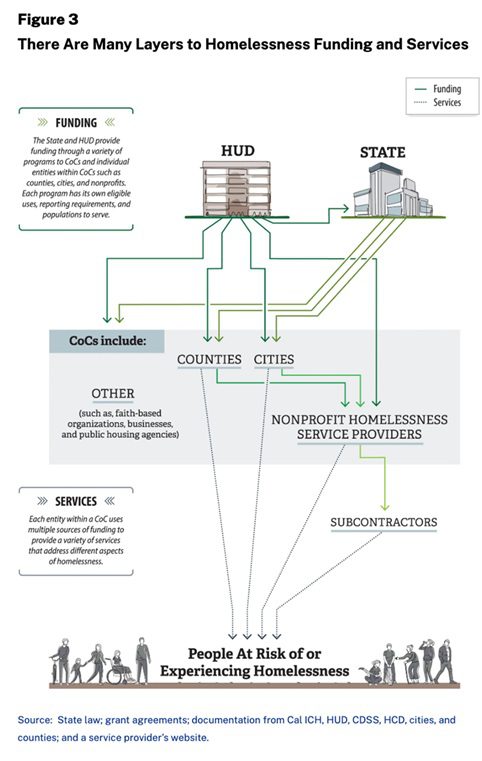
In this chart, “CoCs” are continuum of care agencies, the authority that provides oversight to make a diverse set of interventions work together. They ensure “community-wide planning and strategic use of resources.” At least that’s the theory.
But as the chart also shows, homelessness money raining from the sky reaches actual homeless people only after passing through a long series of sluices, each with salaries to pay and offices to rent. Go back to LAHSA’s statement about its work: In one of California’s fifty-eight counties, LAHSA supports “more than 100 nonprofit partner agencies.”
Chasing outcomes, Los Angeles City Controller Kenneth Mejia sent investigators to look at publicly funded safe housing sites that were meant to help the homeless transition into permanent housing. Contracts with charities for “Indoor Safe” facilities came with a series of requirements, including the mandate that they regularly provide hot meals and fresh food with their government funds. Actual outcome from an on-site audit: “The service provider’s food inventory consisted almost entirely of instant ramen noodles.”
One of Mejia’s site audits led to indictments, as the CEO of the nonprofit Abundant Blessings – whose prior experience running organizations was that he owned a Yogurtland franchise in Santa Monica – was charged with fraud in state and federal courts.
From the federal indictment of Abundant Blessings CEO Alexander Soofer:
Rather than providing the services for which he billed these public entities, Soofer pocketed at least $10 million. He used that public money for a down payment on his $7 million Westwood home, millions of dollars of upgrades to that home, private schooling for his children, lavish spending in Las Vegas, private jet travel, and stays at luxury resorts across the United States – from Hawaii to Florida. Soofer also appeared to use $475,000 to purchase a vacation property in Greece, sending this money to a Greek property developer.
Digging into details, the probable cause affidavit submitted to the district court by an FBI agent described the moment when investigators allegedly tried to question the members of the board that oversaw Abundant Blessings and discovered that it didn’t exist. Then the FBI started piling up paragraphs alleging precisely where LA’s homeless services money had gone:
Hermes is a luxury retailer, and the luxury goods SOOFER and his wife purchased with taxpayer dollars include $910 for women’s Chypre sandals with goat lining, $260 for a men’s Faconnee tie, $1,250 for men’s Paris calf-skin loafers, $455 for a men’s Chevaux en Symetrie tie, and $2,450 for a men’s trotting jacket.
You see, for-profit corporations are greedy, but nonprofits are inherently kind and decent.
Where homeless money flows to nonprofits, it tends to become hard to track. Remember the description of the Weingart Foundation near the start of this report? News stories in Los Angeles reported that the foundation, “one of L.A.’s biggest homeless service providers,” received more than $100 million in public funds in just a few years while also being “continuously out of compliance with federal deadlines to turn in audits — known as ‘single audits’ — since early 2022.”
California’s perennially unsolved homeless crisis is the story of an army of NGOs spending absurd quantities of public money toward no apparent purpose, while collecting enormous administrative salaries to perform the public appearance of virtue. Skid Row funds $455 Hermes ties. How virtuous.
The end of ranching
The State of California had allocated $10 million to The Nature Conservancy to fund TNC’s post-ranching management of the public land at Point Reyes, and had committed the funding long before the ranchers had agreed to the settlement. The neutral arbiter trying to convince the ranchers to settle and leave had a direct financial interest in their departure.
The connection between symbols of virtue and the realities of wealth again become clear in California’s controversies over the management of public lands.
In 2022, a coalition of three environmental nonprofits sued the National Park Service over the presence of historic cattle ranches at Point Reyes National Seashore, in an area called West Marin that sits about an hour north of San Francisco. The “dairy empire” on the point had begun in the 1850s, so the litigation targeted agricultural operations that had been run continuously on the same land for about 170 years.
Intervening, a fourth environmental group that wasn’t a party to the lawsuit offered to negotiate a settlement between the ranchers and the environmental groups, while the park service postured as an onlooker despite being the actual defendant. The Nature Conservancy (TNC), a giant NGO with net assets exceeding $8 billion, was described in news stories as a neutral arbiter, an organization with no interest in the case “which helped facilitate the mediation.” TNC convinced twelve of the fourteen ranchers at Point Reyes to take settlement payments and leave, ending most ranching there.
The Nature Conservancy also funded the settlement that it negotiated, and a series of remarkable stories in the Santa Rosa Press-Democrat began to reveal details in that effort that changed the appearance of TNC’s intervention.
First, in January of 2025, the newspaper described the way The Nature Conservancy pitched the end of ranching at “swank private fundraisers involving high-profile Bay Area philanthropists,” securing cash for “a settlement reached without public input and that is not subject to federal regulations.” Through the instrument of legal action brought by a group of NGOs, private equity wrote checks to end 170 years of ranching on a piece of public land. Here, from the reporting of Press-Democrat writer John Beck, is what it looks like when a nonprofit works to influence the use of public resources:
Making the rounds in the affluent Marin County enclave of Ross on Jan. 12, 2023, they stopped by the house of Dan Kalafatas and his wife, Hadley Mullin. He is chairman of the global climate strategy company 3Degrees, and she is senior partner and senior managing director at the private equity firm TSG Consumer Partners. Together, they agreed early on to support the cause and to help raise funds and spread the word to their well-connected friends.
The Nature Conservancy’s donors “hopped in a convoy of SUVs” for a private tour of Point Reyes, then later attended a fundraising dinner “at a $20 million, 7-bedroom estate in Ross, not far from the Lagunitas Country Club.” There was valet parking, and the caterer provided ranch-themed cocktails. As Beck’s second story in the series noted, the dinner was “a who’s who of Bay Area entrepreneurs, investors, tech execs and venture capitalists,” and one later told him that she looked around the room and “didn’t see any Point Reyes ranchers or West Marin farmers, or really anyone she knew from West Marin.”
And then a third story from John Beck in the Press-Democrat made the whole process very clear: The State of California had allocated $10 million to The Nature Conservancy to fund TNC’s post-ranching management of the public land at Point Reyes, and had committed the funding long before the ranchers had agreed to the settlement. The neutral arbiter trying to convince the ranchers to settle and leave had a direct financial interest in their departure.
“In effect,” Beck wrote, “state funding was already set aside to restore land that ranchers had not agreed to vacate.” The Nature Conservancy officials told Beck that if the ranchers had not agreed to leave, they would have just used the money anyway to do other restoration work at Point Reyes. But they didn’t claim that the ranchers had known about the state funding while they negotiated with the group that was set to receive it.
“When you pull back the curtain,” a former Point Reyes rancher told Beck, “you start to maybe understand a little bit more about what happened.”
And that’s correct: you do start to maybe understand a little bit more. Private equity, NGOs, and government worked in partnership to produce an outcome that wasn’t explained to people outside the circle they created. This story is about as California as it gets.
The purest California NGO story
The Coalition for Humane Immigrant Rights is a nonprofit service provider that nestles up against a nonprofit political activist group, a helping people group that by the most remarkable coincidence also assists politicians in the pursuit of power while being lavishly funded by the governments those politicians run.
Or maybe it’s this one, the purest form of the California NGO story.
The Coalition for Humane Immigrant Rights of Los Angeles (CHIRLA) marries all the themes together. It’s a nonprofit service provider that nestles up against a nonprofit political activist group, a helping people group that by the most remarkable coincidence also assists politicians in the pursuit of power while being lavishly funded by the governments those politicians run.
In 2024, Los Angeles Mayor Karen Bass proudly announced that she had secured federal funding from the Biden administration so that local migrant support groups could provide housing and free stuff – “supportive services” – to new arrivals from other countries. The federal government’s USA Spending website reports that CHIRLA got a $450,000 grant to provide “citizenship education and training.”
At CHIRLA, that much government cash would barely register. Parsing public records, the Capital Research Center’s InfluenceWatch offers a long list of government grants to the organization, mostly from one predictable source:
In 2023, CHIRLA received nearly $34 million in government grants, primarily from the State of California, accounting for roughly three-quarters of its $44.9 million in revenues. In 2022, CHIRLA received $25.6 million in government grants, more than 80 percent of its $31 million in revenues.
Among those grants were $1.28 million from the City Los Angeles between 2017 and 2025. And CHIRLA is also funded by the Los Angeles County Office of Immigrant Affairs. So they’ve run the table: CHIRLA gets paid by city, county, state, and federal governments.
Once again blurring boundaries, this NGO is lavishly funded by government – so really kind of a GO – also took in tremendous amounts of cash from philanthropic foundations: $3 million from the Weingart Foundation, $1,325,000 from the James Irvine Foundation, $2,275,000 from the Evelyn and Walter Haas, Jr. Fund, and so on. Government and philanthropic tributaries run into the same financial rivers.
Funded in good part with taxpayer dollars, CHIRLA also has an affiliated political action fund (using the same name: CHIRLA Action Fund) that endorses candidates for public office, loudly and often, and then canvasses neighborhoods for its preferred candidates. Among many others in a long list, the leaders of CHIRLA recently stood alongside Xavier Becerra to endorse his campaign for California governor. CHIRLA also endorsed Eunisses Hernandez for L.A. City Council. And, of course, they endorsed Karen Bass for mayor while Bass proudly declares her commitment to finding CHIRLA more government funding.
Defending itself against allegations that it crosses boundaries between charity and politics, CHIRLA insists that it isn’t involved in partisan questions and political campaigns. Instead, CHIRLA does “citizenship education” and “supportive services” while the CHIRLA Action Fund issues endorsements and provides campaign support.
That’s true, so far as the letter of the law goes, but in spirit it gets more complicated.
Look up the IRS filings for both CHIRLA and the CHIRLA Action Fund and this is what you’ll find: CHIRLA is a non-profit that’s run out of an office at 2533 W. Third St., Suite 101, and the wholly separate CHIRLA Action Fund is a different organization that’s run out of an office at 2533 W. Third St., Suite 101. If you have a question about CHIRLA, they list Zerihoun Yilma as their point of contact, while the CHIRLA Action Fund lists Zerihoun Yilma as their point of contact.
See, totally separate! Both are run by Angelica Salas, who also serves as a board member at the Latino Community Foundation and the California Wellness Foundation, while serving as a member of the state government’s California Racial Equity Commission.
CHIRLA explicitly describes its “Immigrant Political Power Project” as an effort that “targets new citizens, Latinos, and English learners to build a voter base from scratch, with enough power to sway state politics.”
Here’s how they do that: “We reach out to these community members to build relationships, speaking with them in their language between four and seven times before election day about diverse issues – from their access to state safety-net programs to registering for the census.”
And finally, the group calls the Immigrant Political Power Project “a joint project of CHIRLA and CHIRLA Action Fund,” openly erasing the line between what are supposed to be separate organizations.
The conservative news website RedState frequently covers CHIRLA, with managing editor Jennifer Van Laar discussing (for example) allegations that the nonprofit organizes anti-ICE demonstrations and uses illegal immigrants to canvass neighborhoods for candidates.
Where does CHIRLA end and Democratic politics begin, and what boundaries sit between those things and government use of taxpayer dollars at every level? That’s not a question that invites serious answers. A bowl of soup is eaten with one spoon.
Ruin is an industry
As California grows a laundry list of serious social failures, the one thing you absolutely can’t blame is the availability of resources. “During Gavin Newsom’s governorship,” the Hoover Institution wrote in 2024, “California’s state budget grew over 63 percent…
The California legislature passes somewhere north of a thousand bills every year, while considering about double that number, so there’s not much time for committee hearings. Bills tend to get a few minutes of testimony, a witness or two in favor and a witness or two in opposition reading short statements into the record.
Then comes the unfortunate and hurried ritual known as the “me toos.” Committees invite everyone who wants to speak to come to a microphone at the front of the hearing room, but the me toos are only allowed to say three things: name, organization, position. Speakers who try to wedge in a sentence as an actual argument – I’m opposed, because… – are quickly shut down.
Under a headline about legislators silencing witnesses, a 2025 story on the news website CalMatters described a legislative hearing on a proposed bear hunting bill in which witnesses traveled to the Capitol from all over the state and then had experiences like this one: “One of the bear bill’s supporters, Elizabeth Washoe, took a day off work, filled up her vehicle with $5-plus a gallon gas before she left Modoc County and made the five-hour drive to the capital, only to be given a few seconds at the mic.” This treatment tends to offend people, and legislators tend to not care at all.
The reality in California is that the me toos are giving the important testimony when they say the names of their organizations. That’s the information the lawmakers are listening for, and it’s all they need to hear. Bills advance on the basis of teams and relationships. Planned Parenthood Affiliates of California, in favor. SEIU, in favor. Trevor Project, in favor. And the message is received.
To continue spooling out examples of the way California NGOs work is to keep telling the same story: blurred boundaries, cronyism and incestuous boundary-crossing, partisan power-seeking dressed up as a passion for social justice.
To talk about the controversies in California over election results being reversed a week after the election because of late-arriving ballots is to talk about ballot harvesting by public sector unions and “social justice” NGOs.
To talk about the legislature’s pathological focus on anti-family bills is to talk about sexual identity activism from full-time activists at well-funded NGOs.
To talk about the decline of the cities and the ubiquity of homeless encampments and fatal overdoses on the street is to talk about “harm reduction” NGOs and the teams of “outreach workers” who spend their days getting paid to enable self-destructive behavior.
To talk about the middle-class being priced out of homes in California is to talk about the army of NGOs that exist to advocate for affordable housing, and the growing cost of building in the face of relentless professional activism that increases the costs of each new home.
Ruin is an industry.
As California grows a laundry list of serious social failures, the one thing you absolutely can’t blame is the availability of resources. “During Gavin Newsom’s governorship,” the Hoover Institution wrote in 2024, “California’s state budget grew over 63 percent, rising from around $200 billion in 2019 to about $327 billion in the current fiscal year ending June 30. After adjusting for inflation and California’s population losses since 2019, this represents a 38 percent per person increase in real (inflation-adjusted) state government spending.”
Perpetual growth in government spending, unbroken poverty rates, sticky and ubiquitous homelessness, appalling infrastructure, government-funded political activism for the people who govern the place. The client class is NGOs. The state’s growth industry is buildings full of people who say they ensure access to justice.
As I write this, Governor Gavin Newsom is complaining that the FBI is talking to his friends. We don’t know what they’re looking for, but his former chief of staff has pleaded guilty to federal charges that she stole from political campaign funds to pay for a lavish lifestyle. She was joined in that scheme by a high-ranking staffer for Xavier Becerra, who will probably be the next governor. They see a pot of money and they assume it’s for them: for their nice hotels, for their expensive dinners, for their living room furniture.
There’s a reason for this kind of thinking in California, a state without boundaries. To understand the state and its decline, read a five year-old news story in the Los Angeles Times: “Facebook, Google, other corporate giants flooded Newsom with record $226 million in charity donations in 2020.”
On its face, the headline doesn’t make sense: How do corporations flood the governor of a state with charity donations? Does a governor run charities?
But the controversy over “behested payments” is precisely a crisis over the state’s NGO cronyism. When you get into the details, here’s what the actual donations look like:
Three organizations, including Silicon Valley Bank, collectively gave $175,000 this year on behalf of the governor to the California Partners Project, a nonprofit launched by First Partner Jennifer Siebel Newsom that focuses on promoting gender equity and understanding the impact of technology and media on children.
Large companies doing business in California gave money to the governor’s wife through her non-profit, apparently because of their corporate commitment to “gender equity.”
A little later, in 2024, the governor intervened in a dispute between Indian tribes over federal approval for a new casino, backing one tribe over another. You’ve already guessed the background, which the Washington Free Beacon discovered:
In April 2024, a few months before Newsom sent his letter to the Biden Interior Department, the Democratic governor requested Graton Rancheria to contribute $500,000 to his wife’s charity, the California Partners Project. And in April 2025, one month before Newsom filed his lawsuit against the Trump administration, he again asked Graton Rancheria to contribute another $500,000 to his wife’s charity.
As you can see, it’s a very charitable state, and everyone is committed to helping.
Source: https://capitalresearch.org/article/the-nonprofits-that-ate-the-california-dream/
Anyone can join.
Anyone can contribute.
Anyone can become informed about their world.
"United We Stand" Click Here To Create Your Personal Citizen Journalist Account Today, Be Sure To Invite Your Friends.
Before It’s News® is a community of individuals who report on what’s going on around them, from all around the world. Anyone can join. Anyone can contribute. Anyone can become informed about their world. "United We Stand" Click Here To Create Your Personal Citizen Journalist Account Today, Be Sure To Invite Your Friends.
LION'S MANE PRODUCT
Try Our Lion’s Mane WHOLE MIND Nootropic Blend 60 Capsules
Mushrooms are having a moment. One fabulous fungus in particular, lion’s mane, may help improve memory, depression and anxiety symptoms. They are also an excellent source of nutrients that show promise as a therapy for dementia, and other neurodegenerative diseases. If you’re living with anxiety or depression, you may be curious about all the therapy options out there — including the natural ones.Our Lion’s Mane WHOLE MIND Nootropic Blend has been formulated to utilize the potency of Lion’s mane but also include the benefits of four other Highly Beneficial Mushrooms. Synergistically, they work together to Build your health through improving cognitive function and immunity regardless of your age. Our Nootropic not only improves your Cognitive Function and Activates your Immune System, but it benefits growth of Essential Gut Flora, further enhancing your Vitality.

Our Formula includes: Lion’s Mane Mushrooms which Increase Brain Power through nerve growth, lessen anxiety, reduce depression, and improve concentration. Its an excellent adaptogen, promotes sleep and improves immunity. Shiitake Mushrooms which Fight cancer cells and infectious disease, boost the immune system, promotes brain function, and serves as a source of B vitamins. Maitake Mushrooms which regulate blood sugar levels of diabetics, reduce hypertension and boosts the immune system. Reishi Mushrooms which Fight inflammation, liver disease, fatigue, tumor growth and cancer. They Improve skin disorders and soothes digestive problems, stomach ulcers and leaky gut syndrome. Chaga Mushrooms which have anti-aging effects, boost immune function, improve stamina and athletic performance, even act as a natural aphrodisiac, fighting diabetes and improving liver function. Try Our Lion’s Mane WHOLE MIND Nootropic Blend 60 Capsules Today. Be 100% Satisfied or Receive a Full Money Back Guarantee. Order Yours Today by Following This Link.


| Visits: | 1,828,087,021 |
| Stories: | 8,684,935 |
Whistler Blowers, Insiders

