

The history of homecare fraud: NGO’s, bureaucrats, and labor unions undermined Medicaid fraud prevention

Since 2024, dozens of people in multiple states have been accused of and convicted for their participation in brazen Medicaid fraud schemes that have highlighted how obvious and lucrative some of these Medicaid fraud operations are. The sudden popularity of fraud-busting might give the impression that industrial-scale Medicaid fraud is a recent development. While Medicaid fraud has certainly gotten much worse in recent years, it’s actually a very old problem that the federal and state governments have permitted to grow thanks to a cocktail of incompetence, apathy, and special-interest meddling.
The best example of how long industrial-scale fraud has existed is the Home-Based Community Services (HCBS) program.
Back in April 1992, for instance, a convicted drug dealer fresh out of prison started a
“home health care” business in Los Angeles. By the end of the year, he had already ripped off at least $1.5 million and possibly as much as $2.5 million ($3.5 million to $5.8 million in 2026 dollars) by billing for patients that didn’t exist and care that was never provided. Testifying anonymously as “Mr. A” in November 1995, the convicted scam artist told a U. S. Senate committee exactly how easy it was to loot tax dollars through the program.
Recent headlines about homecare fraud rings show the same loopholes “Mr. A” exploited over three decades ago remain wide open, and the HCBS program remains easy to defraud. Earlier this month, for example, federal authorities busted a homecare fraud operation being run from inside a federal prison in Philadelphia with the man behind the operation being quoted as saying “this home health care is the best kept secret cuz […] Everyone is doing this, if this is a problem you’ll have to arrest the whole city.”
While outrage has been the predominant response to these headlines, bewilderment has been a close second. Why have so many fraudsters been able to operate so blatantly for so long? The reasons are manifold, but one of the most important is that a determined and complicated web of special interest groups has been fighting against one of the only tools for combatting fraud in the HCBS program. The list of bad actors includes healthcare companies, labor unions, nonprofits, government officials, and trade associations.
History of HCBS
“. . we were billing Medicare for patients who either did not live at the address we submitted to Medicare, had not been seen by a doctor in over 5 years, were not home bound, were in a hospital, or were deceased. Medicare did not require any paperwork. . .” — “Mr. A” in 1995
The HCBS “homecare” program was not necessarily a bad idea when section 1915(c) HCBS waivers were created in 1981. The waivers were supposed to be used by Medicare and state Medicaid programs to pay for certain types of care for the impoverished disabled and elderly; to be performed in their own homes rather than a traditional long-term care or nursing home facility. The policy was backed by both Democrats and Republicans who believed it would cut costs while allowing for family members to provide better care to patients.
Though several researchers published papers supporting the idea in 1981, the original HCBS waiver proposal seems to have come from a 1971 report to the Senate Special Committee on Aging by Dr. Robert Morris of the Levinson Gerontological Policy Institute at Brandeis University. Dr. Morris’s program was created with funding from the Max and Anna Levinson Foundation, which tested a prototype form of the homecare program in Massachusetts. Morris would later go on to publish a 1991 book, Personal Assistance: The Future of Home Care, which proposed further expansion and deregulation of the home care program.
It wasn’t long before the program was mugged by reality.
In addition to “Mr. A,” the aforementioned November 1995 U.S. Senate hearing featured several other witnesses who had been prosecuted for home health care fraud. Mr. A told the committee “how easy it was for me to open a home health care agency” that he used to steal millions of dollars. He submitted bogus paperwork and got paid for homecare visits that never happened because there was no real mechanism to easily identify fraud.
As he told the Senate:
All we needed was a name, a health insurance number, and a code for the diagnosis. In fact, by January 1993 we were billing Medicare for patients who either did not live at the address we submitted to Medicare, had not been seen by a doctor in over 5 years, were not home bound, were in a hospital, or were deceased. Medicare did not require any paperwork at the time we sent the claim in electronically.
Mr. A was caught because of a savvy state employee spotting discrepancies in his bogus paperwork, but not before he got a taste of the good life:
We were making so much money that I was able to have a custom home built in Bel Air for $2.5 million, of which I put down $1.2 million. I also leased a Rolls Royce and leased a 500 SL Mercedes Benz. I also invested hundreds of thousands of dollars in a movie production company and movie script about my life. I have also published a book about my life that includes a chapter about United Care Home Health Services, which I will have to revise to include my guilty plea and what awaits me now.
Today, dozens of recent fraud convictions in the homecare program reveal the scam hasn’t changed much since Mr. A’s days. His methods for defrauding Medicare are the same ones currently being used to defraud Medicaid, which has replaced Medicare as the focal point of HCBS spending. Doctors are still taking bribes, fake billing requests are still being approved, patient identities are still being fabricated or stolen, and Medicaid millionaires are still buying mansions and fancy cars.
The problem persists because the homecare program relies mostly upon the honesty of just two people, often family members, who are usually alone together where nothing can be verified. This is the fatal flaw that inhibits reform. Relatiely few would be willing to lie to get themselves placed in a state-run nursing home. But many have been willing to lie about their symptoms, or the hours worked, so the taxpayers will pay family or close friends for taking care of them in their home. This is especially true if the “patient” is getting a cut of the revenue.
Further weakening the program is the fact that many of the “personal care services” the program will pay for require no medical experience or training at all. This includes such tasks as “light housekeeping” and “providing companionship and conversation” that could never be verified even if there was an investigator checking for fraud. You don’t even need a special license to get in on this scam.
On top of that, while the tools for fighting fraud in the HCBS program have stayed essentially the same since Mr. A’s day, the HCBS program has exploded in size. When he testified in 1995, HCBS spending accounted for $10.3 billion, or less than 20 percent of all Medicaid Long-Term Services and Supports (LTSS) expenditures that year. Had it merely kept pace with inflation, HCBS would have spent just $72.9 billion by 2023. Instead, the Medicaid HCBS program in 2023 spent twice that amount, $145.9 billion, or the majority of Medicaid LTSS expenditures.
Some sources indicate that in 1995 the HCBS program had fewer than 150,000 patients, but it grew to roughly 8.4 million patients by 2023. If that 1995 statistic is remotely valid, then the program experienced an increase of more than 500 percent during an era when the total American population grew by just 27 percent. Even the 2023 figure alone means 1 of every 40 Americans in 2023 (2.5 percent of us) was enrolled as a patient in the federal homecare program.
And that’s making the dubious assumption that all 8.4 million patients were both real and still alive.
Electronic Visit Verification (EVV)
Unfortunately, the same groups and people advising states on how to construct EVV are also leading the fight against its existence and effective implementation.
There was one policy change that enabled state agencies to do something to crack down on the rampant fraud in the HCBS program. It has been fought relentlessly by those powerful special interest groups.
Electronic Visit Verification (EVV) is the practice of using digital monitoring devices with GPS capability and medical record keeping software to help verify, with real time data, that a homecare visit occurred. A 2018 report on the EVV system credited Ohio nurse Michelle Boasten with creating it 1996, as part of her “career combatting fraud and waste in home healthcare.” But Ohio has become an ironic birthplace for EVV, as allegations of Medicaid fraud that occurred despite the state’s electronic monitoring recently made headlines, prompting an overhaul of the state’s EVV system.
In 2016, the 21st Century Cares Act made EVV a requirement for state Medicaid agencies. This was the first meaningful anti-fraud improvement in the program’s history. Today, all 50 states have some form of EVV, usually taking the form of a smart phone app that a homecare worker or company uses to log hours, confirm location, and submit it all to the state Medicaid agency before the billing request is submitted.
Sometimes the app will also collect information such as fingerprint data or a signature to verify the patient is truly present. It isn’t a fool proof system. Providers can still just bribe doctors with kickbacks for prescribing unnecessary homecare to patients who don’t really need it. And EVV can be circumvented by providers sitting on the street outside a patient’s house to fool the GPS system and bill for imaginary hours. However, despite its flaws, requiring EVV has still been a huge step forward for fraud prevention in a program that was operating on the honor system for decades.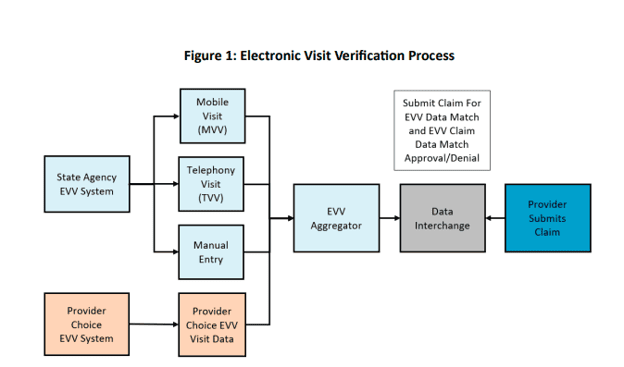
But having EVV doesn’t mean anything if the systems aren’t designed and implemented well and if states aren’t really using it. Unfortunately, the same groups and people advising states on how to construct EVV are also leading the fight against its existence and effective implementation.
The 21st Century Cares Act initially gave states a deadline of 2019 to start using EVV for personal care services and threatened their Medicaid program with financial penalties if they did not meet the deadline. The deadline was delayed, thanks in part to pressure from a group now calling itself ADvancing States, formerly the National Association of States United for Aging and Disabilities. ADvancing States issued a letter explaining that most states were behind schedule because of confusion supposedly created by the Centers for Medicare & Medicaid Services (CMS).
Congress ultimately passed legislation moving the deadline to January 2020. Then, in March 2020, ADvancing States and two other groups, the National Association of Medicaid Directors and the National Association of State Directors of Developmental Disabilities Services, sent another letter claiming that even though the already-moved-back deadline had passed, COVID-19 had made meeting the new deadline impossible and the financial penalties for non-compliance with EVV needed to be moved back at least another year. The delays just kept coming, and states kept requesting and receiving exemptions from the financial penalties by promising that they were working in good faith to finish an EVV system.
Then, in December 2021 the same three groups that authored the second request for delay sent a third letter that called for the abolition of EVV. The letter was written in response to the proposed 21st Century Cures 2.0 Act which, among other things, would have made it illegal for states to use GPS and biometric fingerprint data as part of their EVV programs. The letter stated that more than 40 states had already built an EVV program that relied on GPS data, and that banning states from using GPS would render all existing EVV systems useless and require each state to start over from scratch. They saved the end of the letter to recommend killing the fraud prevention tool altogether:
The EVV provision was originally projected to reduce costs due to a reduction in spending on personal care and home healthcare services. However, we believe that the cost of developing and implementing the systems has already greatly exceeded the projected savings. Due to all of the challenges discussed above, we believe that there would be positive policy outcomes as well as savings associated with completely repealing EVV instead of moving forward with these proposed changes.
This was a major departure from what these groups had said about EVV in the past. In May 2020 ADvancing States, the most influential of the three, had written a separate letter strongly opposing the GPS ban but making no mention of abolishing EVV entirely. In 2018, the group had written that “An effective, well-planned and implemented EVV system strengthens state Medicaid personal care and home health care services, by detecting and preventing fraud, waste, and abuse and improving the quality of PCS and HHCS.” Several more recent publications, including the letters asking for delays, had spoken of EVV systems positively.
But then, after years of helping states design their EVV systems and fighting repeatedly to give them more time for implementation, ADvancing States and its allies were calling for the repeal of EVV requirements entirely because, they claimed, it was costing too much money and not producing any savings. They don’t provide any evidence for this claim, though.
Then, in April 2026, the Medicaid trade associations changed directions once again.
As a new presidential administration took over and headlines about fraud in HCBS programs became common, ADvancing States, the National Association of Medicaid Directors (NAMD), and the National Association of State Directors of Developmental Disabilities Services (NASDDDS) jointly published a toolkit explaining the best ways to fight “waste, fraud, and abuse” in Medicaid programs. EVV, which all three groups had called for a total abolition of in 2021, is reviewed glowingly as one of the main tools for preventing fraud. The toolkit even recommends greatly expanding the use of EVV, integrating EVV data further into fraud detection agencies, and increasing the amount of information EVV systems collect to close more loopholes.
Just a few years ago they had called for the elimination of EVV. Now they are showering it with praise. The flip-flopping is a hint that fighting fraud just might not be a major concern for the homecare industry’s leading representatives.
Sabotaged from the start
This past spring, joint reporting by the Daily Wire and Capital Research Center exposed a massive network of suspicious payments, providers, and fraud in the homecare program surrounding Columbus, Ohio.
EVV can work as a fraud prevention tool, though not a perfect one, but only if states use it properly. Unfortunately, many state agencies led by high-ranking members of the same Medicaid trade associations that opposed and delayed EVV are spending piles of money to implement EVV without using it as intended, or at all, and then claiming EVV doesn’t work.
For example, there is Bonny Silva, current Director of the Office of Community Living at the Colorado Department of Health, which runs portions of the state’s homecare program. She is also president of the ADvancing States board of directors.
In 2026, the federal Department of Health and Human Services Office of Inspector General published the results of an audit of Colorado’s EVV compliance. The audit found 56 percent of personal care services (PCS) claims had EVV compliance problems yet were paid anyway. Auditors discovered that Colorado was allowing users to perform unlimited manual entries of EVV data, a leniency offered in case homecare attendants forgot to clock in or out on their app. But manual entry circumvented the EVV system by allowing providers to enter their own unverifiable data themselves that was often full of errors. In total, 62 out of 160 claims reviewed in the sample were entered manually. This likely means more than one-third of EVV entries statewide aren’t performing the basic EVV independent verification functions.
Auditors found that one provider had submitted every single EVV record that year manually. Another 17 of the sampled claims (10.6 percent) weren’t entered into the EVV at all, yet payments were still made, showing EVV entry isn’t necessary for receiving payment. Even when EVV was submitted with GPS info, Colorado’s system didn’t use it, since another 10 percent of claims had EVV GPS data “exceptions” where GPS locations didn’t match known patient addresses, with no explanation provided. These claims were paid out regardless because, according to the state “although GPS exceptions are flagged in the EVV system, the State agency does not require those exceptions to be corrected or addressed for a visit to be verified.”
In short, Colorado wasn’t requiring EVV at all.
Colorado’s EVV system was designed by Sandata, the same firm that designed Ohio’s EVV system at a price of more than $66 million, and the Ohio EVV system was recently discovered to have nearly identical problems. In Ohio, state auditors found nearly 56 percent of homecare visit claims were not processed through EVV at all, and that, as of July 2024, the GPS verification function was inexplicably switched from a requirement to an opt-in feature, and a signed consent form from the patient was required to turn it on.
The director of the Ohio Department of Aging which jointly administers the HCBS program is Ursel McElroy, the former president of ADvancing States. The Ohio government has also paid ADvancing States nearly $450,000 since 2021 for membership dues, employee training sessions, and administrative consulting services, and Sandata has sponsored both ADvancing States and the NAMD.
This past spring, joint reporting by the Daily Wire and Capital Research Center exposed a massive network of suspicious payments, providers, and fraud in the homecare program surrounding Columbus, Ohio. Governor Mike DeWine, who initially boasted about the strength of the state’s EVV system, issued a series of executive orders that made GPS verification mandatory, and made submitting EVV information necessary for receiving payment. The reporting also led to a statewide moratorium on the enrollment of new homecare companies through Medicaid and a nationwide moratorium on the enrollment of new home healthcare companies through Medicare.
Still worse is New York, where a state audit of EVV compliance found that from January 2021 to March 2023, more than $14.5 billion was paid out for 82 million personal care services claims that did not have any matching EVV records. This was roughly 44 percent of personal care services submitted during that time. The auditors reported that “DOH and GDIT officials stated eMedNY has a feature that will prevent payment of fee-for-service claims that do not have a matching EVV record, but this feature was not turned on.” This meant that, “According to DOH officials, to date, no providers have had claims pended or denied, nor have any been issued a letter seeking recoupment for lack of EVV data [emphasis added].” (DOH is the New York Department of Health and GDIT is General Dynamics Information Technology, a contractor that once performed data aggregation for New York’s EVV system.)
In other words, despite having a nominally working EVV system, New York just hasn’t been using it for anything. Amir Bassiri, Medicaid director for the New York State Department of Health since 2021, sits on the board of the National Association of Medicaid Directors (NAMD), which, as previously noted, jointly called for EVV requirements to be abolished.
Colorado, Ohio, and New York are the only three states that have undergone a publicly available audit of their EVV systems so far. All three have failed. All three have HCBS programs overseen by bureaucrats that also serve as board members of the nonprofits that jointly delayed and then called for the total removal of EVV requirements. Both the president and vice president of ADvancing States are overseeing HCBS programs that have been caught dragging their feet on EVV in virtually every possible way, even when working EVV systems were already available.
The “Deep State” of Medicaid
Medicaid’s “deep state” delayed and delayed EVV, and shielded states from the consequences of not creating an EVV system.
ADvancing States and its cosigners aren’t just ordinary nonprofit advocacy groups. They’re nonprofit advocacy groups created and led by the senior government officials who are running state Medicaid programs.
Current ADvancing State board members include high level employees of the governments of Ohio, Colorado, California, Arizona, Kentucky, Pennsylvania, Washington, and Utah. The National Association of Medicaid Directors (NAMD) is the same, with board members employed at high levels within the Medicaid agencies of Georgia, Washington, Iowa, Maine, New Hamshire, Oregon, California, Michigan, Nebraska, Texas, Louisianna, New York, New Jersey, and the U.S. Virgin Islands. National Association of State Directors of Developmental Disabilities Services (NASDDDS) has board members high-up within the state health department of Missouri, Georgia, Pennsylvania, Nebraska, Maine, Delaware, Tennessee, and New York.
Think of them as the “deep state” of Medicaid. Most of the revenue for these nonprofits flows from contributions and program service fees from states and healthcare companies, many of which are contracted to run state Medicaid programs. It’s a shady intersection of interests without clear incentives to stop fraud. They have incentives to ignore fraud or cut EVV programs to reduce costs and improve their bottom line. Applied Self-Direction, one of the sponsors of the ADvancing States 2021 summit, for example, explicitly stated that their dream was to “Get rid of EVV altogether.”
Medicaid’s “deep state” delayed and delayed EVV, and shielded states from the consequences of not creating an EVV system. Then they hypocritically pivoted to complain that EVV systems were over budget and behind schedule and called for eliminating them entirely. And when the Medicaid fraud flourished on their watch because of their malicious compliance with EVV requirements and became so politically salient that the federal government started to clamp down on state Medicaid funds, the Medicaid “deep state” changed tack and began praising EVV once again as an amazing tool for fighting fraud.
With all this flip flopping, lobbying, and perverse incentive structure in mind, the struggles of EVV and the exploding size of the HCBS program start to look less like ordinary bureaucratic incompetence and more like intentional sabotage.
And the next generation of the Medicaid “deep state” is already in training.
Since 2022, ADvancing States has been running the Next Gen HCBS Leaders Program that “[encourages] up-and-coming professionals to seek senior leadership opportunities” in state HCBS programs by pairing them with mentors already in the industry and giving them scholarships to attend the ADvancing State HCBS Conferences.
Those conferences and their sessions are sponsored, attended, and led by numerous healthcare companies that profit from the Medicaid HCBS program. The Next Gen HCBS Leaders Program is sponsored by United Healthcare, Molina Healthcare, and Pulselight. United Healthcare and Molina Healthcare generate mountains of revenue through their work as contracted managed care organizations (MCOs) for state Medicaid agencies, while Pulselight sells a software called “Trace” that provides analytics for data collected by EVV systems. In total, the Next Gen HCBS Leaders Program has trained 79 bureaucrats that are now ascending through the ranks of Medicaid agencies in 43 different states.
One famous definition of insanity is doing the same thing over again and expecting a different result. If these “Next Gen” leaders are learning from people like ADvancing States board members, then the outlook for the future of EVV is bleak.
The bureaucrats, trade associations, and the healthcare companies are one part of this equation, but large, public sector labor unions have also inserted themselves into the EVV debate. Their incentives likewise put them in favor of ignoring problems rather than finding solutions.
Forcibly unionizing the homecare industry by labeling all Medicaid homecare workers as government employees has been one of Big Labor’s white whales for a very long time. The dues harvested from such a maneuver would have been a huge shot in the arm for national unions with dwindling membership, and their push for unionizing homecare has continued even after the Supreme Court ruled against the unions in 2014.
Service Employees International Union (SEIU) Local 2015 in California represents a huge number of homecare workers and uses dues and fees it collects to donate generously to the Democratic politicians that run California’s Medicaid program. SEIU Local 2015 and other California unions have been advocating against EVV since 2017, calling it “inherently burdensome,” and seemingly urging California to consider not creating an EVV system and taking the financial penalties instead. Ever since, California has been fighting a battle with federal regulators about what their EVV system will look like and do, and California’s In-Home Supportive Services (IHSS) program has ballooned to an almost comically large size at twice the rate of any other state in the country.
The situation is now so bad, and the unions are so involved, that, in a recent op-ed, Dr. Mehmet Oz, Administrator of the Centers for Medicare and Medicaid Services (CMS), explained that the agency had frozen funds to California specifically because California’s pandering to the labor unions had created “a vicious cycle: Lax program integrity standards mean more demand for caregivers, more caregivers mean more union dues and more union dues mean more donations for the elected officials who are supposed to be guarding the cash register.”
Labor unions are similarly pushing for the unionization of hundreds of thousands of homecare workers in New York, where homecare has grown so large that one in nine members of the New York City workforce is a home health aide and New York state now has three times more home health aides per capita than the national average. The Department of Justice has sued the New York Department of Health and Public Partnerships LLC, a company contracted to run New York’s homecare program, alleging that the two are working to enable fraud at a massive scale.
The selection of Public Partnerships LLC to run the program was allegedly tainted by the improper influence of 1199 SEIU United Healthcare Workers East (UHE), the homecare union, which allegedly rigged the bidding process by telling the Hochul administration which company to award the contract to, based on the company’s willingness to concede to the union’s demands. The list of demands has not been made public yet. But it seems likely that the company’s approach to EVV policy and the further unionization of homecare was a major component of the union’s concerns.
Ignore the Fraud-Ignorers
To get serious about stopping fraud in the HCBS program federal and state lawmakers will have to tune out the Medicaid “deep state.” Nonprofits such as ADvancing States, the National Association of Medicaid Directors, and the National Association of State Directors of Developmental Disabilities Services, along with their labor union allies, simply can’t be trusted to fix the massive problems they’ve helped create, but lawmakers are still treating these groups as trustworthy sources.
Certainly, they are not “pro-fraud” by any means, but their constant flip-flopping and foot-dragging on a relatively mundane issue such as EVV proves that they’re incapable of taking a meaningful stand against rampant fraud when stopping it might lead to awkward questions, embarrassing investigations, and possible budget cuts for their bureaucratic and for-profit constituents. If meaningful anti-fraud policies are going to be made, then it’s time for lawmakers to start ignoring the “experts” who let things get this bad in the first place. They had their chance. It’s time to go back and listen to “Mr. A” and find a new approach.
Source: https://capitalresearch.org/article/the-history-of-homecare-fraud-ngos-bureaucrats-and-labor-unions-undermined-medicaid-fraud-prevention/
Anyone can join.
Anyone can contribute.
Anyone can become informed about their world.
"United We Stand" Click Here To Create Your Personal Citizen Journalist Account Today, Be Sure To Invite Your Friends.
Before It’s News® is a community of individuals who report on what’s going on around them, from all around the world. Anyone can join. Anyone can contribute. Anyone can become informed about their world. "United We Stand" Click Here To Create Your Personal Citizen Journalist Account Today, Be Sure To Invite Your Friends.
LION'S MANE PRODUCT
Try Our Lion’s Mane WHOLE MIND Nootropic Blend 60 Capsules
Mushrooms are having a moment. One fabulous fungus in particular, lion’s mane, may help improve memory, depression and anxiety symptoms. They are also an excellent source of nutrients that show promise as a therapy for dementia, and other neurodegenerative diseases. If you’re living with anxiety or depression, you may be curious about all the therapy options out there — including the natural ones.Our Lion’s Mane WHOLE MIND Nootropic Blend has been formulated to utilize the potency of Lion’s mane but also include the benefits of four other Highly Beneficial Mushrooms. Synergistically, they work together to Build your health through improving cognitive function and immunity regardless of your age. Our Nootropic not only improves your Cognitive Function and Activates your Immune System, but it benefits growth of Essential Gut Flora, further enhancing your Vitality.

Our Formula includes: Lion’s Mane Mushrooms which Increase Brain Power through nerve growth, lessen anxiety, reduce depression, and improve concentration. Its an excellent adaptogen, promotes sleep and improves immunity. Shiitake Mushrooms which Fight cancer cells and infectious disease, boost the immune system, promotes brain function, and serves as a source of B vitamins. Maitake Mushrooms which regulate blood sugar levels of diabetics, reduce hypertension and boosts the immune system. Reishi Mushrooms which Fight inflammation, liver disease, fatigue, tumor growth and cancer. They Improve skin disorders and soothes digestive problems, stomach ulcers and leaky gut syndrome. Chaga Mushrooms which have anti-aging effects, boost immune function, improve stamina and athletic performance, even act as a natural aphrodisiac, fighting diabetes and improving liver function. Try Our Lion’s Mane WHOLE MIND Nootropic Blend 60 Capsules Today. Be 100% Satisfied or Receive a Full Money Back Guarantee. Order Yours Today by Following This Link.


| Visits: | 1,833,781,388 |
| Stories: | 8,714,535 |
Whistler Blowers, Insiders

