

Climate NGOs are Xi Jinping’s useful idiots in America

When you drive by a solar energy project near your home, think of it as your local trade consulate for Xi Jinping, the authoritarian commander of China. A 2024 report from the International Energy Agency (IEA) shows 98 percent of the wafers needed for the world’s solar panels come from China, and that China produces 85.5 percent of the planet’s finished solar cells. Another IEA source shows Chinese firms have been cranking out more than twice as many panels as they need for domestic demand, and that solar panels have become “a significant export for China.”
It is nearly impossible to buy solar power without paying China, but President Xi has a lot of useful idiots in the USA who want to keep him in business. Nearly all of America’s largest environmental NGOs and their donors have been implicitly supporting China by promoting the solar industry. A few of those groups have also been explicitly cheering China’s supposed progress on cutting CO2 emissions.
China’s solar panels have also been the subject of a recent national security scare.
A May 2025 Reuters report opened with this alarming news: “U.S. energy officials are reassessing the risk posed by Chinese-made devices that play a critical role in renewable energy infrastructure after unexplained communication equipment was found inside some of them, two people familiar with the matter said.”
At issue were the power inverters solar panels need to convert direct current (DC) into alternating current (AC) and provide it at the correct spinning frequency used by electrical grids. The Reuters report added this explanation to the China risk: “Using the rogue communication devices to skirt firewalls and switch off inverters remotely, or change their settings, could destabilise power grids, damage energy infrastructure, and trigger widespread blackouts, experts said.”
Concerned that China could flip a switch and shut down civilizations, the American government and the European Union have since imposed restrictions against importation of certain types of inverters.
But the potential for inverter failure adds a real blackout risk even if a hostile actor isn’t trying to cause one on purpose. Inverters are not needed in hydroelectric dams and power stations that run on coal, natural gas and nuclear fuels. Combined those four fuels power 84 percent of the American electric grid. Our traditional power stations use huge spinning turbines that don’t need inverters to generate AC at the correct frequency. In doing so, they also provide critical inertia that acts as a shock absorber to keep the grid running through minor disruptions.
More inverters on the grid means less spinning inertia, and less protection from grid failure if the inverters fail. Wind turbines also rely on inverters, as their spinning frequency is randomly decided by whatever wind is (or is not) being provided by the weather.
Compromises to grid reliability and national security are but two of many good reasons why large scale solar and wind energy should not be hooked up to the American electrical grid.
Climate Imperative Foundation
For those who choose to believe carbon dioxide is a pollutant, China’s industrial progress is on a path to swiftly become both the biggest cumulative and annual CO2 producer in human history.
But billionaire John Doerr isn’t convinced. In April of this year—well past the day Reuters exposed the risk of Chinese inverters—Doerr wrote the following:
China has become the world’s first electrostate. It accounts for around 80 percent of the world’s solar panel exports and more than 70 percent of global EV production. This building spree has paid off in spades. Last year, clean technologies drove more than a third of China’s GDP growth.
By leveraging subsidies, automation, and the promise of low-cost access to cleantech, China has forged strategic partnerships with Germany and India, even with Mexico and Canada in the United States’ backyard. Low-cost Chinese clean technology–and the appeal of self-sufficiency–is propelling many countries to radically rethink their domestic energy mix. China is upending the old carbon-based world order. [emphasis added]
An American venture capitalist reportedly worth at least $22 billion, Doerr has been board chair of the Climate Imperative Foundation since it was founded in 2020, and one of its major donors. Through the Benificus Foundation, a tax-exempt private foundation Doerr and his wife use as a giving vehicle, he has already granted at least $133.8 million to Climate Imperative.
Most of the large anti-energy nonprofits in America have already received tens of millions of dollars each from the Doerr-led Climate Imperative. A small list of big examples just from Climate Imperative’s 2024 grant list include the Energy Foundation China ($29.8 million), the Natural Resources Defense Council ($7.8 million), the Rocky Mountain Institute ($7.6 million) and the Environmental Defense Fund ($3.2 million).
Each of them shares Doerr’s soft spot for China, even as China’s track record on CO2 emissions is at odds with real progress on the issue. Public claims to the contrary, those afflicted with this curious China syndrome seem concerned with something other than cutting CO2.
Nearly every year for the last two decades, according to Our World in Data, China has set a new world record for CO2 emissions from industry and fuel use. And despite getting a very late start on the industrial revolution, China is on a path to become responsible for more total historical CO2 emissions than every nation that has ever existed.
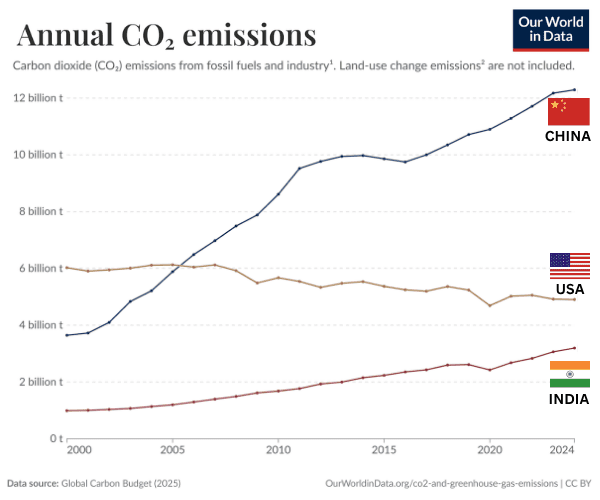
In 2006, the Chinese economy produced 6.49 billion tonnes of CO2 emissions, slightly edging out the prior annual record of 6.13 billion tonnes set by the United States one year earlier. For those who believe carbon dioxide emissions are a major threat to the health of the planet, this was an important inflection point. Since 2006, even as the American population and economy have both grown larger, our annual carbon emissions have been in steep decline, dropping to 4.9 billion tonnes in 2024, the latest year reported by Our World in Data.
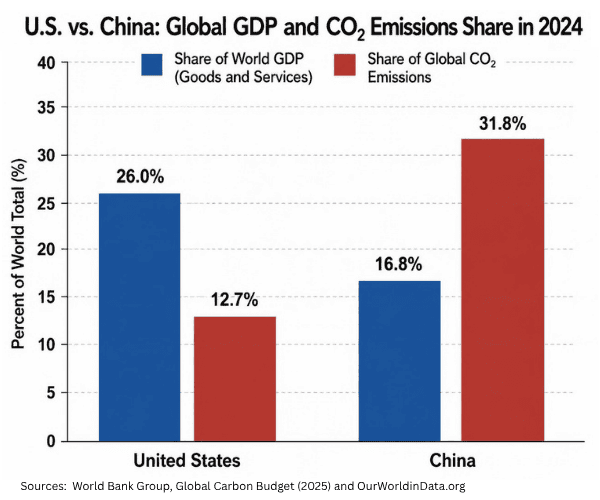
Meanwhile, China ratcheted up all the way up to 12.3 billion tonnes of annual CO2 emissions in 2024. This was yet another world record and—more remarkably—at least double the carbon emissions previously posted in any year by any nation other than China. Even as the United States remains the world’s largest economy, producing 26 percent of the Earth’s total goods and services in 2024, America did this by generating just 12.7 percent of total planetary carbon emissions. China was just the opposite: they needed to crank out 31.8 percent of total planetary CO2 emissions in 2024 to generate a little less than 17 percent of world GDP.
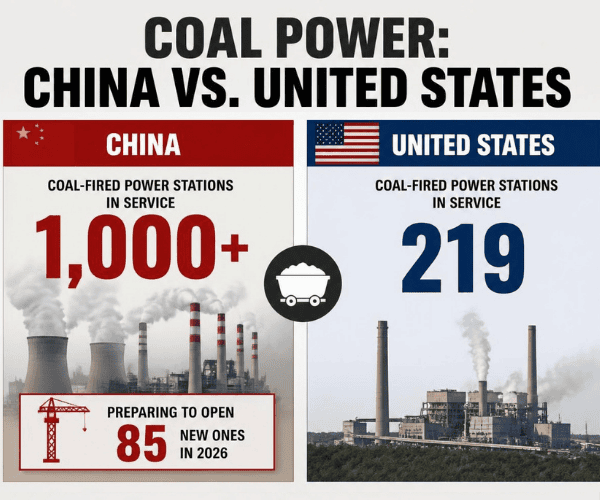
Another striking comparison: China has at least 1,000 (some sources claim more) coal-fired electric power stations in service, and the Financial Times reported in January 2026 that they were preparing to open 85 new ones just this year. The United States currently has only 219 coal-fired power stations.
Coal isn’t an objectively bad source of electricity generation. As just one example, it’s much easier to transport and store than our other reliable fuels. All things equal, a developing nation has good reasons for loading up on coal generation.
But subjectively, the trade-off is cleanliness. Coal burning creates more CO2 emissions per unit of energy produced than any of the other major hydrocarbon fuels, while natural gas emits the least. And while carbon dioxide is not a pollutant, but a critical molecule for feeding plants and thus sustaining human life, burning coal also emits more real air pollution than all other major sources of energy we use.
Over most of the last two decades the natural gas fracking boom in the United States has led to a switch in electricity fuels. Cheaper and cleaner natural gas has been replacing coal, cutting American carbon emissions and actual air pollutants.
A comparison of total historical CO2 emissions demonstrates the big difference this change has caused. Calculating back to the dawn of the industrial revolution in the 1700s, Our World in Data found that by 1951 the United States was responsible for nearly 40 percent of all industrial and economic-related carbon emissions ever produced. But by 2024, the American contribution to total historical carbon dioxide emissions had fallen to just 23.5 percent.
China was still an undeveloped, non-industrial nation in 1951, and by that point had contributed a tiny one percent of all the industrial CO2 emissions ever produced. Yet by 2024, according to Our World in Data, China’s contribution to total historical CO2 emissions had jumped from one percent to 15.4 percent.
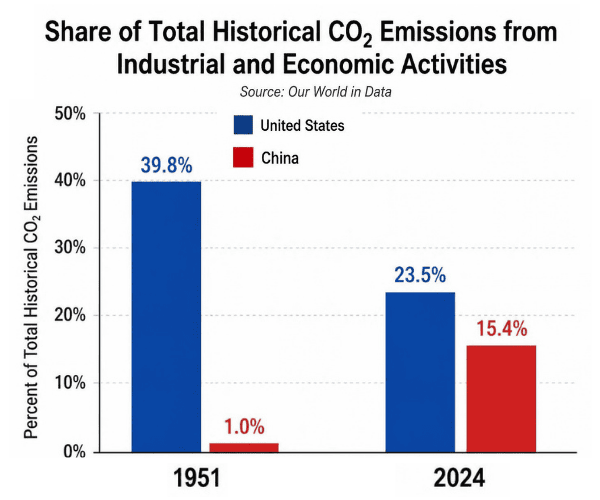
Summing up: despite not participating in the modern world economy until relatively recently, China is already responsible for more than 15 percent of the total CO2 emissions to ever come from it.
For those who choose to believe carbon dioxide is a pollutant, China’s industrial progress is on a path to swiftly become both the biggest cumulative and annual CO2 producer in human history.
Honesty about CO2 emissions
Those concerned about cutting CO2 emissions should have been proponents of nuclear power generation. But nuclear power has been opposed by most of the American climate NGOs, including three big ones that boast of their work in China.
So, China certainly “upended the old carbon-based world order,” as John Doerr claimed in April. But they did so nearly 20 years ago when they seized the undisputed heavyweight championship of the carbon-emitting world order. They may never surrender that title.
But through more than 800 words of his April essay, Doerr wrote not one sentence praising America for cutting carbon emissions, nor criticizing China for their decisive failure to do so.
The relative societal value of imposing radical reductions on CO2 emissions is debatable. As noted, there is a more important matter of real industrial pollutants that (unlike carbon emissions) are directly harmful to humans and animals. To this point, the previously mentioned American transition from coal to clean-burning natural gas in electricity production has dramatically cut both American CO2 emissions and helped trim our air pollution even further.
The American “climate” movement could be promoting a similar carbon-cutting coal-to-gas transition for the rest of the world. This would also promote the jobs and prosperity of the world-dominant American natural gas sector, rather than President Xi’s solar sector.
But nearly all these supposed guardians of the climate treat natural gas as if it is a co-equal polluter with oil and coal. That alone raises the concern that they care more about subsidizing wind turbines and solar panels than they do about cutting carbon emissions.
Additional damning evidence is the American climate movement’s near-unanimous and too-often effective opposition to nuclear energy.
No reliable energy option is as clean and safe as nuclear.
Nuclear reactors provide no emissions at all, just water vapor. As the birthplace of nuclear power, the United States still generates more electricity from it than any other nation. But you wouldn’t know this looking for the supposed pollution. The Department of Energy reports that all the “waste” from the entire history of American nuclear power—technically deteriorated fuel that can be recycled into new fuel—could be stacked ten yards high and fit on a football field.
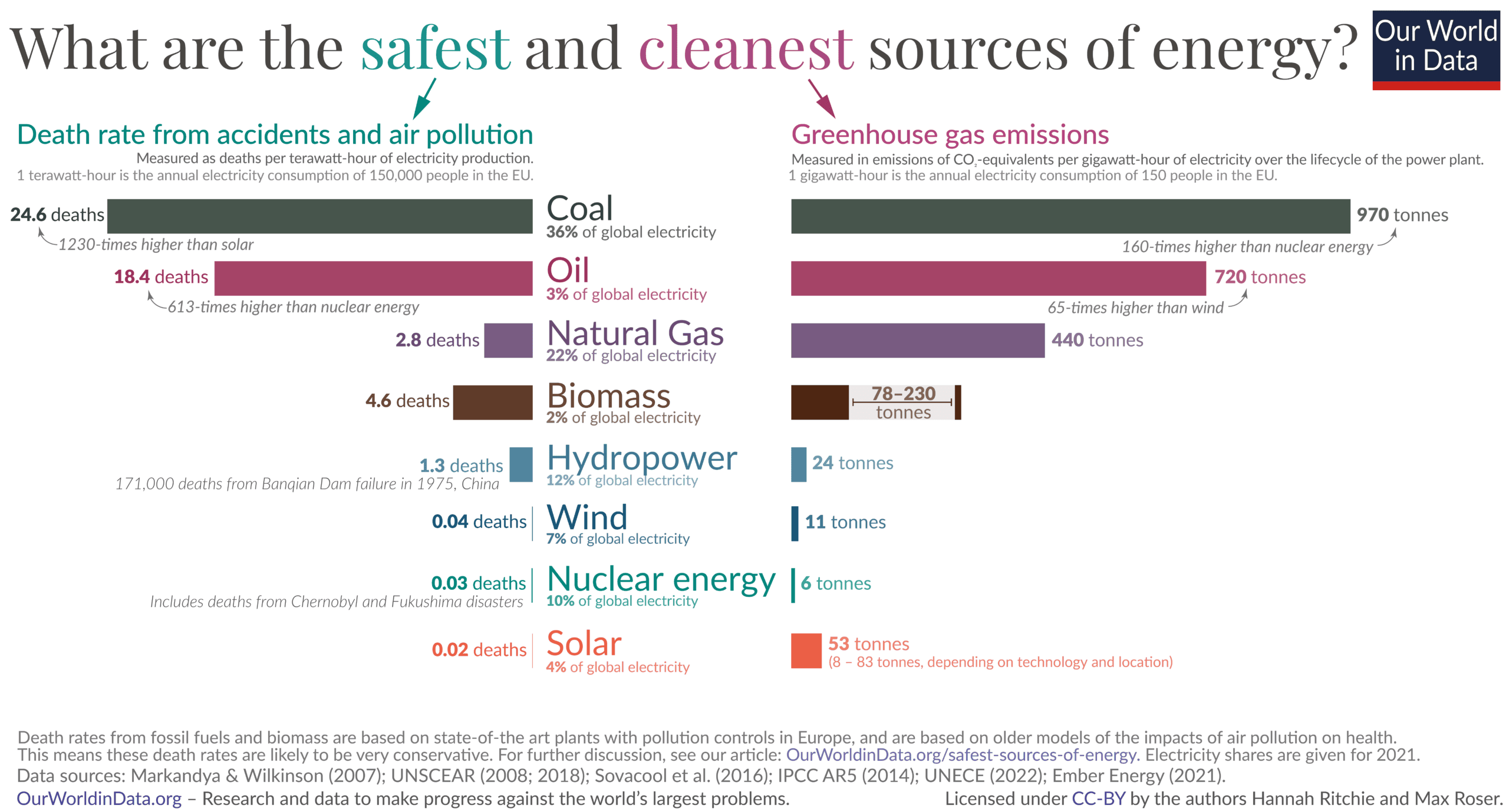
And comparing known fatalities against total energy output, a February 2020 report from Our World in Data found nuclear power to be functionally as safe as weather dependent wind and solar.
Then there is efficiency.
Imagine if a typical American could satisfy an entire lifetime of energy use, including driving and air travel, with only nuclear power. The uranium pellets needed to accomplish this would all fit inside an empty beer bottle. Just one of those pellets is about the size of a grown man’s thumb and produces as much energy as 120 gallons of oil or 17,000 cubic feet of natural gas.
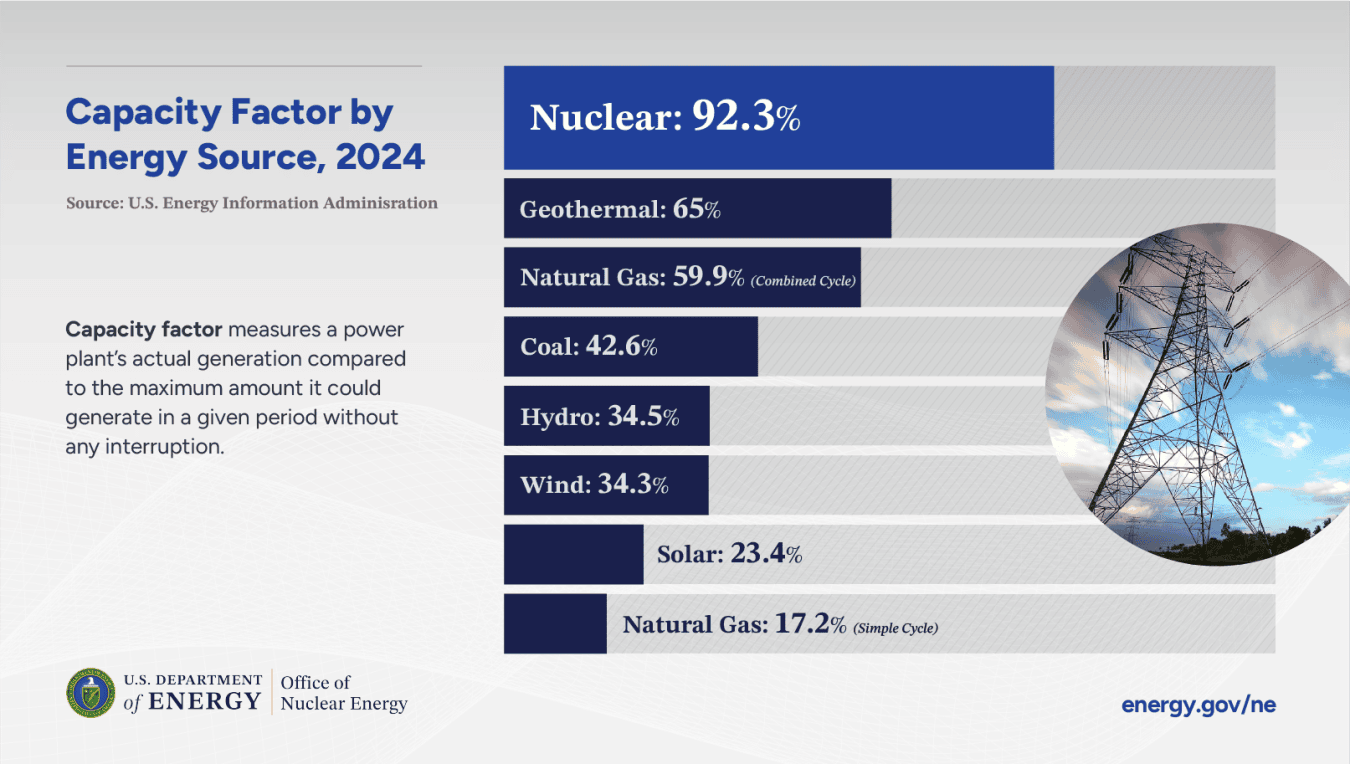
And rather than working only when the wind or sun are cooperating, the U.S. Department of Energy reports nuclear reactors are operating at a capacity factor of 92.3 percent. This means they run at full power almost all the time, compared to wind (34.3 percent) and solar (23.4 percent).
Also, we’ll never run out of nuclear power. “Uranium is a common metal found in rocks all over the world,” reports the Department of Energy. In a 2009 estimate, Scientific American first assumed no further discoveries of nuclear fuel, and projected the current known supply, at current usage, would last nearly five centuries. But even better: assuming more realistically that we’d find or make more nuclear fuels, Scientific American concluded nuclear power could keep the lights on for another 60,000 years.
In sum, no energy source is perfect, and there are always tradeoffs, but nuclear power is the greatest combination of reliability, safety, abundance and cleanliness ever developed. Nuclear is as close to perfection as it gets.
In a rational world, those most concerned about cutting CO2 emissions should have been the biggest proponents of a massive increase in nuclear power generation. But nuclear power has been opposed by most of the American climate NGOs, including three big ones that boast of their work in China: the Natural Resources Defense Council, the Environmental Defense Fund, and the Rocky Mountain Institute.
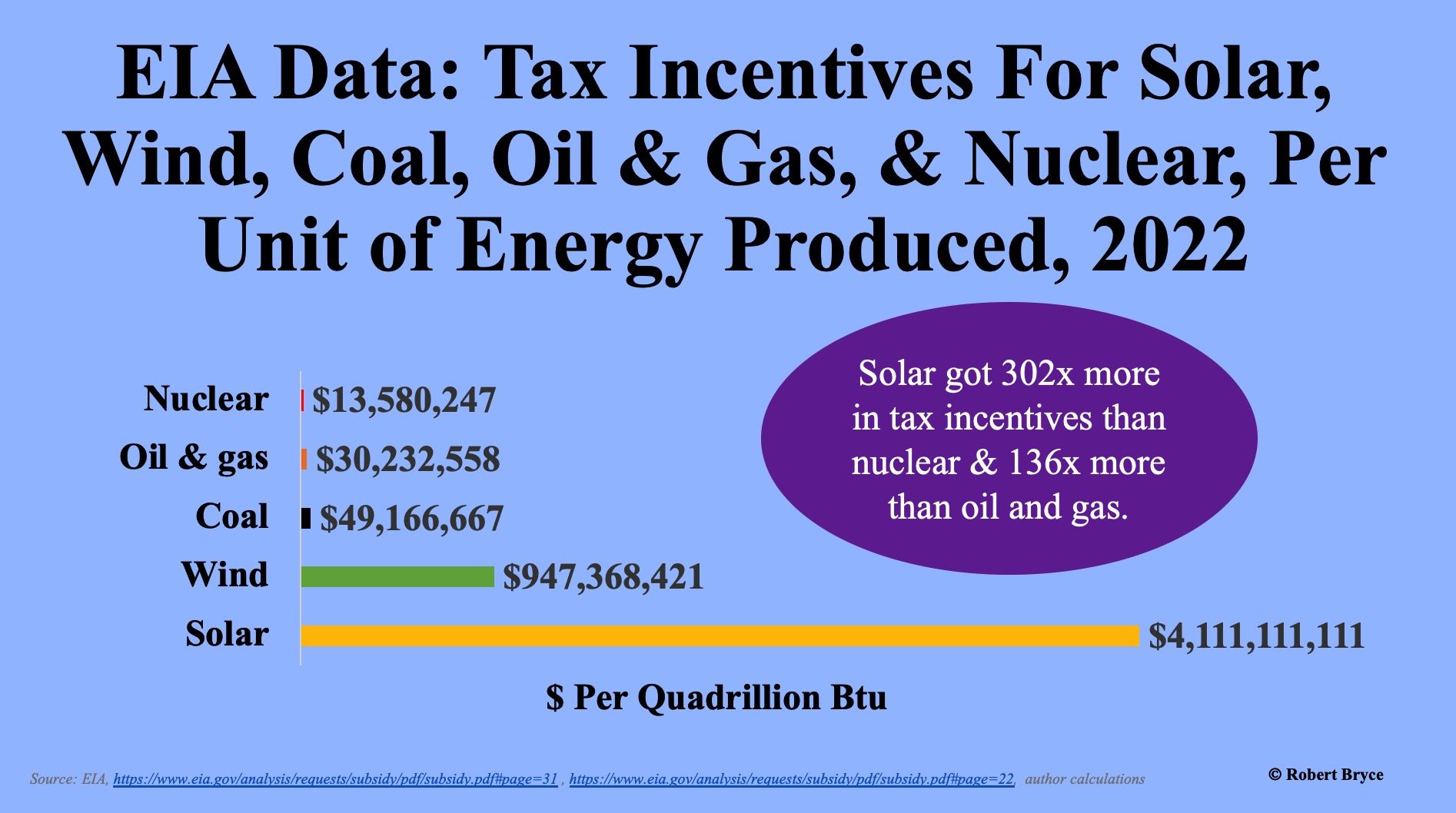
Instead, the NRDC, EDF and RMI and nearly all other CO2-obsessed NGOs are proponents of subsidizing unreliable wind and solar energy. Using 2022 federal data, energy analyst Robert Bryce compared taxpayer subsidies against the British thermal units (BTUs) of energy produced for all major forms of energy. According to Bryce, solar received 302 times more taxpayer support than nuclear power, and 136 times more than oil and gas. Wind got 69 times more than nuclear, and 31 times more than oil and gas.
Solar and wind systems also chew up hundreds of times more of our land (i.e.: the environment) than reliable power sources. An April 2021 analysis in Bloomberg Green showed solar panels need 140 times more land to produce the same electricity as a natural gas power station, and wind turbines need 370 times more. An emissions-free nuclear power plant was presented as 47 times more land friendly than solar and 123 times better than wind. Even a coal fired power station was far more land friendly per unit of electricity produced than wind and solar.
Energy Foundation China
EFC’s cheerleading for China should not be mistaken for Chinese propaganda. Most of the money is coming from wealthy Americans.
Doerr’s Climate Imperative Foundation may be the largest single donor to the Energy Foundation China (EFC), an American NGO that claims “nearly all” of its work is “focused on China given the scale of its energy sector and its role in global emissions.”
A lot of EFC’s “focus” has been on promoting weather dependent power. The main page of the website is dominated by photos of wind turbines and solar panels filling up landscapes. The page for “Clean Power” features the predictable photo of solar panels. And despite all the evidence that China has been sharply increasing production of CO2-heavy energy, EFC’s “Clean Power” page also predicts “that by mid-century, renewables would make up more than 80% of China’s power supply.”
But EFC’s cheerleading for China should not be mistaken for Chinese propaganda. Most of the money is coming from wealthy Americans such as Doerr.
The last four publicly available tax filings from Energy Foundation China, covering the four years through 2024, show combined total revenue of $334.7 million. The closest corresponding tax returns from just eight American foundations during the period show combined donations to EFC that account for $278.3 million (or 83.1 percent) of the four-year total:
- Leading the pack, with $6 million granted to EFC during those four years, is the Doerr-led Climate Imperative Foundation. (29.4 percent of the total)
- The two halves of the Hewlett-Packard tech fortune were next most generous, with the William & Flora Hewlett Foundation contributing $2 million and the David and Lucile Packard Foundation kicking in $19.1 million. (21 percent)
- The ClimateWorks Foundation (a joint creation of left-wing philanthropy giants, including both the Hewlett and Packard foundations) was good for $2 million. (12.9 percent)
- The Sequoia Climate Foundation, a giving vehicle for enigmatic California tech billionaire Fred Taylor, has added at least $10 million. (3 percent)
- The John D. and Catherine T. MacArthur Foundation, yet another of America’s multi-billion-dollar left-wing fortunes, has given at least $7 million. (1 percent)
- The Windward Fund, one tentacle of the left-wing pass-through donor empire formerly managed by Arabella Advisors, granted $8 million. (1.7 percent)
- And finally, an unknown number of the nearly 400,000 separate donor accounts at America’s largest charity, the Fidelity Investments Charitable Gift Fund, have collectively contributed at least $5 million. (13 percent)
What they’re funding at EFC appears to be entirely legal speech, protected by the First Amendment, as it should be. Americans have a right to spend their money to say nice things about a foreign state, be it Israel, Ukraine, the European Union, Canada, Cuba, Qatar, and even China. But what is legal should not be confused with what is wise, let alone accurate.
Similarly, those American donors to EFC and dozens of others have also written generous checks directly to American policy NGOs that promote China’s nonexistent emissions progress and Xi’s solar panels.
Environmental Defense Fund (EDF)
When EDF claims to have begun helping in 1999, China’s air pollution problem was 3.3 times worse than America’s. Nearly a quarter century after EDF declared “significant progress” China’s air pollution was 7.8 times worse than America’s.
For example, the Environmental Defense Fund (EDF) claims to have “been working in China since 1991 with a variety of partners to tackle climate change and pollution.” A timeline of EDF-China’s “major events” begins with 1999:
In 1999, EDF made significant progress in its pollution control efforts in China—the former State Environmental Protection Administration of China and the U.S. Environmental Protection Agency signed a letter of intent to cooperate, designating EDF as the implementation partner for the sulfur dioxide emission reduction cooperation project. [emphasis added]
Every nation with a mildly competent government and room for environmental improvement has cleaned up its act since 1999, so the relative changes since then are the relevant metric to track. How did China do compared to the rest of the world?
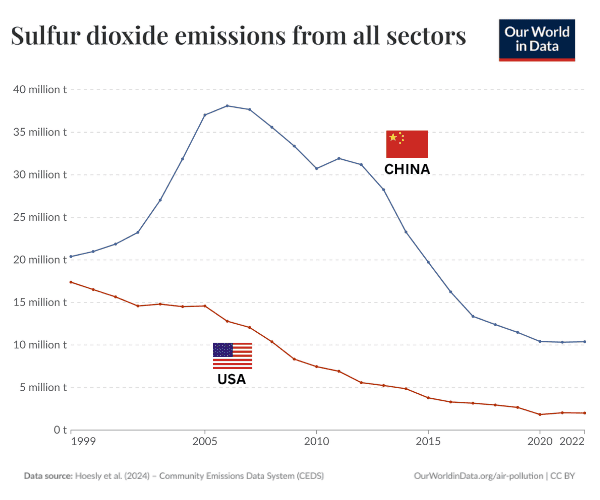
Our World in Data reports total Chinese sulfur dioxide (SO2) emissions in 1999 were only 17.2 percent higher than the USA in 1999. From there, total American SO2 emissions began a steady decline. But Chinese SO2 emissions nearly doubled from 1999 to 2006 and didn’t fall back below China’s 1999 SO2 level until 2015. So, by 2022 China’s SO2 emissions had become 400 percent higher than America’s.
As to general air pollution, according to Our World in Data, a horrifying 27.3 percent of all fatalities from all causes in China were credited to air pollution in 1999. The comparable figure for the USA was 8.1 precent; Canada, the closest rich nation sharing our air, was at 4.1 percent; and Greenland, cleanest in the world, registered just 0.3 percent.
By 2023, the contribution of China’s air pollution to total fatalities had declined to . . . 18.8 percent; progress of a sort, but still nearly one of every five Chinese deaths due to dirty air. Meanwhile, air pollution’s share of American fatalities had sharply declined to only 2.4 percent by 2023, nearly matching Canada’s 2 percent the same year. Greenland, with little room to improve, remained at 0.3 percent.
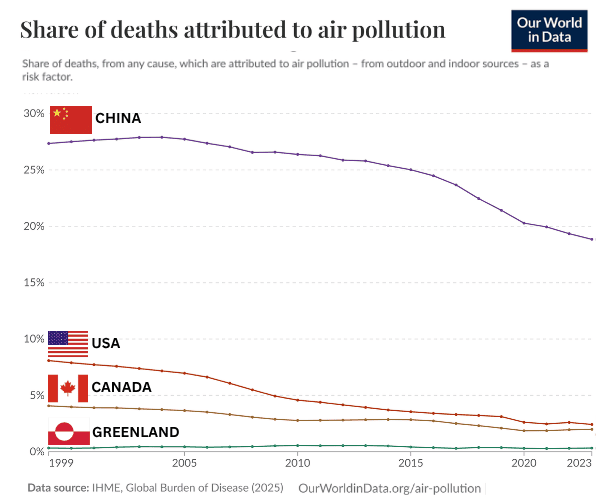
Put another way, when EDF claims to have begun helping in 1999, China’s air pollution problem was 3.3 times worse than America’s. Nearly a quarter century after EDF declared “significant progress” China’s air pollution was 7.8 times worse than America’s.
Rocky Mountain Institute (RMI)
“If you ask me, it’d be little short of disastrous for us to discover a source of clean, cheap, abundant energy because of what we would do with it.” – RMI founder Amory Lovins
Another China promoter is the Rocky Mountain Institute (RMI).
For most of its history the RMI wasn’t one of the largest American environmental NGOs. That has changed as they’ve become more involved in China. For the year ending June 2025, the RMI reported $174.9 million in total revenue, up from $29.5 million as recently as 2016.
The RMI was co-founded in 1982 by a promoter of weather dependent power named Amory Lovins. An opponent of even emissions-free nuclear power, Lovins is still a revered figure within and contributor to the Rocky Mountain Institute. Now the NGO’s chairman emeritus, the RMI website has a dedicated space for his work titled “Inside Amory’s Brain.”
But implementing what’s inside that brain, to paraphrase Amory, would be “little short of disastrous.” In a 1977 interview Lovins said:
If you ask me, it’d be little short of disastrous for us to discover a source of clean, cheap, abundant energy because of what we would do with it. We ought to be looking for energy sources that are adequate for our needs, but that won’t give us the excesses of concentrated energy with which we could do mischief to the earth or to each other. [emphasis added]
That quote is conspicuously missing from the RMI website. What isn’t missing is the RMI’s current cheerleading for China.
In September 2020, according to a news release from the RMI, “President Xi Jinping announced that China will strive to peak emissions before 2030 and achieve carbon neutrality before 2060.” That hollow promise was enough for the Rocky Mountain Institute to compliment Xi for “China’s determination to provide responsible global leadership.”
“The appropriate strategy compatible with China’s long-term carbon-neutrality target should be to ensure that almost all growth in China’s electricity generating capacity is zero carbon, with no new coal investment,” advised the RMI in January 2021 [emphasis added].
Plot spoiler: there was a lot of “new coal investment.”
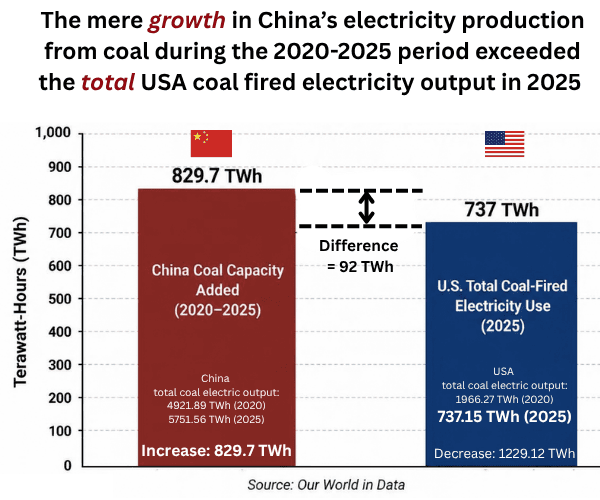
From 2020 through 2025, according to Our World in Data, China added 829.7 terawatt-hours (TWh) of annual coal-fired electricity generation, bringing their annual total to 5751.6 TWh in 2025. For perspective, just the additional 829.7 TWh Chinese coal capacity added during those five years was 92 TWh more than the 737 TWh of coal-fired electricity the entire American economy used in 2025.
Back in 2016, the RMI and China’s National Development and Reform Commission, co-produced Reinventing Fire: A roadmap for China’s Revolution in energy consumption and production to 2050. This absurdly optimistic document laid out a plan for China’s CO2 emissions to peak at 9.6 billion tonnes in 2025 and decline from there. But in the real world, according to Our World in Data, China was already at 12.3 billion tonnes by 2024.
This was a big miss. The difference between the report’s projected 2025 emissions for China and actual emissions was equal to the combined 2024 CO2 output of the entire European Union.
Even by 2021, back when RMI was praising Xi for his “responsible global leadership,” China’s CO2 emissions were already well beyond the peak of 9.6 billion tonnes the Rocky Mountain Institute and (supposedly) Xi’s government were looking to stay within.
After truth overwhelmed optimism, the RMI came out with a new report in 2025: Decoding the Coal-Power Transition in China. “China’s success in renewables is complicated by its persistent reliance on coal in the power sector,” conceded the online introduction for the report. And then it made excuses for why China missed the mark: “A rapidly growing demand for power, a 20-year record-low river flow and hydropower output, lack of power-system flexibility, and increasing concerns about energy security have led to an acceleration of new coal power approvals. . .”
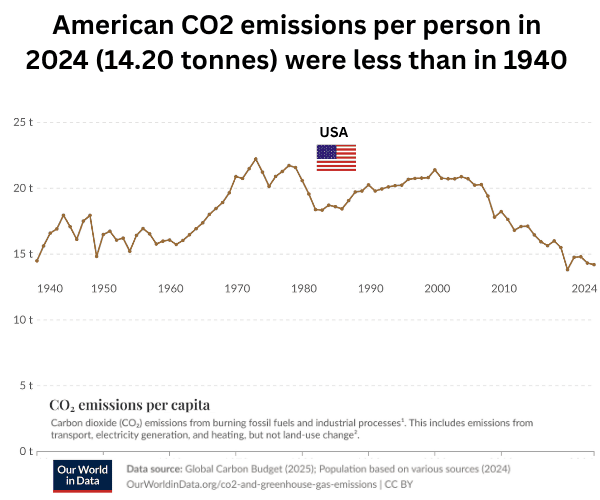
As noted earlier, the switch from high carbon fuel (coal) to low carbon natural gas in electricity generation means America is emitting less real pollution and less carbon dioxide. In fact, on a per person basis, U.S. carbon dioxide emissions are lower today than at any point since the end of World War II.
But in contrast to the serial cheerleading for China’s empty coal promises, the Rocky Mountain Institute has tried to reverse America’s proven progress with natural gas.
In December 2022, during the Biden administration, the RMI co-produced a research paper that dubiously claimed American gas stoves were responsible for 12.7 percent of childhood asthma cases. Richard Trumka, a Biden-appointed member of the Consumer Product Safety Commission (CPSC), used the report to suggest banning residential gas stove installations.
Controversy ensued, which wasn’t surprising because 35 percent of American homes use gas stoves and they are preferred by both amateur and professional chefs. The CPSC and the Biden administration swiftly backed away from Trumka’s suggestion.
Still, the incident showed the Rocky Mountain Institute has been more successful pushing its anti-energy agenda on America than it has on China.
Natural Resources Defense Council (NRDC)
“The development of natural gas will create jobs and power trucks and factories that are cleaner and cheaper, proving that we don’t have to choose between our environment and our economy,” predicted Obama, accurately. He was interrupted by applause from both Democrats and Republicans. But the NRDC wasn’t cheering.
Another China cheerleader, the Natural Resources Defense Council (NRDC), boasts it was “the first international nonprofit to launch a clean energy program in China,” having arrived back in the “mid-1990s,” and “has been supporting China’s sustainable development for more than 20 years.” A sharp reader will note this period correlates closely with China’s rapid ascent to becoming the world’s unrivaled king of cranking out CO2 emissions and undisputed champion of coal powerplant construction.
But as of late August 2026, the NRDC website still made this, seemingly obtuse claim:
China’s 13th Five-Year Plan (2016–2020) established, for the first time, a mandatory target for decreasing the share of coal in total energy consumption. NRDC energy experts are helping the country to decrease the share of coal in total energy consumption. We’re promoting ways to add more wind and solar to the grid and bring efficiency measures to more of the country’s industries.
So, an authoritarian government that doesn’t answer to voters has declared a “mandatory target,” and an American NGO believes it’s real. And while China’s 13th consecutive set of good intentions was enough to win the praise of the NRDC, provable American progress on the same concern was not.
The American natural gas renaissance and ensuring sharp drop in our carbon dioxide emissions began under President Barack Obama. At a minimum, President Obama deserves credit for not getting in the way of it, but it’s also reasonable to credit him with supporting the transition. In his January 2012 State of the Union Address, the Democratic president boasted he had spent his first term opening “millions of new acres for oil and gas exploration” on federal lands and that we had “a supply of natural gas that can last America nearly 100 years.”
“The development of natural gas will create jobs and power trucks and factories that are cleaner and cheaper, proving that we don’t have to choose between our environment and our economy,” predicted Obama, accurately. He was interrupted by applause from both Democrats and Republicans.
But the NRDC wasn’t cheering. Three months later, in March 2012, the Obama administration approved a natural gas drilling project on federal land in eastern Utah. The NRDC responded with a news release accusing the administration of turning the region into “an industrial wasteland.”
The NRDC’s animosity towards American natural gas use and production predictably continued during the two Trump administrations. In one example, the NRDC encouraged supporters to write to Congress to oppose “the Trump administration’s efforts to dramatically expand the production and export of climate-destroying liquefied natural gas…”
Meanwhile, four Chinese cities placed in the top 25 for IQAir’s 2025 ranking of the world’s most polluted cities and the World Health Organization reports that two million Chinese die each year because of air pollution. To the extent the term means anything, China has done more to create “an industrial wasteland” than the combined work of all the American presidential administrations in our history.
But don’t expect the NRDC to fire off a nasty news release at Xi Jinping. Critics of China’s government don’t do so well within its jurisdiction. The only thing complaining would accomplish is a swift end to the NRDC’s decades of supposedly “helping” with what they claim is China’s “sustainable development.”
Even what NRDC cheers about China looks ugly in practice. The NRDC web page for “Climate Change: Renewable Energy” features a photo of a formerly lush green mountaintop in China that is now covered in black solar panels. The caption reads: “Accelerating its shift to a new clean energy system will help China to ensure that it can peak its fossil fuel use and carbon emissions as early and as low as possible. Here, a mountaintop solar power plant in China’s Nanping City.”
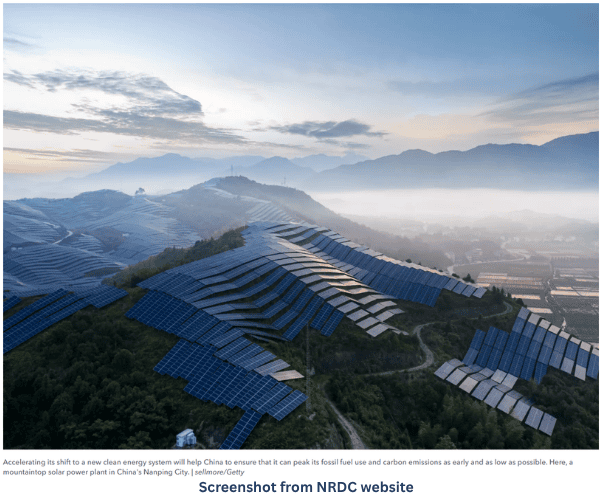 According to its developer, the solar facility in Nanping annually generates “32.4 million kWh” of electricity. This translates to 0.0324 TWh (terawatt hours). For comparison, a single Westinghouse AP 1000 nuclear reactor can annually generate up to 10 TWh, or 300 times the annual output of that ugly mountain full of solar panels.
China the coal-burning king of the world also has 64 nuclear reactors currently operating and 38 more under construction. Most if not all likely exceed, by 100 times or more, the annual energy output reported for Nanping solar. Yet, it is very difficult, and perhaps impossible, to find even one photo of China’s impressive collection of pollution free nuclear stations on the NRDC website. Perhaps the environmental NGO hasn’t been “helping” with this more effective and less environmentally destructive path to cutting China’s CO2 emissions.
But the NRDC’s weather-dependent power promotion is relentless.
A November 2022 “Expert Blog” posted by the NRDC praised “China’s efforts to shift to a new energy system” and the “rapid growth in wind and solar.” The post predicted “it is likely that many of [China’s] most coal and carbon-intensive sectors have already or will soon peak.”
When that didn’t happen, the China cheerleaders didn’t criticize.
The NRDC’s “mid-1990s” arrival in China puts it there a half decade or so beyond the regime’s 1989 massacre in Tiananmen Square. China has a gangster government that was willing to use main battle tanks against unarmed citizens demanding democracy. Such a regime was never going to heed polite advice from an American NGO telling them their industrial carbon dioxide emissions were too high.
An American problem
China has had more than enough wealth to commit to those CO2 emissions promises they have failed to fulfill and didn’t need the advice, money or any form of help at all from American NGOs. What China couldn’t buy on their own was the propaganda value of those credulous Americans calling them an environmental superstar.
In 2024, according to the “China Power” project of the Center for Strategic and International Studies, China spent $317.6 billion on its military, second only to the United States. This is more than the $305.3 billion combined military spending that year by 22 other nations (including India and Japan) that share the Indo-Pacific region with China. Russia and Ukraine put together and fighting a brutal land war against each other spent $217.3 billion on their militaries in 2024.
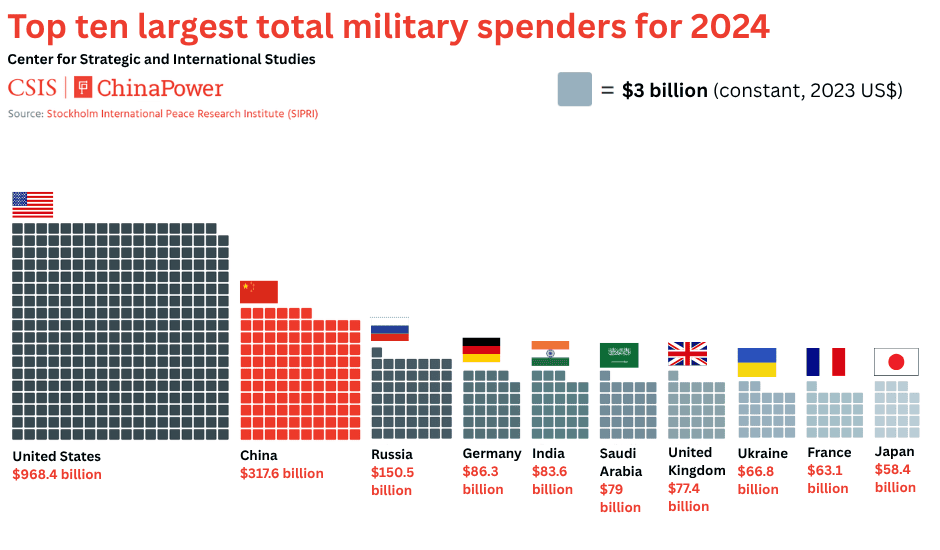
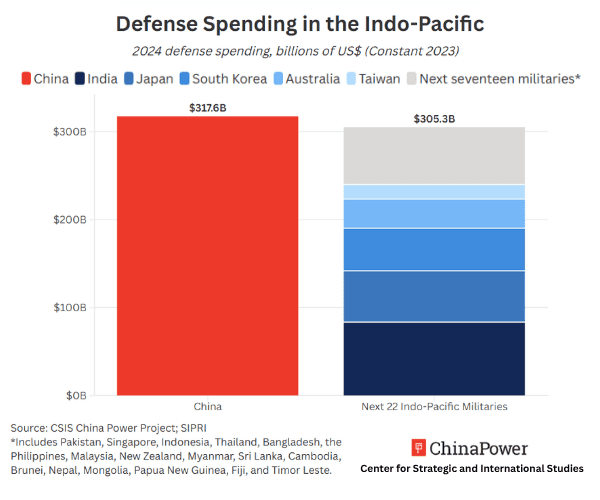 China can afford to commit fantastic sums to weapons procurement because China’s annual GDP now exceeds $20.8 trillion. This is second only to the United States and more than the combined GDP of the next four largest economies on Earth (Germany, Japan, UK and India).
On paper, China has had more than enough wealth to commit to those CO2 emissions promises they have serially and seriously failed to fulfill. So why is China building 85 brand new coal fired power stations this year alone?
They are a near-monopoly supplier of solar panels and wafers, and the major exporter of same. If replacing coal with solar had been feasible and advisable, then China was uniquely positioned to do it all by themselves.
China didn’t need the advice, money or any form of help at all from American NGOs such as the Energy Foundation China, the Environmental Defense Fund, the Rocky Mountain Institute or the Natural Resources Defense Fund. China didn’t need financial assistance from American billionaires such as John Doerr, American pass-through donors such as the ClimateWorks Foundation, or American professional philanthropists in charge of the massive fortunes left behind by American industrialists such as Hewlett and Packard.
But what China couldn’t buy on their own, at any price, was the propaganda value of those credulous Americans repeatedly proclaiming Xi Jinping’s regime to be an environmental superstar. What China couldn’t buy on their own was the propaganda value of those Americans simultaneously pretending, against all evidence to the contrary, that even a Democratic president was creating an “industrial wasteland” in America.
What these China cheerleaders in America are doing is legal; it should not be confused with what is right. Xi Jinping may need their help to sell his sketchy solar panels. The Earth does not.
Source: https://capitalresearch.org/article/climate-ngos-are-xi-jinpings-useful-idiots-in-america/
Anyone can join.
Anyone can contribute.
Anyone can become informed about their world.
"United We Stand" Click Here To Create Your Personal Citizen Journalist Account Today, Be Sure To Invite Your Friends.
Before It’s News® is a community of individuals who report on what’s going on around them, from all around the world. Anyone can join. Anyone can contribute. Anyone can become informed about their world. "United We Stand" Click Here To Create Your Personal Citizen Journalist Account Today, Be Sure To Invite Your Friends.
LION'S MANE PRODUCT
Try Our Lion’s Mane WHOLE MIND Nootropic Blend 60 Capsules
Mushrooms are having a moment. One fabulous fungus in particular, lion’s mane, may help improve memory, depression and anxiety symptoms. They are also an excellent source of nutrients that show promise as a therapy for dementia, and other neurodegenerative diseases. If you’re living with anxiety or depression, you may be curious about all the therapy options out there — including the natural ones.Our Lion’s Mane WHOLE MIND Nootropic Blend has been formulated to utilize the potency of Lion’s mane but also include the benefits of four other Highly Beneficial Mushrooms. Synergistically, they work together to Build your health through improving cognitive function and immunity regardless of your age. Our Nootropic not only improves your Cognitive Function and Activates your Immune System, but it benefits growth of Essential Gut Flora, further enhancing your Vitality.

Our Formula includes: Lion’s Mane Mushrooms which Increase Brain Power through nerve growth, lessen anxiety, reduce depression, and improve concentration. Its an excellent adaptogen, promotes sleep and improves immunity. Shiitake Mushrooms which Fight cancer cells and infectious disease, boost the immune system, promotes brain function, and serves as a source of B vitamins. Maitake Mushrooms which regulate blood sugar levels of diabetics, reduce hypertension and boosts the immune system. Reishi Mushrooms which Fight inflammation, liver disease, fatigue, tumor growth and cancer. They Improve skin disorders and soothes digestive problems, stomach ulcers and leaky gut syndrome. Chaga Mushrooms which have anti-aging effects, boost immune function, improve stamina and athletic performance, even act as a natural aphrodisiac, fighting diabetes and improving liver function. Try Our Lion’s Mane WHOLE MIND Nootropic Blend 60 Capsules Today. Be 100% Satisfied or Receive a Full Money Back Guarantee. Order Yours Today by Following This Link.


| Visits: | 1,834,048,973 |
| Stories: | 8,716,000 |
Whistler Blowers, Insiders

