

Just Like the Days of Noah

To help His listeners better understand the timing and circumstances of the events leading up to, and including, the destruction of the temple before their generation passed away, Jesus draws on two familiar Old Testament judgment events: the flood and the judgment on Sodom. Jesus, teaching by analogy, shows that the coming of the flood waters parallels His own coming, as described in the Olivet Discourse and elsewhere in the Gospels (Matt. 10:23; 16:27-28; 24:30-34; Luke 17:20-37; 19:28-44; Mark 13). In Noah’s time we read about “those days which were before the flood” and “the day NOAH ENTERED THE ARK” (Matt. 24:38). Similarly, there were days before the coming of the Son of Man and the day of the coming of the Son of Man.
The same people were involved in both the “days before” and “the day of ” the Son of Man. Those who “were eating and drinking” and “marrying and giving in marriage” were the same people who were shut out on “the day that Noah entered the ark.” Noah entered the ark on a single day, like the way Jesus, as the Son of Man, came on the “clouds of heaven with power and great glory” (Matt. 24:30), a day and hour known only to the Father (24:36). “Some shall be rescued from the destruction of Jerusalem, like Lot out of the burning of Sodom: while others, no ways perhaps different in outward circumstances, shall be left to perish in it.”[1]
Jesus says that His coming “will be just like the days of Noah” (24:37). The people were doing normal things—“eating and drinking” and “marrying and giving in marriage.” Jesus tells His audience that life will be going on as usual when He returns in judgment. People in Noah’s day had no thought of a coming judgment because there were no signs. Noah was told to prepare for “things not yet seen” (Heb. 11:7). Jesus is not describing evil behavior like drunkenness and sexual sins like “‘exchanging mates’ or ‘wife swapping,’” contrary to what M. R. DeHaan and Jack Van Impe claim.[2] “Marrying and giving in marriage” describes, well, “marrying and giving in marriage” (see Matt. 22:30). Men and women marry, and parents give their daughters away in marriage all the time. D. A. Carson’s comments are helpful:
[T]hat the coming of the Son of Man takes place at an unknown time can only be true if in fact life seems to be going on pretty much as usual—just as in the days before the flood (v. 37). People follow their ordinary pursuits (v. 38). Despite the distress, persecutions, and upheavals (vv. 4-28), life goes on: people eat, drink, and marry. There is no overt typological usage of the Flood as judgment here, nor any mention of the sin of that generation.[3]
Support for Carson’s interpretation can be found in Luke’s account of the time just before Sodom’s destruction: “It was the same as happened in the days of Lot: they were eating, they were drinking, they were buying, they were selling, they were planting, they were building; but on the day that Lot went out from Sodom it rained fire and brimstone from heaven and destroyed them all” (Luke 17:28). Buying, selling, planting, and building describe life going on as usual without any regard to an impending judgment or that the judgment is to be global. As we read in Matthew 24:16, Lot escaped on foot by fleeing to the mountains (Gen. 19:17) because, in both cases, the judgment was local.
Are dispensationalists willing to say that these activities “connote moral corruption”? Darrell L. Bock attempts this interpretation even though he admits that the idea of “moral corruption … is not emphasized in Luke’s description.”[4] No one disputes that Noah and Lot lived in a time of moral corruption that would bring judgment. Jesus’ point is that the people in Noah and Lot’s day went on with their lives as if the promise of imminent judgment was a lie. The same is true of those who were told that Jesus would return in judgment within a generation (see 2 Peter 3:3-4).
Many futurists claim the phrase “took them all away” (24:39) refers to a rapture still in our future. On the contrary. “In the context of 24:37-39, ‘taken’ presumably means ‘taken to judgment’ (cf. Jer. 6:11 NASB, NRSV).”[5] The phrase ties the judgment of the world in Noah’s day with the judgment of the Jews’ world in Israel’s day that took place with the destruction of the city of Jerusalem and the temple. Who was taken away in the judgment of the flood? Not Noah and his family. They were left behind to carry on God’s work.
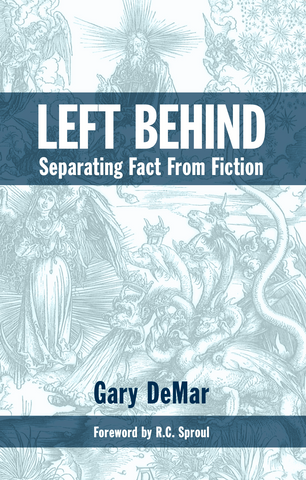
In Left Behind: Separating Fact From Fiction, Gary DeMar takes a critical look at the theology behind this popular fiction series and challenges readers to consider a different interpretation. With confidence based on years of biblical study, DeMar carefully examines eleven major components of the pre-tribulation rapture theology and offers clear, convincing alternatives to the interpretations of Bible prophecy presented in Left Behind.
John Gill writes in his commentary on this passage: “the whole world of the ungodly, every man, woman, and child, except eight persons only; Noah and his wife, and his three sons and their wives….” were taken away in judgment. And what does Gill say about those in the field? They shall be taken away “by the eagles, the Roman army, and either killed or carried captive by them.” The Bible comments on the meaning of “took them all away” in Luke 17:27, 29: “Destroyed them all” is equivalent to “took them all away.” Consider the meaning that dispensationalist John Walvoord gives to “took them away.”
An argument advanced by Alexander Reese and adopted by [Robert] Gundry is that the references in Matthew 24:40, 41 should be interpreted as referring to the rapture. These verses state, “Then shall two be in the field; the one shall be taken, and the other left. Two women shall be grinding at the mill; one shall be taken and the other left.”
Gundry and Reese violate the rule that context should determine a passage’s interpretation. They concede that the context concerns judgment, as it was understood in Noah’s time. According to Matthew 24:39, those living at that time “knew not until the flood came, and took them all away, so shall also the coming of the Son of Man be.” Those taken away were taken away in judgment.
* * * * *
Claiming that those taken in verses 40 and 41 are taken away in the rapture, Gundry in discussing the parallel passage in Luke 17:34-37 ignores verse 37. There two are pictured in the same bed, with one taken and the other left. Two are grinding together, and one is taken and the other left. Two are in the field, one is taken and the other left. Then, in verse 37, the question is asked, “Where, Lord?” The answer is very dramatic: “And He said unto them, Wherever the body is, there will the eagles be gathered together.” It should be very clear that the ones taken are put to death and their bodies are consumed by the vultures. If the ones taken are killed, then verses 40, 41 of Matthew 24 speak of precisely the same kind of judgment as occurred in the flood where the ones taken were taken in judgment.[6]
Robert Young made the following comment on Matthew 24:40: “‘two men’ … be taken away (by the Romans), and the one shall be let alone,’ none touching him.”[7]
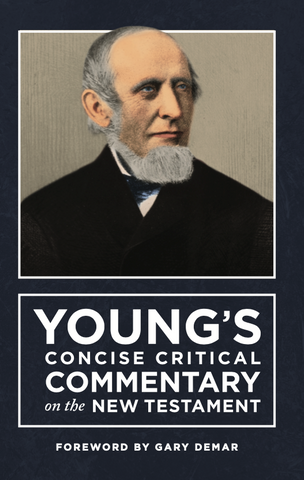
A literal translation of the Bible is very helpful. Robert Young (1822-1888) published several editions of his Literal Translation of the Bible (YLT). He also published the Concise Critical Bible Commentary that was “Specially Designed for Those Teaching the Word of God.” It’s his New Testament version of his Concise Critical Bible Commentary that American Vision has republished. It’s an eye-opener when it comes to words often mistranslated and sometimes not translated in popular Bible translations, and you don’t need to know Greek to benefit from his commentary.
But like Reese and Gundry, Walvoord ignores the time and audience references that run throughout Matthew 24-25, claiming that they refer to a distant coming of Christ and future audience. Since there was a judgment where Jews were in fact “taken away in judgment,” it makes much more sense to place the timing of such an event at the closest event that does not require a rebuilt temple and the restoration of animal sacrifices: Jerusalem’s judgment and the temple’s destruction in AD 70. We find something similar in 2 Kings 25, where some were “carried away in exile” and “some of the poorest of the land” were left behind (vv. 11-12).
[1] Thomas Newton, Dissertations on the Prophecies, Which Have Remarkably Been Fulfilled, and at This Time are Fulfilling in the World (London: J.F. Dove, 1754), 379.
[2] Jack Van Impe, The Great Escape: Preparing for the Rapture, the Next Event on God’s Prophetic Clock (Nashville, TN: Word, 1998), 127.
[3] D. A. Carson, “Matthew,” The Expositor’s Bible Commentary, gen. ed., Frank E. Gaebelein (Grand Rapids, MI: Zondervan, 1984), 8:509. Also see N. T. Wright, Jesus and the Victory of God (Minneapolis, MN: Fortress Press, 1996), 365-366.
[4] Bock, Luke: Baker Exegetical Commentary on the New Testament, 2 vols. (Grand Rapids, MI: Baker Books, 1996), 2:1432-1433.
[5] Craig S. Keener, The IVP Bible Background Commentary: New Testament (Downers Grove, IL: InterVarsity Press, 1993), 115.
[6] John F. Walvoord, The Blessed Hope and the Tribulation: A Historical and Biblical Study of Posttribulationism (Grand Rapids, MI: Zondervan, 1976), 89, 90. Walvoord wrote elsewhere: “Because at the rapture believers will be taken out of the world, some have confused this with the rapture of the church. Here, however, the situation is the reverse. The one who is taken, is taken in judgment. This is in keeping with the illustration of the time of Noah when the ones taken away are the unbelievers.” John F. Walvoord, Matthew: The Kingdom Come (Chicago: Moody Press, 1974), 193.
[7] Concise Critical Comments on the Holy Bible (London: Pickering & Inglis, n.d.), 25.
American Vision’s mission is to Restore America to its Biblical Foundation—from Genesis to Revelation. American Vision (AV) has been at the heart of worldview study since 1978, providing resources to exhort Christian families and individuals to live by a Biblically based worldview. Visit www.AmericanVision.org for more information, content and resources
Source: https://americanvision.org/posts/just-like-the-days-of-noah/
Anyone can join.
Anyone can contribute.
Anyone can become informed about their world.
"United We Stand" Click Here To Create Your Personal Citizen Journalist Account Today, Be Sure To Invite Your Friends.
Before It’s News® is a community of individuals who report on what’s going on around them, from all around the world. Anyone can join. Anyone can contribute. Anyone can become informed about their world. "United We Stand" Click Here To Create Your Personal Citizen Journalist Account Today, Be Sure To Invite Your Friends.
LION'S MANE PRODUCT
Try Our Lion’s Mane WHOLE MIND Nootropic Blend 60 Capsules
Mushrooms are having a moment. One fabulous fungus in particular, lion’s mane, may help improve memory, depression and anxiety symptoms. They are also an excellent source of nutrients that show promise as a therapy for dementia, and other neurodegenerative diseases. If you’re living with anxiety or depression, you may be curious about all the therapy options out there — including the natural ones.Our Lion’s Mane WHOLE MIND Nootropic Blend has been formulated to utilize the potency of Lion’s mane but also include the benefits of four other Highly Beneficial Mushrooms. Synergistically, they work together to Build your health through improving cognitive function and immunity regardless of your age. Our Nootropic not only improves your Cognitive Function and Activates your Immune System, but it benefits growth of Essential Gut Flora, further enhancing your Vitality.

Our Formula includes: Lion’s Mane Mushrooms which Increase Brain Power through nerve growth, lessen anxiety, reduce depression, and improve concentration. Its an excellent adaptogen, promotes sleep and improves immunity. Shiitake Mushrooms which Fight cancer cells and infectious disease, boost the immune system, promotes brain function, and serves as a source of B vitamins. Maitake Mushrooms which regulate blood sugar levels of diabetics, reduce hypertension and boosts the immune system. Reishi Mushrooms which Fight inflammation, liver disease, fatigue, tumor growth and cancer. They Improve skin disorders and soothes digestive problems, stomach ulcers and leaky gut syndrome. Chaga Mushrooms which have anti-aging effects, boost immune function, improve stamina and athletic performance, even act as a natural aphrodisiac, fighting diabetes and improving liver function. Try Our Lion’s Mane WHOLE MIND Nootropic Blend 60 Capsules Today. Be 100% Satisfied or Receive a Full Money Back Guarantee. Order Yours Today by Following This Link.


| Visits: | 1,835,382,595 |
| Stories: | 8,723,374 |
Whistler Blowers, Insiders

