

Questions to Ask Dispensationalists

I received an email asking for help on how to answer questions related to dispensationalism. I have answered these questions numerous times over the years in interviews, articles, debates, and my books. This summary points interested readers to the books for more in-depth treatment.
1. Define the biblical term “antichrist.”
There are only four verses in the NT where the word actually appears (1 John 2:18, 22; 4:3; 2 John 7). Note the time (“last hour” and “already”) and number (“many”). The antichrists were alive in John’s day, and they were defined in a specific way (also see “the synagogue of Satan” in Rev. 2:9; 3:9).
• Children, it is the last hour; and just as you heard that antichrist is coming, even now many antichrists have appeared; from this we know that it is the last hour (1 John 2:18).
• Who is the liar except the one who denies that Jesus is the Christ? This is the antichrist, the one who denies the Father and the Son (v. 22).
• Beloved, do not believe every spirit, but test the spirits to see whether they are from God. For many false prophets have gone out into the world. By this you will know the Spirit of God: Every spirit that confesses that Jesus Christ has come in the flesh is from God, and every spirit that does not confess Jesus is not from God. This is the spirit of the antichrist, which you have heard is coming and which is already in the world at this time” (4:1-3).
• For many deceivers (1) have gone out into the world, (2) those who do not acknowledge Jesus Christ as coming in the flesh. (3) This is the deceiver and the antichrist. (2 John 7)
See my book The Antichrist, Beasts, the Man of Lawlessness, and 666.

The number 666 has long fascinated theologians and mathematicians. Maybe the interest in the number has something to do with the attainment of wisdom and understanding since to “calculate the number of the beast” will reward the diligent (Rev. 13:18). The first readers were to have “understanding” to “calculate the number of the Beast” (Rev. 13:18). The Beast must have been a contemporary of the first-century readers. We can have the same “understanding” by studying the history of the period. We don’t have to speculate on the identity of some future Beast.
2. Where in Scripture does it mention a rapture, the removal of the church from Earth, before, during, or after 7 years? Looking for a specific verse.
There isn’t one. A dispensationalist will most likely bring up the Trinity. See The Rapture and the Fig Tree Generation.

For decades, Christians have been enticed with the belief that they would be taken to heaven before a coming tribulation period in an event called the “rapture.” Since the national reestablishment of Israel in 1948, countless books and pamphlets have been written defending the doctrine, assuring readers that it could happen at any moment. Some prophecy writers claimed the “rapture” would take place before 1988. We are far removed from that date. Where are we in God’s prophetic timetable?
3. If he mentions Daniel 9:24-27, he will have to deal with his claim that there is a gap between the 69th and 70th weeks. Based on Daniel 9:2, which describes the length of the captivity (70 years with no gap), how is it justified to place a gap at any point in the 70 weeks? How can dispensationalists insert a gap into a passage that doesn’t mention it and claim they are interpreting the Bible “literally”?
Is a gap mentioned between the seven weeks (49 years) and the sixty-two weeks (434 years) of the 490 years? No. So why a gap between the 69th and 70th weeks?
The following is from E.W. Hengstenberg’s Christology of the Old Testament and a Commentary on the Messianic Predictions. The period of seventy weeks of years—490 years—“is here predicted as one that will continue uninterruptedly from its commencement to its close, or completion, both with regard to the entire period of seventy [weeks of years], and also as to the several parts (7, 62, and 1) into which the seventy are divided. What can be more evident than this? Exactly seventy weeks in all are to elapse; and how can anyone imagine that there is an interval between the sixty-nine and the one, when these together make up the seventy?”[1]
The seventy weeks are a unit: “The student of the Hebrew text will note that the masculine plural is here construed with a verb in the singular (is decreed). The seventy heptades are conceived as a unit, a round number, and are most naturally understood as so many sevens of years.”[2]
Any time a number (this is important to emphasize) of days, weeks, months, or years is mentioned in the Bible, is there an example where there is a gap?
See the chapter on Daniel’s 70 weeks in Last Days Madness.

In this authoritative book, Gary DeMar clears the haze of “end-times” fever, shedding light on the most difficult and studied prophetic passages in the Bible, including Daniel 7:13-14; 9:24-27; Matt. 16:27-28; 24-25; Thess. 2; 2 Peter 3:3-13, and clearly explaining a host of other controversial topics.
4. Where is the worldwide ekklésia mentioned in Revelation 1-3?
The term “church” refers exclusively to the seven historical local churches in Asia Minor, with no mention of a universal church; therefore, it cannot be claimed that the universal church was “raptured” when John was caught up in Revelation 4:1.
• “John to the seven churches that are in Asia…” (1:4).
• “to the seven churches: to Ephesus and to Smyrna and to Pergamum and to Thyatira and to Sardis and to Philadelphia and to Laodicea” (1:11).
• “the seven stars are the angels of the seven churches, and the seven lampstands are the seven churches” (1:20).
• “To the angel of the church in Ephesus write:” (2:1).
• “He who has an ear, let him hear what the Spirit says to the churches” (2:7).
• “And to the angel of the church in Smyrna write:” (2:8).
• “He who has an ear, let him hear what the Spirit says to the churches” (2:11)
• “And to the angel of the church in Pergamum write:” (2:12).
• “He who has an ear, let him hear what the Spirit says to the churches” (2:17).
• “And to the angel of the church in Thyatira write:” (2:18).
• “And I will kill her children with pestilence, and all the churches will know that I am He who searches the minds and hearts; and I will give to each one of you according to your deeds” (2:23).
• “He who has an ear, let him hear what the Spirit says to the churches.” (2:29).
• “To the angel of the church in Sardis write:” (3:1).
• “‘He who has an ear, let him hear what the Spirit says to the churches” (3:6).
• “And to the angel of the church in Philadelphia write:” (3:7).
• ‘He who has an ear, let him hear what the Spirit says to the churches” (3:13)
• “To the angel of the church in Laodicea write:” (3:14)
• “He who has an ear, let him hear what the Spirit says to the churches” (3:22).
The Church/Israel distinction: The dispensational system is built on the claim that the ‘church’ is something new in the NT. It isn’t.
See “The Myth of an Israel Church Distinction” and “The Myth of Replacement Theology” in Ten Popular Prophecy Myths: Exposed and Answered.
• The Greek word ekklésia was familiar to every Jew who spoke Greek. It was used in the LXX.
• The first NT believers were Jews and made up the ekklésia.
• Jesus used ekklésia in Matthew 18, and no one asked, “What’s the ekklésia?”
• When the Hebrew OT was translated into Greek, the Hebrew word qahal was translated as ekklésia, and when the Greek NT was translated into Hebrew, ekklésia was translated as qahal.
• Tyndale translated ekklésia as “congregation” or “assembly.”
• Stephen mentioned the “ekklésia in the wilderness” (Acts 7:38). The Hebrew translation for ekklésia in Acts 7:38 is קָּהָל.
• The KJV translated ekklésia as “the church in the wilderness.” The same is true of Heb. 2:12: “Saying, I will declare thy name unto my brethren, in the midst of the church (קָהָ֣ל/ekklésia) will I sing praise unto thee,” quoting Psalm 22:22.
• If there are two people of God — one earthly and the other heavenly — why did Jesus say there is “one flock, one shepherd” (John 10:15-16)?
• There is “one new man in Christ,” not two (Eph. 2:15).
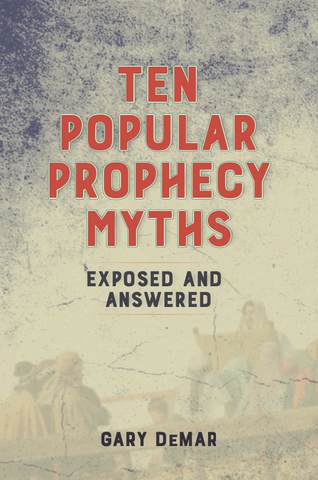
Since the reestablishment of Israel in 1948, “end-time” prophetic speculation has been on the rise. While there is a long history of date setting, the past century has seen an exponential increase in the number of books proclaiming that the end is near. It’s time that the “Boy who cried wolf” syndrome be dealt with in a biblical way. A seismic shift in biblical eschatology is taking place around the world because Christians, some for the first time, are willing to challenge what they have been taught based on what the Bible actually says.
5. Where in the NT does it say another physical temple will be built?
• No verse in the NT says the temple will be rebuilt again.
• The OT says the temple would be rebuilt, and it was.
• The NT states that the temple was being renovated.
• In a book that Thomas Ice wrote with Randall Price, he acknowledged the following: “There are no Bible verses that say, ‘There is going to be a third temple.’”[3]
See “The Myth that the Temple Needs to be Rebuilt” in Ten Popular Prophecy Myths.
• Price’s updated 700-page book on The Temple and Bible Prophecy does not produce a verse from the New Testament that states that another temple is prophetically required to be rebuilt.
• Price has three chapters dealing with predictions in the New Testament on the temple, but he does not mention one verse that says anything about rebuilding the temple (255-324).
• You will be taken to 2 Thessalonians 2 and told that Paul was describing a rebuilt temple. The Jerusalem temple was still standing when the Thessalonian epistles were written.
• The burden of proof is on your dispensational friend to prove that Paul was describing a future temple.
6. If the “rapture of the church” and/or the Second Coming are mentioned by Paul in 2 Thessalonians 2:1-2, how could Paul have written a letter saying it had taken place?
• Whatever Paul had in mind, it was neither the “rapture of the church” nor “the Second Coming.” How could Paul have written a letter explaining whether the rapture or the Second Coming had occurred if he had been taken to heaven in either event?
• Some translations have “is near” (KJV) rather than the more accurate “has come” or “is present” (ἐνέστηκεν/enestéken) in verse 2. The New King James translation has “had come.”
• The temple was still standing, and the “man of lawlessness” was alive (2:6).
• “The abomination of desolation … refers to sacrilegious acts performed by the religious leaders of Israel, captained by their High Priest, right in front of God’s face in the Temple…. We shall see that the Man of Sin in that passage is most likely the High Priest of Israel.”[4]
See the two chapters on 2 Thessalonians 2 in Last Days Madness and “Johann Christian Schoettgen’s Commentary on 2 Thessalonians 2” in Prophecy Wars.

If you’re willing to take the Bible at its word, the study of prophecy can strengthen your faith, but if your trust is in man’s speculations, you will be disappointed every time. And that is why Bible prophecy is such a crucial area for apologetics. Skeptics of all stripes have condemned the Bible as inaccurate merely because various well-meaning Christians have been in error about the End Times.
7. What about 1 Thessalonians 4:13-18?
• Traditionally, these verses were interpreted as the Second Coming. Paul is answering the Thessalonians had about the status of the saints who had died before Jesus’ redemptive work and those who died since.
See chapter 9 in Kim Burgess’s The Resurrection of the Dead.
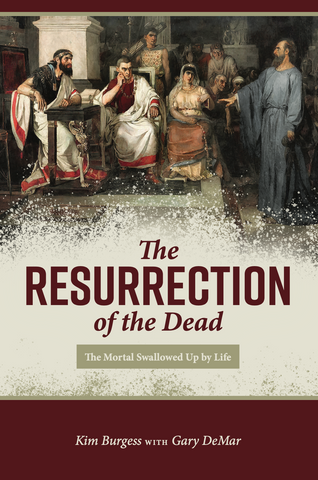
There is life after death. This is God’s promise. Jesus led the way. But some disagree about what happens after death. When do we get our new bodies? Is it at death, or must we remain disembodied spirits until Jesus returns physically and ends this “terrestrial ball”? The primary texts in the New Testament about the resurrection of the dead come from the pen of the Apostle Paul in 1 Corinthians 15, 2 Corinthians 4:16-5:10, and 1 Thessalonians 4:13-18. These and other pertinent texts are vital to unraveling the mystery of Paul’s argument about what happens after physical death.
• The antichrist, a tribulation period, the temple, the church, and seven years are not mentioned in 1 Thessalonians 4.
• Take the dispensationalist advocate back to the verse that specifically states the church will be taken off the earth before, during, or after 7 years. No verse exists.
• What about, “For God has not destined us for wrath, but for obtaining salvation through our Lord Jesus Christ”? (1 Thess. 5:9). He hasn’t! Why does this promise only apply to the Great Tribulation?
• He might take you to Revelation 3:10, a verse that was written to the church at Philadelphia: “Because you [the Christians in Philadelphia] have kept My word of perseverance, I also will keep you from the hour of the testing, that hour which is about to [mellō] come upon the whole world [oikoumené, not kosmos; see Luke 2:1; Matt. 24:14], to test those who live on the land” [possibly what was going to happen in Jerusalem based on what Jesus said in the Olivet Discourse and ‘this generation’].”
See “Searching for the Rapture in Revelation 3:10-11” in Identifying the Real Last Days Scoffers. (New expanded second edition coming soon at AmericanVision.org)
[1] 4 vols. (Grand Rapids, MI: Kregel, [1872-1876] 1956), 3:143.
[2] Milton S. Terry, Biblical Apocalyptics: A Study of the Most Notable Revelations of God and of Christ (Grand Rapids, MI: Baker Book House, [1898] 1988), 201.
[3] Thomas Ice and Randall Price, Ready to Rebuild: The Imminent Plan to Rebuild the Last Days Temple (Eugene, OR: Harvest House, 1992), 197-198.
[4] James B. Jordan “The Man of Sin,” Biblical Horizons, 25 (June 1991).
American Vision’s mission is to Restore America to its Biblical Foundation—from Genesis to Revelation. American Vision (AV) has been at the heart of worldview study since 1978, providing resources to exhort Christian families and individuals to live by a Biblically based worldview. Visit www.AmericanVision.org for more information, content and resources
Source: https://americanvision.org/posts/questions-to-ask-dispensationalists/
Anyone can join.
Anyone can contribute.
Anyone can become informed about their world.
"United We Stand" Click Here To Create Your Personal Citizen Journalist Account Today, Be Sure To Invite Your Friends.
Before It’s News® is a community of individuals who report on what’s going on around them, from all around the world. Anyone can join. Anyone can contribute. Anyone can become informed about their world. "United We Stand" Click Here To Create Your Personal Citizen Journalist Account Today, Be Sure To Invite Your Friends.
LION'S MANE PRODUCT
Try Our Lion’s Mane WHOLE MIND Nootropic Blend 60 Capsules
Mushrooms are having a moment. One fabulous fungus in particular, lion’s mane, may help improve memory, depression and anxiety symptoms. They are also an excellent source of nutrients that show promise as a therapy for dementia, and other neurodegenerative diseases. If you’re living with anxiety or depression, you may be curious about all the therapy options out there — including the natural ones.Our Lion’s Mane WHOLE MIND Nootropic Blend has been formulated to utilize the potency of Lion’s mane but also include the benefits of four other Highly Beneficial Mushrooms. Synergistically, they work together to Build your health through improving cognitive function and immunity regardless of your age. Our Nootropic not only improves your Cognitive Function and Activates your Immune System, but it benefits growth of Essential Gut Flora, further enhancing your Vitality.

Our Formula includes: Lion’s Mane Mushrooms which Increase Brain Power through nerve growth, lessen anxiety, reduce depression, and improve concentration. Its an excellent adaptogen, promotes sleep and improves immunity. Shiitake Mushrooms which Fight cancer cells and infectious disease, boost the immune system, promotes brain function, and serves as a source of B vitamins. Maitake Mushrooms which regulate blood sugar levels of diabetics, reduce hypertension and boosts the immune system. Reishi Mushrooms which Fight inflammation, liver disease, fatigue, tumor growth and cancer. They Improve skin disorders and soothes digestive problems, stomach ulcers and leaky gut syndrome. Chaga Mushrooms which have anti-aging effects, boost immune function, improve stamina and athletic performance, even act as a natural aphrodisiac, fighting diabetes and improving liver function. Try Our Lion’s Mane WHOLE MIND Nootropic Blend 60 Capsules Today. Be 100% Satisfied or Receive a Full Money Back Guarantee. Order Yours Today by Following This Link.


| Visits: | 1,838,274,235 |
| Stories: | 8,736,238 |
Whistler Blowers, Insiders

