

The culture shift from “safe, legal, and rare” to “Shout Your Abortion”

“We’re never going to change these policies unless we change the culture, and the way we change the culture is through art.”
That sentence came from Caren Spruch, who has directed Planned Parenthood’s arts and entertainment engagement since December 1994. She has held the same job for more than thirty years. She didn’t say it in a leaked memo or on a hidden camera. She said it to IndieWire on May 2022. It is her strategy, in her words, and it explains most of what you have watched happen to the abortion debate in your lifetime.
And how does a cultural shift work the quickest? With young people. Spending over ten years in the classroom, I know how easily youth can be influenced. They don’t need a policy paper to change how they think; what works better is a popular TV show, a hashtag, their favorite pop star or rapper promoting it, a teacher who nods along, and enough repetition that the new idea becomes the new normal.
What follows isn’t about one celebrity promoting abortion or even one non-profit, although Planned Parenthood does take a leading role. It is about a coordinated and decades-long shift in how America is allowed to talk about abortion. This shift runs through social media, entertainment, and the classroom, with taxpayers often unknowingly funding it.
Words matter
“Rare” admits something. If you want something to be rare, you think it’s at least a little regrettable.
The shift starts with language and one word that disappears.
For decades, one phrase let the left sound reasonable on abortion: safe, legal, and rare. Bill Clinton made it his 1992 campaign line. This phrase implied that abortion should stay legal, but nobody should be cheering for it, and it should be a last resort. Hillary Clinton was still making the same case in 2008. At a CNN forum on faith and compassion at Messiah College, she told an audience of religious leaders that abortion “should remain legal, but it needs to be safe and rare.”
Then came 2016. Reacting to a Supreme Court ruling, she said only “safe and legal.” The word “rare” had vanished. CBC quoted a former Planned Parenthood director who called the wording “an ongoing point of discussion” inside the movement itself. That wasn’t a slip of the tongue. Somebody was working on how to make that word disappear. “Rare” admits something. If you want something to be rare, you think it’s at least a little regrettable. And a movement that had spent decades on the defensive was finished conceding anything.
In 2021, the National Women’s Law Center, a left-leaning legal advocacy group and non-profit, published a piece titled “Destigmatizing Abortion: Guess What? We Don’t Want It to Be Rare.” It described its vision of a just society as one where anyone can have an abortion “for any reason, at any time.” The author compares abortion to getting your blood drawn, having an IUD inserted, or getting a vaccine, and asks why anyone would want it to be rare. Read that again. For any reason. At any time. Elective late-term abortion? Fine. Sex selective abortion? No problem.
This wasn’t just one organization. The democratic presidential nominee dropped the word in 2016. A former Planned Parenthood director called the debate over it “ongoing.” And by 2021, a legal advocacy group with a lobbying budget was saying out loud that the problem was the word “rare.” Politicians and organizations looked at the left’s old talking point and, one by one, walked away. Today the word is barely heard on the left at all. But “rare” was only one word. The same vocabulary shift reached the other side of the equation: the word for what abortion ends.
“It’s just a clump of cells”
In 2019, NPR sent journalists internal guidance on abortion terms. Joe Neel, writing in the memo, put it flatly: “Babies are not babies until they are born.”
“It’s just a clump of cells.” The phrase is as old as the abortion argument. In October 2022, the Guardian published eight images to back up those words in a photo essay titled “What a pregnancy actually looks like before 10 weeks.” The images showed small clusters of white and yellowish tissue in petri dishes, labeled “pregnancy tissue” and “gestational sac.” The text repeatedly noted the embryo was either not visible or otherwise difficult to see. (In a telling admission at the end of the report, the Guardian added: “This article was amended on 19 October 2022 to include the detail that at nine weeks the nascent embryo is not easily discernible to the naked eye.”)
The source of those pictures wasn’t just a loose clump of doctors. The images came from the MYA Network. A subsidiary of The Community Health Promotion Project (CHPP), a 501(c)(3) tax-exempt charity launched in 2002. The founder and principle officer of CHPP, according to the pro-life group Live Action, is Dr. Joan Fleischman.
A FAQ page on the MYA website explains the agenda:
MYA Network is short for MY Abortion Network. We are an activist group of clinicians who are working to make abortion part of routine medical care. We have our own practices. [emphasis added]
“We are clinicians, patients and activists who work to normalize abortion care, medically and culturally,” proclaims the main page of the MYA website. The donate page explains the tax-exempt donations will be used for linking patients to clinicians, public education, training, and growing its network of clinicians.
Is this medicine masquerading as activism, or activism masquerading as medicine? Charity status exists because the public is supposed to benefit. So it’s fair to ask whether a photo essay that critics say left out the embryo should count as “public education” or public deception.
Dr. Christina Francis, an OB-GYN who chairs the American Association of Pro-life Obstetricians and Gynecologists, claims the embryos had been removed from the tissue before the photos were taken, and the article never said so. Francis told Live Action the images were “clearly intentionally misleading.” The Daily Caller News Foundation adds that the Guardian described “no visible embryo” at seven weeks, but that at that point in pregnancy, according to the Endowment for Human Development, the embryo has visible arms and legs.
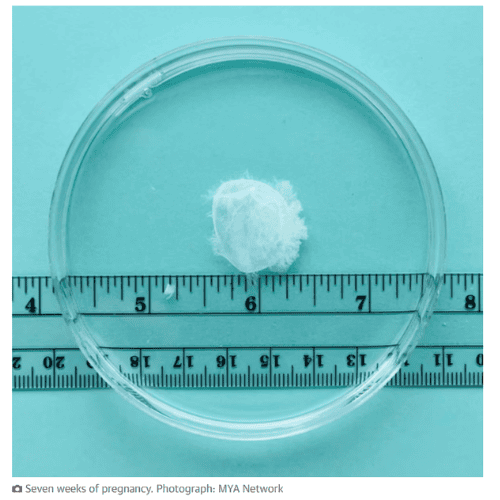
Human embryo at seven weeks of pregnancy, as portrayed by MYA Network and The Guardian. (Photo: The Guardian, “What a pregnancy actually looks like before 10 weeks – in pictures” Oct 19, 2022)
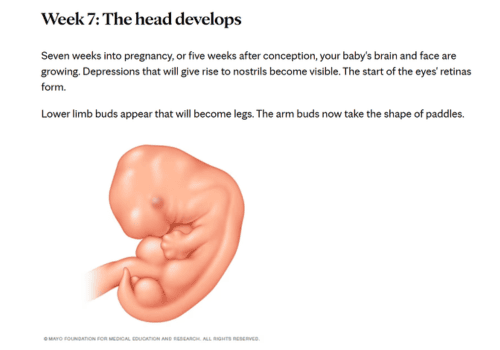
Human embryo at seven weeks, as portrayed by the Mayo Clinic. (Photo credit: “Fetal development: The first trimester.” Mayoclinic.org.)
Doubling down on the controversy, a spokesman for the Guardian defended the images and told the Daily Caller there were “no inaccuracies” in its descriptions, that the photos show everything removed in an abortion, and that the paper amended a caption to make that clearer.
Though this wasn’t explained by the Guardian, SofTouch® is the name of the procedure that produced the tissue in those images. In bolded text, Early Options, a Manhattan abortion practice, proclaims “SofTouch® is noninvasive and natural.” Early Options further claims SofTouch® was designed “to normalize the early abortion experience” and can be performed “in a regular doctor’s office setting.” The decidedly not soft technical description for the SofTouch® procedure is “manual vacuum aspiration abortion” or MVA. The MVA (i.e.: SofTouch®) device is a small handheld aspirator with a tube that resembles a medieval instrument rebuilt in plastic.
Early Options was founded and is owned by none other than Dr. Joan Fleischman, and she is the developer of SofTouch. So the firm that handed Guardian readers a picture of “what a pregnancy actually looks like” is led by a woman who sells the procedure that produced it and trains others to do the same.
Follow the money. The Early Options’ website lists no price for SofTouch, but it does say the practice has a sliding scale and takes most New York State Medicaid plans. This means taxpayers can be the ones paying.
Early Options is also partnering with CaraFem, an abortion service non-profit whose board includes Melissa Grant, the former Planned Parenthood director who told the CBC that dropping “rare” was “an ongoing point of discussion.” Together they have proposed a New York training program in MVA abortions for nurses, physician assistants, and primary care doctors, and they say they hope to compete for a share of the state’s $25 million Reproductive Freedom and Equity Fund.
What the Guardian showed was pregnancy tissue removed with a handheld suction device (with the embryo possibly, and deceptively, removed). A training manual for abortion providers says the gestational sac “may be shredded or intact” after aspiration, and tells providers to rinse and strain the tissue. So the clean white sac in the photo is what was left after suction and straining. It doesn’t accurately portray what a pregnancy looks like in the womb at nine weeks.
But more important than the debate over how much these images were altered is the impact. Several left-leaning news organizations reposted them, and women in the comment sections said how comforted they were to see them. And of course they were comforted. The images bore no resemblance to a baby. They looked like what you blow into a tissue when you are sick.
The MYA Network put in the careful work to dehumanize a baby with visuals. But these pictures made an impact because the shift in vocabulary around abortion was already in place.
In 2019, NPR sent journalists internal guidance on abortion terms. Joe Neel, writing in the memo, put it flatly: “Babies are not babies until they are born.” The memo told reporters not to call a fetus a baby, because it saw that word as “part of the strategy used by antiabortion groups to shift language/legality/public opinion.”
In truth, it was NPR that was acting out the opinion-shifting strategy.
“Baby” was not the only word to go. The same NPR memo tells reporters to say “fetus” to avoid “unborn” unless it is a bill’s title or attributed to anti-abortion groups, and to write “medical or health clinics” in place of “abortion clinics.” It says not to use “pro-life” or “pro-choice” in their own copy. And it says–in all caps–that it is “not correct to call these procedures RARE,” which means the word this article started with was struck from the newsroom as well.
Abortion is not merely being whitewashed. It is being baby washed. Every word that might remind the public what is actually on the table gets scrubbed out, until what is left sounds as palatable as possible. Just a routine visit to a health clinic!
Similarly, there is ReproAction, a project of NEO Philanthropy, which is also the fiscal sponsor of Shout Your Abortion. Donations to ReproAction run through NEO. ReproAction’s website hosts a guide for writers on “de-stigmatizing” abortion language. It tells reporters to separate “embryo,” “fetus,” and “infant,” and to illustrate abortion stories with pictures of medication and clinics, not “fully formed infants” or pregnant bellies
The same instruction reaches the exam room. In 2016, Live Action reported that the Early Abortion Training Workbook, a manual for training abortion providers, listed “BABY” under “Words to avoid when a woman seeks an abortion,” and that it treated a patient’s use of the word as a sign of guilt or regret. If a patient asks what happened to her baby, the suggested answer is that staff examine the pregnancy tissue “to ensure you are no longer pregnant,” according to the workbook’s current online edition. That edition is softer on the word itself and tells providers to use “baby” if the patient does. But the pregnancy-tissue answer is still there, and so is the idea that the pregnancy is a thing to be examined, not a child to be mourned.
Notice who gets to use the word. A wanted pregnancy gets a “baby” shower, a nursery, and a name. An unwanted pregnancy at the same early stage is just “tissue.” The only thing that changed is the mother’s decision, and the vocabulary followed.
That is why language comes first in this story. You can’t grieve what you have been trained not to name. And once “rare” was gone and “baby” was off the table, there was nothing left to whisper about. The next step was to get women to say it out loud, and the movement found a hashtag to do it.
From a hashtag to a brand
Today, it seems there’s no abortion NEO won’t shout about.
On December 1, 2021, the Supreme Court heard arguments in the case that would end Roe v Wade. On that same day, on the steps of the Supreme Court, a handful of activists swallowed abortion pills for the cameras. One of them was Amelia Bonow, who had obtained the pills through Aid Access, according to InfluenceWatch’s Shout Your Abortion profile. The women who took the pills admitted they weren’t pregnant at the time. Imagine being so brainwashed to support abortions that you will take a strong abortion medication as a political stunt.
Shout Your Abortion started in 2015 and was founded by Bonow, writer Lindy West, and Kimberly Morrison. The #shoutyourabortion hashtag was used more than 100,000 times in 24 hours after Bonow publicly described a positive abortion experience. The founder’s stated goal, from the beginning, was “normalizing abortion.”
The abortion hashtag trend continued in May 2019. On May 7, as Georgia’s abortion ban became law, actress Busy Philipps told her talk show audience, “I had an abortion when I was 15 years old.” About a week later, as Alabama passed its own ban, she tweeted an invitation for other women to share their stories under the hashtag #YouKnowMe. By the next night, CBS reported, the tweet had almost 50,000 likes and nearly 10,000 retweets. Cynthia Nixon, Ashley Judd, and Jameela Jamil shared their own stories, as did Keke Palmer, who later deleted her post. On May 23, the ACLU announced an ad campaign narrated by Philipps, a six-figure buy on MSNBC and CNN.
On January 5, 2020, Michelle Williams won a Golden Globe for Best Actress. While pregnant with her second child, she told the audience she “wouldn’t have been able to do this without employing a woman’s right to choose. To choose when to have my children and with whom.” It was a subtle yet powerful message.
For decades, abortion was sold as a way for women to control how many children they had. Think of the overburdened 1950s housewife who couldn’t imagine feeding one more mouth, or the teenager who wasn’t ready for motherhood. (Although adoption was an option for both.) Now the pitch has changed. Millions of impressionable young women watched an award winner say her success depended on abortion access.
The message is that without abortion, your career could be on hold. Abortion is no longer sold as a last resort. It is sold as a path to personal success.
In December 2022, Lizzo accepted the People’s Champion award at the People’s Choice Awards and invited 17 activists up to share the spotlight. The group included Shout Your Abortion co-founder Amelia Bonow, who displayed her “Abortion Pills Forever” handbag in front of a prime-time audience.
They were not alone. Newsweek‘s roundup of famous women who have spoken about abortion reads like a guest list for an awards show. Actress Jemima Kirke told her abortion story in a video for the Center for Reproductive Rights’ “Draw The Line” campaign in 2015, which means an advocacy group handed her the camera. Chelsea Handler told Playboy in 2016 that she had two abortions at 16. Alyssa Milano revealed on a 2019 podcast that she had two abortions in 1993. Stevie Nicks told the Guardian in 2020 that an abortion in 1979 spared her from walking away from Fleetwood Mac. Nicks joined Olivia Rodrigo on stage at the Daisy Chain Fields festival, whose net proceeds went to ten nonprofits, including Planned Parenthood. Uma Thurman wrote in a 2021 Washington Post op-ed about a teenage abortion, calling it her “darkest secret until now.”
These are only the higher-profile testimonials. They leave out the countless non-celebrity women who went viral sharing their own stories under the hashtag, and those may have been even more powerful because they came from someone who looks like your neighbor, not a movie star. The point is simple: the more people share, the less stigma remains. Scroll the comments under these #ShoutYourAbortion posts, and you will find raised-hands emojis and message after message of support from other women.
As noted, Shout Your Abortion is a fiscally sponsored project of NEO Philanthropy. A charitable foundation, NEO collects donations from left-leaning and outright left-wing funders, and then either sponsors in-house projects or regrants the funding to other left-leaning nonprofits. In its most recent IRS filing, covering the year through 2024, NEO reported taking in $169 million in revenue.
As just one example of NEO’s wild supporters and agenda, the Ford Foundation, one of America’s largest and most strident left-wing foundations, reported $8.6 million in 2024 grants for NEO projects. At least $300,000 of that was for NEO’s abortion cheerleading. This included a $100,000 grant that Ford earmarked for NEO’s “ongoing storytelling work centering disabled people’s abortion experience.”
Today, it seems there’s no abortion NEO won’t shout about.
“Abortion pills forever”
When something this serious arrives like an Amazon package, it stops feeling like a decision and starts feeling like a service.
The evolution in abortion promotion mirrors how the general public’s view of pornography has shifted. Within one generation, it went from a windowless shop you had to walk into, with a clerk who knew your face, to an anonymous screen in every pocket. Something that used to be taboo became ordinary, and ordinary things stop being taboo.
A recent Heritage Foundation analysis of academic survey data reached this conclusion: “In 1980, 40 percent of Americans believed pornography should be illegal for people of any age; by 2021, support for complete prohibition had dropped by more than 15 percentage points.”
Attitudes shifted as access grew. So if you want to understand what the abortion pill is doing to our culture, start with that pattern. The easier it is for the general public to get its hands on something once considered taboo, the more socially acceptable it becomes.
Let’s go back to the Supreme Court steps. Behind the four Shout Your Abortion activists who claimed to swallow abortion pills hung a black banner that read “We Are Taking Abortion Pills Forever,” while about 30 more activists worked the crowd, handing out small white boxes labeled “ABORTION PILLS.” Inside each box was a card with photos of the pills, directions for how to get them, and helpline numbers. Bonow said the point was to raise awareness of abortion pills and how to get them by mail.
Guttmacher, a pro-abortion research group, reports that medication-induced abortions made up 63 percent of all abortions in the formal health care system in 2023, up from 53 percent in 2020. The system recorded 1,026,690 total abortions in 2023, about 10 percent more than in 2020. States without abortion bans saw a 25 percent increase over those three years, and states bordering prohibition states experienced a 37 percent increase.
A decision this big used to take place in a medical building, with a waiting room and a doctor. It now fits in a mailbox. When something this serious arrives like an Amazon package, it stops feeling like a decision and starts feeling like a service.
Shout Your Abortion keeps feeding that mailbox. In October 2025, the group worked with Hydra Mutual Aid Fund and Plan C on a billboard promoting abortion pills by mail near Marquette, Michigan. Later that year, it released two short films showing women getting and using pills at home, and promoting “advance provision,” which means keeping mifepristone on hand before a pregnancy. Bonow said, “Access to safe medications does not depend on laws or courts or doctors,” and she set out to raise $100,000 to distribute the films. The group also sells T-shirts printed with the same “abortion pills forever” slogan from the banner and the handbag the founder wore at the awards ceremony with Lizzo. A slogan on a shirt is a fashion statement, and that is exactly the point. Abortion pills are being sold as a brand.
None of this runs on its own. A network of nonprofits covers the costs, and some will even pay for a woman to leave her state to obtain an abortion.
- National Network of Abortion Funds. It formed in 1993 from 22 abortion funding groups and claimed 76 member funds by late 2019. It is an umbrella group for local abortion funds, the groups that help women pay for abortions and the travel to get them, and it supports those funds with their “technical, logistical, and training needs.” For the year through June 2025 the nonprofit reported total revenue of $7 million. Funders include the Ford Foundation, which gave $700,000 in 2024, and the Packard Foundation, which gave $750,000 in 2020. It has sent grants to groups such as the DC Abortion Fund, which received $1.6 million in 2022, and Access Reproductive Care-Southeast, which received $2.1 million in 2023.
- The Brigid Alliance. By its own account, Brigid arranges and pays for bus or plane tickets, gas and parking, lodging, food, phones, and childcare. It serves clients beyond 15 weeks of pregnancy, says most travel more than 1,000 miles, and claims it has helped thousands of people since 2018. Bridgespan, a nonprofit consultancy, puts the average trip at 1,218 miles and the average cost at $2,300 per itinerary.
- The National Abortion Federation. The professional association of abortion providers, runs the National Abortion Hotline. The federation’s patient assistance fund pays for roughly 100,000 abortion procedures and related travel each year. In 2023 alone, its hotline gave financial help to more than 106,000 people, including nearly $2 million in travel help for 1,200 patients.
- Regional travel funds such as Fund Texas Choice and Midwest Access Coalition are some of the groups that move women across state lines. Another is the Northwest Abortion Access Fund, which claims it helps people get to and from the clinic and find a safe place to stay.
- Plan C and Aid Access. Plan C publishes where and how to get abortion pills by mail in every state. Aid Access is the group that supplied the pills at the Supreme Court.
- Vision First Project. A subsidiary of the New Venture Fund, a left-of-center fiscal sponsorship nonprofit, Vision First works to expand abortion access. Its primary funder, the Hewlett Foundation, had given at least $2 million as of 2015.
Most of these groups are tax-exempt charities, or projects housed inside a larger one. That status means donors can deduct their gifts, and foundations can count their grants toward their charitable giving. So when a woman needs a bus ticket, a hotel room, and someone to watch her kids while she travels for an abortion (often to avoid the laws in her state put in place to protect her unborn baby), a nonprofit picks up the bill.
To reach this point, the abortion movement had to change the words: “rare” became “shout it” and “baby” became a clump of cells. Then it made getting an abortion as easy as opening the mailbox. But words and access only go so far. A culture changes when people hear the same message over and over from people they already like, and when the next generation hears it first. So the movement turned to two more fronts: Hollywood, which tells the story, and young women, who are listening.
Hollywood
She told IndieWire she stayed away from Juno because she felt it portrayed Planned Parenthood poorly.
The most effective message is the one the viewer never notices.
Take Gilmore Girls, a TV show mostly remembered as a cozy story about coffee, a small town, and a mother and daughter who finish each other’s sentences. In season 5, which ran in 2005, Rory’s dorm room at Yale has a Planned Parenthood poster bearing the slogan “War on Choice.” No speech. No plotline. Just the smart, relatable girl, with the message sitting quietly behind her. A teenage viewer takes it in the way she takes in the character’s taste in music and boys. This is who the cool, smart girls are.
Subtle works.
Remember the line that opened this article? “The way we change the culture is through art.” Caren Spruch, the woman who said it, is a Planned Parenthood staffer whose job since 1994 has been implementing that culture shift. According to the Washington Post‘s 2019 profile of her, she estimates that Planned Parenthood has advised on more than 150 movies and shows. She has pitched screenwriters at the organization’s annual Sundance event for about seven years. She once had to hunt for projects. Now, in her words, people call her.
Why does a nonprofit that provides abortions need a Hollywood liaison? Spruch has answered that herself. Film and TV are, in her description, one of the organization’s most important tools for reaching young people, and the goal is to “erase the shame” around abortion and sex. That is the strategy behind the quote that opened this article.
So what does that look like on a set?
Here are some examples:
- Obvious Child (2014 film). An abortion romantic comedy, and Spruch counts it as her starting point. According to the Post, she spent nearly two years on the script. She fact-checked the clinic scene, suggested dialogue for the doctor, and reviewed the recovery room scene for its emotional content. A Planned Parenthood staffer helped shape how a comedy about abortion looked and sounded. IndieWire adds that Spruch worked with director Gillian Robespierre and star Jenny Slate on the script, including how the main character handles her decision, and arranged a shoot at a Planned Parenthood facility.
- Jane the Virgin (CW TV show). In 2014, Spruch wrote to the show’s director offering help. Two years later, the Post reports, she helped fine-tune the episode in which Xiomara, the heroine’s mother, has a medication abortion. ANSIRH’s overview of the episode claims Xiomara was the first Latina to have an abortion on a primetime network television show, and that her religious mother disagrees but the family reaches a peaceful resolution.
- GLOW (Netflix TV show). In the episode “Maybe It’s the Disco,” Ruth asks a director to take her to Planned Parenthood, and the show puts her in the procedure room, with a matter-of-fact tone. The Post says Spruch suggested casting a receptionist who “didn’t look forbidding” and a soothing poster for the exam room wall. She also tracked down a retired clinic doctor to check a scene set in the 1980s. Every detail was chosen to make the clinic feel like the safest, kindest place in the building.
- Girls (HBO TV show). In the episode “Close Up,” Mimi-Rose, a co-starring character, has an abortion without telling her boyfriend, and she never explains her choice. The show doesn’t ask her to. Spruch’s fingerprints on this series are smaller, but the Post credits her with suggesting showing condom use on television, which Lena Dunham later put into a scene.
- The 40-Year-Old Virgin (2005 film) Even a raunchy comedy aimed at young adults got the “spruce up abortion” Spruch treatment. Spruch directly sent posters and books to dress a health center set meant to be a Planned Parenthood clinic.
- Never Rarely Sometimes Always (2020 film). Spruch introduced director Eliza Hittman to staff at a New York facility and set up five hours of interviews with a nurse, a social worker, and an educator. Those are the people who work inside a Planned Parenthood clinic, helping to shape a film about a girl who goes to one.
- Happening (2022 film) For the film’s American release, Spruch moderated a Q&A and handed out “Bans Off Our Bodies” pins at a premiere party. It was an abortion campaign dressed up as a film premier.
The rest of Spruch’s influence in entertainment reads like a catalog of the last decade of abortion on screen. She advised on the scripts for Knocked Up, including how Planned Parenthood was depicted, and on the abortion storylines for Grandma, Unpregnant, and Little Woods. She is also listed on Call Jane and, on television, Better Things, A Million Little Things, and Scenes from a Marriage. IndieWire describes her routine this way: review scripts for medical and legislative accuracy, supply talking points, and circulate memos listing recent shows and films that deal with abortion restrictions.
She also picks her projects. She told IndieWire she stayed away from Juno because she felt it portrayed Planned Parenthood poorly. In her own telling, writers and directors know how to tell these stories better than advocates do, so she hands them the talking points and lets them tell the story. That is what “change the culture through art” looks like in practice.
Reaching the young: how a culture really shifts
A 14-year-old can’t buy a lottery ticket, but with the help of Advocates for Youth she could be trained to walk another girl through an abortion.
If you want to change a culture, don’t start with the adults. Start with the young, and especially with young women. A teenager can turn off a television. She can’t easily skip the school day. I spent many years in California schools, and I can tell you that classrooms and college campuses are the places where adults can control the room and influence what the youth believe, oftentimes more than the home. That is why the abortion movement has spent so much money getting to that audience.
Consider who is already in that room. Planned Parenthood describes itself as the single largest provider of sex education in American classrooms, reaching 1.2 million people per year. It is also the largest abortion provider in the country, and its 2023-24 annual report counted a record 402,200 abortions.
The National Network of Abortion Funds has built programs to train young women and make abortion talk ordinary. Its Youth Testify program, a partnership that includes the network, trains young women ages 17 to 25 to advocate for abortion, and one of its activists testified to Congress in June 2019 that Texas’s ban on insurance coverage and its parental consent requirement are barriers to abortion access. Its We Testify project collects short video stories from women who have had abortions, with the stated goal of widening who counts as an “expert” on abortion.
A secondary goal is a culture where left-of-center views on race, sex, and gender prevail. In 2020, the National Network of Abortion Funds launched “The beauty and power of abortion love” with Forward Together, a left-leaning activist nonprofit. According to a Ms. profile, the art project presents “a radical shift away from both progressives’ laser focus on rights and anti-abortion rhetoric of shame and blame . . .”
And then there is Advocates for Youth (AfY), a group founded in 1980 that organizes young activists on sexual and reproductive health. AfY belongs to the Future of Sex Education, a collaboration with Planned Parenthood Federation of America. In 2012, AfY launched the 1 in 3 Campaign to push for expanded abortion access and train “emerging young leaders.” Its programs include Abortion Out Loud, which recruits young “abortion storytellers,” and an Abortion On Campus project that urges colleges to cover off-campus abortion trips and stock abortion medication.
Advocates for Youth also runs the Youth Abortion Support Collective, which offers a seven-week live training series on Zoom for anyone interested in becoming an “abortion doula, companion, and/or support person.” The training covers support in clinical and non-clinical settings for abortions, and it teaches young people how to organize abortion support networks on college campuses. They held a two-day training at the University of North Carolina at Charlotte in November 2025, open to participants ages 14 to 24. Advocates for Youth Mid-Atlantic promoted it on Instagram.
A 14-year-old can’t buy a lottery ticket, but with the help of Advocates for Youth she could be trained to walk another girl through an abortion.
The Susan Thompson Buffett Foundation gave Advocates for Youth more than $10.4 million across eight grants from 2008 to 2016 and another $1.14 million in 2023. The Westwind Foundation gave $2.78 million in 2022. The Ford Foundation gave $500,000 in 2023, and, no surprise here, George Soros’s Open Society Foundations gave $250,000 in 2022. Another funder is you, the taxpayer. The U.S. Department of Health and Human Services has given the group more than $30 million since 1995. In IRS filings covering the year ending March 2025, AfY reported total annual revenue of $8.4 million.
Abortion education campaigns have also become state laws. On October 11, 2019, Governor Gavin Newsom signed California’s Senate Bill 24, which requires the University of California and California State University systems to provide medication abortion on campus, with a compliance deadline of January 2023.
A pro-abortion agenda gets normalized in the place where young people live, learn, and make friends, with abortion pills and resources available right on campus. We are getting to a time where nobody has to be persuaded. It’s just there. That is how a culture really shifts: not by winning the argument with adults, but by reaching the young before the argument ever starts.
Of course, youth are influenced not only in the classroom, but also by the celebrities they love. This August, Planned Parenthood posted an Instagram video of Olivia Rodrigo touring a Los Angeles clinic, dancing to her own song, and describing mifepristone as “very safe.” She has 42 million Instagram followers, and a big share of them are young teenagers. I found no evidence that Planned Parenthood pays her. It doesn’t have to. The movement doesn’t have to buy a believer. It only has to hand her a stage.
And the movement was in the crowd. During Rodrigo’s 2023 Guts tour, the National Network of Abortion Funds set up at nearly every North American stop, giving out free Plan B, condoms, and cards pointing to abortion services, mostly to a teenage crowd. Plan B is legal over the counter at any age, so none of it broke the law. The tables came down after the backlash, and an organizer told Variety why: “children are present at the concerts.”
They knew exactly who was in the crowd.
Conclusion
Caren Spruch told IndieWire the plan: change the culture, and the policies will follow. None of it was an accident. All of it was aimed at young people.
Here is what thirty years of this should teach the rest of us. The abortion movement did not win with one big argument. It won by being everywhere, patiently, with money behind it: a nonprofit here, a writers’ guide there, a trained teenager in a hearing room. No single piece looked like a campaign. Together they added up to one.
The pro-life side does have some strength with our pregnancy centers, adoption agencies, and churches that show up for women every day, and most of that work is done quietly and for free. But quiet service doesn’t set a culture’s vocabulary, and the other side has spent a generation paying people to do exactly that.
So what do we do about it? We can keep winning arguments and losing the culture, or we can start doing what they have done for thirty years. Fund the storytellers. Put pro-life voices in the rooms where scripts, songs, and lesson plans get written. Ask where your tax dollars and your charitable gifts go, and read the filing before you write the check. Teach your own children what an ultrasound really shows at eight weeks, and teach them to love the baby as much as the mother.
They have had thirty years. We can start today.
Source: https://capitalresearch.org/article/the-culture-shift-from-safe-legal-and-rare-to-shout-your-abortion/
Anyone can join.
Anyone can contribute.
Anyone can become informed about their world.
"United We Stand" Click Here To Create Your Personal Citizen Journalist Account Today, Be Sure To Invite Your Friends.
Before It’s News® is a community of individuals who report on what’s going on around them, from all around the world. Anyone can join. Anyone can contribute. Anyone can become informed about their world. "United We Stand" Click Here To Create Your Personal Citizen Journalist Account Today, Be Sure To Invite Your Friends.
LION'S MANE PRODUCT
Try Our Lion’s Mane WHOLE MIND Nootropic Blend 60 Capsules
Mushrooms are having a moment. One fabulous fungus in particular, lion’s mane, may help improve memory, depression and anxiety symptoms. They are also an excellent source of nutrients that show promise as a therapy for dementia, and other neurodegenerative diseases. If you’re living with anxiety or depression, you may be curious about all the therapy options out there — including the natural ones.Our Lion’s Mane WHOLE MIND Nootropic Blend has been formulated to utilize the potency of Lion’s mane but also include the benefits of four other Highly Beneficial Mushrooms. Synergistically, they work together to Build your health through improving cognitive function and immunity regardless of your age. Our Nootropic not only improves your Cognitive Function and Activates your Immune System, but it benefits growth of Essential Gut Flora, further enhancing your Vitality.

Our Formula includes: Lion’s Mane Mushrooms which Increase Brain Power through nerve growth, lessen anxiety, reduce depression, and improve concentration. Its an excellent adaptogen, promotes sleep and improves immunity. Shiitake Mushrooms which Fight cancer cells and infectious disease, boost the immune system, promotes brain function, and serves as a source of B vitamins. Maitake Mushrooms which regulate blood sugar levels of diabetics, reduce hypertension and boosts the immune system. Reishi Mushrooms which Fight inflammation, liver disease, fatigue, tumor growth and cancer. They Improve skin disorders and soothes digestive problems, stomach ulcers and leaky gut syndrome. Chaga Mushrooms which have anti-aging effects, boost immune function, improve stamina and athletic performance, even act as a natural aphrodisiac, fighting diabetes and improving liver function. Try Our Lion’s Mane WHOLE MIND Nootropic Blend 60 Capsules Today. Be 100% Satisfied or Receive a Full Money Back Guarantee. Order Yours Today by Following This Link.


| Visits: | 1,838,486,517 |
| Stories: | 8,737,266 |
Whistler Blowers, Insiders

