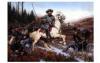
Click image for larger size.
“American Vendée”
by The Zman
“When we had schools, Americans learned about the French Revolution, mostly as a peasant uprising against the king. The storming of the Bastille is usually characterized as the riff-raff reaching their breaking point and taking control of a the dungeon the king used to imprison his political opponents. While the fortress was a symbol of royal authority, it was hardly a tool of royal oppression. The Bastille, when it was stormed, had just seven prisoners. There were four forgers, two lunatics and one degenerate aristocrat inside.
The truth is, the French Revolution was a cosmopolitan affair, led by men who were educated and well off, relative to the peasantry. The Jacobin Club was not for hod carriers and sewer workers. It was lawyers and academics. These were the men who had internalized the ideas of the Enlightenment and began to think about the political framework that should spring from those ideas. Of course, it was centered in Paris, which was where the cognitive elites were centered. These were urban revolutionaries.
That does not mean the countryside had no role in things. It’s just that the waves of change radiated out from Paris.The key insight of the Jacobins was to send representatives out into the smaller towns and cities to organize radicals and incite rebellion. It was a stroke of genius that has been copied by radicals and revolutionaries ever since. Many rural peasants welcomed the revolution as it meant some degree of freedom and the redistribution of lands seized from the Church and aristocracy.
As is always the case with radicalism, they went too far and were soon alienating the people they claimed to champion. The Civil Constitution of the Clergy was passed on July 12, 1790, requiring all clerics to swear allegiance to the French government. The radicals could get away with seizing Church lands, but when they seized the priesthood, the people in the countryside began to resist. The Church was the center of rural life and the foundation of French rural traditional. The radicals were now making war on this.
Imagine you’re living in a farming community and government officials show up and haul away your parish priest because he refuses to swear an oath to the state. Further, those government agents closed the local churches. It would be a lot like the state coming in and telling the Christian baker that they had to celebrate gay marriage and pay for their employee’s abortions. Imagine the government one day saying that your mother and father’s life is no different than two men sharing rent and a bed. Crazy.
The revolt in the Vendée region, on the west coast of France, began with the March 1793 conscription requiring Vendeans to fill their quota of 300,000 men for the army. The enraged populace took up arms and quickly formed a Catholic Army. What started as a demand for reopening the churches and getting their priests back, turned into a Royalist counter rebellion against the Republic. Initially, the Republicans were caught off-guard and the rebels enjoyed some success, even though their army was ill-equipped.
The Republic got its bearings and sent a 45,000 man army to suppress the rebellion and by the fall of that year the rebel army was defeated. The Committee for Public Safety decided that beating the army was not enough and opted for pacification. Whether or not the word “genocide” is appropriate is debatable. Some estimates put the death toll at 400,000 for a population of 800,000. Then there was the “scorched earth” policy of raising the homes of anyone suspected of being a rebel, which was anyone who owned a home.
“The War in the Vendée” is interesting for a number of reasons, but one important lesson is the fervor of those protecting their way of life is no match for the zeal of the Utopian fanatic building his paradise. The romantic rustics of the countryside were beaten by the savvy fanatics of Paris. It was not just the numbers or the resources. The people of the Vendée were people defending the limits of human conduct, while the Committee For Public Safety was limited only by its imagination. They would do anything to reach the promised land.
Another important lesson is the savagery of Louis Marie Turreau, the French officer sent by the Committee for Public Safety to pacify the region, was the result of righteous enthusiasm for his task. The radicals were murdering their enemies not as a means to end but as an end in itself. For the radical, murder becomes a sacrament. When Turreau inquired about the limits of what he could do to pacify the region, the answer from the committee was “eliminate the brigands to the last man, there is your duty.”
This is something to keep in mind when thinking about the present crisis. The revolt that put Trump in office is a revolt of the provincials. Plenty of Trump voters went to college or have office work. It’s not the old class divide. It is the new class divide. The revolution over the last 25 years has been led by a cosmopolitan elite, based in the coastal cities of America. These are the people dreaming up gay marriage and transgenders, not because they make any sense, but because they offend the sensible provincials out in the suburbs.
It’s comforting to think that the pendulum is swinging back toward normalcy, but it could simply be a rearguard action. The radicals running the American “republic” are no less bloodthirsty and malevolent than those who raised the Vendée. They may not unleash genocidal infernal columns on the suburbs, but they are plenty enthusiastic about importing hordes of foreign peasants to wreak havoc on the people. They are also smart and savvy, masters of the tools of power. But most of all, they have no sense of restraint.”
Before It’s News® is a community of individuals who report on what’s going on around them, from all around the world.
Anyone can join.
Anyone can contribute.
Anyone can become informed about their world.
"United We Stand" Click Here To Create Your Personal Citizen Journalist Account Today, Be Sure To Invite Your Friends.
LION'S MANE PRODUCT
Try Our Lion’s Mane WHOLE MIND Nootropic Blend 60 Capsules
Mushrooms are having a moment. One fabulous fungus in particular, lion’s mane, may help improve memory, depression and anxiety symptoms. They are also an excellent source of nutrients that show promise as a therapy for dementia, and other neurodegenerative diseases. If you’re living with anxiety or depression, you may be curious about all the therapy options out there — including the natural ones.Our Lion’s Mane WHOLE MIND Nootropic Blend has been formulated to utilize the potency of Lion’s mane but also include the benefits of four other Highly Beneficial Mushrooms. Synergistically, they work together to Build your health through improving cognitive function and immunity regardless of your age. Our Nootropic not only improves your Cognitive Function and Activates your Immune System, but it benefits growth of Essential Gut Flora, further enhancing your Vitality.

Our Formula includes:
Lion’s Mane Mushrooms which Increase Brain Power through nerve growth, lessen anxiety, reduce depression, and improve concentration. Its an excellent adaptogen, promotes sleep and improves immunity.
Shiitake Mushrooms which Fight cancer cells and infectious disease, boost the immune system, promotes brain function, and serves as a source of B vitamins.
Maitake Mushrooms which regulate blood sugar levels of diabetics, reduce hypertension and boosts the immune system.
Reishi Mushrooms which Fight inflammation, liver disease, fatigue, tumor growth and cancer. They Improve skin disorders and soothes digestive problems, stomach ulcers and leaky gut syndrome.
Chaga Mushrooms which have anti-aging effects, boost immune function, improve stamina and athletic performance, even act as a natural aphrodisiac, fighting diabetes and improving liver function.
Try Our Lion’s Mane WHOLE MIND Nootropic Blend 60 Capsules Today. Be 100% Satisfied or Receive a Full Money Back Guarantee. Order Yours Today by Following This Link.