

The fight to clean up the damage of the Vietnam War isn’t over

This article The fight to clean up the damage of the Vietnam War isn’t over was originally published by Waging Nonviolence.
In the city of Phonsavan in northern Laos, May Sinoun, a 107-year-old woman with a gentle smile, leaned forward on her chair. She tells how she survived one of the most intensive bombing campaigns in world history.
“During the war, if we stayed at home, we had to sleep in pits or holes,” she said. “At night, even a small light could be dangerous. One person died because the plane saw the light and dropped bombs. If we fell down, we would cover ourselves with grass to pretend to be dead.”
From 1964 to 1973 the U.S. led a massive bombing campaign along a supply route it called the Ho Chi Minh Trail. “Operation Barrel Roll,” as it was called, provided support to a CIA-led clandestine army in efforts to subdue the communist Pathet Lao and Northern Vietnamese fighters. The vast majority of victims, however, were civilians.
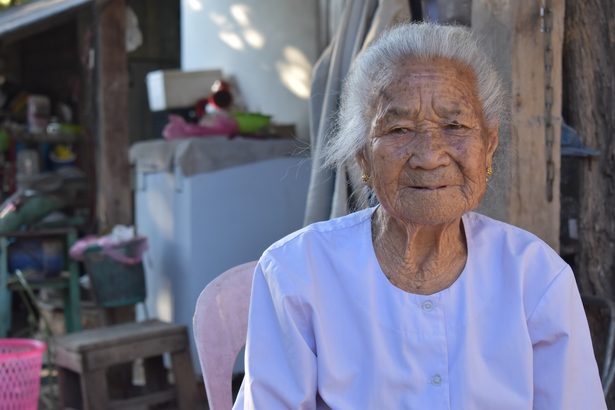
May Sinoun survived the blast from a bomb dropped on a school she was in, but her friends were killed in front of her. She is reminded of the bombing daily. “I have wounds from that time,” she said as she squinted her eyes and contorted her body. She pointed to her arms, shoulders and back, where the pain is most intense. Shrapnel has worn down her muscles for over half a century.
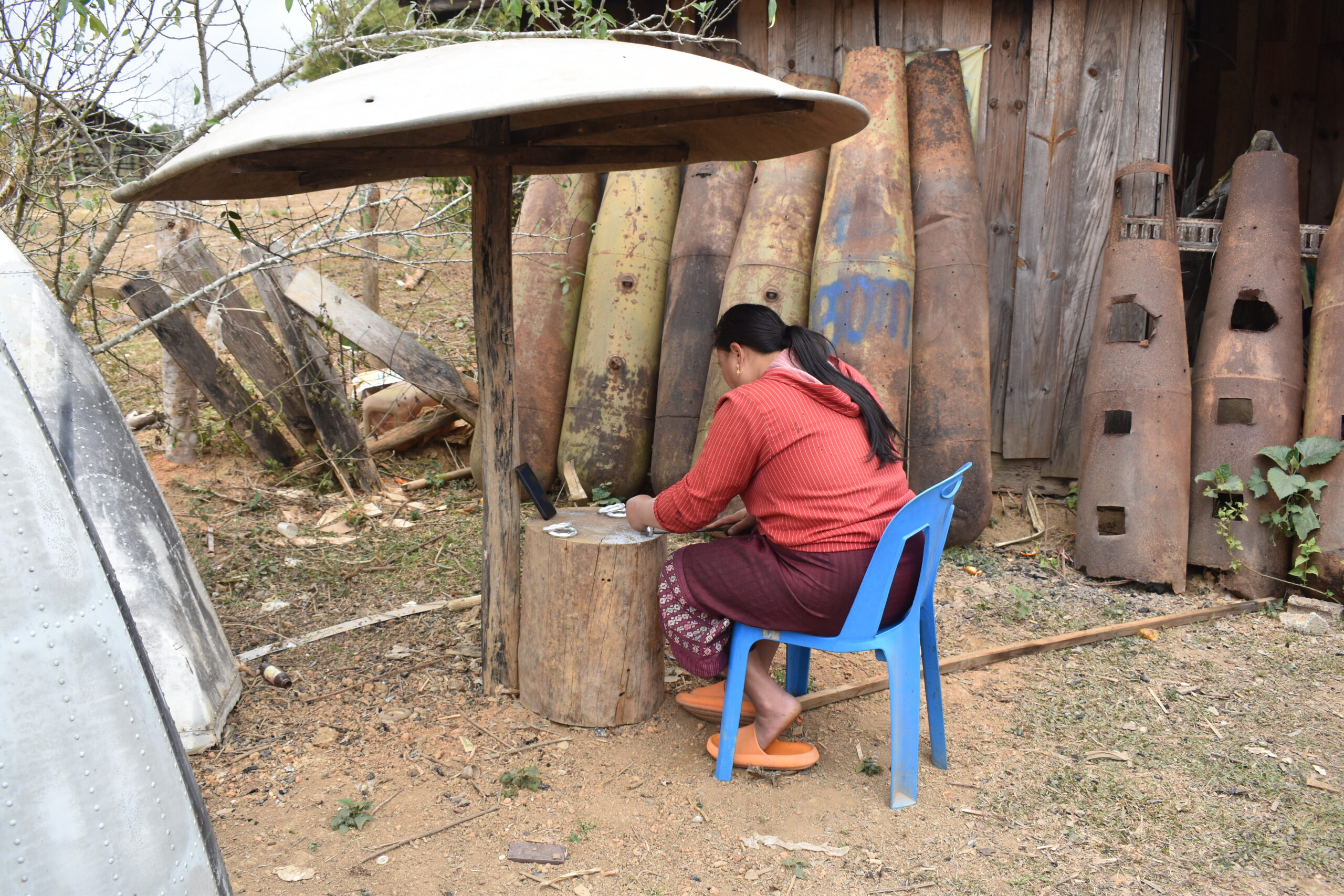
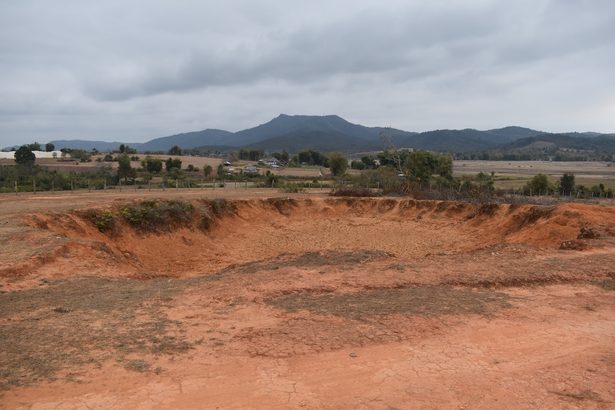
Daily reminders of the war are ubiquitous in Sinoun’s province of Xieng Khouang. The ancient Plain of Jars is covered in bomb craters and a number of funerary jars thousands of years old cracked by the blasts. Defused bombs are scattered across the province, used as construction material, garden beds and as decoration in cafes. Spoons and chopsticks in restaurants are made by melting down aluminum from the bombs.
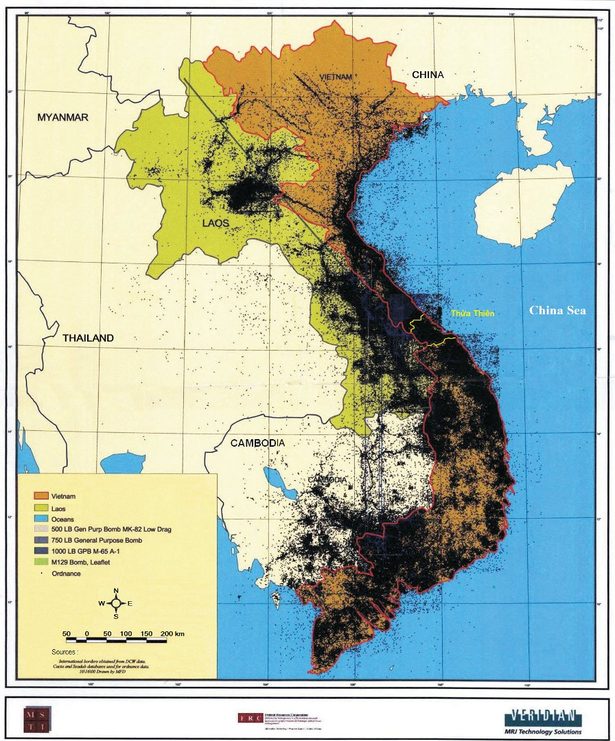
But the deadliest reminders of the war are hidden in the mountains, farms and villages of Laos. Millions of bombs never blew up. Most of them lie just beneath the surface in Xieng Khouang and surrounding northern provinces, and in the southern regions of Laos that border Vietnam. Finding and removing the bombs is a labor-intensive, slow, dangerous process. At the height of the antiwar movement, activists demanded the U.S. government come up with a long-term postwar plan to remove the bombs. Decades after the movement subsided, a small network of grassroots activists has continued to advance the demand under incredibly challenging circumstances.
The most bombed country in history
“Laos is the most heavily bombed country per capita in history,” said Sera Koulabdara, who leads Legacies of War, an organization dedicated to finding solutions to the long-term impacts of the American war in Vietnam, Cambodia and Laos. “The U.S. dropped more than 2.5 million tons of ordnance across 580,000 bombing missions — equal to a planeload of bombs every eight minutes, 24 hours a day, for nine years.” In total, across the three countries, the U.S. military dropped some 13 million tons of ordnance.
Locals who survived the war say that “everything” was bombed — houses, ancient temples, hospitals, farms, schools, entire villages. The ancient city of Xieng Khouang was completely leveled by the U.S. bombing campaign, save for the crumbling remains of some old stupas, a temple and a few French colonial buildings.
One of the more devastating legacies of the war is the unexploded ordnance, or UXO, which still claims lives in Laos every month. It’s estimated that over 30% of the ordnance dropped during the war did not explode. “Today vast amounts of land remain contaminated with unexploded ordnance,” Koulabdara said. “It continues to pose a threat to citizens in all three countries, with many survivors permanently disabled and their families impoverished.”
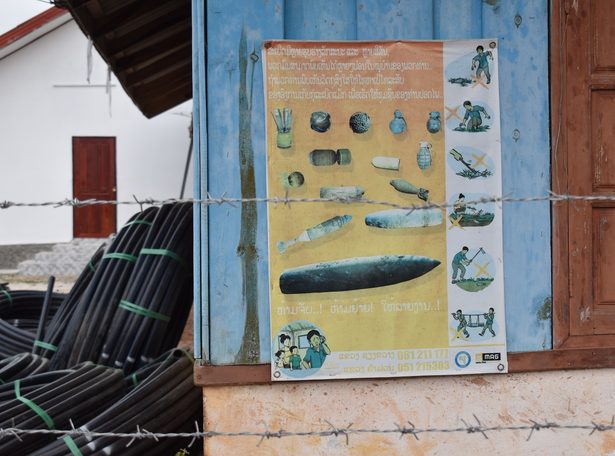
On a backcountry road in Xieng Khouang, vans filled with workers stir up clouds of dust as they navigate the crumbling asphalt. The workers will spend the next few weeks finding and defusing bombs in a remote mountain village. Thousands of government and NGO workers risk their lives daily in the nerve-wrecking hunt for UXO.
Koulabdara’s organization coordinates a vast patchwork of NGOs, volunteers, grassroots organizations, activists and government workers who are dedicated to making Laos bomb-free. Koulabdara said the group brings together “veterans, members of the diaspora community, government officials, students, artists and supporters from across the globe.”
If the work continues at its current rate, however, it is projected to take 1,000 years to clear Laos of UXO. This is a fact that weighs heavily on the people that live and work among the bombs.
The rebellion of the 1960s
Demands for the U.S. to make reparations and clean up the millions of bombs scattered all over Southeast Asia once emanated from the ranks of a mass antiwar movement in the U.S. and communist liberation movements in Southeast Asia.
At its peak, the U.S. antiwar movement was ablaze with resistance on many fronts. Students, workers, the Black Freedom struggle, the feminist movement and the broader New Left rose up in the political whirlwind of the time, not only calling for an end to the bloodshed, but at times openly declaring support for the communist movements in Southeast Asia. Organizations like Students for a Democratic Society swelled to nearly 100,000 members.
In May 1970, more than 4 million students launched a mass strike in response to the U.S. expansion of the war into Cambodia and Laos, and the FBI’s increased political repression of the Black Panther Party. Protests were held at over 700 U.S. colleges and universities. Occupations of buildings, mass teach-ins about the war and pitched battles with the authorities were common.
The strike turned deadly at Kent State University when the National Guard opened fire on demonstrators, killing four. Eleven days later, police killed two students at Jackson State University. In total, nearly 100 people were wounded by authorities across the U.S. during the May strike.
George Katsiaficas was deeply active in the antiwar movement and the New Left, struggles he has chronicled and theorized about in a host of books and articles. In 1972 he was invited to attend a conference in Versailles called the World Assembly for Peace and Independence of the Peoples of Indochina.
At the conference, he witnessed a deep and sincere form of solidarity in practice and was inspired by the speeches given by Vietnamese revolutionaries. It was there that he learned about cluster munitions — the kind that are still killing people in Laos today.
“The Vietnamese gave me a three-inch-high stack of photos about cluster bombs,” Katsiaficas said. He recalled being told, “we don’t think the American people know about this” and being urged to educate them when he returned home. Although there was some public knowledge of the U.S. using cluster bombs in Southeast Asia and even actions targeting their production, Katsiaficas said this was the first time he learned about them.
He was horrified. Cluster bombs are designed to open in midair and release smaller “bombies” over an area as large as five football fields. The bombies are filled with plastic and fiberglass shrapnel so they could not be detected by X-ray. They are specifically designed to kill and injure humans.
Previous Coverage
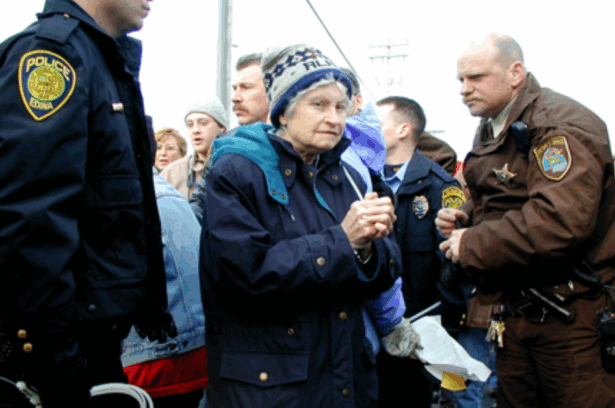 A 40-year fight against cluster bombs offers lessons to stop the US-Israel weapons pipeline
“I was outraged at the U.S. government. I’m still outraged,” Katsiaficas said. He went back to the U.S. and gave the information on cluster munitions to other activists who created brochures and distributed them en masse. He and other activists drove across the U.S. in a speaking tour to mobilize local antiwar and activist groups to protest the 1972 Republican and Democratic national conventions. Education about cluster munitions became part of their presentation.
“People were genuinely shocked,” he said. “Outrage, I would say, was the main reaction that people had. Indignation, you know, digging their heels in to really fight against the war. It just made people more determined than ever that the United States was evil.”
As more people became aware of cluster bombs, more protests were organized against their use.
Sera Koulabdara said that over the years, this mass organizing, educational work and advocacy to pressure the U.S. government for reparations and cleanup has certainly helped her group and other NGOs secure U.S. funding to address these “legacies of war.”
The revolt of American soldiers who turned against the war was also at the heart of the movement.
Susan Schnall was a lieutenant and nurse in the Navy during the war, and now serves as president of Veterans for Peace. She made headlines in 1969 when she was dismissed from the Navy for wearing her uniform at a veterans antiwar march in San Francisco. She later launched a daring action with two other activists where they flew a plane over military bases in the Bay Area and dropped thousands of antiwar flyers. “When I look back on it, I think we were just very, very lucky that they didn’t shoot us down,” Schnall said. She organized alongside other GIs and healthcare professionals, joining the Medical Committee for Human Rights and the Medical Aid for Indochina, which sent medical supplies and aid directly to North Vietnam.
As the war progressed, and as more Americans saw the mistake, futility or inhumanity of what the U.S. military was doing in Southeast Asia, GI resistance surged. Vietnam Veterans Against the War and other antiwar veterans groups formed, and GI coffeehouses and underground newspapers sprung up across the country to organize soldiers against the war. Increasingly, more soldiers went AWOL, refused orders or refused to fight. Morale broke down in the military. In 1970 alone, the Pentagon reported 209 fraggings (targeted killings of officers by soldiers). There were 65,643 desertions from the Army that same year. This was the largest form of soldier-led resistance to a war in the history of the United States.
The mass antiwar movement and GI resistance played a critical role in hastening the end of the war. The military conflict finally ended in 1975, but economic sanctions and political isolation became U.S. policy in the region for decades. Vietnam, Cambodia and Laos lay in ruins, UXO continued to kill and maim, and the U.S. reneged on the Paris Peace Accords agreement in its promise to give $3.25 billion in reconstruction aid to Vietnam. No similar aid was ever promised to Laos.
From national liberation to NGOs
Fifty years after the war’s end, the demands for reparations are now muted. The movement has long since faded away, and the communist forces in Southeast Asia became consumed by bureaucracy and state power, replacing the revolutionary language of Marxism and liberation with the capitalist language of development and finance.
With no mass antiwar movement using disruption and direct action to pressure the U.S. government to address the legacies of war, a small network of volunteers and grassroots activists have filled this void and turned toward raising public awareness, lobbying and directly assisting with UXO education and removal on the ground in Laos.
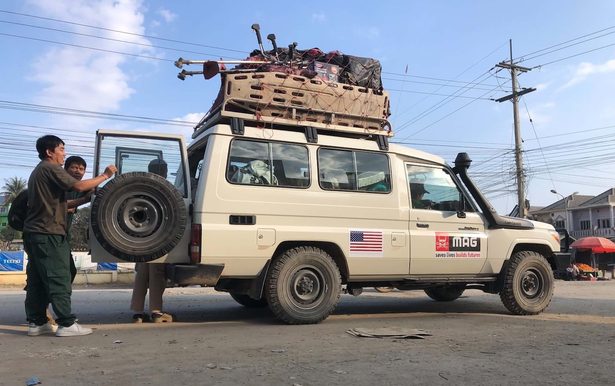
In the 1990s the U.S. started to change its policy towards Laos, Vietnam and Cambodia and work more closely with its former foes. As more money for international aid and development began to trickle in, NGOs became increasingly dominant in efforts to clear UXO. While these shifts have benefited people most at risk from UXO, they also come with strings attached.
Susan Hammond’s organization, the War Legacies Project, was once offered a $20,000 grant from a development consulting firm that she calls a “D.C. Beltway bandit for-profit corporation.” Her organization was slowed down by bureaucracy and constraints set by the donors. “I would never do it again,” she said. “A lot of the funding that’s going to Vietnam right now and Laos is going through these for-profit entities. NGOs are all having a really difficult time, and so they tend to not want to take on issues that might be sensitive.”
Funding to clean up UXO in Vietnam often comes from the Department of Defense and USAID, Hammond added. “They don’t do it for any kind of reparations, or even feel guilty by any means. It’s a way for them to get closer to the Vietnamese military.”
This also happened in Laos when President Barack Obama visited the country in 2016 and pledged over $90 million in aid to address UXO. The closer political relationship between both countries has been beneficial for American corporations as they vie to establish new markets, and for the U.S. military and government as they work more closely with Laos in a U.S.-led attempt to counter Chinese dominance in Southeast Asia.
Activists have to grapple with the ethics of getting funding from the U.S. government, and in particular from agencies like USAID, which was central to the war operation in Southeast Asia.
Susan Schnall said that Veterans for Peace had an opportunity to apply for a grant from USAID to assist survivors of the effects of Agent Orange. “We had major issues and disagreements, and some people … wouldn’t take the money. Then there were others of us that said we need to take care of these children. We need to clean up the land.” In the end, the money was not offered.
When President Trump froze funding to USAID and UXO programs in Laos in early 2025, the limitations of doing work contingent on funds from the U.S. government became painfully clear to people in Laos. Thousands of de-mining workers were taken out of the field, programs were shuttered and many NGOs heavily scaled back their operations or halted them altogether.
Legacies of War took a series of actions to reverse the funding freeze, Koulabdara said. “When many partners hesitated to go public, we stepped forward — using our voices, our credibility and decades of collective experience to reframe the national conversation on U.S. foreign aid and war legacy. We refused to allow the narrative to be so narrow.”
Legacies of War put pressure on the U.S. government through public education and delivered a letter signed by 17 former American ambassadors to Vietnam, Cambodia and Laos to Secretary of State Marco Rubio, urging him to continue funding UXO removal.

Waging Nonviolence depends on reader support. Make a donation today!
The funding began to flow again after months of mounting public pressure and organizing, and a Supreme Court decision upholding a lower court’s ruling that the Trump administration must release over $2 billion in frozen funds.
What will it take ultimately to make Laos bomb-free? It’s a difficult question, but there is an acute sense from volunteers on the ground that it will take much more than increased education, awareness and funding.
Another mass movement could address the war legacies in Southeast Asia and also stop current wars, interventions and support for genocide. Until that day comes, the people of Laos must shoulder the bulk of the burden, clearing one bomb at a time.
This article The fight to clean up the damage of the Vietnam War isn’t over was originally published by Waging Nonviolence.
People-powered news and analysis
Source: https://wagingnonviolence.org/2026/08/movement-to-cleanup-unexploded-vietnam-war-bombs-in-laos/
Anyone can join.
Anyone can contribute.
Anyone can become informed about their world.
"United We Stand" Click Here To Create Your Personal Citizen Journalist Account Today, Be Sure To Invite Your Friends.
Before It’s News® is a community of individuals who report on what’s going on around them, from all around the world. Anyone can join. Anyone can contribute. Anyone can become informed about their world. "United We Stand" Click Here To Create Your Personal Citizen Journalist Account Today, Be Sure To Invite Your Friends.
LION'S MANE PRODUCT
Try Our Lion’s Mane WHOLE MIND Nootropic Blend 60 Capsules
Mushrooms are having a moment. One fabulous fungus in particular, lion’s mane, may help improve memory, depression and anxiety symptoms. They are also an excellent source of nutrients that show promise as a therapy for dementia, and other neurodegenerative diseases. If you’re living with anxiety or depression, you may be curious about all the therapy options out there — including the natural ones.Our Lion’s Mane WHOLE MIND Nootropic Blend has been formulated to utilize the potency of Lion’s mane but also include the benefits of four other Highly Beneficial Mushrooms. Synergistically, they work together to Build your health through improving cognitive function and immunity regardless of your age. Our Nootropic not only improves your Cognitive Function and Activates your Immune System, but it benefits growth of Essential Gut Flora, further enhancing your Vitality.

Our Formula includes: Lion’s Mane Mushrooms which Increase Brain Power through nerve growth, lessen anxiety, reduce depression, and improve concentration. Its an excellent adaptogen, promotes sleep and improves immunity. Shiitake Mushrooms which Fight cancer cells and infectious disease, boost the immune system, promotes brain function, and serves as a source of B vitamins. Maitake Mushrooms which regulate blood sugar levels of diabetics, reduce hypertension and boosts the immune system. Reishi Mushrooms which Fight inflammation, liver disease, fatigue, tumor growth and cancer. They Improve skin disorders and soothes digestive problems, stomach ulcers and leaky gut syndrome. Chaga Mushrooms which have anti-aging effects, boost immune function, improve stamina and athletic performance, even act as a natural aphrodisiac, fighting diabetes and improving liver function. Try Our Lion’s Mane WHOLE MIND Nootropic Blend 60 Capsules Today. Be 100% Satisfied or Receive a Full Money Back Guarantee. Order Yours Today by Following This Link.


| Visits: | 1,831,418,741 |
| Stories: | 8,701,164 |
Whistler Blowers, Insiders

