

Inside the resistance to Spain’s crackdown on migrants in Ceuta

This article Inside the resistance to Spain’s crackdown on migrants in Ceuta was originally published by Waging Nonviolence.
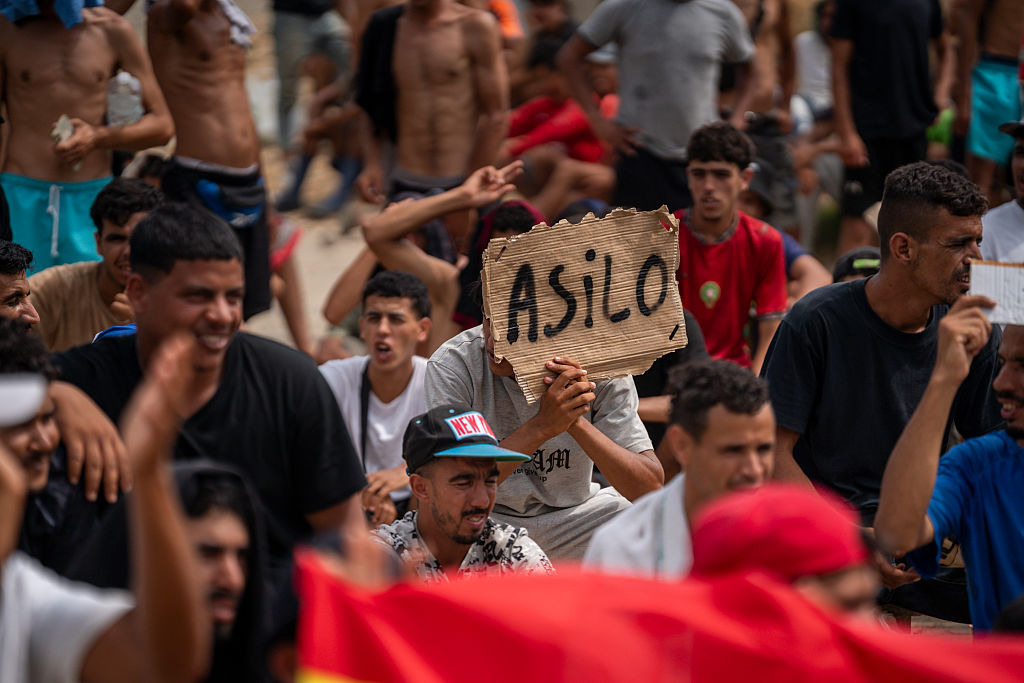
On July 30, images streamed across TVs, social media feeds and newspapers of thousands of people approaching a fence along the beach, in boats and by foot. Migrants, including children and families, were attempting to cross into Ceuta, a Spanish enclave bordered by Morocco. Facing violent border guards and the threat of drowning, over 70,000 people made it to Ceuta, with hopes of eventually reaching the Spanish mainland. Officials in Ceuta said that 100 people died in the crossing — either by drowning or being crushed — and sources on the ground believe the number was higher.
“I lost my phone, my money, my ID card, everything I had,” one Moroccan teenager recalled. “At one point I got pulled to the bottom, so far down that my feet touched the sand. When I looked around me, I saw women and babies who had drowned.”
“There was no proper humanitarian response from the local authorities — whether it is basic hygiene, food or shelter,” said Ric Fernández, coordinator and spokesperson for humanitarian and migrant advocacy group No Name Kitchen, or NNK, about the first days after the mass crossing. “Instead, there was an institutional response of pressuring people to ‘voluntarily’ return to Morocco. … There was repression, violence against people on the move in every form — legal, administrative and physical, and the forced expulsion of people.”
Facing intense pressure and violence from both the Spanish police and military, within 96 hours most people returned to Morocco. Estimates about how many migrants remain are in flux, but the Spanish government said in late September that up to 10,000 people are still in Ceuta.
While the global mainstream media quickly moved on from this story, the situation in Ceuta has remained tense over the last three months, with increased violent harassment by the police, evictions and collective expulsions. In recent weeks, “voluntary returns” and evictions from makeshift camps on the beach have ramped up.
Irene Estébanez Gutiérrez, a family and community doctor in Madrid, spent two weeks in Ceuta as a volunteer. “An information campaign has been waged that portrays people on the move as invaders, violent and dangerous,” she said. The media coverage, she believes, has failed to adequately address “the resulting humanitarian crisis, the systematic violation of rights, the lack of protection for minors, and the systematic violence and discrimination to which people are being subjected to, particularly by the military.”
Those who remain include Moroccan men and women, alongside Sudanese, Syrians, Palestinians, Malians and Nigerians. According to NNK, a significant number are minors. They are still stranded; the majority of them have slept in the street or in makeshift tents since they crossed into Ceuta over two months ago.
Kora, who uses a pseudonym as an activist to protect her identity, arrived in Ceuta to volunteer in early August and found the violence and the lack of access to basic necessities particularly angering. The authorities were “not letting them access the supermarkets to get food or water,” she said. “They turned off the publicly and freely accessible water [to shower or drink] on the beaches and beat them or scare them in the middle of the night … to purposefully making their lives more miserable.”
Organizing solidarity, facing criminalization
This violence, however, did not prevent activists and migrants from developing forms of organizing and resistance. Hundreds of migrants staged a protest on a popular beach in Ceuta in August to demand asylum. On Sept. 21, Migreurop, a Euro-African network of organizations, activists and researchers that monitors European migration policies, noted in a joint statement with over 100 organizations: “We have witnessed forms of resistance in everyday survival practices.” They mentioned the sharing of information, food and medicine, as well as safety and protection practices.
Besides migrants’ self-led efforts, civil society has stepped up to help, with the Spanish Red Cross distributing food at Trampolín Beach, the site of one makeshift camp. Other local charities like Luna Blanca, have been providing between 2,700 and 3,500 meals a day in five locations with initial funding from the Spanish government. NNK, a group started by Serbian activists in 2017 that supports migrants along the Balkan and Mediterranean routes to the EU, has been working in Ceuta since 2021. It has grown from a fixed team of four to more than 21 volunteers, after a call for help in early August through social media and Signal groups with other grassroots organizations providing aid to migrants in EU borders. Operations have shifted in the three months since the migrants arrived, and NNK is now cooking and serving over 1,200 meals a day in a new industrial-size kitchen.
Fernández shared how the group has adapted its work on the ground to keep up with a crisis situation. “For more than a month [after July 30], we were not able to do proper legal accompaniment, because the system was broken and we were just trying to register people,” he said. “We tried to divide our work into four different teams: legal, health, cooking, awareness.” To keep things coordinated, aid groups in Ceuta hold a weekly meeting to share information and needs. The most pressing needs are for immediate humanitarian assistance, including clothes distribution, housing for vulnerable groups and phone charging.
Volunteers arrive from Spain and mostly other European countries, contributing what they can based on their experience. “I provided direct basic health care because of the barriers to accessing medical care and the huge health needs due to violence and living conditions,” said Irene, the doctor who volunteered with NNK. She said she assessed dozens of cases involving wounds or injuries resulting from assaults, mostly perpetrated by the Spanish military.
The hostility of authorities toward migrants has also extended to volunteers, who carry out their daily work under intense police monitoring. Police constantly ask for identification documents and conduct searches, including of food containers meant for distribution. Reprisals against volunteers and grassroots groups have taken multiple forms, from administrative fines to criminal charges of “trafficking.” A volunteer who had previously spent time in Ukraine and Syria reported that the seven-square mile enclave of Ceuta felt considerably more militarized than either of those countries.
Lessons learned and the way ahead
Spain’s response to the people who crossed into Ceuta has been shocking to many observers, especially for a country that has been considered among the more progressive in the European Union on migration. This comes at a time when states are slowly beginning to implement the EU Pact on Migration and Asylum, a new and comprehensive reform to migration management which includes a focus on external borders. Legal advocates argue that this pact, coupled with the use of emergency laws, could suspend migration and human rights law in the EU during mass border crossings like the one in Ceuta.

Waging Nonviolence depends on reader support. Make a donation today!
Solidarity groups have also come under attack and are looking for ways to move forward in this new atmosphere. Greece is among the first countries to implement the pact and one that has led the way in criminalizing humanitarian efforts to support migrants. This increasing criminalization is happening “through the misuse of the criminal justice system to target and persecute activists and people in solidarity for their work, as well as through administrative law, such as harsher requirements for the registration of civil society organizations,” said Eleni Sirri from the Border Violence Monitoring Network, a network of NGOs, associations and collectives that monitors human rights violations at and within European borders.
Anna Gruber is the advocacy manager from Collective Aid, an NGO working with migrants in the borderlands of Serbia, Bosnia and Greece. She shared how Collective Aid also had to reorganize and strategize about the way ahead, given the increase in crackdowns on humanitarian work, as well as the anticipated changes because of the EU pact. “We are now focusing more on capturing conditions in detention, [and] mapping deaths and disappearances on the borders,” she said. “While these are hard to trace, bringing all the scattered evidence we can find together helps showcase the EU’s focus on detention camps and the containment of migration that is at heart of the new pact.”
Like other groups navigating the criminalization of migration and anticipated changes under the new pact, NNK feels it is important for grassroots groups across the EU and beyond to come together around migrant rights. Fernández believes putting energy into growing networks and collectives of grassroots groups is the way forward. “The far-right in Europe and instrumentalization of migration will continue to grow,” he said. “We need to prepare for that and learn from each other to be stronger.”
Kirsten Dimovitz, the advocacy coordinator for the Border Violence Monitoring Network and a volunteer in Ceuta, contributed additional reporting to the story.
This article Inside the resistance to Spain’s crackdown on migrants in Ceuta was originally published by Waging Nonviolence.
People-powered news and analysis
Source: https://wagingnonviolence.org/2026/10/inside-the-resistance-to-spains-crackdown-on-migrants-in-ceuta/
Anyone can join.
Anyone can contribute.
Anyone can become informed about their world.
"United We Stand" Click Here To Create Your Personal Citizen Journalist Account Today, Be Sure To Invite Your Friends.
Before It’s News® is a community of individuals who report on what’s going on around them, from all around the world. Anyone can join. Anyone can contribute. Anyone can become informed about their world. "United We Stand" Click Here To Create Your Personal Citizen Journalist Account Today, Be Sure To Invite Your Friends.
LION'S MANE PRODUCT
Try Our Lion’s Mane WHOLE MIND Nootropic Blend 60 Capsules
Mushrooms are having a moment. One fabulous fungus in particular, lion’s mane, may help improve memory, depression and anxiety symptoms. They are also an excellent source of nutrients that show promise as a therapy for dementia, and other neurodegenerative diseases. If you’re living with anxiety or depression, you may be curious about all the therapy options out there — including the natural ones.Our Lion’s Mane WHOLE MIND Nootropic Blend has been formulated to utilize the potency of Lion’s mane but also include the benefits of four other Highly Beneficial Mushrooms. Synergistically, they work together to Build your health through improving cognitive function and immunity regardless of your age. Our Nootropic not only improves your Cognitive Function and Activates your Immune System, but it benefits growth of Essential Gut Flora, further enhancing your Vitality.

Our Formula includes: Lion’s Mane Mushrooms which Increase Brain Power through nerve growth, lessen anxiety, reduce depression, and improve concentration. Its an excellent adaptogen, promotes sleep and improves immunity. Shiitake Mushrooms which Fight cancer cells and infectious disease, boost the immune system, promotes brain function, and serves as a source of B vitamins. Maitake Mushrooms which regulate blood sugar levels of diabetics, reduce hypertension and boosts the immune system. Reishi Mushrooms which Fight inflammation, liver disease, fatigue, tumor growth and cancer. They Improve skin disorders and soothes digestive problems, stomach ulcers and leaky gut syndrome. Chaga Mushrooms which have anti-aging effects, boost immune function, improve stamina and athletic performance, even act as a natural aphrodisiac, fighting diabetes and improving liver function. Try Our Lion’s Mane WHOLE MIND Nootropic Blend 60 Capsules Today. Be 100% Satisfied or Receive a Full Money Back Guarantee. Order Yours Today by Following This Link.


| Visits: | 1,835,620,768 |
| Stories: | 8,724,969 |
Whistler Blowers, Insiders

