
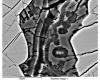
The Fracture-Fill Explanation of Martian Polygons Is Challenged.

All articles by Wretch Fossil are here: http://www.wretch.cc/blog/lin440315&category_id=0
https://wretchfossil.blogspot.com/2026/07/same-color-in-same-polygon-indicates.html
This version presses the strongest defensible argument: the proposed erosion-resistant fill should behave as a connected material system, but the visible color appears organized polygon by polygon.
Polygon-Specific Color Coherence Strongly Challenges the Fracture-Fill Explanation of Martian PolygonsAbstract
A close-range MAHLI image acquired by NASA’s Curiosity rover on Sol 4745 reveals numerous small polygonal structures on a block in the Monte Grande boxwork hollow. The Curiosity team provisionally described the protruding polygon boundaries as fracture-filling material and planned separate APXS and ChemCam measurements of the polygon centers and ridges. NASA’s broader boxwork model proposes that groundwater deposited minerals in fractures, strengthening those zones so that they resisted wind erosion while the surrounding, less resistant rock was removed. (NASA Science)
The visible color organization of the Sol 4745 polygons presents a serious problem for this interpretation. Within individual polygons, the raised boundaries, interior surfaces, and associated fragments appear to share a common color, whereas adjacent polygons may show distinguishable colors. Thus, the apparent optical identity follows the individual polygon rather than the proposed continuous fracture-fill network.
Hardness or erosion resistance does not always produce a visible color difference. Nevertheless, when a model requires later mineral deposition sufficient to make one component substantially more erosion-resistant than another, it is reasonable to expect some consistent material signature—optical, textural, spectral, chemical, or structural—distinguishing the resistant fill from the softer substrate. The apparent absence of such a ridge-versus-center distinction, combined with polygon-specific color coherence, strongly weakens the simple fracture-fill model.
1. Introduction
NASA’s Curiosity rover photographed a polygon-covered block in the Monte Grande hollow on December 11, 2025, corresponding to mission Sol 4745. NASA described the image as showing polygon-shaped features and referred to their visibly protruding boundaries as fracture-filling material. However, the same mission report stated that APXS and ChemCam LIBS observations of the polygon centers and polygon ridges were planned specifically to measure their composition. (NASA Science)
This sequence is scientifically important. The term “fracture-filling material” was applied as a morphological interpretation before a published ridge-versus-center compositional comparison was available. The visual description should therefore not be confused with an experimentally established identification.
The most important unresolved observation is the distribution of color. If the ridges are later mineral deposits physically and mechanically distinct from the softer polygon bottoms, the material contrast should be organized primarily between the ridges and the interiors. Instead, the visible color appears to remain coherent within each complete polygon.
This produces a direct conflict between the expected organization of a fracture-fill network and the organization visible in the image.
2. The Geological Model Requires Differential Resistance
NASA’s large-scale boxwork model proposes that groundwater moved through fractures in pre-existing bedrock and left minerals behind. These mineral concentrations hardened or cemented the fractured zones. Subsequent Martian wind erosion preferentially removed the less reinforced surrounding rock, leaving the hardened fracture zones standing as ridges. NASA has explicitly stated that the minerals strengthened the regions that became ridges while unreinforced portions were eroded into hollows. (NASA Jet Propulsion Laboratory (JPL))
This explanation requires a real mechanical difference:
-
the ridges must be more resistant to erosion;
-
the intervening material must be less resistant;
-
the resistance difference must be substantial enough to generate persistent positive relief.
The geological model therefore does not merely claim that cracks once existed. It claims that later mineralization or cementation transformed the cracks into a mechanically distinct component.
No direct hardness measurement has been reported for the small Sol 4745 polygon ridges. Greater hardness or erosion resistance is inferred from their survival in relief. Nevertheless, the model still depends on a meaningful difference between the raised material and the polygon bottoms.
3. A Mechanically Distinct Fill Should Possess a Material Identity
Hardness and visible color are not identical properties. Two materials can have the same visible color while differing in porosity, cementation, grain bonding, crystallinity, or fracture density.
However, this general qualification cannot make color irrelevant.
The fracture-fill interpretation proposes that mineral-bearing fluids entered cracks after the host rock had formed. The resulting fill or cement became sufficiently resistant to remain elevated while adjacent material eroded downward. If this process created a major mechanical contrast, then the resistant component should possess some repeatable identity distinguishing it from the less resistant component.
That identity could appear as:
-
a different visible color;
-
a different brightness or reflectance;
-
a distinct texture or grain size;
-
a consistent spectral response;
-
an elemental enrichment;
-
a vein-like internal structure;
-
or a sharply defined contact with the host material.
Martian fracture fills frequently do show such distinctions. NASA has documented white calcium-sulfate veins within fractures in the boxwork-region bedrock, and earlier Curiosity studies described abundant light-toned calcium-sulfate fracture-fill material in Gale crater. (NASA Jet Propulsion Laboratory (JPL))
NASA has also illustrated possible Martian mud cracks in which mineral-filled cracks are visibly much brighter than the surrounding rock. (NASA Jet Propulsion Laboratory (JPL))
These examples do not prove that every fracture fill must be visibly different. They demonstrate, however, that secondary mineralization commonly creates recognizable material contrasts. Therefore, when a supposed fill is mechanically important enough to control erosion but possesses no obvious network-scale visual identity, that absence becomes relevant evidence requiring explanation.
4. The Expected Color Pattern Under Fracture Filling
A straightforward fracture-fill model predicts two principal material populations:
A. Original host-rock material
This material should occupy the centers or bottoms of the polygons.
B. Later fracture-related material
This material should form the raised boundaries and should continue along the interconnected fracture network.
If visible color reflects even partially the composition, texture, cementation, or weathering behavior of these components, then the expected organization is:
polygon interiors resemble other polygon interiors, while raised fracture fills resemble other portions of the connected fracture network.
The most natural visual contrast should therefore occur across the ridge–interior contact.
The expected pattern is not that every polygon develops an independent color identity that includes both its supposedly soft center and its supposedly harder boundary.
5. The Observed Pattern Appears Reversed
The Sol 4745 image appears to show a different organization:
-
the bottom of one polygon resembles its associated raised parts;
-
fragments belonging to the same polygon preserve a similar color;
-
adjacent polygons may differ in color;
-
color does not obviously define a uniform ridge population extending through the network.
This means that color appears to track polygon membership, not fracture-fill membership.
That is a major distinction.
If a raised edge and a lower interior surface share the characteristic color of one polygon, while the neighboring polygon has a different color, the image is not visually separating a hard fill from a soft host. It is instead grouping the hard and soft portions together as one polygon-specific unit.
The apparent relationship can be expressed as:
Color similarity within one polygon is greater than color similarity among all supposed fracture-fill ridges.
If confirmed quantitatively, that relationship directly opposes the simplest geological prediction.
6. The Shared-Ridge Contradiction
The geometry of shared polygon boundaries creates an additional problem.
Two adjacent polygons are separated by a common boundary. Under a fracture-fill model, that boundary represents one fracture occupied or altered by one body of mineralized material. It cannot simultaneously be an independent fill uniquely belonging to each neighboring polygon.
A connected fracture network should therefore show material continuity along the network. Even if the fill varies gradually, its properties should primarily reflect:
-
fluid chemistry;
-
fracture generation;
-
temperature;
-
pressure;
-
alteration history;
-
and the timing of mineral deposition.
Its appearance should not repeatedly reset according to the identity of each polygonal compartment.
If boundary material visually follows the color of one complete polygon rather than maintaining continuity with adjoining ridges, the geological model faces a spatial contradiction. The alleged fill behaves not like a cross-cutting secondary vein network, but like an integrated component of each polygonal unit.
This is more difficult to dismiss than the simple statement that two surfaces have the same color.
7. Harder Ridges and Softer Bottoms Should Not Be Assumed to Be Indistinguishable
A defender of the fracture-fill model may argue that the ridge can be harder while retaining the same visible color as the bottom.
That is physically possible. A small amount of colorless cement, reduced porosity, or microscopic recrystallization might increase erosion resistance without producing a dramatic color change.
But this response only identifies a possible exception. It does not demonstrate that such an exception applies to the Sol 4745 polygons.
To preserve the fracture-fill model, one must assume all of the following:
-
The raised ridges are materially or mechanically different from the polygon bottoms.
-
The difference is large enough to produce substantial differential erosion.
-
The alteration nevertheless creates no visible ridge-versus-bottom distinction.
-
A surface coating or dust does not erase the differences between neighboring polygons.
-
Yet each polygon retains its own internally coherent color.
-
The apparent alignment between color and polygon membership is coincidental or produced by an unidentified secondary process.
This is a considerably more complicated explanation than the initial statement that minerals merely filled cracks and became resistant.
The same-color observation therefore shifts the burden of explanation. It is no longer sufficient to point to raised boundaries and label them fracture fill. The model must explain why mechanically different components are optically integrated within each polygon while adjacent polygons remain distinguishable.
8. Dust Does Not Easily Resolve the Problem
A common explanation for similar Martian colors is that dust or oxidation coatings cover both the ridge and the bottom.
A sufficiently uniform coating could conceal compositional differences. However, a uniform coating should tend to make the entire block more uniform. It should not naturally produce one coherent color within one polygon and another color within an adjacent polygon.
To explain polygon-specific color coherence, dust retention would itself need to be controlled by the individual polygons. That would imply polygon-specific differences in:
-
texture;
-
porosity;
-
electrostatic behavior;
-
roughness;
-
slope;
-
cementation;
-
or weathering.
Such an explanation would still establish that each polygon is a distinct physical domain. It would not support the idea that the surface consists merely of homogeneous host rock divided by an independent, continuous fracture-fill network.
Dust can obscure composition, but it cannot be invoked without explaining why its effects apparently respect polygon boundaries.
9. Lighting Is Also an Insufficient General Explanation
Different surface orientations can generate differences in brightness and apparent color. Shadowed areas may appear darker or more saturated than sunlit areas.
However, lighting becomes an inadequate explanation when:
-
differently inclined surfaces within one polygon share a similar hue;
-
broken or displaced parts retain the polygon’s characteristic color;
-
adjacent surfaces under comparable illumination differ;
-
and the color changes coincide repeatedly with polygon boundaries.
If color were controlled primarily by illumination, it should correlate with slope orientation and shadow geometry—not consistently with polygon membership.
A quantitative analysis should control for lighting, but lighting cannot simply be assumed to explain a repeated boundary-constrained pattern.
10. NASA’s Own Measurement Plan Shows That the Interpretation Is Unconfirmed
The Curiosity team planned APXS and ChemCam LIBS measurements on both polygon centers and polygon ridges. (NASA Science)
This choice is significant. If the raised material had already been demonstrated to be a compositionally distinct fracture fill, there would be no unresolved need to determine whether the center and ridge differed.
Separate targeting acknowledges that the relationship remains an empirical question.
A fracture-fill interpretation would receive strong support if the measurements showed:
-
reproducible chemical differences between ridges and bottoms;
-
a common ridge composition extending across multiple polygons;
-
enrichment of vein-forming or cementing minerals in the ridges;
-
and a ridge signature stronger than polygon-to-polygon differences.
The interpretation would be weakened if:
-
each ridge closely resembled its adjacent polygon bottom;
-
different polygons showed greater differences than ridges versus centers;
-
or ridge compositions failed to form a consistent network-scale population.
Until those comparisons are publicly available, the visible morphology cannot be treated as conclusive proof of fracture filling.
11. The Strongest Testable Hypothesis
The decisive question is:
Does material similarity follow the connected ridge network, or does it follow individual polygonal units?
This can be tested using calibrated imaging and compositional data.
For each polygon, investigators should compare:
-
the center;
-
the raised perimeter;
-
detached or fragmented parts;
-
shared boundaries;
-
adjacent polygon centers;
-
and distant ridge segments.
Two competing predictions can then be evaluated.
Fracture-fill prediction
All ridges should show a stronger common material signature with one another than with their adjacent centers.
Polygon-unit prediction
Each ridge, center, and associated fragment should show a stronger relationship within its own polygon than with equivalent parts of neighboring polygons.
The visible color pattern appears more consistent with the second prediction.
12. Implications
Same color alone does not prove identical chemical composition, and polygon-specific color does not by itself prove artificial manufacture.
Nevertheless, the observation has substantial evidentiary value because it conflicts with the expected spatial organization of the proposed geological mechanism.
The issue is not simply:
Why can two materials have the same color?
The scientifically relevant question is:
Why does the same color repeatedly unite the supposedly harder ridge and softer bottom of one polygon, while neighboring polygons appear different?
A geological explanation must account simultaneously for:
-
differential erosion;
-
mechanical contrast;
-
lack of an obvious ridge-specific color;
-
color coherence across the alleged ridge–bottom boundary;
-
and color differences between adjacent polygons.
Merely naming fracture filling does not answer these observations.
13. Conclusion
NASA’s boxwork hypothesis proposes that groundwater deposited minerals in fractures, strengthening them so that they survived erosion as raised ridges while softer surrounding material was removed. (NASA Jet Propulsion Laboratory (JPL))
Applied to the Sol 4745 polygons, this model predicts a mechanically distinct fracture-related component surrounding less resistant polygon interiors. Such a component need not always have a dramatically different visible color, but it should possess a coherent material identity detectable optically, texturally, spectrally, chemically, or structurally.
The image instead appears to show that:
-
raised and lower portions within one polygon possess similar coloration;
-
neighboring polygons may differ;
-
and color coherence follows polygon identity rather than the connected ridge network.
This is the opposite of the most straightforward fracture-fill prediction.
The color evidence therefore provides strong grounds for rejecting any claim that fracture filling has already been demonstrated. At minimum, it shows that each polygon must be investigated as a coherent physical unit rather than treated automatically as ordinary bedrock bounded by later mineral veins.
Until APXS and ChemCam measurements establish a consistent ridge-specific composition distinct from the polygon bottoms, the fracture-fill interpretation remains an unverified hypothesis. The observed polygon-specific color coherence is positive morphological evidence against its simplest form and requires a substantially more detailed explanation than has presently been provided.
This wording supports the post strongly while keeping the conclusion tied to evidence that future ridge-versus-center measurements can test.
Wretch Fossil’s website:http://wretchfossil.blogspot.com/
Source: https://wretchfossil.blogspot.com/2026/07/the-fracture-fill-explanation-of.html
Anyone can join.
Anyone can contribute.
Anyone can become informed about their world.
"United We Stand" Click Here To Create Your Personal Citizen Journalist Account Today, Be Sure To Invite Your Friends.
Before It’s News® is a community of individuals who report on what’s going on around them, from all around the world. Anyone can join. Anyone can contribute. Anyone can become informed about their world. "United We Stand" Click Here To Create Your Personal Citizen Journalist Account Today, Be Sure To Invite Your Friends.
LION'S MANE PRODUCT
Try Our Lion’s Mane WHOLE MIND Nootropic Blend 60 Capsules
Mushrooms are having a moment. One fabulous fungus in particular, lion’s mane, may help improve memory, depression and anxiety symptoms. They are also an excellent source of nutrients that show promise as a therapy for dementia, and other neurodegenerative diseases. If you’re living with anxiety or depression, you may be curious about all the therapy options out there — including the natural ones.Our Lion’s Mane WHOLE MIND Nootropic Blend has been formulated to utilize the potency of Lion’s mane but also include the benefits of four other Highly Beneficial Mushrooms. Synergistically, they work together to Build your health through improving cognitive function and immunity regardless of your age. Our Nootropic not only improves your Cognitive Function and Activates your Immune System, but it benefits growth of Essential Gut Flora, further enhancing your Vitality.

Our Formula includes: Lion’s Mane Mushrooms which Increase Brain Power through nerve growth, lessen anxiety, reduce depression, and improve concentration. Its an excellent adaptogen, promotes sleep and improves immunity. Shiitake Mushrooms which Fight cancer cells and infectious disease, boost the immune system, promotes brain function, and serves as a source of B vitamins. Maitake Mushrooms which regulate blood sugar levels of diabetics, reduce hypertension and boosts the immune system. Reishi Mushrooms which Fight inflammation, liver disease, fatigue, tumor growth and cancer. They Improve skin disorders and soothes digestive problems, stomach ulcers and leaky gut syndrome. Chaga Mushrooms which have anti-aging effects, boost immune function, improve stamina and athletic performance, even act as a natural aphrodisiac, fighting diabetes and improving liver function. Try Our Lion’s Mane WHOLE MIND Nootropic Blend 60 Capsules Today. Be 100% Satisfied or Receive a Full Money Back Guarantee. Order Yours Today by Following This Link.


| Visits: | 1,827,404,942 |
| Stories: | 8,683,042 |
Whistler Blowers, Insiders

