

Competitive Golf Mental Preparation: The Elite Guide to Tournament Success

Why does the swing that felt effortless on the practice range suddenly feel like a foreign object the moment you step into the tee box? Many players believe they need more technical practice to fix their tournament struggles, but the truth is usually the opposite. Your mechanics aren’t failing you; your mental architecture is. Effective competitive golf mental preparation isn’t about trying harder or searching for a new swing thought that works under pressure. It’s about developing the stoic discipline required to separate your performance from your ego.
You’ve likely felt the frustration of a great warm-up session failing to survive the first three holes. This guide provides the framework you need to transition from a range player to a consistent tournament winner. We’ll examine how to build a repeatable pre-round routine, maintain emotional stability after a double bogey, and master the internal control necessary to lower your tournament scoring average. By the end, you’ll have the tools to manage your mind so your physical skills can finally shine when the stakes are highest.
- Identify the psychological “Competitive Gap” to understand why your range swing often disappears under the pressure of the first tee.
- Shift your focus from outcome-based scores to structured process goals, which are the foundation of elite competitive golf mental preparation.
- Implement a 24-hour tournament timeline that prioritizes emotional regulation and eliminates technical swing thoughts before your round begins.
- Protect your focus by mastering “in-between” time management and treating your pre-shot routine as a sacred space for commitment.
- Develop a permanent mental architecture through daily discipline to ensure your peak performance becomes a repeatable habit rather than a lucky occurrence.
The Competitive Gap: Why Tournament Golf Feels Different
The “Competitive Gap” is the distance between your physical potential and your actual performance when a scorecard is in your hand. Most golfers possess the skill to strike the ball purely, yet they struggle to replicate that quality when it matters most. This discrepancy isn’t a flaw in your swing mechanics. It’s a physiological response to a change in environment. Within the broader field of Sport Psychology, we recognize that the brain processes a tournament round differently than a casual afternoon with friends. Understanding this shift is the first step in effective competitive golf mental preparation.
When you perceive a shot as “important,” your amygdala often takes over. This part of the brain triggers a fight-or-flight response, treating a missed fairway like a physical threat. Your heart rate increases, your grip pressure tightens, and your focus narrows. In this state, your body seeks safety through control. You begin to utilize an “Internal Focus,” where you’re over-analyzing your elbow position or wrist hinge instead of looking at the target. To find stability, you must build a mental architecture that shifts your attention back to an “External Focus.”
The Range to Course Disconnect
The practice range is a vacuum of consequence. You can hit dozens of shots to the same flag, and if you miss one, another ball is already teed up. This environment builds a false sense of confidence because it never tests your emotional resilience. On the course, every shot has a permanent result. Many players try to fix this by “practice-swinging” their way through a round, desperately searching for a mechanical feel that will save them. This rarely works. You must stop searching for sensations and start mastering your response to the environment. You can explore further details on Why You Play Better on the Range Than the Course to identify your specific triggers.
The Psychology of Tournament Pressure
Pressure isn’t an external force; it’s an internal creation. Your ego often views a poor score as a threat to your identity or your status among peers. This fear leads to “playing not to lose,” a defensive mindset where you swing with hesitation and aim for the “safe” miss. Competitive pressure is the gap between your expectations of what should happen and the reality of what is occurring. To overcome this, you have to stop treating the golf course as a place where your value is decided. Instead, view it as a laboratory for your mental discipline and focus.
The Core Pillars of Competitive Golf Mental Preparation
Tournament success depends on three foundational pillars: Process Goals, Emotional Regulation, and Routine. These elements form the structural integrity of your competitive golf mental preparation. Most amateurs make the mistake of focusing on outcome goals, such as shooting a specific score or finishing in the top five. This is a strategic error. Outcomes are the results of your actions, not the actions themselves. By obsessing over the scorecard, you invite anxiety because you are attempting to control variables that are fundamentally outside of your immediate reach.
Adopt the mindset of the “Stoic Golfer.” This philosophy dictates that you focus exclusively on your own choices and responses. You cannot control a gust of wind, a slow group ahead of you, or a ball that catches a bad bounce into a hazard. You can, however, control your reaction to these events. Environmental acceptance is a hallmark of elite performers. It allows you to remain unshakeable regardless of external chaos. When you stop fighting the conditions, you free up mental energy to focus on the next shot.
Setting Process-Based Goals
Success should be measured by the quality of your execution rather than the number on the card. Define your performance through process-based goals that are 100% within your control. For example, commit to completing your full pre-shot routine for every single shot, regardless of how you feel. When you hit these internal targets, you have succeeded. This shift in perspective is essential for Mastering Golf Emotional Control and maintaining focus during the closing holes of a tournament.
Building Emotional Resilience
Aim for a “flat line” emotional state throughout the round. Highs and lows are equally dangerous; extreme excitement after a birdie can lead to a lapse in focus on the next tee just as easily as a bogey can lead to anger. Staying neutral is far more effective than “trying to stay positive.” If you feel your heart rate rising after a difficult hole, utilize specific golf breathing techniques to reset your nervous system. These physical anchors bring your mind back to the present moment and prevent emotional spiraling.
Building these pillars takes consistent effort. For players who want to install these habits into their game permanently, The Ultimate Mental Game Training System provides the structured framework needed to turn these psychological principles into an automated part of your performance.
A Step-by-Step Tournament Preparation Timeline
Elite performance isn’t a random event. It’s the result of a deliberate countdown that begins 24 hours before you strike your first shot. Most golfers treat their warm-up as an isolated event, but effective competitive golf mental preparation requires a broader view. You need to manage your cognitive load and emotional energy long before you reach the property. By creating a structured timeline, you remove the friction of decision-making on tournament morning, allowing your mind to remain calm and focused on the task at hand.
The Night Before: Cognitive Offloading
Your preparation starts with cognitive offloading. This process involves emptying your mind of logistical worries so you can rest deeply. Prepare your equipment, pack your bag, and check your starting time before dinner. Once the logistics are settled, spend ten minutes visualizing the course. Focus on a “conservative strategy, aggressive execution” approach. This means picking smart, high-margin targets but committing to a full, unhesitant swing once you’ve made your choice. Use this time to rehearse your response to adversity. If you see yourself hitting into a bunker, visualize yourself walking to the ball with a neutral expression and executing a disciplined recovery. This mental rehearsal ensures that nothing on the course can surprise you or break your composure.
The 30-Minute Pre-Round Routine
On tournament morning, your goal is to transition from a technical mindset to a rhythmic one. Avoid the temptation of “technical check-ins” on the range. If you start searching for a swing thought 40 minutes before your tee time, you’ve already lost the mental battle. Instead, use a structured tool like the 30 Minute Pre-Round Confidence Booster to prime your brain for performance. This routine shifts your focus from “how” to “where.”
Follow these specific guidelines during your warm-up:
- The 30-Ball Rule: Don’t hit more than 30 balls. The range is for loosening your muscles and finding your rhythm, not for fixing your path or plane.
- The Acceptance Speech: Before leaving the range, take a moment to decide that you’ll accept whatever version of your swing showed up today. You don’t need your “A-game” to score well; you only need your best mental discipline.
- The First Tee Reset: Adrenaline will be at its peak on the first tee. Don’t fight it. Acknowledge the physical sensation, take two deep belly breaths, and narrow your focus to a specific, small target in the distance.
By the time you walk to the first tee, your competitive golf mental preparation should be complete. You aren’t there to find a swing. You’re there to execute a process you’ve already mastered in your mind.
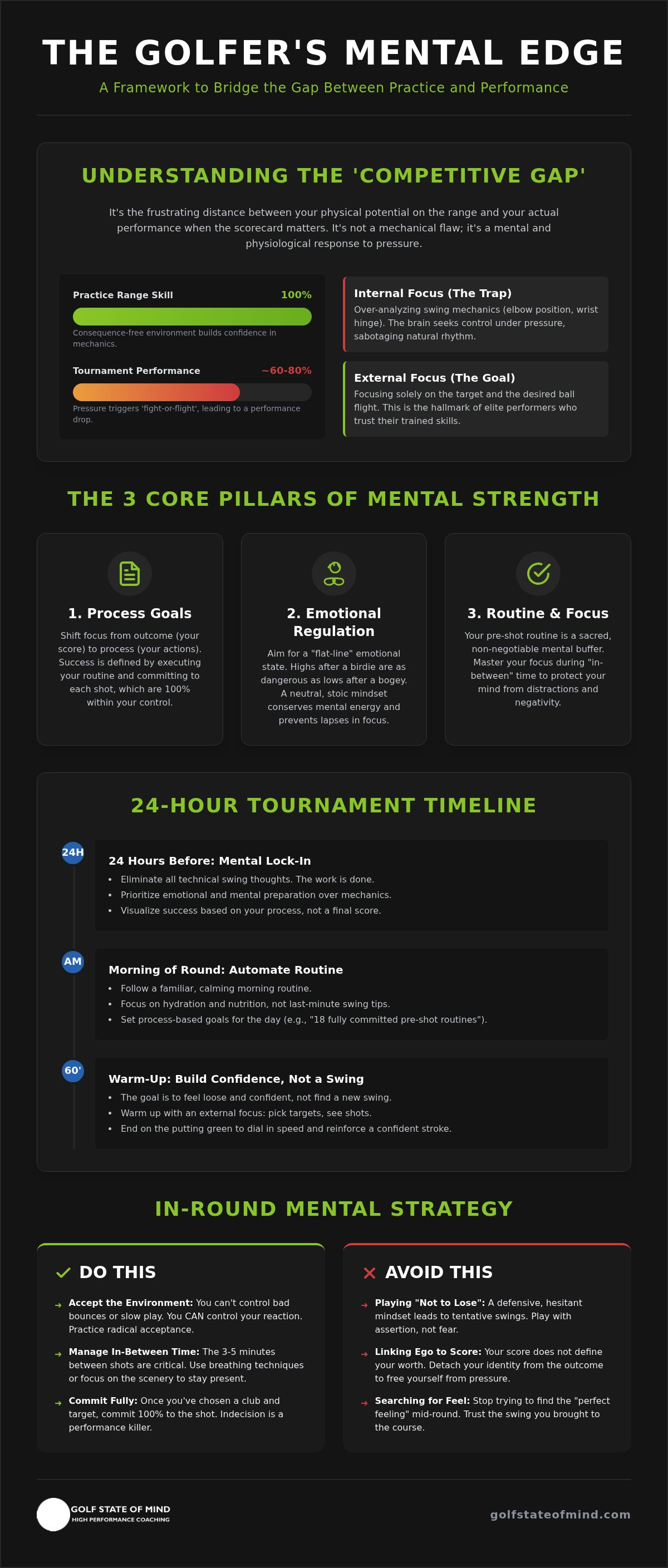
In-Round Management: Maintaining the Competitive Mindset
The actual execution of a golf shot takes less than two seconds. Over a four-hour tournament round, you spend roughly 90% of your time walking, waiting, and thinking. This “in-between” time is the primary battlefield for competitive golf mental preparation. If you remain in a state of high intensity for the entire round, you will inevitably suffer from mental fatigue by the 14th tee. To perform at your peak, you must learn to manage your cognitive energy through a deliberate on/off switch. This ensures your focus is sharp when you step into the ball and relaxed when you are between shots.
Mastering Focus and Energy Management
Think of your concentration as a finite resource. You cannot keep it pinned at maximum for four hours without a crash. Practice turning your focus “on” only when you enter your pre-shot routine. This routine is a sacred space where you commit fully to your target and visualization. Once the shot is over and the club is back in the bag, turn the switch “off.” Use the walk to the next tee to observe your surroundings or engage in light conversation. Learning how to focus during a golf round is about rhythm, not constant effort. Additionally, maintain your mental clarity on the back nine by staying hydrated and consuming small, frequent snacks to prevent blood sugar drops that lead to poor decision-making.
Recovering from Tournament Setbacks
Tournament success is often defined by how you handle your worst shots, not your best ones. When a bad break occurs, use the “10-Step Rule.” You are allowed to feel frustrated for exactly ten steps after hitting the shot. Once you take that eleventh step, the shot is history. This prevents one mistake from turning into a blow-up hole. Your post-shot routine should involve a neutral evaluation of the process. Did you commit to the target? Was your routine disciplined? If the answer is yes, you have succeeded, regardless of where the ball landed. This stoic approach is vital for overcoming a golf slump or mid-round dip in form.
As you approach the closing holes with the lead or a personal best on the line, the temptation is to “steer” the ball. This defensive mindset is the enemy of performance. Stay aggressive by picking specific, small targets and swinging with full commitment. True competitive golf mental preparation means trusting your training when the pressure is highest. To build this level of trust and create a bulletproof mindset, consider implementing The Ultimate Mental Game Training System into your regular practice schedule.
Building Your Permanent Mental Architecture
Competitive golf mental preparation is not a switch you flip only when you arrive at the tournament site. It is a fundamental shift in how you process information and manage your internal state. To see lasting results, you must treat your mind with the same rigor you apply to your physical swing. This involves daily discipline and a commitment to long-term growth. Tools like The Ultimate Mental Game Training System provide the necessary structure to build this architecture, ensuring your psychological foundation remains stable under the highest levels of pressure.
Maintain a golf journal to track mental performance metrics rather than just your score. Record your commitment levels, your ability to reset after bogeys, and the consistency of your pre-shot routines. Tracking these variables turns subjective feelings into objective data you can improve. If you find yourself hitting a plateau or struggling with recurring mental blocks, 1:1 Mental Coaching offers the external perspective needed to identify and dismantle specific competitive barriers that hold you back from the winner’s circle.
The Mental Practice Plan
Integrate mental drills into your weekly range sessions to make your preparation more robust. Practice hitting shots to different targets with a full pre-shot routine for every ball. This bridges the gap between practice and competition. For deeper subconscious priming, utilize Golf Mental Game Audios during your commute or before sleep. Mental discipline is the ability to stick to a process when it is most difficult. By training these neurological pathways regularly, you ensure they’re available when a tournament lead is on the line.
Next Steps for the Competitive Golfer
Adopting the “Mental Architect” philosophy means valuing the process of self-mastery over immediate trophies. You’re building a system that protects your talent from your ego. This approach ensures your performance is a reflection of your preparation, not your anxiety. Remember that your best golf is already inside you; the mental game simply provides the clearance for that skill to emerge without interference. If you’re ready to refine your strategy and lower your tournament scoring average, book a free 15-minute consultation to discuss your tournament preparation and how to reach the next level of performance.
Mastering the Mental Architecture of Winning
Tournament success isn’t defined by the perfection of your swing. It’s defined by the stability of your response to an imperfect game. By bridging the “Competitive Gap” and committing to process-based goals, you ensure your skills translate from the practice range to the pressure of the first tee. You now have the framework for a 24-hour preparation timeline and the in-round discipline required to manage your cognitive energy. This level of competitive golf mental preparation transforms you from a range player into a consistent tournament performer.
To solidify these habits, you need a proven system. David MacKenzie has coached winners on all major professional tours, and his training methods are currently used by thousands of competitive amateurs globally. This system is 100% focused on psychology, providing the tools to build a permanent mental architecture without interfering with your swing mechanics.
Master Your Tournament Mindset with The Ultimate Mental Game Training System
The talent you’ve worked so hard to develop is already inside you. By mastering your mind, you finally give that talent the freedom to show up on the scorecard.
Frequently Asked Questions How far in advance should I start mental preparation for a tournament?
You should begin your mental training several weeks before a major event to build sustainable habits. While the immediate 24-hour countdown is critical for logistics, long-term competitive golf mental preparation requires daily discipline. This lead time allows you to integrate mental drills into your weekly range sessions and use auditory training to prime your subconscious. Consistent effort ensures your mental architecture is solid enough to withstand the pressure of the first tee.
What is the best way to handle first-tee nerves in competition?
Accept that adrenaline is a natural part of competition rather than trying to fight the sensation. When you feel your heart rate increase, utilize deep belly breathing to regulate your nervous system. Narrow your focus to a very specific, small target in the distance to ground your attention. By shifting from an internal focus on your hands to an external focus on the target, you prevent your ego from creating perceived threats.
Can I use swing thoughts during a competitive round?
No, you should avoid technical swing thoughts during a tournament round. Effective competitive golf mental preparation involves moving from a “how” mindset to a “where” mindset. If you are thinking about your elbow position or wrist hinge, you aren’t fully committed to the target. Use the practice range for technical check-ins, but once you step onto the course, trust the swing you have and focus entirely on rhythm and execution.
How do I stop overthinking my score when I am playing well?
Shift your attention back to your process-based goals immediately. When you realize you are projecting a final score, acknowledge the thought and then return to your pre-shot routine. Focus on the single shot in front of you as if it were the only one that exists. By staying in the present moment, you prevent the anxiety of expectation from disrupting the flow state that allowed you to play well in the first place.
What should I do if I lose my focus halfway through a round?
Use a physical anchor to reset your concentration. This might be a specific breathing sequence or a deliberate adjustment of your glove. Mental fatigue often stems from keeping your “focus switch” on for too long. Ensure you are using the “off” switch between shots to relax and conserve energy. If you feel a lapse, take a moment to re-evaluate your process and recommit to your routine for the very next shot.
Is visualization really effective for competitive golf?
Yes, visualization is a cornerstone of elite performance because it primes the brain for physical movement. Seeing the ball’s flight and hearing the sound of the strike before you swing creates a mental blueprint for success. This practice builds confidence and reduces the “Competitive Gap” by making the actual shot feel like a repetition of a successful mental event. It is a vital component of a disciplined pre-shot routine.
How can I recover mentally after a double bogey or a bad break?
Implement the “10-Step Rule” to neutralize emotional spiraling. Allow yourself to feel the frustration for ten steps, then consciously leave the shot behind. Evaluate the process of the shot rather than the result. If you committed to your target and followed your routine, you performed your job correctly. This stoic approach prevents a single bad break from turning into a blow-up hole that ruins your entire tournament scorecard.
What is the difference between a pre-shot routine and a mental routine?
A pre-shot routine includes physical actions like club selection, while a mental routine involves internal cognitive processes. The mental portion includes visualization, commitment to a target, and emotional regulation. While the physical steps provide a sense of familiarity, the mental routine is what actually protects your focus. It ensures you are fully prepared to execute the shot under pressure without the interference of doubt or technical overthinking.
The post Competitive Golf Mental Preparation: The Elite Guide to Tournament Success appeared first on Instruction For The Mental Game of Golf.
Source: https://golfstateofmind.com/competitive-golf-mental-preparation-the-elite-guide-to-tournament-success/
Anyone can join.
Anyone can contribute.
Anyone can become informed about their world.
"United We Stand" Click Here To Create Your Personal Citizen Journalist Account Today, Be Sure To Invite Your Friends.
Before It’s News® is a community of individuals who report on what’s going on around them, from all around the world. Anyone can join. Anyone can contribute. Anyone can become informed about their world. "United We Stand" Click Here To Create Your Personal Citizen Journalist Account Today, Be Sure To Invite Your Friends.
LION'S MANE PRODUCT
Try Our Lion’s Mane WHOLE MIND Nootropic Blend 60 Capsules
Mushrooms are having a moment. One fabulous fungus in particular, lion’s mane, may help improve memory, depression and anxiety symptoms. They are also an excellent source of nutrients that show promise as a therapy for dementia, and other neurodegenerative diseases. If you’re living with anxiety or depression, you may be curious about all the therapy options out there — including the natural ones.Our Lion’s Mane WHOLE MIND Nootropic Blend has been formulated to utilize the potency of Lion’s mane but also include the benefits of four other Highly Beneficial Mushrooms. Synergistically, they work together to Build your health through improving cognitive function and immunity regardless of your age. Our Nootropic not only improves your Cognitive Function and Activates your Immune System, but it benefits growth of Essential Gut Flora, further enhancing your Vitality.

Our Formula includes: Lion’s Mane Mushrooms which Increase Brain Power through nerve growth, lessen anxiety, reduce depression, and improve concentration. Its an excellent adaptogen, promotes sleep and improves immunity. Shiitake Mushrooms which Fight cancer cells and infectious disease, boost the immune system, promotes brain function, and serves as a source of B vitamins. Maitake Mushrooms which regulate blood sugar levels of diabetics, reduce hypertension and boosts the immune system. Reishi Mushrooms which Fight inflammation, liver disease, fatigue, tumor growth and cancer. They Improve skin disorders and soothes digestive problems, stomach ulcers and leaky gut syndrome. Chaga Mushrooms which have anti-aging effects, boost immune function, improve stamina and athletic performance, even act as a natural aphrodisiac, fighting diabetes and improving liver function. Try Our Lion’s Mane WHOLE MIND Nootropic Blend 60 Capsules Today. Be 100% Satisfied or Receive a Full Money Back Guarantee. Order Yours Today by Following This Link.


| Visits: | 1,831,600,602 |
| Stories: | 8,702,325 |
Whistler Blowers, Insiders

