
Hockey Training Academy in Canada: A Practical Guide to Developing Hockey Skills

Choosing the right training environment can make a meaningful difference for hockey players who want to improve their skating, shooting, passing, puck control, and overall game awareness. A Hockey Training Academy in Canada can provide structured practice that complements regular team training and helps players focus on specific skills at their own pace.
Whether a player is new to hockey, returning after a break, or looking to refine advanced techniques, targeted training can help create consistent habits. The key is understanding what different training programs offer and how to use practice time effectively.

What Is a Hockey Training Academy?
A hockey training academy is a structured learning environment focused on developing individual and team-related hockey skills. Training may include skating, shooting, stickhandling, passing, puck control, agility, and game-specific decision-making.
Unlike regular team practices, academy-style sessions often allow more time for individual skill development. Players may repeat particular movements several times, receive technical feedback, and gradually increase the difficulty of drills.
Who Can Benefit From Hockey Training?
Structured hockey training can be useful for:
-
Youth players developing fundamental skills
-
Teenagers preparing for competitive hockey
-
Adult recreational players
-
Players returning after time away from the sport
-
Athletes working on a specific technical weakness
-
Players preparing for tryouts or higher levels of competition
The appropriate training level should depend on age, experience, physical condition, and individual goals.
Key Skills Developed Through Hockey Training
A well-rounded training program generally addresses several areas rather than focusing exclusively on scoring.
Skating
Skating is one of the foundations of hockey. Players need balance, acceleration, edge control, stopping ability, turning, and efficient changes of direction.
Useful skating exercises include:
-
Forward and backward acceleration drills
-
Edge-control exercises
-
Crossovers
-
Tight turns
-
Quick stops and starts
-
Transition drills
Players should focus on technique before trying to increase speed. Efficient movement usually comes from good body positioning and controlled edges.
Stickhandling and Puck Control
Stickhandling requires coordination between the hands, eyes, body, and feet. Players can practice controlling the puck while stationary before progressing to movement-based drills.
A simple progression is:
-
Control the puck while standing.
-
Move the puck from side to side.
-
Add forward movement.
-
Change direction while controlling the puck.
-
Add obstacles or defensive pressure.
Practicing both sides of the body can help players become less predictable during gameplay.
Shooting
Shooting involves more than simply hitting the puck hard. Accuracy, release speed, balance, weight transfer, hand position, and timing all affect the result.
Players can work on:
-
Wrist shots
-
Snap shots
-
Slap shots
-
Backhand shots
-
Shooting while moving
-
Shooting after receiving a pass
The Tim Turk Shooting program is an example of specialized shooting-focused training that can help players examine shooting mechanics and develop more consistent techniques.

Why Repetition Matters in Hockey Development
Skill development requires repeated practice. However, repetition should be purposeful rather than simply performing the same movement without feedback.
For example, a player working on shooting accuracy could select five target areas and take a controlled number of shots at each one. The player can then record accuracy and identify which areas require additional practice.
This creates measurable goals rather than relying only on the feeling that a skill is improving.
Comparing Different Hockey Training Approaches
Different training environments can serve different purposes. There is no single practice format that suits every player.
|
Training Approach |
Main Focus |
Best Used For |
|
Team Practice |
Team systems and gameplay |
Tactical development |
|
Individual Training |
Specific technical skills |
Correcting weaknesses |
|
Small-Group Training |
Skills and competitive drills |
Skill development with pressure |
|
Off-Ice Training |
Strength, mobility, coordination |
Physical preparation |
|
Video Analysis |
Decision-making and positioning |
Understanding game situations |
Combining several approaches can give players a more complete development routine.
How to Choose a Hockey Training Academy in Canada
When evaluating a training academy, players and parents can consider several practical factors.
Check the Training Structure
Look at how sessions are organized. A structured program should have clear objectives rather than relying entirely on unplanned drills.
Questions to consider include:
-
What skills are covered?
-
Are sessions divided by age or ability?
-
How much individual practice is included?
-
Is progress monitored?
-
How frequently should players attend?
Consider Coaching Experience
Coaching quality can influence how effectively a player learns a technical movement. Look for coaches who can explain techniques clearly, demonstrate movements, and provide constructive feedback.
Match Training to the Player’s Level
A beginner may need basic skating and puck-control exercises, while an experienced player may benefit from more complex drills involving speed, pressure, and decision-making.
Training that is too difficult can create poor habits. Training that is too easy may not provide enough challenge.
Actionable Tips for Better Hockey Practice
Players can improve the quality of their practice sessions with a few simple habits.
Set One or Two Specific Goals
Instead of trying to improve everything during one session, choose a small number of objectives.
For example:
-
Improve shooting accuracy
-
Practice faster transitions
-
Strengthen backward skating
-
Improve puck control while changing direction
Specific goals make practice easier to evaluate.
Use Short, Focused Drills
Long sessions are not automatically better. Short periods of focused practice can help maintain concentration and technique.
Players can divide a session into sections such as:
-
10 minutes of skating
-
15 minutes of puck control
-
15 minutes of shooting
-
10 minutes of passing
-
10 minutes of game-situation drills
The exact schedule should be adjusted according to age, fitness, and training goals.
Practice With Both Hands and Directions
Players often develop habits that favor one side. Practicing movements in both directions can improve adaptability and coordination.
Track Progress
Keep simple records of measurable results, such as shooting accuracy, skating times, successful passes, or repetitions completed with proper technique.
Progress tracking can reveal improvements that may not be obvious from one practice session.
The Importance of Off-Ice Preparation
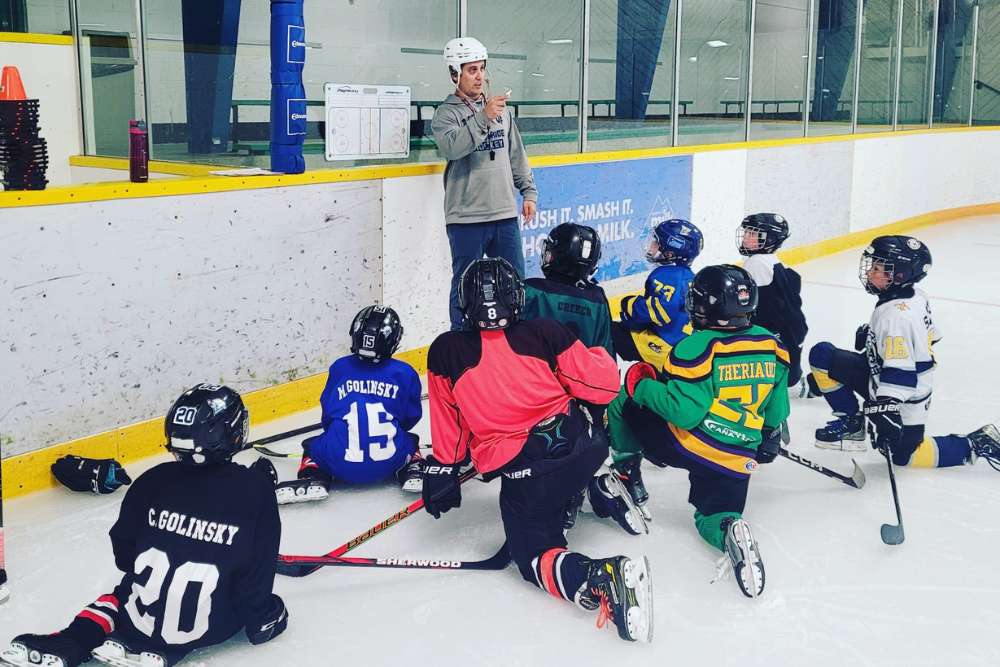
Hockey development does not stop when players leave the rink. Off-ice activities can support skating and game performance when appropriately designed.
Useful areas include:
-
Lower-body strength
-
Core stability
-
Balance
-
Mobility
-
Coordination
-
Cardiovascular conditioning
-
Recovery
Players should also prioritize adequate rest, hydration, and nutrition. Younger athletes in particular should follow age-appropriate training programs rather than copying professional athletes’ routines.
Frequently Asked Questions
What should beginners learn first in hockey?
Beginners should generally start with skating, balance, stopping, turning, puck control, and basic passing before progressing to more complex game situations.
How often should a hockey player train?
Training frequency depends on age, experience, competition schedule, and recovery needs. Consistent practice is generally more useful than occasional high-volume sessions.
Is skating more important than shooting?
Skating and shooting serve different purposes. Strong skating helps players move effectively around the rink, while shooting contributes to offensive opportunities. A balanced program should develop both.
Can adults benefit from hockey skill training?
Yes. Adult recreational and competitive players can use structured training to improve skating, puck control, shooting, and overall confidence on the ice.
Does off-ice training improve hockey performance?
Off-ice training can support physical qualities such as strength, balance, mobility, and conditioning. It works best as a complement to on-ice technical practice.
FAQ: Hockey Training in Canada
What does hockey academy training usually include?
It may include skating, stickhandling, passing, shooting, puck control, agility, and game-situation exercises.
Should hockey training be different for beginners and advanced players?
Yes. Beginners generally need fundamental movement and puck skills, while experienced players can work on speed, pressure-based drills, advanced shooting, and decision-making.
How can players improve shooting accuracy?
Players can practice controlled shooting toward specific targets, work on release mechanics, and gradually add movement and game-like pressure.
Is individual hockey training useful alongside team practices?
Individual training can provide additional time to focus on technical skills that may receive less attention during team sessions.
What should parents consider when selecting hockey training?
Parents can review the coaching approach, training structure, player-to-coach ratio, skill level, scheduling, and whether the program matches the player’s development needs.
Hockey development is a gradual process that combines technical practice, physical preparation, repetition, feedback, and game experience. A Hockey Training Academy in Canada can provide a structured setting for players who want to work on individual skills alongside their regular hockey activities.
The most effective approach is usually one that matches training difficulty with the player’s current ability and focuses on measurable, realistic goals. Consistent practice in skating, puck control, passing, shooting, and decision-making can help players build skills that transfer to real game situations.
For readers exploring structured hockey development resources, Pro Stride Hockey is one example of an organization offering hockey-focused training opportunities.
Pro Stride Hockey
3743 98 St NW, Edmonton, AB T6E 5N2, Canada
780-232-4776
Anyone can join.
Anyone can contribute.
Anyone can become informed about their world.
"United We Stand" Click Here To Create Your Personal Citizen Journalist Account Today, Be Sure To Invite Your Friends.
Before It’s News® is a community of individuals who report on what’s going on around them, from all around the world. Anyone can join. Anyone can contribute. Anyone can become informed about their world. "United We Stand" Click Here To Create Your Personal Citizen Journalist Account Today, Be Sure To Invite Your Friends.
LION'S MANE PRODUCT
Try Our Lion’s Mane WHOLE MIND Nootropic Blend 60 Capsules
Mushrooms are having a moment. One fabulous fungus in particular, lion’s mane, may help improve memory, depression and anxiety symptoms. They are also an excellent source of nutrients that show promise as a therapy for dementia, and other neurodegenerative diseases. If you’re living with anxiety or depression, you may be curious about all the therapy options out there — including the natural ones.Our Lion’s Mane WHOLE MIND Nootropic Blend has been formulated to utilize the potency of Lion’s mane but also include the benefits of four other Highly Beneficial Mushrooms. Synergistically, they work together to Build your health through improving cognitive function and immunity regardless of your age. Our Nootropic not only improves your Cognitive Function and Activates your Immune System, but it benefits growth of Essential Gut Flora, further enhancing your Vitality.

Our Formula includes: Lion’s Mane Mushrooms which Increase Brain Power through nerve growth, lessen anxiety, reduce depression, and improve concentration. Its an excellent adaptogen, promotes sleep and improves immunity. Shiitake Mushrooms which Fight cancer cells and infectious disease, boost the immune system, promotes brain function, and serves as a source of B vitamins. Maitake Mushrooms which regulate blood sugar levels of diabetics, reduce hypertension and boosts the immune system. Reishi Mushrooms which Fight inflammation, liver disease, fatigue, tumor growth and cancer. They Improve skin disorders and soothes digestive problems, stomach ulcers and leaky gut syndrome. Chaga Mushrooms which have anti-aging effects, boost immune function, improve stamina and athletic performance, even act as a natural aphrodisiac, fighting diabetes and improving liver function. Try Our Lion’s Mane WHOLE MIND Nootropic Blend 60 Capsules Today. Be 100% Satisfied or Receive a Full Money Back Guarantee. Order Yours Today by Following This Link.


| Visits: | 1,835,535,072 |
| Stories: | 8,724,365 |
Whistler Blowers, Insiders

