

How to Use Golf Breathing Techniques to Stay Calm Before Every Swing

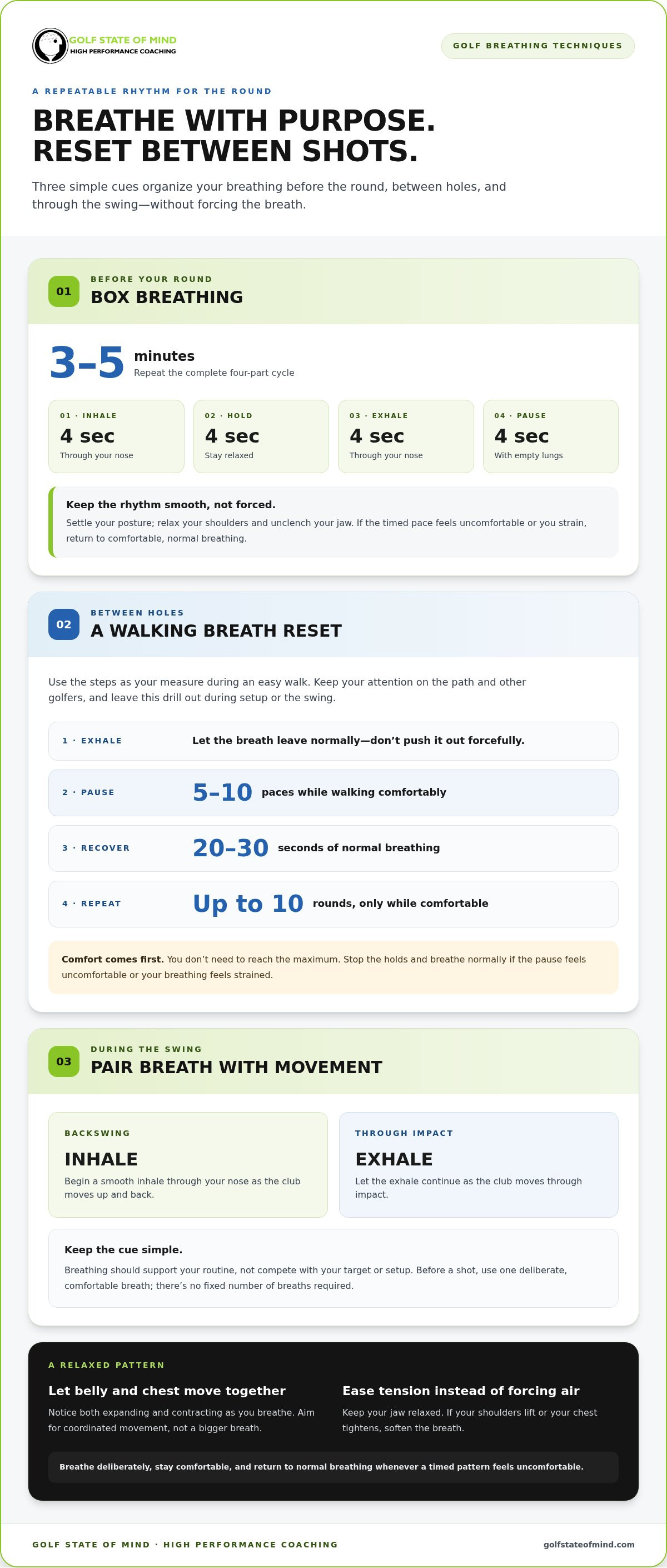
A steady breath gives you a repeatable cue when pressure builds. Use golf breathing techniques by inhaling through your nose for 4 seconds, holding for 4, exhaling for 4, then pausing for 4 before a round; repeat for 3-5 minutes. Between holes, hold your breath after exhaling for 5-10 paces, then breathe normally for 20-30 seconds. As you prepare to swing, inhale through your nose during the backswing and exhale as the club moves through impact.
It’s natural to focus on the club, the target, and the shot ahead. But when tension pulls your attention in several directions, a simple breathing routine can give you one clear process to return to. The aim isn’t to force a perfect swing. It’s to prepare your attention and breathe deliberately.
This guide breaks the routine into practical steps: box breathing before your round, walking breath holds between holes, and controlled breathing through the swing. You’ll also learn how to practise a calmer resting-breath pattern and adapt your cues without letting them distract you from the shot. Start with the method that feels easiest to repeat, then bring that steady rhythm to the course.
- Use a four-part breathing rhythm before your round to give your attention a steady anchor.
- Try brief, controlled breath holds while walking between holes, then return to normal breathing.
- Pair an inhale during the backswing with an exhale through the swing to create a consistent cue.
- Learn how breathing with your belly and chest can support a more relaxed, repeatable pattern.
- Build a pre-shot routine that feels calm and simple enough to use under pressure.
Box breathing before a golf round
Use a four-part rhythm for 3-5 minutes before your round. Practise it seated or standing, then carry the same measured attention into your pre-shot routine.
- Settle your posture and relax your shoulders before starting. Keep your jaw unclenched and your hands resting comfortably, rather than gripping a club tightly.
- Inhale through your nose for 4 seconds. Let the breath feel smooth, not forced, and keep your attention on the count.
- Hold the full breath for 4 seconds. Stay relaxed through the pause; if you strain, return to comfortable breathing before restarting.
- Exhale through your nose for 4 seconds, then pause with empty lungs for 4 seconds. Repeat the complete cycle for 3-5 minutes.
Keep each side of the breathing “box” even: inhale, hold, exhale, pause. If the 4-second pace feels uncomfortable, stop the timed cycle and breathe normally. Resume when you can follow the sequence without forcing the breath.
- Practice Box Breathing Before the Round
Choose a quiet moment before your round and practise the full 4-second cycle for 3-5 minutes. Use the same posture and count each phase consistently, so the routine feels familiar when you reach the course. Notice whether your shoulders rise or your jaw tightens. Ease that tension instead of taking a larger, strained breath.
- Choose a Breath Count Before Each Shot
Use one deliberate, comfortable breath as your cue before each shot. There’s no fixed number of breaths required. Let the exhale mark the transition from assessing the target to starting your setup. Breathing gives you a repeatable way to direct your attention, but it doesn’t guarantee a change in score. Keep the cue simple and consistent.
- Practice Breathing at Home and During a Round
Rehearse the 4-second sequence at home for 3-5 minutes, then apply a single comfortable breath before a shot during your round. At home, check that each phase remains smooth and unforced. On the course, don’t extend the full box cycle when play requires you to move. Use a natural breath as your brief reset instead.
Breath holds while walking between holes
Use a short, controlled breath hold as a walking reset between holes. Keep the sequence measured, then return to normal breathing after each hold.
- Choose a clear stretch of path. Begin between holes when you can walk at an easy, steady pace. Keep your attention on the path and other golfers, not just your breath. This drill belongs between shots, not during your setup or swing. Treat the walk as a transition from one hole to the next.
- Exhale normally before the hold. Let the breath leave without pushing it out forcefully, then pause breathing as you walk. Count 5-10 paces, using your steps as the measure rather than watching a timer. For example, count each footfall until you reach the chosen number, then resume breathing.
- Keep your pace and posture natural. Walk comfortably while counting, with relaxed shoulders and your gaze along the path. Don’t turn the breath hold into an endurance test. The goal is a brief, deliberate pause, not a strained effort or a change to your stride.
- Return to normal breathing for 20-30 seconds. After the 5-10 paces, breathe naturally while continuing your walk. Let the next breaths settle before considering another hold. This recovery interval separates repetitions and gives you a clear rhythm: brief pause, normal breathing, then a decision about whether to repeat.
- Repeat only while the sequence stays comfortable. The walking exercise can be repeated up to 10 rounds. You don’t need to reach that maximum; choose fewer rounds if your attention or breathing feels strained. Stop the holds and breathe normally if the pause feels uncomfortable. Resume the drill only when the walk feels settled.
- Use the walk to reset attention. After each hold, release thoughts about the previous shot and notice the next practical task, such as approaching your ball or checking the lie. Keep the breathing pattern separate from swing mechanics. A simple mental routine can help organize these transitions; structured mental game training can help you build that process.
- Adjust the drill to the course moment. Use the 5-10-pace hold during an unhurried walk, then leave it out when you need to move promptly or focus on course awareness. For example, walk normally toward your ball, complete one brief hold on a clear stretch, and return to ordinary breathing before choosing your next shot.
Consistency matters more than completing all 10 rounds. Keep the pattern simple: exhale, pause for 5-10 paces, breathe normally for 20-30 seconds, and repeat only when comfortable. That gives the walk a deliberate structure without carrying the hold into the shot itself.
Breathing during the golf swing
Coordinate each breath with a distinct phase of your swing. These golf breathing techniques should support your routine, not compete with your target or setup.
- Understand Diaphragmatic Breathing
Let your belly and chest expand and contract together as you breathe. Rest your tongue gently against the roof of your mouth and keep your jaw relaxed. Notice if your shoulders lift or your chest tightens. Use those signs to soften your breathing instead of forcing a deeper inhale before addressing the ball. The goal is coordinated movement, not a bigger breath.
- Set a Breathing Routine Before the Swing
Begin a smooth inhale through your nose as you prepare to swing. Continue inhaling while the club moves up and back, without deliberately holding your breath at the top. Keep your attention on the target and setup, not on counting. The breath should fit your routine naturally. If it becomes another swing thought, return to comfortable breathing.
- Coordinate Breathing With the Swing
Inhale through your nose as you prepare and move the club up and back. Exhale through your nose as you drive the club forward, through the downswing and into contact. Michael Mullin recommends inhaling during the eccentric phase and exhaling during the downswing. Use the movement as your timing cue instead of forcing a particular breath depth or speed.
- Avoid Breathing Mistakes That Create Tension
Notice if you hold your breath, force an inhale, or lift your shoulders. These habits can make breathing feel tense and pull your attention away from the swing sequence. Avoid pushing air out sharply at impact. Instead, let a controlled exhale follow the club through contact. If you feel tight, reset with an easy breath before your next shot.
- Rehearse the timing without adding swing thoughts. Make a slow practice swing and pair the inhale with the club moving back. Let the exhale follow as the club moves forward. Keep your tongue resting against the roof of your mouth, and let your belly and chest move together. Check that your breathing stays quiet and continuous.
Use the same sequence for a practice swing and the shot itself. Inhale during preparation and the backswing, then exhale through the forward motion and contact. If the rhythm slips, don’t force it mid-swing. Reset with comfortable breathing before your next shot. Golf breathing techniques work best as a steady cue, not another demand for perfect execution.
Think of the inhale as accompanying the movement that prepares the swing, not as a separate effort to fill your lungs. Mullin recommends inhaling during the eccentric phase of a movement to foster greater mobility, then exhaling during the downswing to transfer stored power into the swing and golf ball. Let that guidance shape your rhythm without turning the transition into a pause or breath-holding test. As the club moves forward, keep your exhale controlled through contact. The article recommends exhaling through the nose as you drive the club forward and make contact with the ball. Return your attention to the shot once your breathing and movement align.
How does diaphragmatic breathing work for golfers?
Practise breathing in a way that lets your abdomen and chest move together. Use the steps below to notice the pattern at rest, then carry it into your golf routine.
- Place one hand on your abdomen and one on your chest. Sit or stand comfortably, then breathe gently through your nose. Notice how both hands move as you inhale and exhale. Aim for coordinated movement, not a large breath. Keep your shoulders relaxed, and avoid sharply lifting your chest to draw in air.
- Let the diaphragm guide an easy inhale. As the diaphragm contracts and moves downward, the lungs expand to draw air in. Let your abdomen move outward naturally as your chest also expands. Don’t push your stomach forward or brace your trunk. Check that the inhale stays smooth from beginning to end.
- Allow a soft exhale without collapsing your posture. As you breathe out, let your abdomen and chest settle together. Keep your spine comfortably upright and your shoulders relaxed. For example, notice whether your chest drops abruptly at the end of an exhale. If it does, soften the release rather than forcing the air out.
- Keep your tongue resting against the roof of your mouth. Michael Mullin recommends this position while breathing. Pair it with nasal breathing at rest, and notice whether your jaw stays relaxed. A tight jaw or raised shoulders can signal that you’re forcing the pattern. Adjust gently, then return your attention to the moving breath.
- Practise the resting pattern before adding a golf movement. Mullin recommends six to 10 breaths per minute at rest, with each inhale and exhale lasting about 5.5 seconds. Treat these figures as a resting rhythm, not a pace to impose during a swing. If counting disrupts your comfort, return to easy nasal breathing.
- Carry the coordinated movement into a simple practice swing. Let your belly and chest expand and contract together without exaggerating either movement. Mullin recommends inhaling during the eccentric phase and exhaling during the downswing. Notice whether your breathing stays fluid as the club moves. If it feels forced, pause and practise the relaxed pattern again.
Use nasal breathing during the day to become familiar with the pattern, and try maintaining it during exercise. At night, mouth tape is suggested as a way to encourage nasal breathing during sleep. The central check is simple: your abdomen and chest move together while your shoulders and jaw remain relaxed.
What is the best breathing routine before a golf swing?
Build a simple sequence around your resting breath and the phases of your swing. Michael Mullin recommends nasal breathing at rest, then a natural inhale and exhale coordinated with movement.
- Practise nasal breathing while resting. Breathe through your nose whenever possible, as Mullin recommends. Keep your jaw and shoulders relaxed, and let your breath remain comfortable. This resting pattern gives you a familiar baseline before you practise a pre-shot routine. Don’t force a deeper inhale just because you’re preparing to play.
- Settle into a measured resting rhythm. Mullin recommends six to 10 breaths per minute at rest, with each inhale and exhale lasting about 5.5 seconds. Use that guidance while sitting or standing comfortably, not as a strict swing tempo. Let the rhythm guide relaxed practice before taking it onto the course.
- Begin your pre-shot routine by focusing on the target. Choose your line and finish your decision before moving into the swing. Then take a comfortable nasal inhale as you prepare. Keep the breath in the background: it should support your established routine, not replace your target choice or add another mechanical thought.
- Continue the inhale as the club moves back. Start inhaling through your nose while preparing to swing, then continue as the club moves up and back. Avoid deliberately pausing at the top. A smooth breath helps connect the backswing to your preparation instead of turning them into separate, forced actions.
- Exhale through the forward swing. As the club moves down and forward, exhale through your nose. Continue the exhale through contact with the ball. Mullin recommends inhaling during the eccentric phase and exhaling during the downswing, directing your attention toward a consistent sequence rather than a forced breath.
- Keep your mouth and upper body relaxed. Rest your tongue against the roof of your mouth, as Mullin recommends, and let your chest and belly expand and contract together. Check for a clenched jaw or raised shoulders before starting. If either appears, soften your posture and return to comfortable breathing.
- Rehearse the whole sequence without rushing. Practise inhaling during preparation and the backswing, followed by exhaling through the downswing and contact. Keep the same order in your practice swing and your next shot. If counting interrupts your focus, drop the count and follow the movement instead.
Use the routine as one stable part of a broader mental process. To develop a more structured approach to focus and preparation, explore the mental game training system.
Golf State of Mind: The Ultimate Mental Game Training System
Golf State of Mind offers The Ultimate Mental Game Training System for golfers who want a broader framework for mental performance. Breathing can serve as one cue within a consistent routine; the training system addresses the psychological side of playing, including focus and confidence. If you want personalized support applying mental skills to your own challenges, 1:1 Mental Coaching is another option. Mental Game Audios can also support your mental practice.
Consider these resources when breathing alone doesn’t address recurring distractions, confidence struggles, or difficulty maintaining a steady process under pressure. Choose the format that fits the kind of support you’re seeking. Visit golfstateofmind.com to explore the mental game resources.
Carry a Calmer Process Into Your Next Round
Make calm preparation part of how you approach the game. Choose one cue to practise, then notice whether it helps you return your attention to the shot instead of chasing perfect control. The value of golf breathing techniques is having a steady process to return to, even when a round feels demanding.
For a broader mental skills framework, explore The Ultimate Mental Game Training System. Golfers who want individualized support can consider 1:1 Mental Coaching, while How to Cure the Yips addresses a specific putting challenge. Choose the path that fits the mental obstacle you’re working through, and build from there.
Explore The Ultimate Mental Game Training System and keep developing a composed, repeatable approach to your game. Each round offers another chance to practise with intention.
Frequently Asked Questions What breathing techniques help golfers improve focus and calm nerves?
Use a familiar, steady breathing pattern to give your attention one clear task. Before a round, box breathing provides a structured practice; between holes, a brief walking breath hold can mark a reset. Before an important putt, keep it simpler: soften your jaw, notice one comfortable breath, and return your attention to the target. Treat breathing as a focus cue, not a promise of a particular result.
How should golfers breathe during the backswing and downswing?
Begin an easy nasal inhale during preparation and continue as the club moves back. Let the exhale begin as the club moves forward and carry through contact. For example, rehearse the timing with a practice swing before using it over the ball. If matching breath and movement makes you tense or distracts you from the target, breathe naturally and keep your swing routine uncomplicated.
What breathing exercises can golfers use to manage pressure on the course?
Use box breathing before play, then choose a simpler reset during the round. On a clear walk between holes, exhale normally, pause for 5-10 paces, and breathe normally for 20-30 seconds. Repeat only while comfortable, up to 10 rounds. Under pressure beside your ball, skip the walking drill and take an ordinary, unforced breath before returning attention to your target.
How can golfers use box breathing or 4-7-8 breathing before a shot?
Use box breathing before your round, inhaling for 4 seconds, holding for 4, exhaling for 4, then pausing for 4. Repeat for 3-5 minutes. Before an individual shot, avoid turning a timed pattern into another task; take a comfortable breath and focus on your target. The 4-7-8 pattern isn’t needed for this routine. Keep the pre-shot cue familiar and easy to repeat.
Can breathing techniques improve golf performance, and what does research show?
Breathing can provide a repeatable cue to direct attention and support a calmer routine, but the material does not establish that it improves scores or describe research findings.
The post How to Use Golf Breathing Techniques to Stay Calm Before Every Swing appeared first on Instruction For The Mental Game of Golf.
Source: https://golfstateofmind.com/how-to-use-golf-breathing-techniques-to-stay-calm-before-every-swing/
Anyone can join.
Anyone can contribute.
Anyone can become informed about their world.
"United We Stand" Click Here To Create Your Personal Citizen Journalist Account Today, Be Sure To Invite Your Friends.
Before It’s News® is a community of individuals who report on what’s going on around them, from all around the world. Anyone can join. Anyone can contribute. Anyone can become informed about their world. "United We Stand" Click Here To Create Your Personal Citizen Journalist Account Today, Be Sure To Invite Your Friends.
LION'S MANE PRODUCT
Try Our Lion’s Mane WHOLE MIND Nootropic Blend 60 Capsules
Mushrooms are having a moment. One fabulous fungus in particular, lion’s mane, may help improve memory, depression and anxiety symptoms. They are also an excellent source of nutrients that show promise as a therapy for dementia, and other neurodegenerative diseases. If you’re living with anxiety or depression, you may be curious about all the therapy options out there — including the natural ones.Our Lion’s Mane WHOLE MIND Nootropic Blend has been formulated to utilize the potency of Lion’s mane but also include the benefits of four other Highly Beneficial Mushrooms. Synergistically, they work together to Build your health through improving cognitive function and immunity regardless of your age. Our Nootropic not only improves your Cognitive Function and Activates your Immune System, but it benefits growth of Essential Gut Flora, further enhancing your Vitality.

Our Formula includes: Lion’s Mane Mushrooms which Increase Brain Power through nerve growth, lessen anxiety, reduce depression, and improve concentration. Its an excellent adaptogen, promotes sleep and improves immunity. Shiitake Mushrooms which Fight cancer cells and infectious disease, boost the immune system, promotes brain function, and serves as a source of B vitamins. Maitake Mushrooms which regulate blood sugar levels of diabetics, reduce hypertension and boosts the immune system. Reishi Mushrooms which Fight inflammation, liver disease, fatigue, tumor growth and cancer. They Improve skin disorders and soothes digestive problems, stomach ulcers and leaky gut syndrome. Chaga Mushrooms which have anti-aging effects, boost immune function, improve stamina and athletic performance, even act as a natural aphrodisiac, fighting diabetes and improving liver function. Try Our Lion’s Mane WHOLE MIND Nootropic Blend 60 Capsules Today. Be 100% Satisfied or Receive a Full Money Back Guarantee. Order Yours Today by Following This Link.


| Visits: | 1,835,665,298 |
| Stories: | 8,725,252 |
Whistler Blowers, Insiders

